
Category: Reviews
Review – I, Frankenstein (2014)
Director: Stuart Beattie
Starring: Aaron Eckhart, Bill Nighy, Miranda Otto, Yvonne Strahovski, Jai Courtney
 Mary Shelley could never have seen this coming when she created one of the horror genre’s iconic characters back in 1818. In I, Frankenstein her creature becomes the latest classic to be reimagined for the screen via the graphic novel.
Having lived in secrecy for 200 years, Frankenstein’s monster, here named Adam, finds himself in the middle of a centuries old battle between demons and gargoyles. When a demon is killed its soul descends to hell and it can only return to Earth if it can find a living body without a soul. So Naberius, the leader of the demons, sees in Adam the secret to reanimating corpses into soulless vessels, and therefore the key to a potentially limitless army.
I, Frankenstein is the latest idea from the mind of Kevin Grevioux, the co-creator of the Underworld. That reasonably successful action/fantasy franchise concerned the ongoing war between vampires and werewolves, so I, Frankenstein is not so much a new idea as a variation on a theme. Between its effects heavy battle scenes, the movie labours through some truly ridiculous dialogue. At times this is the result of some poor writing, but largely it is because the premise of this film is such utter nonsense that when characters are forced to verbalise it they can’t help but sound ridiculous. And therein lies I, Frankenstein’s biggest problem. The film contains no acknowledgement of its ludicrousness, and therefore there is no sense of fun, humour or satire. Instead it takes itself far too seriously and it simply cannot afford to.
Turning Frankenstein’s monster into an action hero requires a stark reimaging of the famous character, so Aaron Eckhart’s monster bears little resemblance to Boris Karloff’s iconic lumbering giant. Eckhart has got himself in impressive shape for the role, so impressive in fact that in one scene in which he removes his shirt the creature even attracts a lustful double-take from Terra, the respected electrophysiologist who had been working for Naberius before she discovered his true identity. This version of the monster also does significantly more talking than any we’ve seen before. It might have made for a more interesting, if less action-packed, film if the monster was more traditional – a helpless innocent caught in the centre of this ongoing battle rather than a bad-ass butt-kicking machine.
The film closes with a voiceover from the creature in which he promises to go on fighting demons and protecting mankind, clearly setting itself up for a franchise. Fortunately I doubt we’ll ever see it. I, Frankenstein is an early contender for worst movie of the year.
Rating: ★
Review by Duncan McLean
Review – Canopy (2013)
Director: Aaron Wilson
Starring: Khan Chittenden, Mo Tzu-Yi
 Canopy is an Australia/Singapore co-production shot on location in the beautiful Singaporean jungle which announces debutant director Aaron Wilson as a potentially interesting new voice in the Australian cinema.
It’s 1942 and Singapore is under attack from the Japanese. An Australian fighter pilot, Jim, crashes into the jungle and finds himself alone and unarmed in enemy territory. He crosses paths with a Singapore-Chinese soldier, Seng, in a similar predicament and the two join forces in the hope of getting out alive.
A far cry from the adventures, epics or men-on-a-mission stories we usually get from the war genre, Canopy endeavours to tell a smaller more human story in these most trying of circumstances. In their fight for survival, Jim and Seng experience a basic human connection despite the fact two men don’t speak each other’s language so communication is limited.
While Canopy is the first feature from young Australian director Aaron Wilson ,he has previously made a number of short films and it shows. Canopy has a bit of a short film feel to it (it has a runtime of only 84 minutes). It is a very simple story told in a minimalist fashion. A smaller budget war film is naturally going to be restricted in what it can show on screen, so must come up with other devices. In the case of Canopy the sound design is very important to the film’s effectiveness. Wilson’s use of sound creates an immersive cinematic experience as we are placed in Jim’s subjectivity. We only see the things he sees, but we also hear the things he hears; birdsongs, the rustling of bushes, the pops of gunfire, the overhead hum of fighter planes, the far off sounds of explosions. The terror and uncertainty of his experience in the jungle comes from the fact that he can hear things that he can’t see, and the film allows us to share that experience.
This subjectivity extends to the relationship between the two characters. As mentioned, there is very little dialogue in the film as the two characters don’t share a language. While Seng talks significantly more than Jim, we are not given subtitles for his dialogue so we don’t come to know him any better than Jim does.
The film’s conclusion is a bit disappointing, not as a result of providing an unsatisfactory resolution to the narrative but rather due to its lack of clarity. It was not until scrolling through the names in the final credits that I was actually able to decipher what the ending was seeking to represent.
While Canopy is unlikely to make an impact at the box office – its business will be done on the festival circuit – the recent success of Gravity and, to a lesser extent All is Lost, has seen the subgenre of the single character survival drama achieve some prominence recently, and while Canopy is a significantly more modest film that either of those, it is none the less an interesting addition to the subgenre.
Rating – ★★★☆
Review by Duncan McLean
Review – The Monuments Men (2014)
Director: George Clooney
Starring: George Clooney, Matt Damon, Bill Murray, John Goodman, Jean Dujardin, Bob Balaban, Cate Blanchett, Hugh Bonneville, Dimitri Leonidas
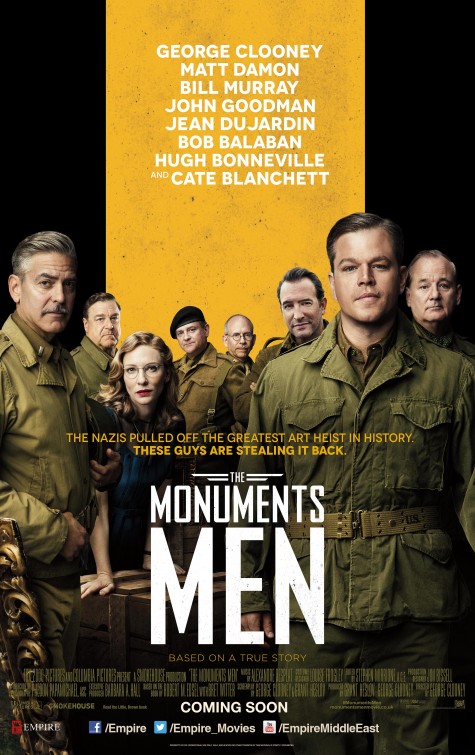 The most significant moments in our history are made up of many, many stories. These stories provide the colour and the detail that give the greater narrative its significance. The story of the Monuments Men, a small group of experts who headed into war torn Europe to preserve a culture, is one of these stories and it has been brought to the screen by actor/director George Clooney.
As the Third Reich marched through Europe in the Second World War they collected important artworks and cultural artefacts from churches, museums and homes with the intention of displaying them in the planned Führer Museum in Hitler’s hometown of Linz. By 1944 the tide had turned in the War, the Nazi’s were retreating and fears started to arise that they would destroy their stockpiles of artworks as they moved out. “You can wipe out an entire generation,” explains Clooney’s Frank Stokes, “You can burn their homes to the ground and somehow they’ll still find their way back. But if you destroy their history, you destroy their achievements and it’s as if they never existed.” Even with the War seemingly all but won, were a history to be lost in its final stages the victory would be an incomplete one. So Roosevelt green-lit the Monuments, Fine Arts and Archives program, in which a small team of art historians, architects and curators were sent into the warzone with the job of finding, retrieving and returning the stolen works.
The Monuments Men is George Clooney’s fifth feature film as a director. It has an old-fashioned adventure story feel to it. They are, after all, treasure hunters. But in creating this tone, Clooney seems to have sacrificed his own unique style in favour of something which feels like it is merely trying to imitate an older form. The narrative is episodic in nature. As the Monuments Men split up and head to different points of the European continent on different missions we move between their different stories. Some of these episodes are amusing, some are touching, some are exciting. However, with our attention being split between eight co-protagonists, none of the characters are given enough time or depth to really engage us. There are simply too many of them for a two hour movie. That being said, Clooney has assembled an all-star cast, with the likes of Matt Damon, Bill Murray, John Goodman, Jean Dujardin, Bob Balaban, Cate Blanchett and, of course, Mr Clooney himself. While it may not have the wow factor of the Ocean’s 11 cast, it is none the less an impressive collection of talent and it is the charisma of these actors, more so than their characters, which keeps you engaged in the film and represents its greatest strength.
The Monuments Men looks great. It is beautifully shot by Pheldon Papamichael and the production design is top notch. It focuses in on a really fascinating and unique story, but unfortunately it fails to reach the heights that story deserves. It is not quite as funny and irreverent as it could have been – especially considering its cast – but neither is it as serious and gritty as it could have been. Instead we are left with a very earnest and sentimental film which at times is just a bit bland.
Rating: – ★★★
Review by Duncan McLean
Review – Non-Stop (2014)
Director: Jaume Collet-Serra
Starring: Liam Neeson, Julianne Moore, Michelle Dockery, Corey Stoll, Lupita Nyong’o
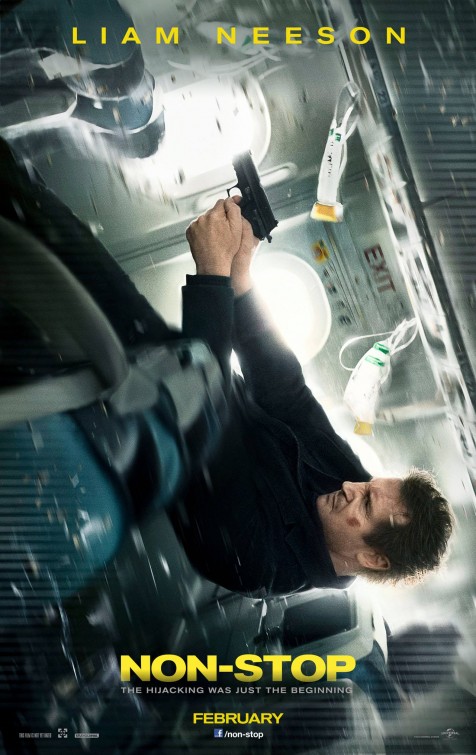 Liam Neeson is a terrific actor who has been in some really wonderful films. But at some point in the last decade, despite being on the other side of fifty, he has made an unlikely transition into being an action hero, a kind of contemporary Clint Eastwood. The upside of being a recognised movie action hero is that he can pay the bills by doing paint-by-numbers thrillers, of which Non-Stop, which sees him reunite with director Juame Collet-Serra from Unknown, is definitely one.
Neeson plays US Air Marshall Bill Marks, a burned-out alcoholic who is on a routine flight from New York to London when he starts receiving a series of text messages threatening to kill a passenger every 20 minutes unless $150 million is transferred into a secret, off-shore account. With the lives of 200 passengers in his hands, Marks has to determine which one of them is the culprit, preferably without causing a state of panic 40,000 feet above the ground.
Setting a thriller on an aeroplane mid-flight creates an interesting variation on the Agatha Christie formula which sees our key players – the detective and all of the potential suspects – confined to one location for the duration of the story. From the very outset of the film, before we know what is about to unfold, some clever camerawork from cinematographer Flavio Martinez Labiano creates suspicion of every character we encounter. Likewise, before it is even revealed that Bill is an Air Marshall we know that he is a watcher of people. It is through his gaze that we notice little details about the passengers around him.
As the narrative progresses, with its countless red-herrings, there are moments in which you are genuinely hooked into this mystery. This cat-and-mouse scenario creates some legitimate tension, and Non-Stop looks like being a basically enjoyable, if largely generic, thriller. But then it steps into the ludicrous. Like a plane with serious engine failure, this film plummets in its final third. The final reveal is disappointing, due in part to the sheer ridiculousness of the motives at play – the hijacker is the last in a long number of characters in the film who share needlessly elaborate, and in this case nonsensical, backstories. But surely the point at which this film completely descends into farce is when a moment of anti-gravity caused by the free-falling plane righting itself sees a gun that was lying on the floor levitate in front of our hero at the opportune moment for him to grab it and fire. I’m not sure the 50-50 split between groans and laughter is the audience reaction that the filmmakers were hoping for.
Even though Neeson is clearly going through the motions, he, like the rest of a surprisingly quality cast, struggles valiantly against some sub-standard material and manages to give more than it deserves. Ultimately though, Non-Stop fails to live up to the potential of what could have been quite a fun premise.
Rating – ★★
Review by Duncan McLean
Review – Nebraska (2013)
Director: Alexander Payne
Starring: Bruce Dern, Will Forte, June Squibb, Bob Odenkirk
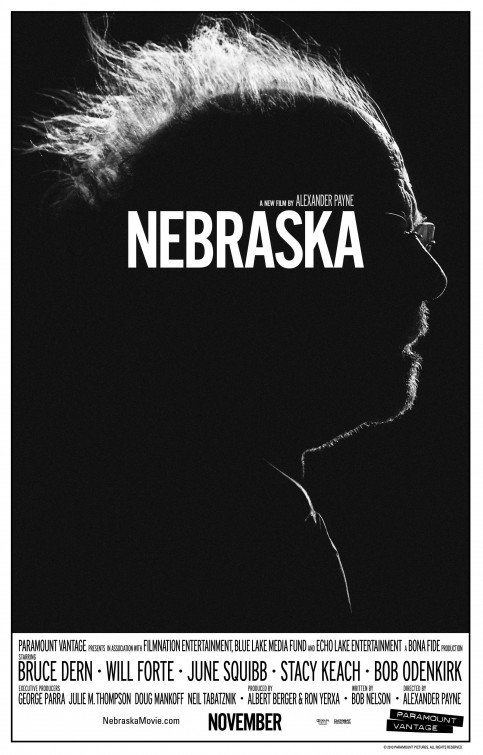 The road movie has always been a form that resonates with America, perhaps because it is such a large country, and one of its most interesting voices of late has been independent filmmaker Alexander Payne. Starting with a widower journeying to his daughter’s wedding in About Schmidt, and then a pair of middle aged men on a tour of the Californian wine country in Sideways, Payne likes to venture out on the road with unabashedly ordinary characters. He is at it again with a father and son in Nebraska.
After receiving an unsolicited piece of junk mail, ageing alcoholic Woody Grant is convinced that he has won one million dollars in a sweepstakes and needs to get to Lincoln, Nebraska – over 800 miles from his home in Billings, Montana – to collect his winnings. While his wife, Kate, and adult sons, David and Ross, are all too aware that this is a scam, there is no convincing Woody, and eventually David decides that the only way to put an end to it is if he takes Woody to Lincoln himself. On their way they stop off in Woody’s hometown of Hawthorne where the news that he has struck it rich spreads like wildfire, bringing all manner of friend and relative out of the woodwork to stake their claim for their piece of Woody’s expected winnings.
With its Middle American locations shot in beautiful widescreen black-and-white by Phedon Papamichael, Nebraska moves at a slow, almost melancholy pace. Road movies don’t need to be defined by momentum, and this one feels no compulsion to be. We know from the very beginning that the thing they are journeying towards, Woody’s million dollars, will not be there in the end, so the film is free to meander. Instead, as the old cliché goes, the journey becomes more important than the destination. At its heart, Nebraska is the story of a father and his son, or rather of a son and his father. For despite it being Woody’s image that appears on the poster, this is David’s story. It is David through whose subjectivity we encounter this tale. Woody is not a talkative or relational man, and it becomes apparent that for the entirety of his sons lives he never has been. Woody has always been removed from his sons. For Ross, this is the cause of much anger and resentment, but for David it is just the source of disappointment. This journey provides David with the opportunity to spend some time with his father, and through the stories he hears from the people of Hawthorne he comes to gain some understanding of this man who for his whole life has been a mystery.
The veteran character actor Bruce Dern has stumbled upon the role of his career at the age of 77. Woody is headstrong but vague. Is that vagueness a result of his years of alcohol abuse, or is he retreating into his own mind and memories? He is a character who, aware that he is in his twilight years, is determined leave his mark on the world. There is a lack of contentment in him and it is in this regard that Dern really brings something to the character that a more celebrated name couldn’t have. While it is Dern who is deservedly getting all the plaudits, Will Forte is also brilliant. The casting of Forte as David, the more subtle of the two leads, was a brave move that paid off. As a Saturday Night Live alumnus, Forte is best known as a comedic performer and a particularly unsubtle one at that, but he brings a real humanity to David and the perfect amount of uncomfortableness to his interactions. Outside of the two leads, it is June Squibb, as Woody’s fed-up, eye-rolling wife Kate who makes the biggest impact. Payne had previously used Squibb as the wife of Jack Nicholson’s character in About Schmidt, but in that film she died early on. Here she makes it through to the end and the film benefits greatly from her presence. It is Squibb, rather than the more obvious Forte or Odenkirk, who provides the films comic relief. In particular, the matter-of-fact accounts she shares with David about all the men from the old town who had tried to get into her pants are very funny.
A film reminiscent of small town films like The Last Picture Show, Nebraska blends humour and humanity with the result being a heartfelt, poignant and even uplifting film.
Rating – ★★★★
Review by Duncan McLean
Review – The Wolf of Wall Street (2013)
Director: Martin Scorsese
Starring: Leonardo DiCaprio, Jonah Hill, Margot Robbie, Kyle Chandler, Rob Reiner, Matthew McConaughey, Jean Dujarden
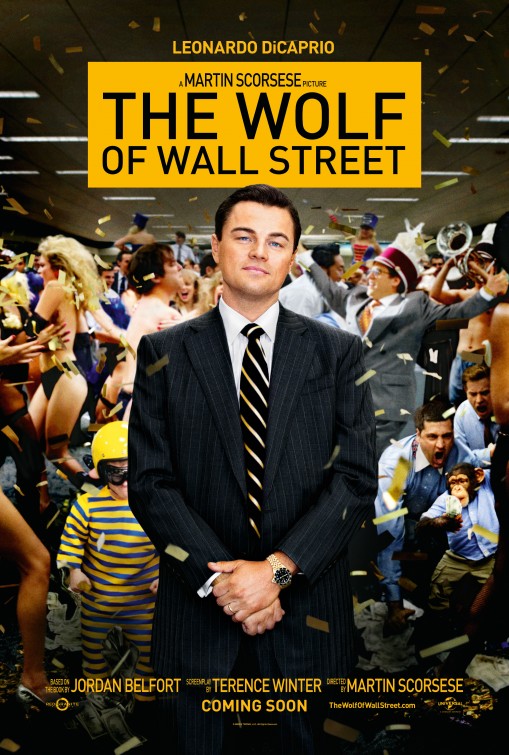 In recent years, with films like The Departed, Shutter Island and Hugo, Martin Scorsese has ventured into the world of narrative-driven filmmaking. However the films upon which his lofty reputation is based – films like Mean Streets, Goodfellas and Casino – were never so concerned with narrative. They were films that created a world and dropped us into it, introducing us to the people, the language and the rituals of that place and time. They had an almost anthropological feel to them. Scorsese’s latest film, The Wolf of Wall Street, is a return to this type of storytelling. It has that old-fashioned Scorsese flavour to it with one additional ingredient, humour.
The Wolf of Wall Street is a biting satire of a culture that values personal gratification above all else and gives little thought to the consequences. The film explores the rise and fall of stockbroker Jordan Belfort. We meet Jordan on his first day working at L.F. Rothschild where he starts at the bottom of the ladder. On the very day that he gains his trading license, 19th October 1987, the stock market crashes and he finds himself out of a job. He starts to rebuild by selling “penny stocks,” hustling suckers who can’t afford it into buying worthless stocks at huge margins. Things really take off when he founds his own firm, the evocative but meaninglessly named Stratton Oakmont, and employs the same tactics with blue chip stocks to land much bigger fish. The film doesn’t require you to understand how their operation works, it doesn’t even try and explain it, just to know that it was all quite illegal. With Jordan and his team of hucksters making a lot of money very quickly it was only a matter of time before they caught the eye of the FBI.
Based on the confessional memoir of the real-life Jordan Belfort, The Wolf of Wall Street is told entirely from Jordan’s point of view. It is DiCaprio’s voiceover narration that guides us through the film and he regularly turns to the camera to directly address the viewer. It is in this subjectivity that the root of much of the film’s controversy lies. As in the past, when sections of the audience have accused Scorsese’s film of celebrating gangsters, The Wolf of Wall Street has been attacked for the way in which it indulges in the extravagant excess of these characters lives, an excess which is funded by illegal practices. Despite being a cautionary tale, it is not a didactic or judgemental one. With Belfort himself showing no genuine remorse or contrition for the effects of his actions, the subjectivity of the film likewise does not judge him or apologise for him. The victims of Jordan’s crimes are as invisible to us as they are to him. Instead, the character of Jordan Belfort, through telling his own story, tries to charm, schmooze and woo us as viewers into siding with him despite our understanding of the despicable selfishness of his lifestyle.
The Wolf of Wall Street is a confronting film in its examination of a completely amoral life of excess. Much has been said about the over the top sex, drugs and in particular language of this film – it was well documented that it had set a new record with 506 variations of the F-word – but arguably the more confronting aspect of the lifestyle on display is its misogyny. Whether The Wolf of Wall Street is a misogynistic film, a film about a misogynistic world, or a bit of both is open to discussion. Regardless, it is an intensely male film in which women, regardless of their relationship or role, are regarded primarily as commodities and sexual objects. There is only one female character, Joanna Lumley’s Aunt Emma, who has a level of authority equal to that of the male characters.
Leonardo DiCaprio is one of the finest actors going around at the moment, but this fifth collaboration with Martin Scorsese has afforded him the opportunity to display his versatility. Much of his success in the past has come from playing tortured loners, but Jordan is the ultimate people person. He thrives on the energy of having people around him and being the centre of attention. So DiCaprio is called upon to play the extravert in a way we don’t regularly see. The bigger surprise though is the ease with which he handles the film’s comic material. DiCaprio has always radiated seriousness as an actor, but here he gets to have some fun. In doing so he shows a surprising talent for physical comedy, bordering on slapstick, which very few would have imagined was in his repertoire.
DiCaprio is ably supported by a strong cast. Jonah Hill continues to show he has serious acting chops, while his background in improvisational comedy adds to the spontaneity of some exhanges. The relatively unknown Australian Margot Robbie turns heads as Belfort’s trophy wife more than holds her own in a number of scenes with DiCaprio. Rob Reiner threatens to steal the movie at times as Belfort’s short-tempered father, and cameos from the likes of Matthew McConaughey, Jean Dujarden and Jon Favreau add colour to intricately constructed world.
While The Wolf of Wall Street is undoubtedly Scorsese’s funniest movie, it is by no means a comedy. It is a drama with humour – there are plenty of laughs while Jordan is living the high life, but when things turn bad its gets serious. While it won’t be to everyone’s’ liking, it is arguably Scorsese’s best film in two decades.
Rating – ★★★★☆
Review by Duncan McLean
Review – Dallas Buyers Club (2013)
Director: Jean-Marc Vallée
Starring: Matthew McConaughey, Jennifer Garner, Jared Leto, Denis O’Hare, Steve Zahn
 The AIDS virus is a truly terrifying disease. In the 1980s, at the height of the AIDS crisis in America, that terror was compounded by a lack of knowledge and understanding of the disease. To be told you were HIV positive was tantamount to being given a death sentence. It is from this desperate context that Jean-Marc Vallée’s powerful independent film Dallas Buyers Club brings us the true story of the most unlikely of crusaders.
After a workplace accident lands him in hospital, electrician and part-time rodeo cowboy Ron Woodroof is informed that his blood tests have revealed him to be HIV positive. With the hospital participating in a trial of a new wonder drug, AZT, Ron bribes a hospital employee to sneak him the medication. When the AZT doesn’t appear to be doing the trick, he ventures across the border into Mexico where he is able to get his hands on a number of alternative treatments which have not been approved for use in the USA. Seeing an opportunity to make some money, Ron starts smuggling the unapproved medications into the country and, with the help of his transgender business partner Rayon, founds the Dallas Buyers Club, where a monthly fee gets you all the medication you need. The beauty of the Club is it keeps his hands clean. He isn’t selling drugs. He’s selling memberships. Ron quickly becomes the last hope for Dallas’s many AIDS sufferers and starts to face strong opposition from the authorities.
What differentiates Dallas Buyers Club from the standard AIDS narrative is its protagonist. Woodroof is anything but a sympathetic character. He is a whoring, drug-taking, brawling, cheating bigot. The first words we hear from him are a homophobic slander of Rock Hudson, shortly after the actor’s death from AIDS. Upon being diagnosed, Woodroof seems angrier with the doctor’s implication that he might have engaged in homosexual activity than he is about the fact that he is HIV positive. Ron is just as prejudiced against other AIDS sufferers as other people are against him. He founds the Club not out of any sense of charity or desire to help others, but out of simple opportunism. The Club presents him with the opportunity to get his medication and make some money on the side. The film’s drama comes from watching the way this degenerate is transformed by his circumstances and the people around him to the point that he can become an activist and voice for this marginalised community. Craig Borten and Melisa Wallack’s excellent screenplay makes that transition subtle while still apparent, and most importantly believable.
Sympathetic he may not be, but Ron Woodroof is engrossing and much of the credit for that has to go to the performance of Matthew McConaughey. Over the last couple of years McConaughey has gone from being a run-of-the-mill movie star hunk to one of the most interesting actors working in Hollywood and his performance here is undoubtedly the best of his career. Having lost approximately 20kgs in preparation for the role, his emaciated appearance is confronting, but Woodroof retains some of that McConaughey charisma, incorporating it into this unattractive package and keeping us hooked on him. But McConaughey doesn’t carry the film alone. His achievement is matched and maybe even exceeded by that of his co-star, Jared Leto. In his first feature film in five years, Leto is brilliant as Ron’s transgender business partner and, eventually, friend Rayon. Leto gives Rayon a real grace and sensitivity, successfully grounding a character that could so easily have been a caricature.
Dallas Buyers Club is a special film that manages to be uplifting without being sentimental and insightful without being preachy.
Rating – ★★★★
Review by Duncan McLean
Review – Labor Day (2013)
Director: Jason Reitman
Starring: Kate Winslet, Josh Brolin, Gattlin Griffith
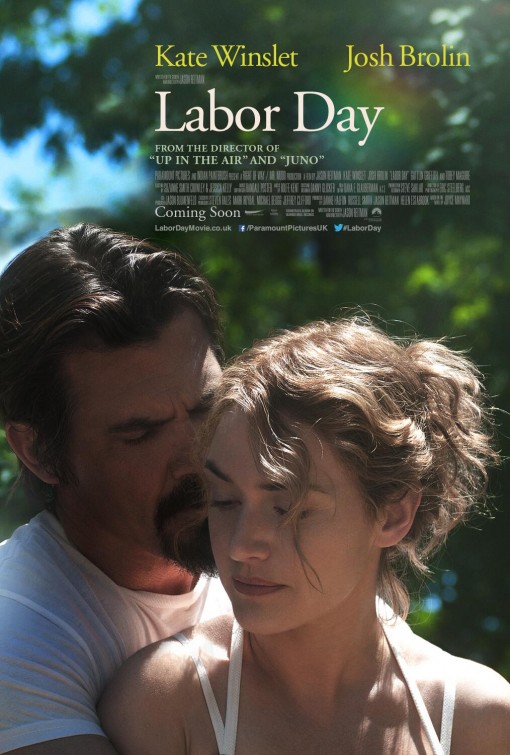 Told through the eyes of the 13 year old Henry, Labor Day is the story of a five day love affair that took place on the Labor Day long weekend of 1987 between his mother, Adele, and a fugitive who sought refuge in their home, Frank. Crippled by her depression and anxiety, Adele rarely ventures outside. On their monthly shopping trip for supplies, they are accosted by a wounded Frank, who demands they take him back to their home so he can hide until nightfall. With his wound not allowing him to leave as soon as planned, Frank sets about making himself useful by performing the household duties that haven’t been seen to since Adele’s husband walked out. A bond is formed between them and, for a fleeting moment, the family feels whole again.
Labor Day is a movie which doesn’t manage to live up to its early promise and represents the first real misstep in the career of talented writer-director Jason Reitman (Juno, Up in the Air). While it is based on a novel by Joyce Maynard, the schmaltz gets dialled up so high you could be forgiven for thinking you were watching another Nicholas Sparks adaptation – the centrepiece of the film is a palpably sensual scene reminiscent of the pottery scene in Ghost in which Frank and Adele make a peach pie together. The introduction of Frank into the lives of Adele and Henry creates an intriguing situation, but the story that unfolds is just too simplistic. While they talk as though they are aware of the seriousness of their situation, they sure don’t act like it. If the police are combing the streets trying to find him, what is he doing up a ladder clearing out the gutters? Why do they spend so much time on the back porch or in the yard? Why don’t they at least close the curtains? That the lovers live in this dream world means that film lacks energy and because everything seems to be so easy, so convenient, the plot twists which are required in order to create drama then feel forced rather than arising naturally out of the story.
Stockholm syndrome is a psychological phenomenon in which hostages have been known to empathise with, and in extreme cases fall in love with, their captors, and if all kidnappers were as perfect as Frank it wouldn’t be hard to see why. Having just escaped from a lengthy prison stay he has no issues relating to people, even complex and sensitive people like Adele, Henry and their disabled neighbour Barry. He easily steps into the routine of normal life, cooking up a meal for the family on his first night with them. With his handyman skills and wealth of wisdom he becomes a substitute father and husband overnight. Despite the fact he is convicted of murderer – don’t worry, that gets explained – not for one moment do we think he is going to hurt either of them. Were his character just slightly more complicated it would have gone a long way to helping the film become something quite interesting.
Kate Winslet is magnificent as always, creating a believable and sincere character in Adele. Josh Brolin does well considering the limitations of his character, and the two make for a pleasing pairing. Ultimately, however, this is a film which you are either going to go with or you aren’t. Labor Day is a sweet little love story about two people who have been living in their own prisons and find freedom in each other, but to really enjoy it requires a willingness to overlook more than a few faults.
Rating – ★★☆
Review by Duncan McLean
Review – Grudge Match (2013)
Director: Peter Segal
Starring: Robert DeNiro, Sylvester Stallone, Kim Basinger, Kevin Hart, Alan Arkin, Jon Bernthal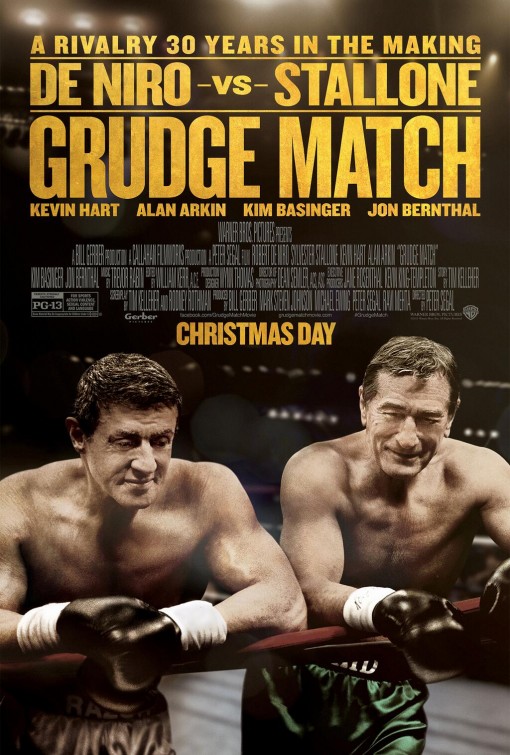
Hollywood has a history of mashing together popular franchises in the search of blockbuster success. We’ve had AVP: Alien vs. Predator and Freddy vs. Jason. Back in the 1940s you had Abbott and Costello Meet Frankenstein. The same mindset is at play in Peter Segal’s Grudge Match, which may as well have been called ‘Rocky vs. Raging Bull.’ Of course, technically it is not a mash up as it presents new and original characters. But in casting Sylvester Stallone and Robert De Niro in the leads, the filmmakers have inherited the audience’s associations with the legendary pugilists they have previously portrayed. It’s an odd pairing because despite both being about boxing, the two films couldn’t be more different. Rocky is an uplifting sports movie about a likeable underdog who finally gets his shot. Raging Bull is an art-house film about a damaged man whose anger and violence destroys his life. There is a reason there are six Rocky movies and only one Raging Bull.
But this isn’t Balboa vs La Motta. It is Henry ‘Razor’ Sharp vs. Billy ‘The Kid’ McDonnen. Razor and The Kid enjoyed one of the great sporting rivalries in their prime. They met twice in the ring for one victory a piece, with each loss being the only defeat of that fighter’s career. But the third and deciding bout never happened because in the lead up to the anticipated fight Razor shocked the world by announcing his retirement. Thirty years go by before a down-and-out, motor-mouthed promoter manages to coax them back in the ring for the grudge match the world has been waiting to see.
Grudge Match clearly wants to trade off the legacies of Rocky and Raging Bull. So we first meet The Kid doing a rather pathetic nightclub show which is reminiscent of the final act of Raging Bull, and we have the obligatory scene in a meat locker where Razor shapes up to punch a beef carcass before being told not to. There is also a key plot point relating to Razor and the final fight which comes straight out of Rocky II. But as much as it tries to get you to think of those movies, you are also very aware that what you are watching isn’t them. Nowhere is that more apparent than in the training montage which feels eerily quiet without the brass of ‘Gonna Fly Now’ blaring over the soundtrack.
Rather than being a straight up sports movie Grudge Match is a comedy, and that doesn’t help it. The jokes aren’t good enough to make the film genuinely funny, but they are constant enough to be a distraction. Some of the jokes are also in surprisingly poor taste. While De Niro has settled into a career as a comic actor, and Kevin Hart and Alan Arkin are right at home, the comedy format doesn’t make the best use of Stallone. Sly is a better actor than many people give him credit for. He has a real ability to elicit sympathy for a character – it’s part of what made the Rocky franchise work – and in the more dramatic scenes of Grudge Match he acts rings around De Niro. But he struggles with comedy. His sense of timing and his delivery aren’t as strong as his co-stars and the material isn’t good enough to compensate for that.
All of the film’s plot complications feel unnecessarily forced and the final fight, despite being the thing the whole movie has built towards, doesn’t quite crescendo the way that it should. In the end this movie feels as tired as its two aging stars must have after going ten rounds. The most interesting part of the movie comes in the final credits where there is a short scene between Mike Tyson and Evander Holyfield.
Rating – ★☆
Review by Duncan McLean
Review – Blue Jasmine (2013)
Director: Woody Allen
Starring: Cate Blanchett, Sally Hawkins, Bobby Cannavale, Andrew Dice Clay, Peter Sarsgaard, Louis C.K., Alden Ehrenreich
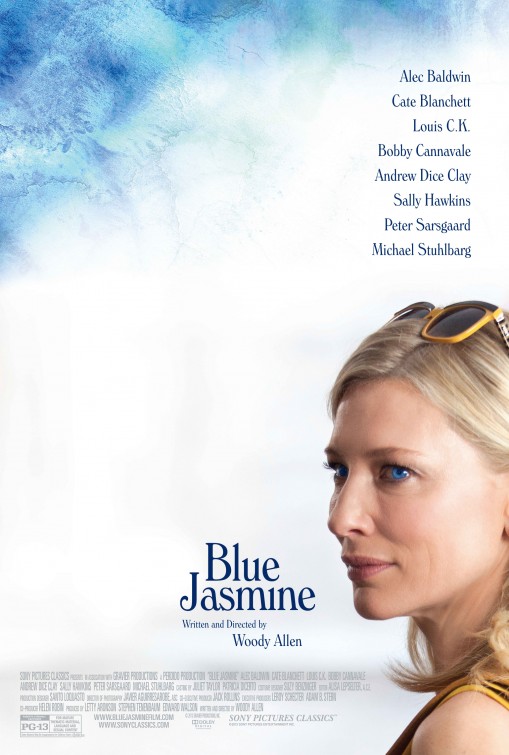 There are two types of Woody Allen films: those which are just for the Woody Allen fans and those which are for everyone. I suppose there is also a third group: those which kind of miss the mark and fail to please anyone, but that is forgivable for a filmmaker who has made at least one movie a year for the last four decades. His latest film, Blue Jasmine, is one for everyone due in no small part to a lead performance from Cate Blanchett that is really something quite special.
In a classic tale of riches to rags, we first encounter Jasmine as she arrives in a San Francisco to move in with her working class sister, Ginger. A former New York socialite, Jasmine lost everything – her home, her money, her lifestyle and her mind – when her investment banker husband was jailed for some Bernie Madoff-style dealings. While Jasmine formulates a plan to get her life back on track –she takes a computer course with the ultimate aim of studying interior design online – she causes considerable chaos in Ginger’s life.
Indebted to Tennessee Williams’ A Streetcar Named Desire, Jasmine, the latest in a long line of brilliant female characters written by Allen, is our Blanche DuBois. She is a delusional woman forced to move into her sister’s working class life, surrounded by brutish men and pining for her lost life of privilege. As with Blanche, we find ourselves simultaneously drawn to and repelled by Jasmine. On one level we sympathise with her. She has had the rug pulled out from underneath her and is clearly damaged. But as much as she is a victim of her husband’s crimes, she is also a victim of her own self-delusions. Whether it is turning a blind eye to her husband’s shonky dealings and infidelities or changing her name from Jeanette to Jasmine and devising a colourful story about how her mother gave it to her, Jasmine seems content both to be deceived and to deceive herself, and as such has no problem with being false in her engagement with other people.
While the supporting cast of Sally Hawkins, Alec Baldwin, Bobby Cannavale and Andrew Dice Clay is quite excellent, really, this film is all about Cate Blanchett. She is already an Oscar winner and considered among the finest actresses of her generation, but Blue Jasmine may just represent her best work to date. Blanchett’s performance is layered and multifaceted. Jasmine is at once fragile, vulnerable, arrogant and cruel. The film’s narrative structure jumps back and forward in time between Jasmine’s current situation in San Francisco, and her old life in New York, which means that rather than watching the progressive deterioration of a character, we are jumping back and forth to different points in that deterioration. We see in New York Jasmine evidence of the same insecurity and fragility which will overwhelms and then defines her in San Francisco.
Blue Jasmine doesn’t feel like a normal Woody Allen film. The working class setting doesn’t allow for the rapid, pseudo-intellectualism one usually associates with his dialogue, and while there are moments of humour, this is a serious story. But while it isn’t typical, it is none the less Allen – and Blanchett – in top form.
Rating – ★★★☆
Review by Duncan McLean


You must be logged in to post a comment.