
Category: Reviews
Review – The Fault in Our Stars (2014)
Director: Josh Boone
Starring: Shailene Woodley, Ansel Elgort, Laura Dern, Nat Wolff, Sam Trammell, Willem Dafoe
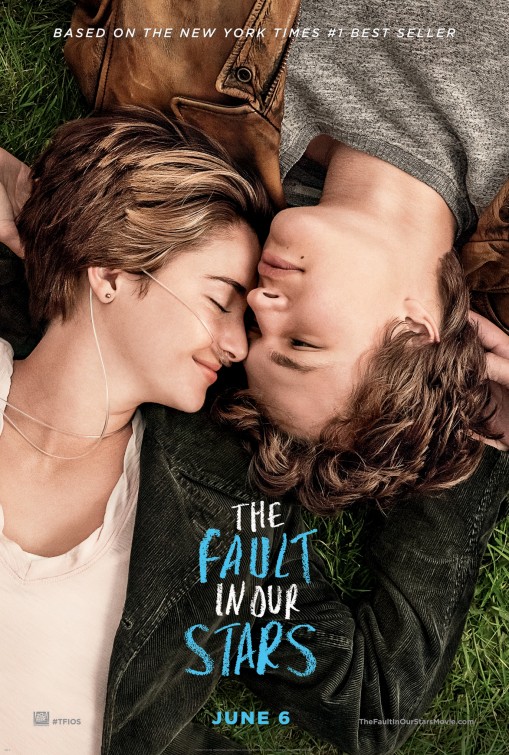 If the quality of a film was measured in the litres of tears its audience cried over it, then The Fault in Our Stars would be an instant classic. Though what else would you expect of a teen romance cancer tragedy?
Sixteen- year-old Hazel Grace Lancaster has cancer. What started as thyroid cancer has now spread to her lungs and as a result she requires constant oxygen and is forced to wheel around a tank with her. Her favourite novel is “An Imperial Affliction,” a book about a girl with cancer which vividly captures her own experience. At one of the support groups her parents insist she go to, she meets Augustus Waters. Charming and witty, Augustus is a cancer survivor, though has an artificial leg to show for his experience. Augustus falls for Hazel immediately, but Hazel resists becoming romantically attached, believing she is a ticking time bomb and only pain can come from getting involved with her. But Augustus is determined and pulls some strings to enable Hazel and him to travel to Amsterdam to meet the author of “An Imperial Affliction.”
Based on the best-selling 2012 novel of the same title by John Green, The Fault in Our Stars packs an emotional wallop. Its title is a reference to a line from Shakespeare’s Julius Caesar – “The fault, dear Brutus, lies not in our stars but in ourselves that we are underlings.” But sometimes the fault is in our stars. Sometimes people just get dealt a bad hand and there is nothing they can do to change it. This is a story about two young people who have been dealt such a hand, and know that this could be their only chance at a great love. Yet despite the spectre hanging over the film, The Fault in Our Stars shows that a short life can still be a full one.
Shailene Woodley is very much the up and coming it-girl of the moment and even at this early stage in her career has shown impressive diversity in films like The Descendents, The Spectacular Now and the sci-fi-adventure movie Divergent. She is very good in this film, delivering a performance as Hazel which seems to authentically capture the emotional experience of a young woman who knows she is sick and unlikely to ever get better. Her co-star Ansel Elgort (who, interestingly, played her brother in Divergent) is sure to make many a teenage girl swoon as the impossibly charming Augustus. But the fact that he is impossibly charming is a bit of a problem. His character doesn’t ring as true as hers. Where there is an authenticity to Hazel’s character and experience, Augustus doesn’t feel real. He feels like a teenage girl’s fantasy.
While the film will naturally resonate more with a teenage girl audience who can put themselves in Hazel’s shoes, The Fault in Our Stars explores some universal themes and is accessible to anyone. Those who react against being overtly manipulated by a film will struggle with The Fault in Our Stars, but the many fans of the book and those who are willing to be swept up in this journey will find it a melancholy, touching, yet still surprisingly funny experience. Just don’t forget your tissues.
Rating: ★★★
Review by Duncan McLean
Have you seen The Fault in Our Stars? Leave a comment and let us know what you thought.
Review – Chef (2014)
Director: Jon Favreau
Starring: Jon Favreau, Emjay Anthony, John Leguizamo, Sofia Vergara, Bobby Cannavale, Scarlett Johansson, Oliver Platt, Dustin Hoffman, Robert Downey Jr.
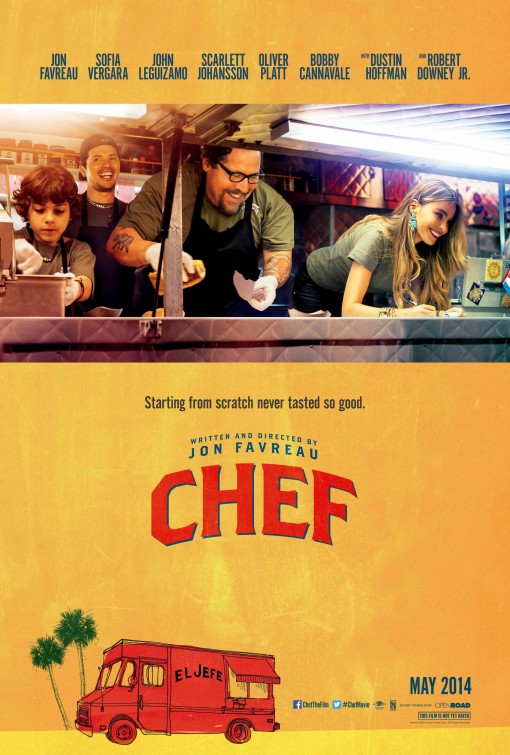 Jon Favreau started his career as an indie sensation with Swingers and Made, but the overwhelming success of Iron Man in 2008 drew him into the world of the blockbuster. With Chef the talented writer/director/actor returns to his independent roots.
Favreau plays Carl Casper, a highly regarded but burned out Los Angeles chef. His career took off ten years earlier as a result of a glowing review from influential food critic Ramsey Michel, but since then he has fallen into a bit of a rut. The news that Ramsey is going to return to his restaurant for the first time since that original review inspires Casper to plan an exciting new menu especially for the critic. But the restaurant’s owner steps in, insisting that the chef cook the existing menu, that he play the hits. The result is a scathing review which starts a Twitter war between chef and critic, ending in Casper losing his job. On a trip to Miami to clear his head with his ex-wife, Inez, and son, Percy, Casper buys and refurbishes an old taco truck. With his son and sous chef, Martin, by his side he drives and cooks his way back to Los Angeles, via New Orleans and Austin.
It is hard not to read this film as at some level allegorical. Is this really the story of a successful movie director who longs to make films that inspire him and that he is proud of, but is convinced by the studios that pay the bills to stick to the tried and tested and give the people what they want, only to then be slammed by the critics for being tired and unoriginal? Whether Favreau intends for Chef to be read as somewhat autobiographical or not, one thing is for sure, his heart and soul are completely in this film.
Chef has the feel of a passion project. This is a film that was made because Favreau wanted to make it, needed to make it, not because any studio was demanding it. Clearly there have been some favours called in, with previous collaborators like Robert Downey Jr and Scarlett Johansson appearing in smaller roles and giving the film some weight by association. But that passion pays off. Chef is so vibrant and alive. The food, the flavours, and the Cuban inspired soundtrack all combine with Favreau’s passion to create a film with a real sense of joy.
A word of warning: Chef is not a film to see on an empty stomach. Favreau has clearly not only learned to cook food (he was tutored by Chef Roy Choi), he has also learned how to shoot food. The food in Chef looks amazing. There is even a scene where Casper makes a grilled cheese sandwich for Percy which is somehow made to look like the most delicious thing in the world.
Yet while Chef works as pure food porn, the film has enough heart to ensure that it is more than just that. As well as being a celebration of food and cooking, Chef is about the reconnection of a father and a son. There is a great chemistry between Favreau and Emjay Anthony, the young actor who plays his son. As writer, director and performer, Favreau clearly has a great affection for this character and delivers the best performance of his career, and the ten-year-old Anthony gives an impressively natural performance, particularly in the scenes with Favreau and Leguizamo which would appear to be quite improvised.
Once the truck has been collected Chef becomes a meandering road trip, a film about taking the time to engage with your family, your friends, and your passions. A deceptively simple story, the film finishes quite abruptly, but that is not surprising because there is very little that needs resolving. Chef is an endearing celebration of food, cooking, creativity, passion and family which you can’t help but embrace.
Rating: ★★★★
Review by Duncan McLean
Have you seen Chef? Leave a comment and let us know what you thought.
Review – Calvary (2014)
Director: John Michael McDonagh
Starring: Brendan Gleeson, Chris O’Dowd, Kelly Reilly, Aiden Gillen, Dylan Moran, M. Emmett Walsh
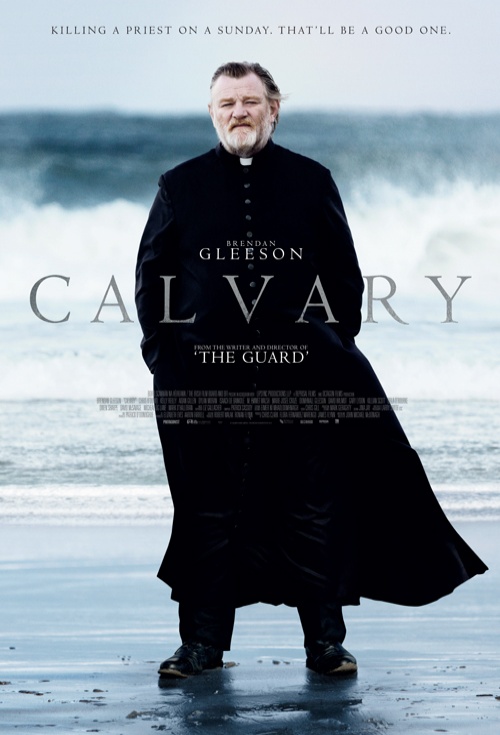 Three years after his debut film The Guard became the most successful Irish film of all time at the domestic box office and earned rave reviews around the world, director John Michael McDonagh and his star Brendan Gleeson are back with Calvary. The second part of the director’s “Glorified Suicide Trilogy,” Calvary is a very different, but every part as brilliant, film. More serious and thought provoking, it none the less demonstrates the same wicked humour, gift for dialogue and strong sense of place that made The Guard a success.
Father James Lavelle, a good man, serves as the priest of a small County Sligo parish on the west coast of Ireland. One day, while hearing confession, one of his parishioners confides that he was sexually assaulted by a priest for a number of years in his childhood. With the priest in question having long since died, the victim has decided that he will gain retribution by killing Father James. The Father is to become the victim precisely because he is innocent. “There’s no point killing a bad priest. But killing a good one? That’d be a shock.” The unidentified man gives Father James a week to get his house in order, and they are to meet the following Sunday on the beach.
From the moment that Father James receives his threat, in the very first scene of the film, he knows who it is that has delivered it. He is, after all, a good priest who knows the voices of his parishioners. But in a clever decision by the filmmaker, this information is kept from us. The film then, on one level, becomes a reversal of the traditional whodunit – a who-is-going-to-do-it. However, with the priest already knowing the identity, his week is not spent investigating the threat. That is our concern, not his. So while we watch those around him carefully, looking for clues as to the identity of the would-be murderer, Father James continues performing his role as one trying to provide spiritual assistance and guidance to his small, detached community.
His is not the easiest flock to tend to. The Father – played brilliantly by Gleeson – is confronted by a spiteful and confrontational community, and saddened by their complete indifference to matters of faith. One of his parishioners takes perverse pleasure from flaunting her adultery, with another of his parishioners, before him. Her husband, while possibly beating her, has no problem with the unfaithfulness. An atheist doctor goads him whenever he is called upon to visit someone dying in hospital. The local publican vents his financial frustrations on the Father as a representative of the wealthy Catholic Church. The film provides insight into the life of a priest in a society that no longer values or respects his contribution.
Recent years have seen a number of films exploring narratives surrounding the past crimes and abuses of power by the Catholic Church and attacking the institution (consider last year’s Philomena for example). Calvary takes a different approach to the issue. McDonagh’s film explores the impact of these revelations on the church’s place in the community. It does not attempt to defend the perpetrators of those crimes, or the institution that protected them, but rather invites us to consider the plight of those remaining good people whose efforts to do good works in the world are hindered by being forced to bear the burdens of an institution that has failed them.
Calvary features the same dark humour which made The Guard so brilliant, but here it is in service of a more serious story. At some point during its narrative, Calvary transitions from being a black comedy to a quite profound modern passion play. Father James becomes the symbolic innocent who must bear the sins of others, in this case the sins of the institution that he represents. The week that we count down marks his own walk to Calvary, as he endures the torment and ridicule of those around him.
While at times still very funny, Calvary ends up being a poignant and powerful film. At a time when most movies tend to opt for the simple and straight forward, it is encouraging to see a thoughtful film which has something to say. It also confirms McDonagh and Gleeson as a collaboration very much worth keeping an eye on.
Rating: ★★★★☆
Review by Duncan McLean
Have you seen Calvary? Leave a comment and let us know what you thought.
Review – The Grand Budapest Hotel (2014)
Director: Wes Anderson
Starring: Ralph Fiennes, Tony Revolori, F. Murray Abraham, Mathieu Amalric, Adrien Brody, Willem Dafoe, Jeff Goldblum, Harvey Keitel, Jude Law, Bill Murray, Edward Norton, Saorise Ronan, Jason Schwartzman, Tilda Swinton, Tom Wilkinson, Owen Wilson
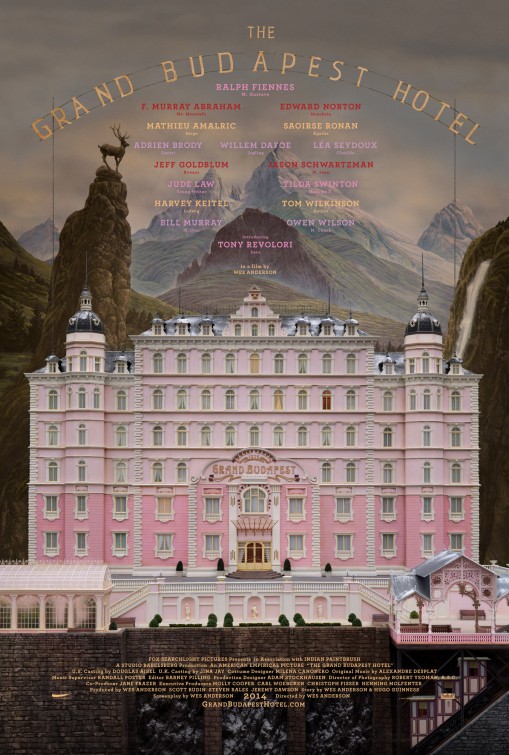 Wes Anderson is probably the most distinctive cinematic voice in America today. An Indie darling, he has strong sense of aesthetic design and a quirky approach to narrative and character which he has been refining for almost two decades. With The Grand Budapest Hotel,Anderson’s eighth feature, we get his take on the 1930s caper movie, and in many ways the film his entire body of work has been building towards.
The Grand Budapest Hotel presents us with a Russian doll structure, with layer upon layer of prologue leading us in to the story. Each era, each layer of untrustworthy narration, is visually represented by a different aspect ratio. We start in the present day as a girl visits a park where there stands a monument to ‘The Author.’ She opens a book called ‘The Grand Budapest Hotel.’ From there we are taken to 1985, to the study of that author, who sets about narrating to us the story of his visit to the hotel. We then venture back to 1968 when the author, as a younger man, first arrived at the once great hotel and became intrigued by its wealthy owner, Zero Moustafa. Over dinner one evening, Mr. Moustafa begins to recount to the author the story of how he came to own the hotel. Finally, we come to rest in 1932 with the story of the young Zero, a humble lobby boy, and his mentor, M. Gustave. M. Gustave was the heart and soul of the Grand Budapest Hotel. A concierge, Gustave is at the beck and call of the many wealthy dowagers who are drawn to the Grand Budapest by, among other things, the ‘services’ he offers. When one of the older and wealthier of these clients, Madame D, expires, her will is found to bequeath a priceless artwork to Gustave. Her family is outraged and Gustave finds himself accused of murdering her. What results is a good old-fashioned caper farce.
At a time when so many mainstream comedies are built around rambling improvisation, there is something really striking about the meticulously crafted nature of Anderson’s films. The Grand Budapest Hotel is very carefully structured. The dialogue and performances are precisely delivered. The framing of each and every shot has an intentionality to it. The film is alive with Anderson’s trademark bright pastel colours, in this case particularly pinks and purples. This fictional Europe Anderson has created has a sense of fantasy to it (the titular hotel is not in fact located in the Hungarian capital but rather in the fictional country of Zubrowska), with some exterior scenes employ a sort of stop-motion animation style, with a similar mechanical feel to The Fantastic Mr. Fox. All performers speak in their own accents, creating an endearing hodge-podge of dialects.
The Grand Budapest Hotel boasts a truly star-studded cast. There are recognisable names playing even the smallest of roles. The Anderson regulars like Jason Schwartzman, Bill Murray and Owen Wilson, take a back seat in this one, filling only very minor roles. Previous collaborators like Willem Dafoe, Adrien Brody, Jeff Goldblum and Edward Norton are back for another go around to flesh out the cast, but at the centre of the film are four newcomers to the world of Wes; Ralph Fiennes, F. Murray Abraham, Jude Law and Tony Revolori. Across the board the cast is wonderful, but it is Fiennes who really shines.
Ralph Fiennes and Wes Anderson seems like a strange combination. But just as Anderson drew one of the great comedic performances out of Gene Hackman in The Royal Tenenbaums, Fiennes, despite not being known as a comedic performer, proves to be tremendous as the concierge-gigolo, M. Gustave. While still speaking and moving in accordance with Anderson’s rhythms, Fiennes brings a different presence to the film which enables the character to move beyond some of the constraints of a Wes Anderson character. M. Gustave is a more sexualised character than we are used to encountering in Anderson’s work. He also has these explosive outbursts of swearing, similarly out of character for an Anderson protagonist, but used to great comic effect when contrasted with his usual polished demeanour.
As a filmmaker, Wes Anderson is yet to make a serious misstep in his 20 year career, so expectations are always reasonably high when a new film is released. But The Grand Budapest Hotel is such a well-crafted, vibrant and fun film that it quite possibly could be his best film yet.
Rating: ★★★★★
Review by Duncan McLean
Have you seen The Grand Budapest Hotel? Leave a comment and let us know what you thought.
Review – Captain America: The Winter Soldier (2014)
Directors: Anthony Russo & Joe Russo
Starring: Chris Evans, Scarlett Johansson, Samuel L. Jackson, Anthony Mackie, Robert Redford, Sebastian Stan
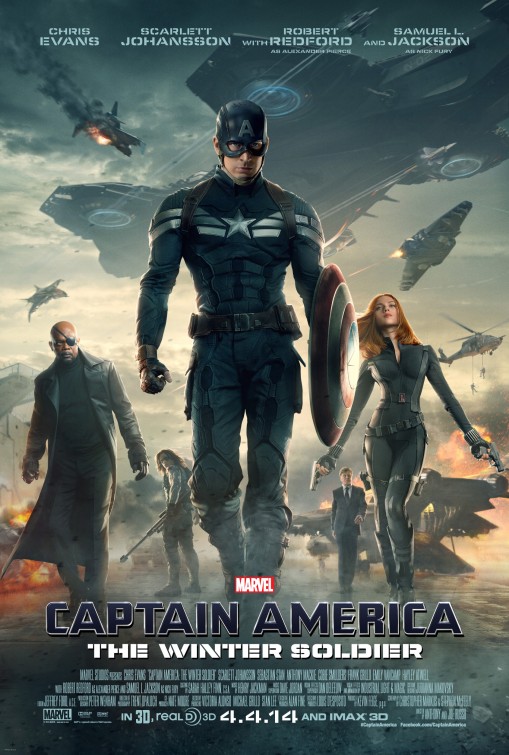
Captain America: The First Avenger was the most divisive of the first phase of Marvel’s Avengers movies. While some people really liked its war-time narrative and the old-fashioned heroism the character represented, others, more drawn to the charismatic egotism of Favreau’s Iron Man or the brooding menace of Nolan’s The Dark Knight,struggled to get behind it.
After being frozen for half a century, thawed out in the modern day, and having played a key role in The Avengers, Cap is back for his second solo outing. Still trying to get his head around the changed world he now finds himself in, Steve Rogers carries around a notebook in which he lists things he needs to catch up on. This list is different for different cinematic markets, with Australian audiences seeing a list that includes ACDC, Tim Tams and Skippy the Bush Kangaroo. With no family and few friends, he immerses himself in his work, protecting his country as SHIELD’s most devastating soldier. But when it becomes apparent that SHIELD has been compromised, and it looks like Nick Fury is involved, Rogers finds himself on the outer, not knowing who he can trust. Alexander Pierce, the Secretary of SHIELD, employs the full force of the organisation to try and bring Captain America in. This includes the mysterious Winter Soldier, a super-soldier who for decades has been believed to be the stuff of legend.
Captain America: The Winter Soldier is an interesting blend of the new and the old. It is very much a film for the post-9/11, war on terror world. Its central thematic discussion concerns the appropriateness of forfeiting freedom in the name of security, and the morality of pre-emptive strike justice, eliminating threats before they become threats. Yet while dealing with these quite current themes, the movie has the feel of a 1970s paranoid conspiracy thriller like Three Days of the Condor (which also starred Robert Redford) thanks to its narrative about the criminal infiltration of government institutions.
This blend of the new and the old is also evident in the characters. Steve Rogers is a man of the 1940s, confronted by a world which is more complex than the one into which he was born. It is not just culture and technology which he has to catch up with. His sense of morality is also challenged. Rogers is a moral absolutist. For him there is a clear right and wrong, and this causes him to butt heads with moral relativists like Nick Fury and Natasha Romanoff, for whom the ends tend to justify the means.
Where this film really stands out compared to some of the others in the franchise is in the chemistry between its stars. Evans, Johansson, Jackson and newcomer Anthony Mackie all play off each other quite well. The film also continues to develop those characters returning from previous adventures. In particular Scarlett Johansson’s Natasha ‘the Black Widow’ Romanoff, who has been a supporting character in Iron Man 2 and The Avengers, is really made a focus of the film and is fleshed out into quite an interesting character and a great foil for Captain America.
As is to be expected from these movies, the action sequences are top notch. Evenly scattered through the film, they never drag and are different enough from each other that they capture your interest. The film contains the expected nods to the other characters from the Avengers franchise, but where once these moments were cause for excitement, since The Avengers they only serve to make you wonder why it is those heroes being alluded to are not choosing to get involved in this particular international disaster. More interesting are a couple of nods to other films. In particular there is a little something in there for the observant Pulp Fiction fan which is really top notch.
In all though, the combination of good action, strong characters and a decent storyline makes Captain America: The Winter Soldier one of the better Marvel movies and ensures the franchise will continue to motor along.
Rating: ★★★★
Review by Duncan McLean
Have you seen Captain America: The Winter Soldier? Leave a comment and let us know what you thought.
Review – Muppets Most Wanted (2014)
Directors: James Bobin
Starring: The Muppets, Ricky Gervais, Tina Fey, Ty Burrell
 Muppets Most Wanted, the follow up to the Muppets’ triumphant big screen return in the 2011 film The Muppets, opens with a very self-aware musical number titled, “We’re Doing a Sequel.” “We’re doing a sequel. That’s what we do in Hollywood, and everybody knows that the sequel’s never quite as good.” As well as being the catchiest song in the film, it also, unfortunately, proves slightly prophetic.
The movie picks up where the last one left off. The Muppets return show has been a great success, the Muppet theatre has been saved and now they have to decide what they are going to do next. The forebodingly named Dominic Badguy suggests they make the most of their moment by going on a world tour. So with Dominic as their new manager, the Muppets head out on the road. But, surprisingly, Mr. Badguy isn’t all above board. He is actually the world’s second most wanted thief, and he is in cahoots with the world’s first most wanted thief, Constantine. Constantine is the world’s most dangerous frog and also just happens to be a dead ringer for Kermit. The old switcheroo is pulled and Kermit finds himself incarcerated in a Siberian Gulag while Constantine fronts the Muppets, with the tour around Europe serving as a front for he and Dominic to pull a series of high profile burglaries.
The Muppets was a brilliant film (it made my top ten of 2012). A vibrant, joyful movie, even in returning to these old, much loved characters it seemed to find a sense of freshness. At its heart was an incredible and overwhelming affection for these characters. In contrast, Muppets Most Wanted feels like a sequel, a more cynical exercise designed to exploit previous success.
Jason Segel, as both a co-writer and actor, was the driving force in getting the Muppets back on the big screen, but he was not involved in this sequel and his presence is missed both on and off screen. He and Amy Adams brought a sweetness and innocence to the human characters in the first film. They felt appropriately Muppety. Ricky Gervais, Tina Fey and Ty Burrell (who spends the whole movie doing a bad Inspector Clouseau impression) are all gifted comic performers, but none of them have that same quality and as such you don’t feel the same investment in the movie’s human characters.
There are still plenty of laughs. Muppets Most Wanted has the typical Muppets combination of high brow and quite simple humour. One minute there will be an allusion to Ingmar Bergman’s The Seventh Seal in which we see a black and white scene of the Swedish Chef playing a game of chess with the grim reaper, the next you’ll be giggling at the fact none of the Muppets recognise Constantine has replaced Kermit, despite his thick Russian accent and his continually getting all their names wrong. There are also cameos a plenty. Lady Gaga, Danny Trejo, Puff Daddy, Salma Hayak, Stanley Tucci, Tom Hiddleston, James McAvoy, to name but a few. Some of them are so brief that you almost miss them. The pick of them though is Josh Grobin, who is merely a disembodied singing voice coming from an isolation cell at the Gulag
Bret McKenzie of Flight of the Concords is back as the songwriter. A few of the songs are quite good – notably the aforementioned “We’re Doing a Sequel,” Tina Fey’s big number introducing Kermit to prison “The Big House,” and the finale “Together Again” – but none quite reach the heights of his effort the first time around for which he won an Oscar.
While the Muppets themselves remain such loveable and fun characters that they are always worth seeing, the joyous vitality and exuberance of the previous film is just not there this time around and as a result Muppets Most Wanted falls a bit flat.
Rating: ★★☆
Review by Duncan McLean
Have you seen Muppets Most Wanted? Leave a comment and let us know what you thought.
Review – The Lego Movie (2014)
Directors: Phil Lord, Christopher Miller
Starring: Chris Pratt, Elizabeth Banks, Will Ferrell, Will Arnett, Liam Neeson, Morgan Freeman, Alison Brie
 The Lego Movie marks the latest step in the recent diversification of the Lego Group, producers of everyone’s favourite colourful, interlocking construction toys. The last decade-and-a-half has seen them produce a series of best-selling video games and DVDs, but a $60 million motion picture backed by Warner Brothers represents arguably their most ambitious step yet. However, rather than feeling like a film made by a toy company, Phil Lord and Christopher Miller, the writer/directors behind Cloudy with a Chance of Meatballs, have delivered a film that is surprisingly clever, creative and funny.
The Lego world is under the control of the tyrannical Lord Business. Business likes logic and order. He separates the Lego world into different realms, keeping the city of Bricksburgh separate from the Old West, Pirate Cove, Clown Town and the rest. He encourages people to follow the instructions and stifles creativity. But there is a prophecy that tells of the Special, “the most talented, most interesting and most extraordinary person in the universe,” who will reunite the Master Builders and remove Business from power. Somehow, the Special turns out to be Emmett, a simple, lonely construction worker from Bricksburgh. He is identified by the spunky heroine Wyldstyle who takes him to meet the Master Builders so they can prepare for their assault on Lord Business. Oh, and of course Emmett becomes quite smitten with Wyldstyle. But she has a boyfriend… and he’s Batman.
The Lego Movie is all about imagination, both in its form and its content. Visually, the film presents us with a world in which everything is made from Lego. And when I say everything is made from Lego, I mean everything. Buildings, vehicles, landscapes, water, fire, all Lego. But rather than this limiting the scope of the film, it makes it entirely limitless. The internal logic which guides the film is that of a child’s imagination. Rather than being kept separate and adhering to real world story logic, the different realms of the Lego world intermingle resulting in an amazingly diverse story where our characters include Batman, cowboys, the cast of Star Wars, Abraham Lincoln, pirates, Gandalf, Michelangelo (both the Renaissance artist and the ninja turtle), space men and Shaquille O’Neal.
A fun, irreverent adventure that feels a bit like Toy Story meets Inception or The Matrix, the film’s narrative reinforces this focus on imagination and individual creativity by taking its lead from the very toys which inspire it. Yes, Lego comes with instructions but the real fun is to be had when the instructions are thrown out and your imagination takes over. So while Lord Business desires order and conformity, our heroes are the Master Builders whose creativity enables them to see the potential of their surroundings, enabling them to dismantle the world around them to build something new.
The Lego Movie is magnificently animated by the team from Australian animation house Animal Logic. The animation, while clear and vibrant, has a slightly clunky quality to it which works perfectly with the limited pliability of Lego figurines. This animation is then complemented by a strong voice cast including Chris Pratt, Will Arnett, Elizabeth Banks, Morgan Freeman, Liam Neeson and Will Ferrell. You get the impression that these funny people have been given a little bit of freedom in their characterisation, so while the film is very much G-rated in its content, the humour has the same patterns and rhythms of today’s more successful comedies.
With creativity and originality in mainstream animation appearing to have plateaued over the last couple of years, The Lego Movie feels fresh and exciting. Clever, funny and with enough heart to prevent it from being a cynical product promotion, it is possibly the best animated feature since Toy Story 3.
Rating: ★★★★
Review by Duncan McLean
Have you seen The Lego Movie? Leave a comment and let us know what you thought.
Review – Noah (2014)
Director: Darren Aronofsky
Starring: Russell Crowe, Jennifer Connelly, Emma Watson, Logan Lerman, Ray Winstone, Douglas Booth, Anthony Hopkins
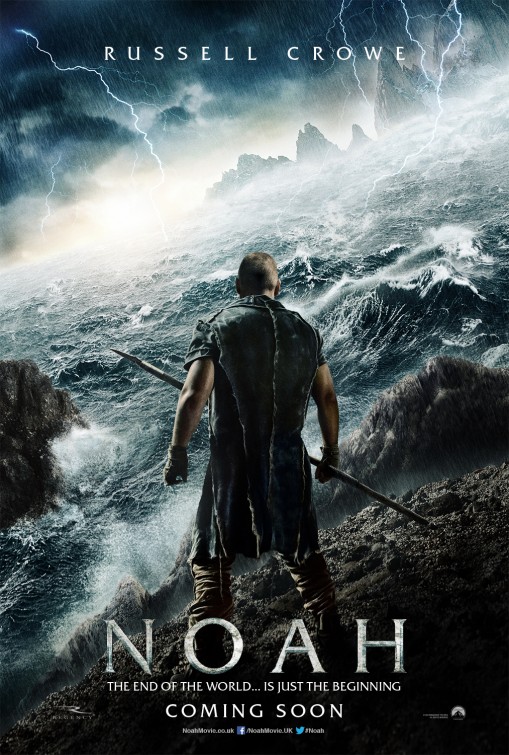 Darren Aronofsky is one of contemporary filmmaking’s true auteurs. A unique and interesting cinematic voice, when it was announced that he would be following up his surprise hit Black Swan with an adaptation of the story of Noah’s ark, a story which had apparently fascinated him since his childhood, there was little doubt we were going to get a film which was unlike any depiction of this story we had seen before.
Noah, is an audacious and bold piece of filmmaking, and while uneven it is more ambitious than most films which draw on Biblical stories, which tend to play it safe. The film presents the story of Noah not as a Biblical history, but rather as a mythology – a pre-historic great flood mythology is part not only of the Judeo-Christian tradition but many of the world’s religions. As such, the film takes on an aesthetic that is more akin to the fantasy genre than the historical epic. This is particularly evident in the depiction of ‘the Watchers,’ Aronofsky’s take on the Nephilim (fallen angels mentioned briefly in the Genesis text), which are shown as giant, Ray Harryhausen-esque rock creatures.
As is to be expected, the film has been attacked by some conservative Christian circles for its lack of Biblical accuracy (as is also to be expected, many of its most vocal opponents will openly admit they have not seen the film that has so offended them). They do have a point. At times Noah bears little resemblance to the Genesis account. Aronofsky has himself described the film as “the least biblical biblical film ever made.” But it begs the question whether in this situation biblical accuracy matters? Aronofsky’s film is not at all attempting to make a theological statement. It has no evangelistic agenda. It is neither seeking to persuade nor dissuade its viewers of the truthfulness of the story or the authenticity of the Genesis account.
If Noah is evangelistic about anything, it is environmentalism rather than theology. Aronofsky engages with the story of Noah not as a biblical story, but as one of Western society’s foundational narratives. He employs the standard practice of refocusing a well-known story in order to shine a light on a particular relevant issue. Aronofsky’s Noah thus becomes a film about stewardship and dominion. Noah and his family, descendents of Seth, believe humanity is tasked by the Creator – Noah always uses the moniker “the Creator” instead of God, the Lord, etc – to be stewards of creation and they aim to tread lightly on the Earth. “We take only what we need, what we can use,” Noah instructs his children as they pick food from the ground. The rest of humanity, descendents of Cain, whose murder of his brother Abel is depicted by the film as the defining moment of humanity’s corruption, believe the Creator has given them dominion over the Earth and it is theirs to plunder and use. In this film it is as much the way that humanity has treated the creation as it is the way they have treated each other that prompts the Creator to wipe the slate clean and start again.
While not a typical epic, Noah is still an impressive visual experience. The film carefully combines computer generated material with some impressive sets. The ark itself is an imposing structure – a monolithic, wooden box nothing like the traditional boat shape usually represented. All of the film’s animals are computer generated, which isn’t as bad as it sounds. Aronofsky also employs some interesting and arresting aesthetic devices. Noah recounts the creation story to his family, and his words are accompanied with a flickering time-lapse imagery, which is very effective.
Russell Crowe is strong in the title role as a character who is supposed to challenge us. On the one hand, we see him as an honourable figure, one who protects his family in a hostile world and seeks to live a righteous life. He sees a vision from the Creator and he is obedient. Yet as we sit inside the ark with Noah and his family and hear the cries for mercy from those on the outside as the floodwaters rise, we wrestle with Noah’s complicity in this genocide. Then when he comes to doubt the vision he has seen, and question whether it is indeed his family’s responsibility to repopulate the Earth or whether they are simply to shepherd the animals through this period and then themselves die off, he becomes quite a threatening figure to his wife and children, and Crowe is able to convincingly move from powerful guardian to threat. It is a controversial but very interesting characterisation.
Noah has its problems, it is a bit uneven and at times its environmental agenda is overplayed, but you will struggle to find a bolder, more ambitious and thought provoking blockbuster.
Rating: ★★★★
Review by Duncan McLean
Review – Pompeii (2014)
Director: Paul W.S. Anderson
Starring: Kit Harington, Emily Browning, Kiefer Sutherland, Adewale Akinnuoye-Agbaje, Jared Harris, Currie Graham
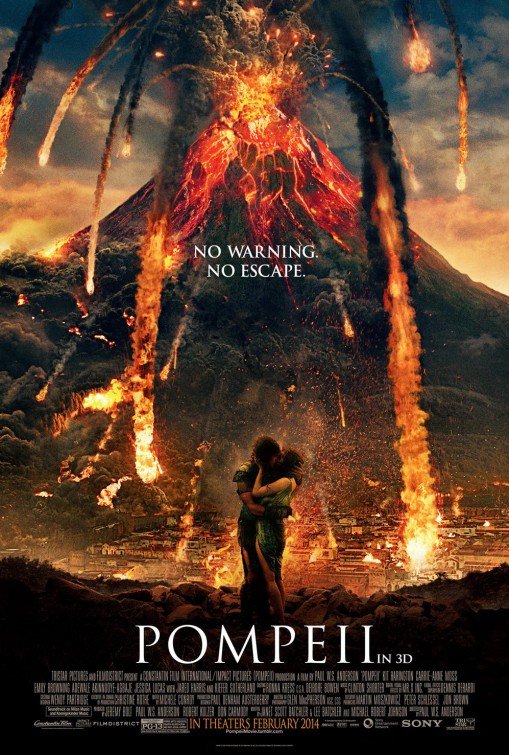 Pompeii, a $100 million, effects heavy, swords-and-sandals disaster movie, is the latest film from director Paul W. S. Anderson. It should be clarified up front that this is Paul W. S. Anderson of Alien vs Predator, Death Race and many a Resident Evil film, not Paul Thomas Anderson of There Will Be Blood, Boogie Nights and The Master, so expectations should be adjusted accordingly.
When his entire village in Britannia are massacred by the Roman army, young Milo is sold into slavery. He grows up to become “The Celt,” one of the most fearsome new gladiatorial talents in the Empire. As such he is taken to Pompeii to fight in the games that are to be staged there. There he catches the eye of a young noblewoman, Cassia, who has been unwillingly betrothed to the Roman Senator Corvus. As Mount Vesuvius erupts and the city crumbles, Milo must fight to save his beloved Cassia.
Pompeii opens with slow, emotive panning shots of the famous Pompeii body casts, people preserved in very human, often tender moments, by the ash from the eruption. These haunting images suggest a level of profundity that the gladiator-cum-disaster movie that follows doesn’t really possess.
From the moment the movie starts we are basically waiting for that enormous mountain that looms over the city to wreak havoc. But the first half of the film is effectively filler as we are made to wait over an hour for that event to occur. In the meantime we are entertained by the occasional well-staged gladiatorial bout, and the screenplay momentarily touches on an interesting area, looking at the dynamics of a relationship between two gladiators who know that at some point they will be required to try and kill each other. But if you are going to make the audience wait this long for the disaster to occur, it needs to be in service of really establishing a connection with the characters, and that is where Pompeii misses the mark. The characters are largely forgettable and the poor-boy, rich-girl love story is one we’ve seen so many times before.
Thankfully, though, the second act is where the film comes into its own. Once the volcano erupts, Pompeii sets a cracking pace and it doesn’t let up for the next 45 minutes, maintaining momentum right through to its completion. It is for these scenes that the film has been shot in 3D and the visual effects are quite impressive and exhilarating. We see plumes of ash, fireballs, lava, earthquakes, even a tsunami. It really is all happening in this horrifying, apocalyptic moment. For a disaster movie, particularly in the age of digital effects, it is so important to get this part right, and the eruption and the destruction of Pompeii really are the strongest scenes in the film.
Pompeii attempts to be Gladiator meets Titanic, but where both of those films succeeded in connecting with audiences on a human level, Pompeii relies solely on its impressive special effects. As such it ends up proving that one plus one can still somehow equal significantly less than one.
Rating: ★★☆
Review by Duncan McLean
Review – Ride Along (2014)
Director: Tim Story
Starring: Kevin Hart, Ice Cube, Tika Sumpter, John Leguizamo, Bryan Callan, Bruce McGill, Laurence Fishburne
 Kevin Hart has to be one of the hardest working men in show business at the moment. He has a successful career in stand-up comedy, a popular television series in Real Husbands of Hollywood, and numerous film projects in various stages of development. With the buddy-cop movie Ride Along Hart is attempting to make the transition into the realm of the “above the title” movie star.
Hart plays Ben Barber, a security guard in an Atlanta high school and an avid gamer, who has finally been accepted into the police academy. With his life falling into place, he plans to propose to his girlfriend, Angela, but first wants to get the blessing of her protective older brother, James. James is a cop himself, of the lone-wolf variety, and demands that Ben prove himself capable of looking after his sister before he will grant his blessing. So James invites Ben to ride along with him for a day to test him out.
Ride Along fancies itself as a comedic take on Training Day, and the numerous references to the film are obviously intended to make sure the audience draws that connection, but really what we have here is an action comedy in the tradition of Beverly Hills Cop, Lethal Weapon, 48 Hours and Rush Hour… though not quite as good. The action-comedy is a genre we don’t get as much of these days but it is a proven star maker and the ideal genre for someone of Kevin Hart’s talents. In Ride Along Hart is playing that Eddie Murphy role (from back in the days when Murphy limited himself to playing just the one character in each film), that fast talking, energetic, comic character.
If this review seems to be all about Kevin Hart it is because when it boils down to it, Ride Along is all about Kevin Hart. The film is at its best when it puts the progressing of the largely ho-hum storyline to one side and just lets him be the focus. Watching this loud, motor-mouthed but ultimately extremely unqualified character attempting to handle police situations is quite fun. His co-star Ice Cube, on the other hand, is a bit harder to handle. Whether by design or simply through his performance, Cube’s character just comes across as very one note. There is no light and shade, no real character development. What he does do is demonstrate how difficult it actually is to play the straight man opposite the clown.
Ride Along is a very formulaic film, but let’s face it, no one is going along to see this movie hoping to be challenged in any way. Its formulaic nature makes it comfortable, and if you come in with sufficiently low expectations there are some genuine laughs here and there is some fun to be had.
Rating: ★★☆
Review by Duncan McLean


You must be logged in to post a comment.