
Category: Reviews
Review – Begin Again (2013)
Director: John Carney
Starring: Keira Knightley, Mark Ruffalo, Adam Levine, Hailee Steinfeld, James Corden, Mos Def, Catherine Keener
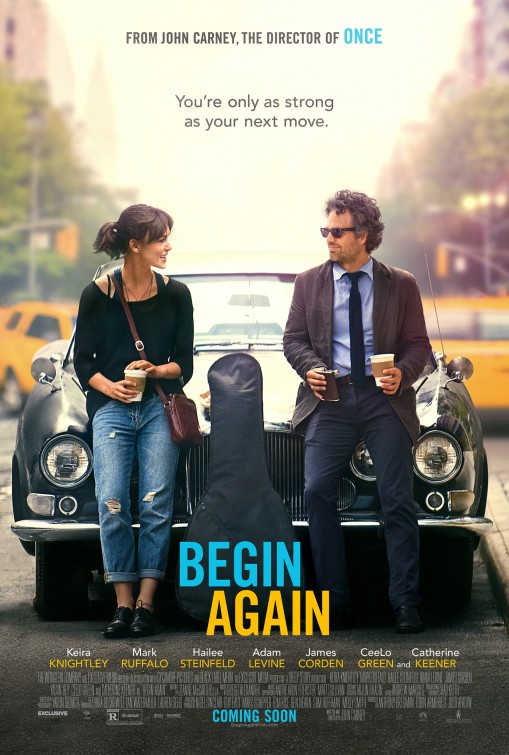
In 2006, Irish writer-director John Carney had an indie hit with his shoestring budget musical Once. The film, about a romance between a Dublin busker and a Czech flower seller who are brought together by their passion for music, won an Oscar for Best Original Song and spawned a Tony Award winning Broadway musical. Carney returns to familiar territory with Begin Again. Originally titled ‘Can a Song Save Your Life?’, the film explores the redemptive power of music and creative collaboration.
In a New York bar a young woman is invited up on stage to sing one of her songs and is almost completely ignored except for one man who stands transfixed. We rewind to approach the scene from two different perspectives; first his, then hers. He is Dan, a music producer who has hit rock bottom. His marriage has broken up, his daughter doesn’t respect him and he has just been fired from the record company he founded. She is Greta, recently broken up from her long-time boyfriend and song-writing partner after he hits the big time and is corrupted by fame. Dan hears something in Greta’s music that lights a fire in him and convinces her to record an album. Without access to a studio Dan and Greta decide they will make the album an ode to New York, and set about recording tracks live in different locations around the city, incorporating the ambient sounds of the town into their music.
While very derivative of Once, Begin Again is a glossier, more Hollywood movie with a bigger cast and bigger stars. Despite this, it manages to retain the sincerity of the earlier film thanks largely to strong performances from Keira Knightley and Mark Ruffalo. The two share great chemistry, but Carney thankfully resisting the urge to slip into cliché and keeps their relationship platonic. While that these two can act should be no surprise, that Knightley can sing might be. She does all her own singing, and while she doesn’t have a big voice, it is an emotive one. These two are surrounded by a quality supporting cast including Hailee Steinfeld, Catherine Keener and Maroon 5’s Adam Levine. It is James Corden though who steals the show as Greta’s old friend and the film’s chief comic relief.
While not a musical, music is obviously of central importance to the story. For these characters music is their life, and the film has some really clever ways of demonstrating the importance of music to them. There is one magical scene in which we see Greta’s initial bar performance from Dan’s perspective. As Dan’s imagination flies away arranging this song we see different instruments – a piano, drums, strings – start to play themselves accompanying the lone guitarist.
With music being so central to the story, it is supremely important that Carney and his team got the songs right. Fortunately, the film’s songs, primarily written by former New Radicals front man Gregg Alexander, are among its strongest attributes. However, there is a slight inauthenticity in the filmmakers’ unwillingness to back the premise of the album they are recording. We watch these live street recordings taking place but it is all too obvious that we are hearing studio mastered audio.
Begin Again is not as artistically aspirational as its characters are. It prefers to engage in some mainstream Hollywood feel-goodery. But the fact that this film remains upbeat, never wallowing even as the characters go through some low times, makes it a very hard film not to enjoy.
Rating: ★★★☆
Review by Duncan McLean
Have you seen Begin Again? Leave a comment and let us know what you thought.
Review – A Most Wanted Man (2014)
Director: Anton Corbijn
Starring: Philip Seymour Hoffman, Rachel McAdams, Grigoriy Dobrygin, Willem Dafoe, Nina Hoss, Robin Wright, Daniel Brühl
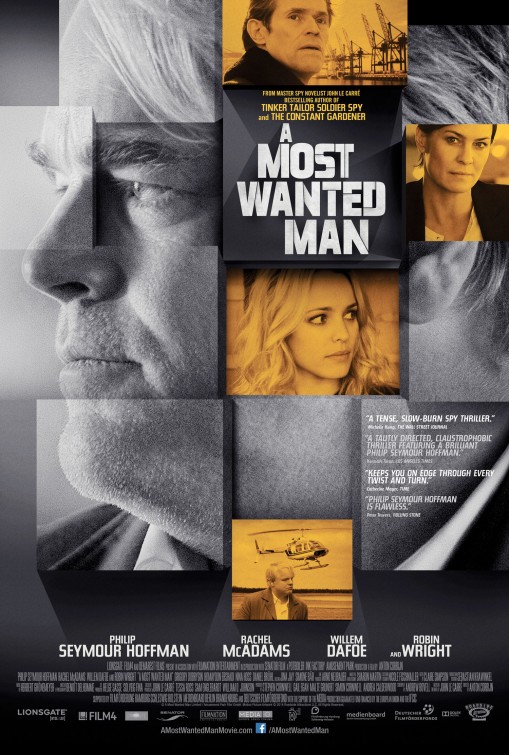 It is a bitter sweet time to be a film lover as new films from the late Philip Seymour Hoffman continue to hit the screen. The latest of them is Anton Corbijn’s slow burning spy thriller A Most Wanted Man.
With the 9/11 attacks having been planned from Hamburg, the German port city has become a key counterterrorist hub in the years since. There we meet the rumpled and weary Gunter Bachmann, head of a German counterterrorism unit. Constantly butting heads with Hamburg intelligence head Dieter Mohr who want to see more arrests, Gunter is interested in playing a longer game. As he explains, it is about using the minnow to catch the barracuda, and using the barracuda to catch the shark. Both have their sights set on Issa Karpov, a mysterious Chechen refugee with past militant links, who has arrived in Hamburg seeking to claim a multi-million Euro inheritance. For Dieter, Karpov is a prize, for Gunter he is a minnow with which he can catch the barracuda he his team has been tailing for years.
Being based on a John le Carré novel, A Most Wanted Man obviously does not deliver a spy thriller in the James Bond mould. There is a distinct lack of explosions, chases and action set pieces of any kind. Rather, this is classic espionage in a post-9/11 context. Corbijn’s film takes us into the morally dubious world of intelligence gathering where nothing is straight forward, nothing is black and white. We encounter rival agencies with rival motives, working together when it is convenient, and behind each other’s backs when that is. The result for the viewer is that we are left not just wondering who are the good guys and who are the bad guys, but whether there are good guys and bad guys at all.
This uncertainty about who to side with is reinforced by a structure which sees us move between apparent protagonists for much of the first half of the film. It takes a while for the film to settle into a fixed point of view. The ensemble cast features a number of Americans playing Germans, while impressive German actors like Nina Hoss and Daniel Brühl are reduced to minor roles. Of the Americans, some (Hoffman) do a more convincing job with their accent than others (McAdams).
Anton Corbijn, who came to feature filmmaking from music videos, is a very precise filmmaker, and in serving le Carré’s densely layered plot, he delivers a meticulously crafted film. With cinematography from Frenchman Benoît Delhomme, A Most Wanted Man is also a sharp looking film.
A subdued film that is at times quite slow, A Most Wanted Man is interesting without being truly compelling.
Rating: ★★★
Review by Duncan McLean
Have you seen A Most Wanted Man? Leave a comment and let us know what you thought.
Review – Dawn of the Planet of the Apes (2014)
Director: Matt Reeves
Starring: Andy Serkis, Jason Clarke, Toby Kebbell, Keri Russell, Gary Oldman, Kodi Smit-McPhee, Nick Thurston
 The decision to reboot the Planet of the Apes franchise in 2011 raised a few eyebrows. It felt like a slightly dated concept, and the previous attempt, Tim Burton’s 2001 Planet of the Apes remake, had been a terrible flop. But Rise of the Planet of the Apes proved to be one of the pleasant surprises of 2011, well received both critically and at the box office. But while a successful reboot is one thing, a successful sequel is an entirely different beast. However, expectations have been surpassed again, as Dawn of the Planet of the Apes is an intelligent, thrilling blockbuster which succeeds in taking this franchise to the next level.
Ten years after Caesar led his clan of genetically modified apes out of captivity and into the woods outside San Francisco the world looks very different. The ALZ113 virus which was being tested on the apes has become an epidemic, known as simian flu, and has wiped out most of the earth’s human population. Only those lucky enough to have a genetic immunity to the virus survive. A few hundred of these survivors have settled in San Francisco under the leadership of ex-military man Dreyfus and former architect Malcolm. With their fuel running low, their only hope is to get the hydro-electric system at O’Shaughnessy Dam up and running. Doing this means heading into the woods which the apes have made their home. While diplomacy between Malcolm and Caesar allows for initial cooperation, the hot-heads of Dreyfuss and Caesar’s second in command, Koba, mean that tension is never far from boiling over.
Dawn of the Planet of the Apes succeeds in going beyond what Rise of the Planet of the Apes gave us. The ambitious film gives us an expansion of scale. Where the first film was mainly shot in interiors, this sequel is shot entirely on location and primarily outside. This gives the picture a grander scope and a more epic quality. It also marks the first time that motion capture technology has been extensively used on location rather than in the controlled environment of a studio, and the results are stunning.
While upping the scale, Dawn of the Planet of the Apes returns to the heart of what science fiction is supposed to be. Rather than the simplistic spectacle it so often becomes these days, when done well science fiction uses its fantastical narratives to offer social commentary or insight into the human condition. The screenplay by Mark Bomback, Rick Jaffa and Amanda Silver, wears its political heart on its sleeve, exploring themes of empathy and fundamentalism, tolerance and prejudice.
In this war between humans and apes, we are not encouraged to take sides. This is a great strength of the movie. Instead it wants us to see the similarities between the two species. There are good humans and good apes, and there are bad humans and bad apes. Neither species can claim moral superiority. As tensions rise we see that peace requires us to see those things which we have in common, while conflict comes from an inability to see past those things that make us different.
Visually, this film is very impressive. The visual effects, supervised by Joe Letteri and Dan Lemmon, are tremendous in both the large scale action sequences, and the minute detail of the motion capture which brings the apes to life. But motion capture, or performance capture, is not just a technical achievement. The film’s strongest characters are simian, not human. The ape characters are both well-conceived and well written. The majority of the communication between them is in the form of a simple sign language, yet the actors use this primitive communication to effectively display complex emotions. Similarly, the film’s strongest performances come from the motion capture actors. Andy Serkis, with his iconic work as Gollum in the Lord of the Rings films, has established himself as the world’s premier motion capture actor. But his performance as Caesar is something to behold. Serkis gives the weary leader of the apes a real gravitas. Caesar shows arguably the most complex, subtle emotional depth the cinema has ever seen in a non-human character. While I’m not sure that the Hollywood establishment is yet ready to recognise a motion capture performance with an award nomination, Serkis would not be out of place in that discussion.
In an era where the science fiction genre is often merely an excuse for special effects and spectacle, Dawn of the Planet of the Apes aspires for something more. Refreshingly intelligent for a big budget sequel, Dawn of the Planet of the Apes is easily the best blockbuster of the year so far.
Rating: ★★★★
Review by Duncan McLean
Have you seen Dawn of the Planet of the Apes? Leave a comment and let us know what you thought.
Review – Locke (2013)
Directors: Steven Knight
Starring: Tom Hardy, Olivia Colman, Ruth Wilson, Andrew Scott, Ben Daniels
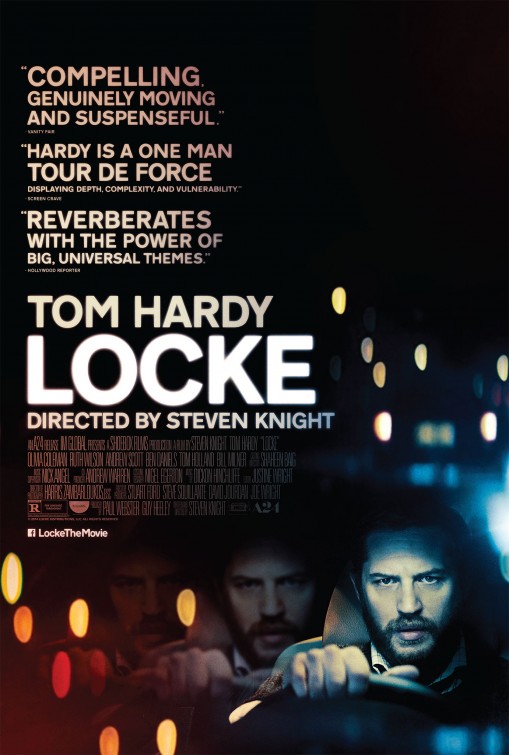 Filmmaking can be very formulaic, so it is exciting when you encounter a film that tries to do something quite different, a film that attempts something truly unique. In its brave rethinking of how to tell a story on screen, Steven Knight’s film Locke is such a film.
The evening before a major concrete pour, the biggest non-military pour Europe has ever seen, Welsh construction manager Ivan Locke gets in his car and leaves the Birmingham construction site, heading for London. He starts making phone calls. The first is to home, where his wife and two sons are waiting for him to join them for the big football game. He tells them he won’t be able to make it. The next is to his subordinate at work. He tells him that he won’t be on site tomorrow so must delegate responsibility for the pour. Where is he going? What is it which requires him to drop everything at such a pivotal moment? As Ivan’s journey continues, and calls are made and received, we come to understand the predicament he finds himself in and watch his endeavour to manage the situation.
A masterful piece of minimalist filmmaking, Locke reimagines the very nature of what is cinematic. Knight’s compelling script is a variation on a one-man play, with the entirety of the film taking place in Ivan’s car in real time as he drives to London. With no flashbacks or cutaways, the film places an incredible faith in the power of dialogue, with all of our narrative information coming through the phone calls Ivan makes and receives on his journey. Despite the seeming limitations of its format, Knight’s film is a gripping and suspenseful thriller.
There are very few actors in the world who can hold you in the palm of their hand for ninety minutes on their own, but Tom Hardy is definitely one of them. It is difficult to imagine this film working without Hardy’s performance. Having played some incredibly intense characters in his career, Hardy here delivers a wonderfully restrained and layered performance as a man trying to stay calm in a crisis. Ivan Locke is a really interesting character psychologically, as he wrestles with notions of culpability and responsibility. A meticulous man, he is determined to fix things. He is determined to control the chaotic situation in which he finds himself, and while we can see the flaws in what he is attempting to do, we also perfectly understand why it is the only thing that he, being the character that he is, can do in this situation.
This unusual film required an unusual shoot. The entire film was shot in six days. Each night, as the car was towed along the motorway, Hardy would perform the film in its entirety, from start to finish, stopping only to reload the memory cards on the three cameras mounted on and inside the vehicle. He had six autocues hidden around the vehicle, and the phone conversations were actual calls, with the rest of the cast located in a hotel by the motorway. With the whole project going from the initial idea to its debut at the Venice Film Festival in only a few months, there is an incredible energy in the production.
While the film is not perfect – there are moments in which Ivan addresses the ghost of his father, who appears in the rear view mirror in the back seat of the car, and these feel a bit forced in comparison to the rest of the film – you forgive those slight missteps because of the overall boldness of the piece. Coming in at just under ninety minutes, a perfect length, this unique, compelling piece of storytelling will have you absolutely riveted from beginning to end.
Rating: ★★★★☆
Review by Duncan McLean
Have you seen Locke? Leave a comment and let us know what you thought.
Review – Devil’s Knot (2014)
Director: Atom Egoyan
Starring: Colin Firth, Reese Witherspoon, James Hamrick, Rex Lin, Seth Meriwether, Kristopher Higgins, Kevin Durand, Dane DeHaan
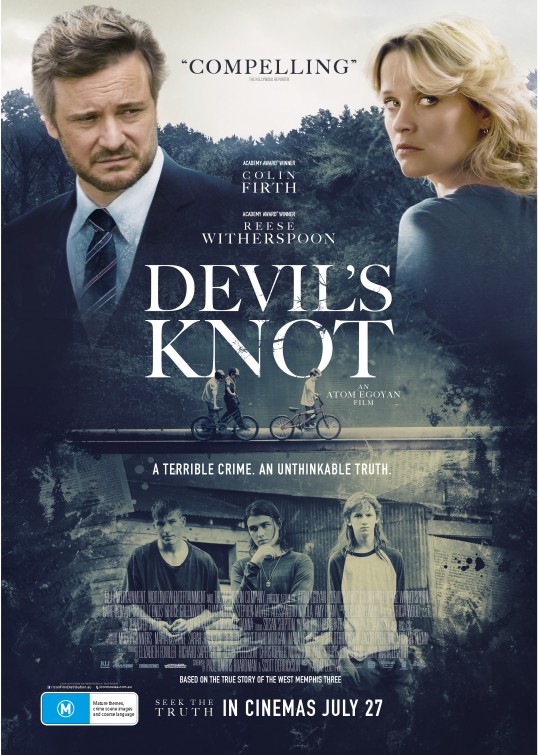 In 1993, the town of West Memphis, Arkansas was rocked by the brutal murder of three young boys. After a short investigation, three teenage boys, who would come to be known as the West Memphis Three, were arrested for the crimes. Despite stunning investigative blunders, a complete lack of physical evidence linking them to the murders and a confession filled with errors, they were found guilty of the murders. On 19th August 2011, after the presentation of new evidence, the West Memphis Three were released from prison having served 18 years. Devil’s Knot, based on investigative journalist Mara Leveritt’s bestselling book, explores the farcical events which saw the three teens convicted.
The film has two main protagonists. Pam Hobbs is the mother of one of the murdered children. Ron Lax is a private investigator. Between them we are given two perspectives on the events. Pam gives us the view of the shaken townspeople, Ron a seemingly more impartial view of the facts. Rather than seeking to answer the question of who actually committed the crimes, Devil’s Knot is more interested in examining how a community deals with fear. We watch as a town gripped with hysteria turns on those who are different. The three teenagers are vilified for their black clothes, heavy metal music and interest in the occult, none of which is acceptable behaviour in this conservative Bible-belt town. We see how an investigation literally became a witch hunt, and the legal systems of the town were deployed to simulate retribution. We watch people whose desire for answers and to apportion blame trumps their sense of logic and reason.
The case of the West Memphis Three has already been the subject of numerous books and documentaries, some of them quite good. Where Devil’s Knot struggles to add to this pool of material is that it does not have a clear purpose. Pre-production on the film started before the release of the trio. As such, its initial purpose was to expose the trial for the farce that it was and to campaign for the release of the three no-longer-young men. However, when the state of Arkansas released the West Memphis Three, the project’s original purpose was no longer required. While the case is still interesting, and the film presents it methodically, it simply fails to grip you.
A devil’s knot is a knot which theoretically cannot be opened. It is a puzzle without a solution, and that is exactly what we are given with this film. We leave the film with an incomplete picture. Devil’s Knot answers the question of who did it only by concluding that the trio in question did not. The film hopes to trouble us with its lack of resolution, but with this material having been explored before, albeit not in a feature film, its lack of new insight and unwillingness to speculate only serves to frustrate and underwhelm.
Rating: ★★☆
Review by Duncan McLean
Have you seen Devil’s Knot? Leave a comment and let us know what you thought.
Review – 22 Jump Street (2014)
Directors: Phil Lord, Christopher Miller
Starring: Channing Tatum, Jonah Hill, Ice Cube, Amber Stevens, Wyatt Russell, Peter Stormare, Jillian Bell, Nick Offerman
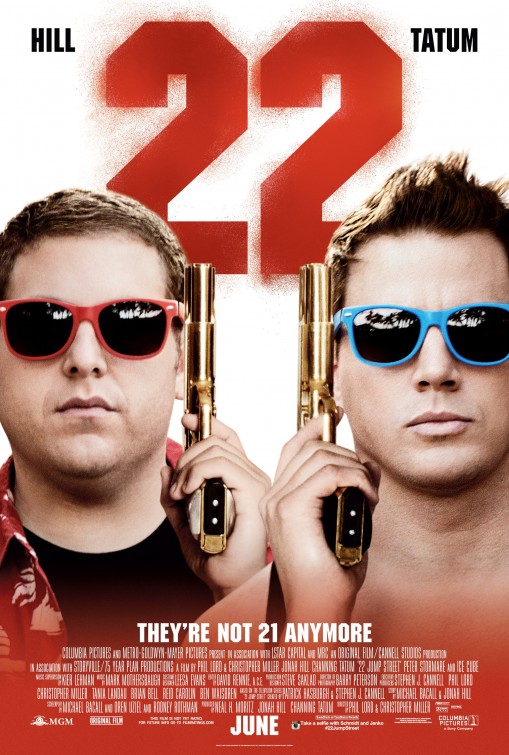 At a time when we like our popular comedy dripping with irony, the directing partnership of Phil Lord and Christopher Miller is steadily rising to the top of the pack. After solid success with their debut feature Cloudy with a Chance of Meatballs, and surprising success with the television remake 21 Jump Street, Lord and Miller had a legitimate popular and critical hit earlier in the year with The Lego Movie. With all three of those films, the pair took a project which was far from a sure thing and turned it into a hit with their unique and clever style of humour. But 22 Jump Street marks their biggest challenge yet, a sequel.
Having successfully gone undercover at a local high school to blow open a drug ring, the odd-couple of Schmidt and Jenko are back to do it all again. Now too old to pose as high schoolers, the pair are off to college where a new drug known as WHY-PHY (Work Hard, Yes – Play Hard, Yes) has claimed its first life. However, just like last time, the social politics of student life puts pressure on their investigation and bromance as the two find themselves moving in different circles – Jenko with the football crowd and Schmidt with the art students.
The plot sounds repeated and generic, but the beauty of this movie is in its complete self-awareness. At the beginning of the film, the two cops are called into the office of Deputy Chief Hardy who informs them that his superiors were pleasantly surprised by the success of the rebooted Jump Street program so have decided to do it again. They want it to be exactly the same as last time, although because they know it can be successful, the department has been given a bigger budget. He also informs them that they have had to move out of the abandoned Korean church at 21 Jump St, but were able to find an abandoned Vietnamese church across the road at number 22, which will now be their base. All of this is pointless, he adds, because everyone knows that nothing ever works as well the second time around. By winking at the audience, 22 Jump Street is able to not only parody buddy cop movies and college movies, but also blockbuster sequels.
They weren’t kidding about the upped budget either. 22 Jump Street is a noticeably bigger film than the first one, with a number of large scale action sequences, chases and explosions. These scenes aren’t particularly exhilarating in themselves, but they are there to allow the film to joke about action-comedies like Bad Boys or Lethal Weapon rather than as part of a serious attempt to be one of these films. 22 Jump Street is first and foremost a comedy, and it manages to be quite clever, while still engaging in more than its fair share of pratfalls and crude humour (of the sexual rather than toilet variety).
Much of the success of the film, like the first instalment, is down to Jonah Hill and Channing Tatum. This seemingly unlikely pair displays an easy chemistry. They appear really comfortable riffing off one another and the film has a very loose style that allows them to do that. While Hill has always been known as a comic actor, Tatum’s comedic chops were a revelation in 21 Jump Street and he is again really charming here as the muscle bound doofus, Jenko.
While Marvel have, in recent years, made an art form out of the post credits teaser, 22 Jump Street uses its credit sequence to deliver one of its funniest scenes. Parodying the trajectory of blockbuster franchises, the credits deliver a series of teaser trailers for sequels from 23 through to about 40 Jump Street, with the pair going everywhere from dance school to beauty school to culinary school and various gimmicks and cast changes along the way. Amazingly, given that this sequel achieves the rare feat of exceeding the first instalment, you leave the film with the distinct impression that this franchise is not planning to outstay its welcome.
Rating: ★★★☆
Review by Duncan McLean
Have you seen 22 Jump Street? Leave a comment and let us know what you thought.
Review – Charlie’s Country (2013)
Director: Rolf de Heer
Starring: David Gulpilil, Peter Djigirr, Luke Ford
 Charlie’s Country is the third collaboration between iconic Aboriginal actor David Gulpilil and director Rolf de Heer, after The Tracker and Ten Canoes. Together the three films form an informal trilogy, exploring the Indigenous experience at different points in Australia’s history. Charlie’s Country is the first of these films to be set in the present day and the most personal of the collaborations.
Charlie lives in a government controlled rural community in Arnhem Land. The first image we see in the film is a Liquor Act sign, declaring this to be an alcohol restricted community. While Charlie enjoys largely congenial relationships with the local white police, there is an undeniable tension simmering beneath the surface. He grows increasingly frustrated with the trying to live under the Intervention’s “white fella” rules. The white doctor tells Charlie that for the sake of his health he has to stop eating the white junk food, the only food available in town. But when Charlie goes hunting to catch his own food, “real food,” the white police confiscate his gun and fine him for recreational shooting. When he carves himself a spear, that too is confiscated as a dangerous weapon. In frustration, Charlie leaves the town to return to his country and live the old way, only to find that world no longer exists.
David Gulpilil’s performance as Charlie is the heart and soul of this film. It has been rightly earning critical praise around the world, including winning Best Actor at this year’s Cannes Film Festival. The actor delivers a captivating performance as a disenfranchised man, caught between two worlds, unable to exist in either. Gulpilil was a co-writer on the film and the character obviously draws heavily on his own life experience. The film was first formulated while Gulpilil was serving time in prison and subsequently in a drug and alcohol rehabilitation centre.
Charlie’s Country explores the tension that occurs when one culture is imposed over another. Where Warwick Thornton’s Samson and Delilah sought to shine a light without pointing a finger, Charlie’s Country is much more didactic. This film comes from a place of Indigenous frustration. In the colonialist world the film depicts, white influence is seen in the form of drugs, alcohol, guns, junk food and laws. While the first half of the film, set in Arnhem Land, is really engrossing, the second half, set in Darwin, is weaker and significantly less subtle in its exploration of these issues. A Darwin doctor asks if he can call Charlie by his first name because “I have difficulty pronouncing foreign names.” It’s a good line, but about as subtle as a sledgehammer.
A slow paced film – it feels longer than it is – Charlie’s Country is a pointed indictment of contemporary Australian Indigenous relations, highlighting the unworkable imbalance that exists between white law and Indigenous culture in the Northern Territory.
Rating: ★★★☆
Review by Duncan McLean
Have you seen Charlie’s Country? Leave a comment and let us know what you thought.
Review – The Rover (2014)
Director: David Michôd
Starring: Guy Pearce, Robert Pattinson, Scoot McNairy, David Field, Tawanda Manyimo
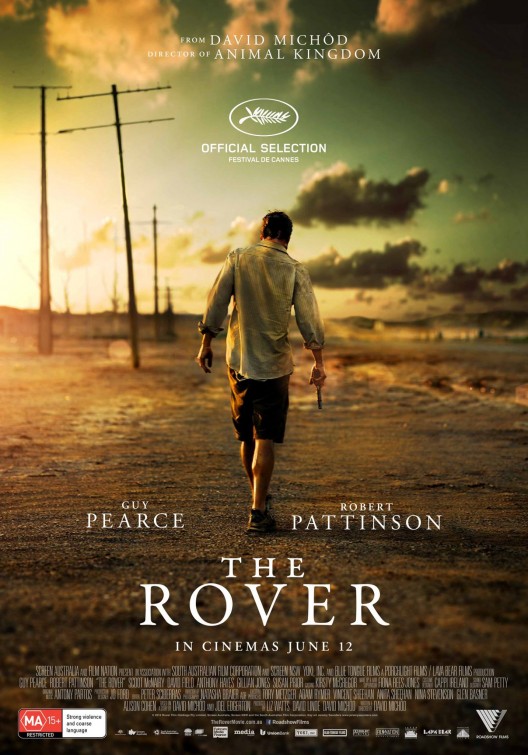 In 2010, writer-director David Michôd announced himself as the next big talent in the Australian cinema with his remarkable debut feature, Animal Kingdom. The gritty suburban gangster story earned international critical acclaim and even garnered an Oscar nomination for Jacki Weaver. Now, four years later, Michôd brings us his second feature, The Rover, which he describes as “a dark, dirty, violent fable.”
Ten years after an unspecified catastrophic event, referred to only as “the collapse,” a man, Eric, living in a rural Australian wasteland has his car stolen by a trio of men, seemingly on the run, who have just rolled their truck. Eric sets off in pursuit of his car and along the way he encounters Rey, the younger brother of one of the trio of thieves, who has been left for dead with a gunshot wound. To Eric, Rey is the means to find his car. To Rey, Eric is the means to being reunited with his brother. After tending to Rey’s wound, they form an uneasy alliance, with neither knowing what the other plans to do when they reach their destination.
The Rover paints a bleak, nihilist picture. Argentinian director of photography Natasha Braier brings an outsider’s eye to South Australia’s Flinders Ranges, giving a stark, menacing quality to this barren landscape, this vast emptiness. The film seems to have come from an angry place within Michôd. The temptation is to refer to it as a post-apocalyptic film, but to do so would not quite be accurate. “The collapse” which precedes the events of the film is not as the result of an external force. The implosion of society appears to have been its own doing. The fact that traders in the film refuse to accept anything other than US dollars suggests that there is an economic element to this collapse. The world that remains is a harsh one in which survival is the only priority.
At the heart of The Rover are gripping lead performances from Guy Pearce and Robert Pattinson. Pearce’s Eric is an unstoppable force. A man stripped of any remaining personality or morality, his pursuit of his car is single-minded and relentless and it is not until the very final moment of the film that we are given any insight into his motivation. Pearce and Michôd perform a delicate balancing act with Eric being at the same time the film’s protagonist and its most terrifying character. His ruthlessness and seeming disregard for human life is important though, because it serves to humanise Pattinson’s character, and draw us to him. Where we understand Eric as the type of man who can survive and even thrive in this bleak dystopia, the developmentally challenged Rey lacks that hardness. In what is undoubtedly the performance of Pattinson’s career thus far, he gives his character an underlying innocence and vulnerability despite his determination to appear threatening.
The Rover is a confrontingly violent film. This is not a reflection on the quantity of violence, but rather the coldness with which Michôd presents it. This world evidences a complete disregard for the sanctity of life. The first killing is quite shocking, because at that point we have not been prepared for the cutthroat way in which this society operates, but from there on it is a challenging, merciless film.
There have been numerous films in this dystopian wasteland genre, but none quite as nihilistic as this one. An unsettling but engrossing picture, in Michôd’s mind The Rover is a more hopeful film than Animal Kingdom. I would be surprised if audiences agree with him.
Rating: ★★★★
Review by Duncan McLean
Have you seen The Rover? Leave a comment and let us know what you thought.
Review – X-Men: Days of Future Past (2014)
Director: Bryan Singer
Starring: Hugh Jackman, James McAvoy, Michael Fassbender, Jennifer Lawrence, Peter Dinklage, Nicholas Hoult, Patrick Stewart, Ian McKellen, Ellen Page
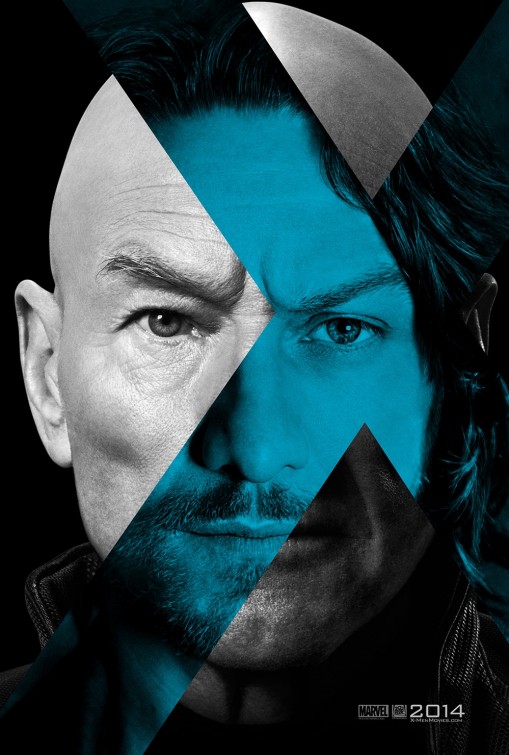 Five years ago, the X-Men franchise was looking like it might have run its course. X-Men: Last Stand had disappointed and X-Men Origins: Wolverine was widely panned. But Matthew Vaughn’s X-Men: First Class breathed new life into the series in 2011, and now Bryan Singer, the director who helped launch the franchise, is back at the helm for the much anticipated, and confusingly titled, X-Men: Days of Future Past.
We begin at the end. It is the year 2023 and we are in the final stages of a war between the mutants and giant robots known as Sentinels. But it is not so much a war as an extermination. Knowing they have nowhere left to hide, a small band of mutants – including among others, Wolverine, Professor X and Magneto, by this point an ally – devise a last ditch plan. Kitty Pryde uses her telepathic powers to send Wolverine’s consciousness back in time. Awaking in his 1973 body, Wolverine must seek out the young Professor X and Magneto, at this point sworn enemies, and with their help change the past in order to prevent this war from ever beginning.
X-Men: Days of Future Past feels like the continuation of a story. It feels like we are picking up where a previous film left off, but we are not. As a result the first half of the movie is chock full of exposition because there is a whole story that we have not seen which needs to be explained to us in order to understand what we are now seeing. We learn how in 1973 Mystique murders scientist Boliver Trask, inventor of the Sentinels, and that act cements the general public’s fear of the mutants and leads to the green-lighting of the Sentinel project. We learn how after being captured, Mystique’s shape-shifting DNA is incorporated into the design of the Sentinels making them highly adaptable and near impossible to defeat. We learn how the machines started out targeting mutants, but soon moved on to targeting mutant-sympathising humans and eventually all humans. We start the film at the culmination of this narrative and then return to the very beginning to try and stop it ever happening, but the result is the feeling that we’ve actually missed out on quite a good story.
X-Men: Days of Future Past continues the strongly allegorical nature of the series, exploring themes of intolerance, prejudice and the fear of the other. In Professor X and Magneto we are shown two different forms of leadership and two different approaches to combatting prejudice. Professor X is the Martin Luther King figure, preaching cooperation, unity and understanding, while Magneto is more Malcolm X, calling for a more militant, fight-the-power response. These important themes are explored effectively, but still in an entertaining package. There are some impressive action sequences and visual effects, and this film contains more fun and humour than we have seen in some of the previous installments in the series. That we experience the 1970s through the eyes of a character from the future means that the sights and sounds of that era – clothes, music, hair styles, lava lamps and waterbeds – can all be played up for comic effect.
X-Men: Days of Future Past does suffer a bit from character overload, with many being very thinly sketched. The X-Men universe contains so many characters and the temptation is always there to introduce new ones each film. In this film, the dual time period means that we have two casts of characters. There are just too many characters here for them all to be meaningfully represented. Of the new characters introduced, the teenage Quicksilver is a highlight. He is responsible for probably the film’s best scene, helping spring Magneto from a maximum security prison, but despite proving himself incredibly useful he is then inexplicably left behind.
The plot of X-Men: Days of Future Past provided an excellent opportunity to wrap up the series, but, unsurprisingly, that option was not taken and the film is clearly setting itself up for a sequel (talk is that X-Men: Apocalypse will be hitting screens in 2016). With this film’s rewriting of the past essentially throwing away the events and chronology of the previous four films in the franchise, it will be interesting to see what they choose to move forward with in the sequel.
There is plenty in X-Men: Days of Future Past to please returning fans of the series, but newcomers will find this a very difficult film to get up to speed with. While it has some quite strong moments, it is very messy in terms of its screenplay and narrative and doesn’t really live up to the high expectations that preceded it.
Rating: ★★☆
Review by Duncan McLean
Have you seen X-Men: Days of Future Past? Leave a comment and let us know what you thought.
Review – Godzilla (2014)
Director: Gareth Edwards
Starring: Aaron Taylor-Johnson, Ken Watanabe, Elizabeth Olsen, Bryan Cranston, David Strathairn, Sally Hawkins, Juliette Binoche
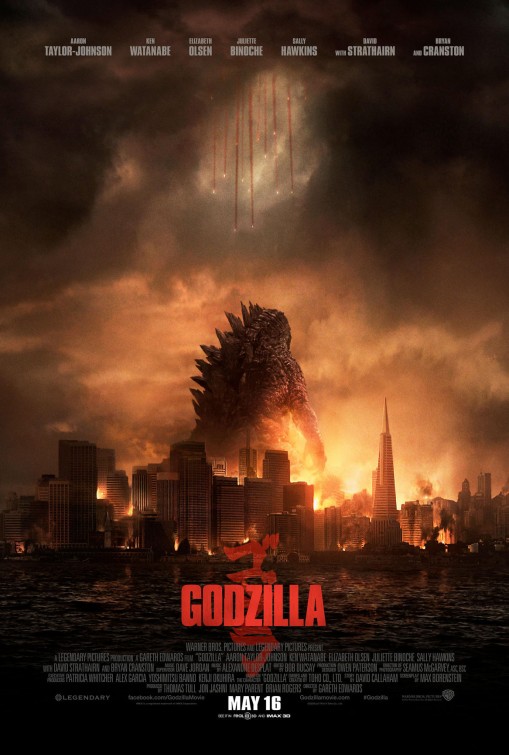 For sixty years now Godzilla has been the undisputed king of movie monsters. Debuting in Ishiro Honda’s 1954 film, Godzilla, the legendary creature has appeared in 28 films for Japan’s Toho Company. Despite that legacy, only once, in Roland Emmerich’s much maligned 1998 effort, also called Godzilla, has he received the Hollywood blockbuster treatment. But sixteen years later, Hollywood is ready to give it another go: different studio, different director, same title – Godzilla.
Scientist Joe Brody is certain that the Japanese government is covering up the true nature of a nuclear power plant disaster which took his wife’s life fifteen years earlier. With his son, Ford, a Navy explosives expert, he discovers that rather than being the result of a natural disaster, it was an attack from a MUTO, a Massive Unidentified Terrestrial Object. That MUTO, and its mating pair, are now heading across the Pacific Ocean towards the west coast of the USA and their only hope appears to be an equally large and mysterious creature which is tracking them.
Godzilla is only Gareth Edwards’ second feature film, after the 2010 independent film Monsters. He does, however, have a background in visual effects and that really comes through in this movie. Clearly taking his lead from Spielberg in Jaws, Edwards is careful not to overexpose us to the monster – in fact with Godzilla not featuring prominently until the third act there is a fair argument to be made that we don’t see enough him. But when he does show us the star of the film, he makes it count. Godzilla looks fantastic. The combination of immense scale and intricate detail makes for a very impressive visual presence. Edwards avoids the quick-cutting, shaky-camera style that makes some of the action sequences in the Transformers films such a headache inducing mess, allowing us a really good look at creatures as they battle it out. The film retains the traditional shape and lumbering movement of Godzilla, so even with these brilliant effects there are still moments when you get that nostalgic feel of a man in a costume, which is fun.
One of the other things this movie does really well is give a classic film figure contemporary relevance. This is achieved through the clever way that the film’s narrative ties in with contemporary fears. The catalyst that gets everything rolling is a nuclear power plant disaster in Japan. There is a tsunami. We see crowded city streets enveloped by a cloud of dust as skyscrapers crumble, which feel very familiar to 9/11 footage. All of these moments engage our memories of real world events. Effectively pressing the emotional buttons of relatable, real world experiences serves to ground what is otherwise a fantastical story.
Unfortunately though, as much as there are some great things about Godzilla, the film also has some pretty glaring problems. Primary among them are the film’s human characters. They simply aren’t engaging. Bryan Cranston’s nuclear scientist, the film’s most compelling character, does not feature as prominently as the trailers would have you believe. Aaron Taylor-Johnson plays a pretty bland, cookie-cutter protagonist, serving his role adequately but failing to take us on any sort of emotional journey. Elizabeth Olsen, who is a really good young actress, is the most underutilised, getting little more to do than wait by the phone and worry about her husband. The blockbusters of the last few years have made audiences largely immune to watching cities being leveled. We need individual characters to care about, and this film doesn’t adequately give them to us.
These characters are also not helped by the fact that there is an unavoidable disconnect between the characters and the central narrative of the film. Classical film narrative uses characters as the primary causal agents which propel a cause-and-effect narrative towards its resolution. The actions of the protagonist are supposed to make things happen, to ultimately determine the outcome of the film. In Godzilla, the human characters have very little dramatic importance. The message of the film is that nature will find a way to correct imbalance. Thus, the events that the human characters are involved in are only side stories, having little bearing on the outcome of the film which is to be determined by the battle between Godzilla and the MOTUs.
Godzilla is a film that gets some things very right and some things quite wrong. It possibly takes itself more seriously than a film about a 350ft sea-lizard should, but as a piece of pure spectacle cinema it does the trick.
Rating: ★★★
Review by Duncan McLean
Have you seen Godzilla? Leave a comment and let us know what you thought.


You must be logged in to post a comment.