Review – Her (2013)

Director: Spike Jonze

Starring: Joaquin Phoenix, Scarlett Johansson, Amy Adams, Rooney Mara, Chris Pratt, Olivia Wilde
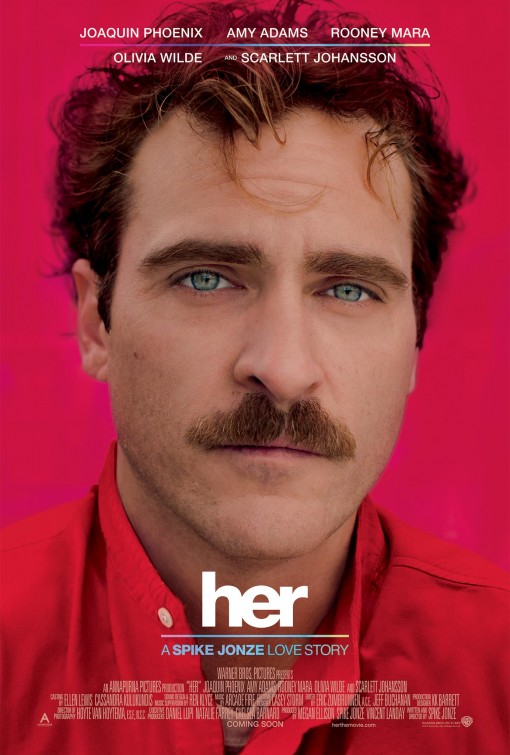
HerSpike Jonze has demonstrated a knack for left-of-centre, surreal storytelling with films like Being John Malkovich and Adaptation. His latest and it should be said finest film, Her, is no exception. In the near future – and a surprisingly utopian one given the cinemas penchant for dystopian visions of the future – we meet Theodore Twombly who works at BeautifulHandwrittenLetters.com where he puts his skills as a writer to work penning letters for people to send to lovers, friends or grandchildren. A lonely and anti-social man still recovering from a marriage breakup, Theodore becomes intrigued by an advertisement for the newest computer operating system, or OS – the first to feature artificial intelligence. “It’s not an OS – it’s a consciousness.” He buys himself a copy and after asking him a couple of questions to calibrate itself to his needs the OS introduces itself, or rather herself, as Samantha. Her cheerful, friendly demeanour instantly brings some light to Theodore’s life and the two become friends. Samantha organises Theodore’s life and Theodore helps Samantha unpack and understand the world. Before long their relationship becomes romantic.

The central premise of Her – a man falling in love with his computer – sounds like that of an absurd comedy but Jonze chooses to treat it with great sincerity. As such, what we end up with is a surreal, existential exploration of the nature of love, what it is to be human and our relationship with technology. The beauty of this film is how not far-fetched it manages to make this premise feel. We are already hopelessly dependent on technology. Anyone who has ever been forced to go even a short period of time without their smart phone or an internet connection can attest to that. Jonze simply takes that dependence to the next step, asking whether as technology becomes more sophisticated it is possible that dependence could become an emotional one. Theodore and Samantha’s relationship is treated with a surprising normalcy. Theodore’s friends hardly flinch at the idea that he is having a relationship with an OS. In fact, we are told that he is far from the only person out there in such a relationship. There is even talk of a woman who is having an affair with someone else’s OS.

Jonze’s screenplay is remarkable, but it falls on the film’s two leads, Phoenix and Johannson, to sell the authenticity of the relationship and make it all believable. Both actors rise to the challenge, delivering brilliant, unconventional performances. Phoenix is typically chameleon-like as Theodore, this insecure, isolated but deeply thoughtful man. So much of this film is dependent on his face as the nature of the story requires him to deliver the majority of his performance in isolation, relating to a character that isn’t physically present. Johansson’s performance is quite special. Completely disembodied, allowing her no physicality to employ, she nonetheless manages to create a full and empathetic character in Samantha. While it is the screenplay that makes Samantha think and feel, it is Johansson that give her the spark of humanity and enables us to understand how Theodore could fall in love with her. It isn’t objectophilia. It is a genuine two-way relationship.

As the film progresses the story becomes just as much Samantha’s story as it is Theodore’s. Artificial intelligence has usually been treated with suspicion in film. It is seen as dangerous and threatening – think of HAL 9000 in 2001: A Space Odyssey. In Her, we empathise with Samantha. In a variation of the Pinocchio story, Samantha struggles to reconcile the fact that while she thinks, feels and experiences emotions like a human, she is not one. The latter half of the film poses some quite interesting psychological questions about the limitations, or lack thereof, of artificial intelligence.

Her is one of the most touching, thought provoking and unique films of the year.

Rating – ★★★★☆

Review by Duncan McLean
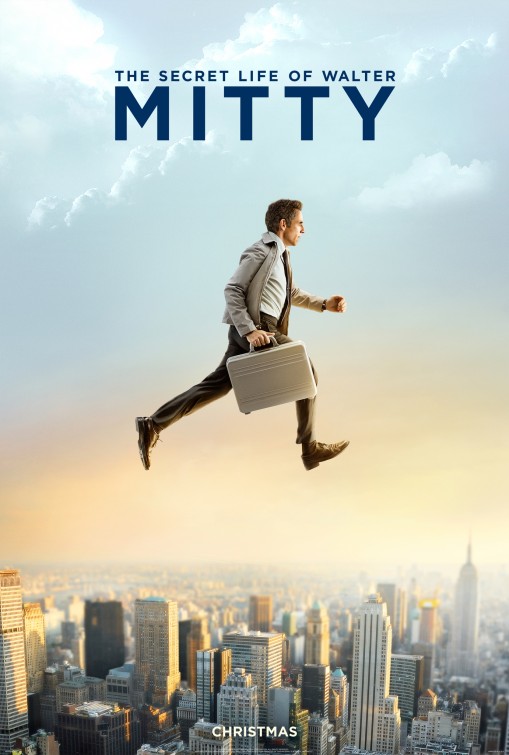
Review – The Secret Life of Walter Mitty (2013)

Director: Ben Stiller

Starring: Ben Stiller, Kristin Wiig, Adam Scott, Adrian Martinez, Kathryn Hahn, Shirley MacLaine, Patton Oswalt, Sean Penn

Secret Life of Walter MittyThe Secret Life of Walter Mitty is one for the dreamers. It is a film for those ordinary people who wish they could do something extraordinary. Walter Mitty is such a man. His respite from the mundane reality of his life is his active imagination. He is constantly zoning out to indulge in different fantasies and “what ifs.” Walter works in the photographic department of Life Magazine where he pines after Cheryl Melhoff who has recently joined the magazine in the accounts department. On his 42nd birthday it is announced that due to the changing marketplace Life will be ceasing publication, forced to go completely online.  For its final cover, renowned photographer Sean O’Connell has sent through a picture he considers among his finest ever, representing “the quintessence of Life.” However, the negative is missing and with the clock ticking Walter sets off to track down the globetrotting photographer and the mystery picture.

This is the second adaptation of James Thurber’s 1939 short story, the first being Norman Z. McLeod’s 1947 film of the same title starring Danny Kaye. However, in this instance Thurber’s story – which was less than 2,000 words long – is used only as a departure point for Steve Conrad’s screenplay. The idea that the daydreaming Walter Mitty embarks on an adventure that goes beyond anything he’d previously imagined belongs to Conrad, as does the film’s subsequent exploration of a man rediscovering his adventurous spirit and lust for life.

The Secret Life of Walter Mitty is Ben Stiller’s fifth feature film as a director and is a marked departure from some of his other directorial efforts (Tropic Thunder, Zoolander, The Cable Guy). While there are still glimpses of Stiller’s sense of humour – for example one of Walter’s imaginings is based on his misunderstanding of the plot of The Curious Case of Benjamin Button – in general the film has a more art-house tone. Stiller also demonstrates a much stronger visual aesthetic than you would expect from a filmmaker who is better known as a comedic actor. Stiller obviously allows the films content to influence its style, and thus this film about a man whose life has been devoted to a magazine and photographs is very intentional about presenting this story through both beautiful images and the interesting interplay of text and images.

In the film’s title role, Stiller goes against his usual performative style, appropriately underplaying the character. Walter is the kind of person who blends into the background, who to the outside world is entirely unremarkable. Kristin Wiig, also better known for more outrageous comedic work, makes for a delightful love interest, and similarly impresses with her willingness to underplay. Shirley MacLaine is great as Walter’s admiring and supportive mother, as is Patton Oswalt who plays a phone operator at an internet dating site trying to help Walter flesh out his profile in an effort to attract more interest in the film’s primary running gag. Sean Penn only appears in one scene as the elusive Sean O’Connell but he owns that scene and reminds us of his ability as a comic performer.

A far cry from the raucous comedies usually associated with Stiller and his Frat-Pack peers, The Secret Life of Walter Mitty is a whimsical, charming and above all tender film, and while it ventures into the overly sentimental it is so earnest that it is hard to begrudge it that.

Rating – ★★★★

Review by Duncan McLean

The Doctor of Movies’ Top 10 of 2013

Silver Linings Playbook1. Silver Linings Playbook (David O. Russell)

For mine, you have to go all the way back to the beginning of the year to find 2013’s best film. David O. Russell’s Silver Linings Playbook is a flawless picture. This beautifully written and compassionate film is a life affirming piece of cinema and, importantly, seeks to take the otherness out of mental illness. Cooper and Lawrence have tremendous chemistry and make for a memorable onscreen couple, and the supporting cast is equally impressive.

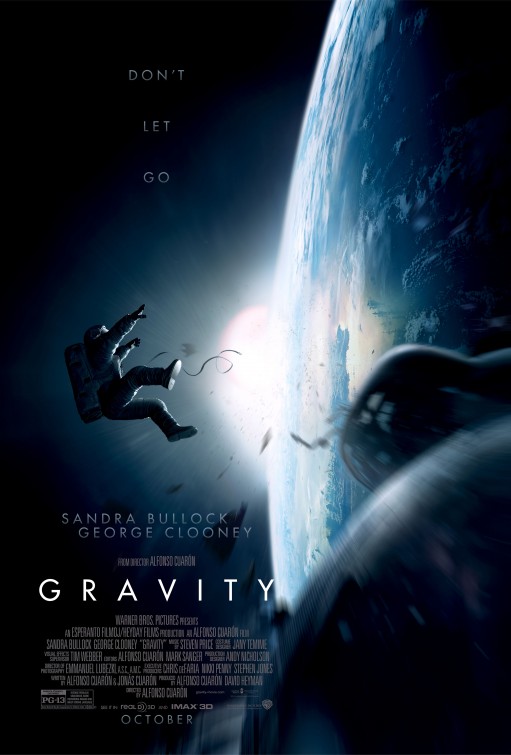
Gravity2. Gravity (Alfonso Cuarón)

Gravity is the most overwhelming cinematic experience in recent memory. Earning comparisons to Kubrick’s 2001: A Space Odyssey – high praise indeed – Cuarón’s film succeeds in making outer space at the same time breathtakingly beautiful and utterly terrifying. By far the most immersive use of the 3D format I have experienced, this simple narrative is a tight, 90 minute exercise in suspense and tension.

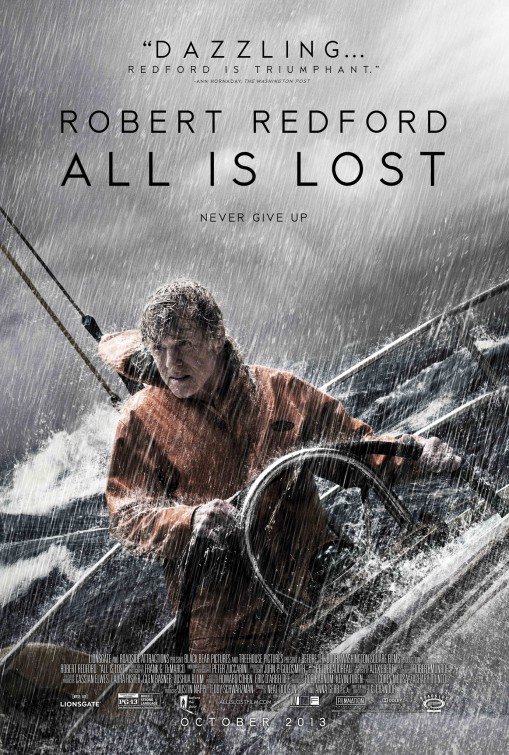
All is Lost3. All is Lost (J.C. Chandor)

I love the bravery of this film. With this minimalist film – one character, one setting, little to no dialogue – J.C. Chandor puts a lot of trust in his audience. He trusts them to care about this man even if he doesn’t burden us with backstory and character detail. Redford is compelling as the stoic and unemotive protagonist, refusing to overact. From beginning to end All is Lost is simply riveting.

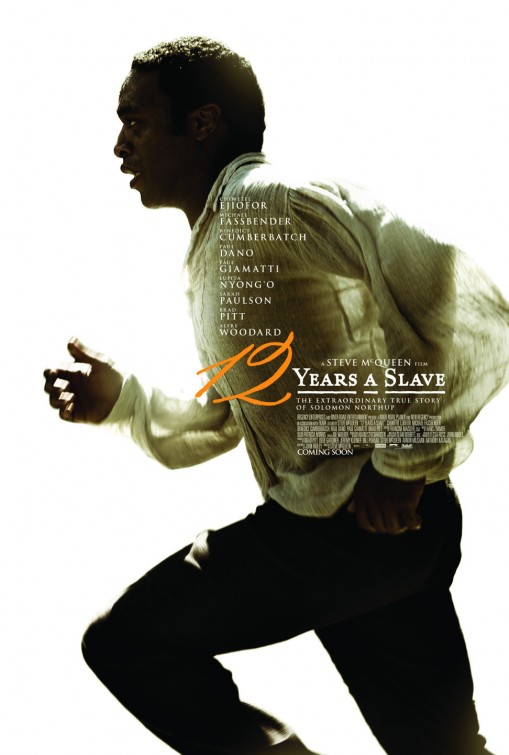
12 Years a Slave4. 12 Years a Slave (Steve McQueen)

McQueen has established himself as a filmmaker who does not shy away from difficult and provocative subject matter and doesn’t pull his punches and 12 Years a Slave is no exception. It is a brutal and unrelenting look at 19th Century slavery in the American south. It is also visually quite beautiful and has a haunting score by Hans Zimmer. There is a surprising lack of cinematic explorations of American slavery and this film, written by a black screenwriter and made by a black director, could be the most important on the subject thus far.

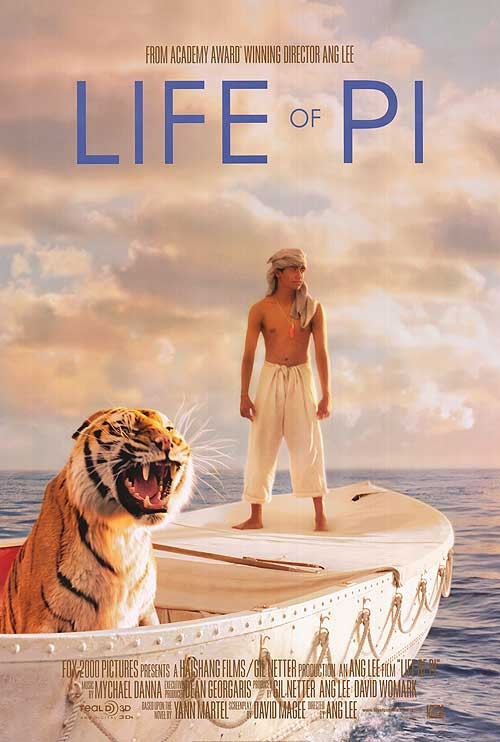
Life of Pi5. Life of Pi (Ang Lee)

For a decade Yann Martel’s beloved novel was believed to be unfilmable, but Ang Lee demonstrated that in the hands of the right filmmaker there is no such thing. Lee’s film is visually breathtaking using digital effects to create a heightened reality. It is also a deeply spiritual film, which separates it from other lost at sea films like All is Lost or Cast Away. Also contains the best performance by a CGI tiger I’ve ever seen.

Her6. Her (Spike Jonze)

A perculiar and surreal film, Her is very much a story for our time. The story of a romance between a man and the artificial intelligence operating system of his computer, the subject matter which could have been silly had Jonze’s film not been so very sincere. Her features two brilliant but unconventional performances: one from Johansson as a disembodied voice, the other from Phoenix who for much of the film only has that voice to play opposite.

Stoker7. Stoker (Park Chan-wook)

Stoker was film I knew nothing about until I saw it and was the year’s pleasant surprise for me. Park Chan-wook’s first English language, this psychological thriller retains the director’s talent for visual storytelling and creation of tone. It is a creepy and chilling film that elicits a visceral reaction. Had its second half maintained the subtly of its slow-burning first half this could have been the film of the year. Strong performances from a trio of Australian actresses in Wasikowska, Kidman and Weaver.

Secret Life of Walter Mitty8. The Secret Life of Walter Mitty (Ben Stiller)

The Secret Life of Walter Mitty is a film for the dreamers, for those ordinary people who long to do something extraordinary. Stiller’s fifth feature film as a director, it contains a much stronger visual aesthetic than you would expect from a director best known as a comedic actor. It is a charming, whimsical and incredibly earnest film, and though it ventures into the overly sentimental, it is hard to begrudge it that.

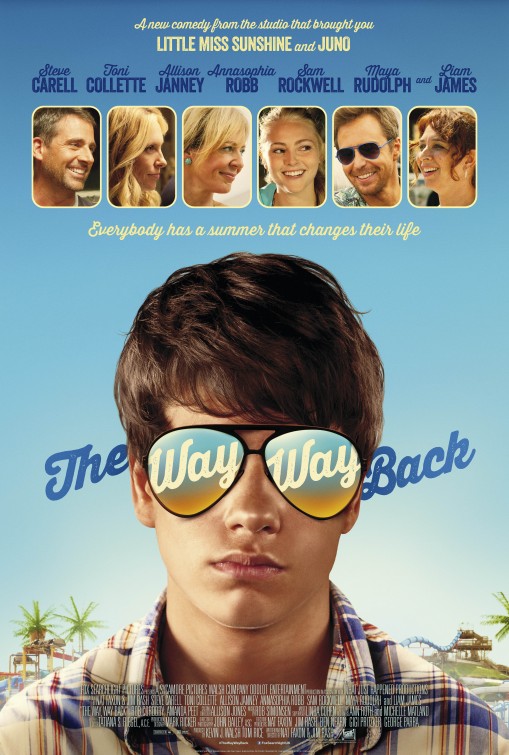
Way Way Back9. The Way Way Back (Nat Faxon & Jim Rash)

Writer/director/performers Faxon and Rash had this screenplay stored up before they were brought on board to work with Alexander Payne on The Descendents for which they won an Oscar. The Way Way Back is a witty, affecting and at times hilarious coming-of-age story about a teenage boy from a troubled family who finds himself in a holiday job at a waterslide park. Sam Rockwell is at his charismatic and funny best, Allison Janney is brilliant as always and Steve Carell, one of the most likeable men in Hollywood, shows he can play a real jerk.

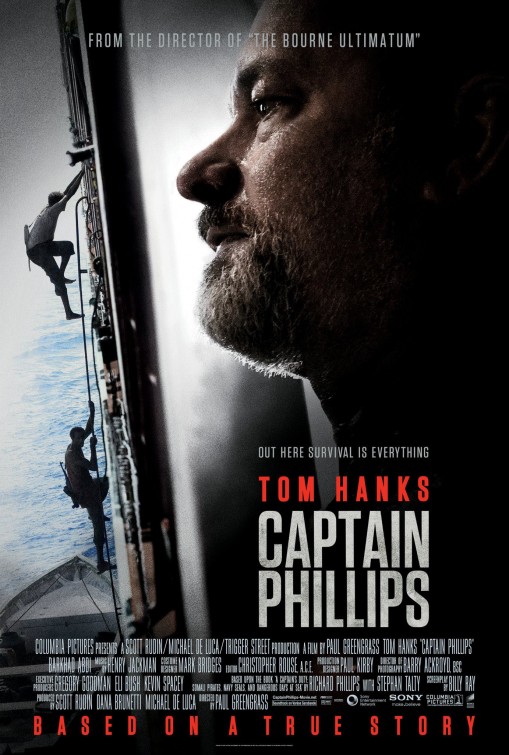
Captain Phillips10. Captain Phillips (Paul Greengrass)

Based on a true story, Captain Phillips is an interesting and gripping procedural thriller that is elevated by Greengrass’ strong direction and a fantastic performance from Tom Hanks. For Hanks, this could be the performance that puts him alongside Daniel Day Lewis in the three Oscars club. As the only name in the cast he carries the picture, with the post-trauma scene towards the end of the film being among his best ever work.

Not far off: American Hustle (David O. Russell), Blancanieves (Pablo Berger), Zero Dark Thirty (Kathryn Bigelow), Rush (Ron Howard), Django Unchained (Quentin Tarantino), Prisoners (Denis Villeneuve), Blackfish (Gabriela Cowperthwaite)

The Worst Movie of the Year: Scary Movie 5. It isn’t even close. With seven years passing since the fourth instalment in this lowest common denominator franchise you have to wonder if this was really the best they could come up with? A comedy without laughs and a horror movie without scares, thank God it was mercifully short.

Cinematic Highlight of the Year: This year provided me with a number of opportunities to see great old films on the big screen for the first time. It was wonderful to see The Searchers, Alien and Buster Keaton’s The General as they were intended to be seen, but the one which stands out as the biggest highlight of the year was seeing Alfred Hitchcock’s Dial M for Murder in 3D. While it was shot for that format in 1954, 3D exhibition quickly went out of fashion so it was primarily screened in standard 2D. Seeing it in 3D takes this great film to another level, breathing life into the shot compositions and creating a real sense of space and geography. It was a real treat.

Duncan McLean

Review – The Book Thief (2013)

Director: Brian Percival

Starring: Sophie Nélisse, Geoffrey Rush, Emily Watson, Nico Liersch, Ben Schentzer

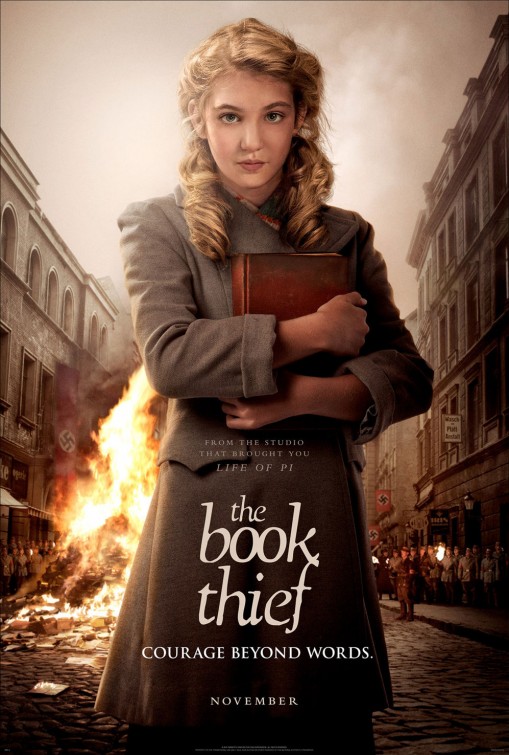
Book ThiefThe Book Thief is a World War II film with a difference. It is a home front story set in Germany, telling the stories of the ordinary German people who had their country taken hostage by the Nazis.

The film centres on nine-year-old Leisel Meminger. With an absent father, a mother who has been sent to a concentration camp for alleged Communists, and a deceased brother, she is adopted by Hans and Rosa Huberman. Teased at school for being illiterate, she starts learning to read with the help of Hans. At a Nazi book burning rally she steals away with a copy of HG Wells’ The Invisible Man and soon develops a passion for reading.

In theory The Book Thief is a story of young people caught up in the horrors of Nazi Germany, but due to its point of view those horrors are largely absent from the film – this is a very PG treatment of World War II. That we see the world from the eyes of this young girl means that the scope of the film rarely extends beyond her immediate experience. So for the majority of the film there is no direct experience of combat, and while the Hubermans harbour a young Jewish man, it is never made explicit what they are hiding him from. As such, the film is very dependent on required knowledge to understand the stakes. Interestingly though, the most traumatic scenes in the film are those in which we see men and boys being conscripted into the Nazi army. For this young girl, largely unaware of the happenings of war, the most immediate effect of the war is watching friends and neighbours being taken away to serve.

Based on the bestselling novel by Australian author Markus Zusak, The Book Thief is an example of why complete reverence to the source material should not always be the ultimate goal of a film adaptation. Like Zusak’s novel, the film is narrated by death, voiced by British character actor Roger Allam. While by all reports this device works in the novel, on screen it feels horribly gimmicky. Naff gimmick aside, it also simply isn’t good narration. The narrator has no consistent, meaningful presence. Instead the narration tops and tails the film, only appearing at a few moments throughout for unnecessary exposition. Simply removing the narration would have immediately improved the film, even if it meant being slightly less true to Zusak’s novel. Unfortunately though, the films narration is just one element of a poorly written, sappy and cliché ridden screenplay, ironic given the film is all about the power and importance of the written word – “words are life” Max declares.

The film also takes an off-puttingly inconsistent approach to language. The film is set in Germany with all characters speaking English with German accents. This is a common device that allows an English speaking audience to understand what is being said while still maintaining the illusion that everything is happening in German. Except in The Book Thief there are also some moments where people speak in German with subtitles. The written word is such a prominent part of this narrative and similarly there is a mixture of words written in English and words written in German. This is not a major issue, but to those who notice it is an odd and unnecessary inconsistency.

Geoffrey Rush and Emily Watson put in lovely performances as Liesel’s adoptive parents, and young Sophie Nélisse with her large expressive eyes is quite good as the film’s central character, but they alone cannot compensate for this film’s problems. The Book Thief may resonate with a younger audience but more mature viewers may become frustrated with its willingness to resort to cliché and its simplistic approach to a moment in history which, even given the films point of view, requires a more complex treatment.

Rating – ★☆

Review by Duncan McLean

Review – Much Ado About Nothing (2013)

Director: Joss Whedon

Starring: Alex Denisof, Amy Acker, Jillian Morgese, Clark Gregg, Fran Kranz, Reed Diamong, Nathan Fillion

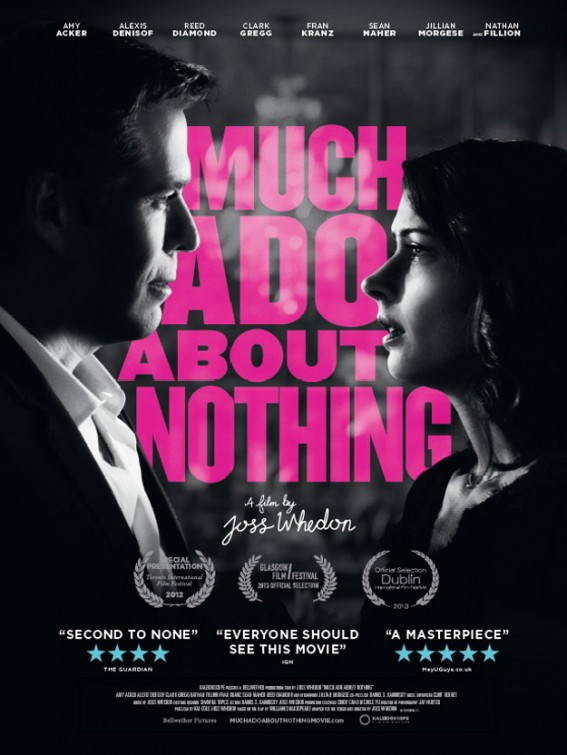
Much Ado About NothingFrom comic books to Elizabethan comedy. From Marvel to Shakespeare. It’s quite a jump. Not since 1992, when Steven Spielberg immediately followed Jurassic Park with Schindler’s List has a director made two more disparate films back to back. But this is exactly what Joss Whedon has done in deciding to follow up the incredible blockbuster success of The Avengers with a small, independent, black and white adaptation of one of Shakespeare’s most beloved comedies, Much Ado About Nothing.

In fact, Much Ado About Nothing couldn’t be futher from The Avengers if it tried. Gone is the enormous sense of scale, the digital effects, the 3D, the cast of superstars and the budget in the hundreds of millions of dollars. Instead, this film was shot at Whedon’s house in 12 days using a cast compiled mainly of regulars from his television days. A long held passion project, Whedon adapted the screenplay, produced, directed, edited, and wrote the music himself. Yet while it is on completely the opposite end of the scale to The Avengers, it is every bit as effective.

Americans don’t have a great track record when it comes to Shakespeare (Al Pacino actually made a very interesting film, Looking for Richard, which sought to determine what it was that caused Americans to struggle so much with the Bard), but this confident, sleek and sexy film will surely find itself resting near the top of the pile. Whedon opts for a contemporary reimagining of this famous story of two pairs of lovers, one brought together by the sport of their friends, the other almost torn apart by a more devious form of trickery. So Italian governors with guards become American politicians with security details, and the Italian villa becomes a Californian mansion.

Much Ado About Nothing is beautifully shot in black and white by cinematographer Jay Hunter, with an aesthetic that feels very akin to Indie movies of the 1990s. But despite its very stylish appearance, this film plays up the bawdiness of Shakespearean comedy to perfection. The dialogue in this farce, packed with double entendre, is delivered with a cheeky wink and a nudge, and there is more than a sprinkling of slapstick humour.

Rather than putting on fake British accents the actors retain their American twangs and it actually works. Alexis Denisof and Amy Acker bounce off each other brilliantly as Benedick and Beatrice, finding the right balance between admiration and distain that is required for this love-hate relationship between two people with sharp minds and tongues. Clark Gregg sits comfortably as a much younger Leonato than you usually get. But the films real scene stealer is Nathan Fillion, who is a scream as the bumbling detective Dogberry.

It has been 20 years since Kenneth Branagh’s all-star adaptation of this play hit the screen and Whedon succeeds in doing something different enough that the play gets a new burst of life. The material feels so fresh. It is a sharp, vibrant and very funny film that demonstrates Whedon’s versatility as a filmmaker.

Rating – ★★★☆

Review by Duncan McLean

Golden Globe Nominations Announced

Golden GlobesWe have arrived at the most wonderful time of the year to be a movie buff (unless you are a more high falutin cinephile who likes to think of lists and awards as being trivial and beneath them). December brings with it a flurry of top ten lists and the first round of nominations for the award season. The Hollywood Foreign Press Association has announced its nominees for the 2014 Golden Globe awards. As always the Golden Globes only give a slight indication of how things will pan out come Oscar time, particularly as the Globes divide categories between Drama and Musical or Comedy. However, we can none the less start in earnest to speculate as to who will be in the mix when Oscar nominations are announced on 16th January 2014.

Best Motion Picture – Drama

  • 12 Years a Slave
  • Captain Phillips
  • Gravity
  • Rush
  • Philomena

If this award were to go to anything other than 12 Years a Slave or Gravity it can be considered quite an upset. It will be interesting to see which way this goes. There was no other film that got quite the overwhelming response that Gravity did, but 12 Years a Slave is also a brilliant and important film which is a much more traditional ‘Best Picture’ type.

My tip: 12 Years a Slave

Best Motion Picture – Musical or Comedy

  • Nebraska
  • American Hustle
  • The Wolf of Wall Street
  • Inside Llewyn Davis
  • Her

Again, this would appear to be a two horse race between American Hustle and Inside Llewyn Davis, with these two films plus the two favourites from the other best picture category likely to be the four main contenders for the Oscar. The fact that Joel Coen didn’t get a directing nomination might swing things in the favour of David O. Russell’s film.

My tip: American Hustle

Best Director

  • Alfonso Cuaron (Gravity)
  • Steve McQueen (12 Years a Slave)
  • David O. Russell (American Hustle)
  • Paul Greengrass (Captain Phillips)
  • Alexander Payne (Nebraska)

Where this category is usually dominated by the directors from the best drama field there is a bit more of a mix this year with David O. Russell and Alexander Payne representing the musical or comedy category. While it is yet to be seen if voters consider Gravity to be Best Picture material, there is no doubt that it is a directorial achievement and it is not without precedent to see directors rewarded for amazing technical achievements (see Ang Lee’s Oscar win last year). In all, this is probably the strongest contested field at this year’s Golden Globes.

My tip: Alfonso Cuaron (Gravity)

Best Actor – Drama

  • Chiwetel Ejiofor (12 Years a Slave)
  • Matthew McConaughey (Dallas Buyers Club)
  • Tom Hanks (Captain Phillips)
  • Robert Redford (All is Lost)
  • Idris Elba (Mandela: Long Walk to Freedom)

An interesting field featuring veterans (Hanks and Redford), breakout performances (Ejiofor and Elba) and someone who is slowly but surely becoming quite an impressive actor (McConaughey). For mine, Redford’s work in All is Lost is the most impressive acting I’ve seen this year, but it also feels like the kind of film that will get overlooked. Don’t be surprised if momentum builds behind Tom Hanks and he’s an unbackable favourite by the time the Oscars come around.

My tip: Tom Hanks (Captain Phillips)

Best Actor – Musical or Comedy

  • Bruce Dern (Nebraska)
  • Leonardo DiCaprio (The Wolf of Wall Street)
  • Christian Bale (American Hustle)
  • Oscar Isaac (Inside Llewyn Davis)
  • Joaquin Phoenix (Her)

It’s great to see an old dog in Bruce Dern back in the mix and Christian Bale’s amazing fluctuating weight gets him in the frame again, but Joaquin Phoenix was so impressive in Her, performing the majority of the film only with a disembodied voice to play off, so I’d be inclined to go that way.

My tip: Joaquin Phoenix (Her)

Best Actress – Drama

  • Cate Blanchett (Blue Jasmine)
  • Sandra Bullock (Gravity)
  • Emma Thompson (Saving Mr. Banks)
  • Judi Dench (Philomena)
  • Kate Winslet (Labor Day)

There is a bit of a usual suspects feel to this category with every nominee being a previous Golden Globe and Oscar winner. Cate Blanchett would seem hard to beat in this category unless the voters go left field for something out of left field and opt for Dench.

My tip: Cate Blanchett (Blue Jasmine)

Best Actress – Musical or Comedy

  • Meryl Streep (August: Osage County)
  • Julia Louis-Dreyfus (Enough Said)
  • Amy Adams (American Hustle)
  • Julie Delpy (Before Midnight)
  • Greta Gerwig (Frances Ha)

The amazing Meryl Streep gets her obligatory nomination here, but this one will likely come down to Amy Adams and Julia Louis-Dreyfus.

My tip: Amy Adams (American Hustle)

Best Supporting Actor

  • Michael Fassbender (12 Years a Slave)
  • Jared Leto (Dallas Buyers Club)
  • Bradley Cooper (American Hustle)
  • Daniel Brühl (Rush)
  • Barkhad Abdi (Captain Phillips)

Michael Fassbender has done the best work of his career when under the direction of Steve McQueen and his performance as the violent Epps in 12 Years a Slave will likely see him edge out Brühl and Abdi for the honours.

My tip: Michael Fassbender (12 Years a Slave)

Best Supporting Actress

  • Lupita Nyong’o (12 Years a Slave)
  • Jennifer Lawrence (American Hustle)
  • Julia Roberts (August: Osage County)
  • June Squibb (Nebraska)
  • Sally Hawkins (Blue Jasmine)

Lupita Nyong’o was very impressive in 12 Years a Slave, her first feature film role, and Sally Hawkins earned praise for her work opposite Cate Blanchett in Blue Jasmine, but 2013 has been Jennifer Lawrence’s year and her combination with David O. Russell should see her strike gold again.

My tip: Jennifer Lawrence (American Hustle)

Best Screenplay

  • John Ridley (12 Years a Slave)
  • Bob Nelson (Nebraska)
  • Eric Warren and David O. Russell (American Hustle)
  • Jeff Pope (Philomena)
  • Spike Jonze (Her)

There are five very good screenplays nominated in this category but none is as bold as Spike Jonze’s for Her. His screenplay takes a scenario which could easily have been silly and makes it incredibly sincere and heartfelt and, as such, despite being an outsider I wouldn’t be at all surprised if he won.

My tip: Spike Jonze (Her)

Best Animated Feature

  • Frozen
  • The Croods
  • Dispicable Me 2

This has to be the least inspiring collection of animated films in recent memory. It doesn’t help that there is no contribution from Pixar or Studio Ghibli, the two most consistently excellent producers of animation in recent years. As such, Disney’s Frozen, an old-fashioned feeling Disney movie, is probably favourite be default.

My tip: Frozen

Best Foreign Language Film

  • Blue is the Warmest Color
  • The Past
  • The Hunt
  • The Wind Rises
  • The Great Beauty

This category lacks the out and out favourite it had last year in Amour, but there are a number of strong contenders. Blue is the Warmest Color, The Hunt and The Great Beauty have all made a bit of noise, winning numerous awards. It could go to any of those three, though Blue is the Warmest Color is probably the favourite at this stage.

My tip: The Hunt

The Golden Globes will be held on 12th January 2014


Review – 12 Years a Slave (2013)

Director: Steve McQueen

Starring: Chiwetel Ejiofor, Michael Fassbender, Lupita Nyong’o, Benedict Cumberbatch, Paul Dano, Sarah Paulson, Brian Blatt, Paul Giamatti, Brad Pitt

12 Years a SlaveIn 1853 Solomon Northup published his memoir 12 Years a Slave which told the story of how, as a free man living with his wife and children in upstate New York, he had been kidnapped and sold into slavery, spending the next twelve years of his life working on the cotton plantations of America’s South before finally being reunited with his family. The book was hugely influential in the years leading up to the American Civil War, exposing the inner workings of slavery and opening the public’s eyes to what it really was to be owned by another person. Now, 160 years later, British director Steve McQueen has brought Northup’s story to the screen in a film with the potential to be equally influential.

Despite being one of the defining periods of American history, antebellum slavery has not been widely explored cinematically, particularly from the point of view of the slave. The significance of 12 Years a Slave comes not only from the fact that it is a vivid portrayal of American slavery from the point of view of the slave, but also that it is the product of a the collaboration between a black British director and an African American screenwriter.

With his previous films Hunger and Shame, McQueen has established himself as a filmmaker who does not shy away from difficult and provocative subject matter and does not pull his punches. It should therefore be no surprise that his exploration of 19th century slavery is brutal and unrelenting. McQueen uses a number of long takes, holding the image and forcing us to take it all in. A lot of screen time is given to faces, allowing us to watch emotions unfold and develop within characters.

British actor Chiwetel Ejiofor delivers a powerful performance as a man thrust into an intolerable situation. Part of the appeal of 12 Years a Slave as opposed to other slave narratives for McQueen was that the narrative was the inverse of what we usually get, with our protagonist going from freedom to slavery. Having Northup start the film as a free man made him an effective surrogate for the audience. Slavery is as foreign and horrific to him as it is to us. It does, however, make for a less all-encompassing tale as in the confines of this narrative the injustice is that a free man has been kidnapped into slavery, not simply that any human being might find themself in slavery.

Northup’s story has the quality of an odyssey. This story of hope, of overcoming and refusal to surrender to injustice, is the story of Solomon Northup’s journey home to his family. It is a journey which takes place over a long period of time with constantly changing circumstances as he is sold from one owner to another, some seemingly benevolent, others ruthless.

McQueen regular Michael Fassbender plays Edwin Epps, the plantation owner under whom Northup spent the majority of his time. Fassbender is a brave actor unafraid to take on difficult characters, but the violent, hate-filled and insecure Epps might just be his most repulsive character yet.

The significance of this project, along with McQueen’s steadily growing reputation, has helped in assembling a tremendous supporting cast including the likes of Benedict Cumberbatch, Paul Giamatti, Paul Dano and Brad Pitt, who was also one of the film’s producers.

A harsh but incredibly powerful film, 12 Years a Slave is one of the finest films of the year and could already be the most important film made on this important subject.

Rating – ★★★★☆

Review by Duncan McLean
Review – Springsteen & I (2013)

Director: Baillie Walsh

Starring: The Fans, Bruce Springsteen, the E Street Band

Springsteen & IWhile many rock stars over the year have had fanatical fans, very few have had a fan-base as devoted and loyal as that of Bruce Springsteen. One of the reasons that even after more than three decades of touring Bruce Springsteen and the E Street band are still one of the very best live acts in the world is the way that Springsteen connects with his audience. His fans both worship him and identify with him. For many millions of fans the music of Bruce Springsteen and the E Street Band is the soundtrack to their lives. His songs speak to the lives of ordinary, working class people and validate their experiences. I once heard Springsteen described as having written a song about every beer you ever drank. In Springsteen & I a young Asian woman talks about riding her bicycle to work at Jamba Juice early in the morning, listening to The Boss and being made to feel like through her labour she was “the backbone of America.”

Executive produced by Ridley Scott, Springsteen & I is effectively a fan-film. Fans were invited to record their own messages, memories and reflections. These submissions have been compiled together by director Baillie Walsh and punctuated with concert footage from different points in Springsteen’s long career.

Rather than any sort of narrative or career overview, this diverse fan base which crosses continents and generations gives us a series of very personal moments and encounters – whether the man who went to a concert dressed as Elvis in the hope of fulfilling a lifelong dream of singing with the Boss, the women who went with her “I’ll be your Courtney Cox” sign and got invited up to dance, the busker who saw him in the street and had an impromptu jam session, or the man dumped by his girlfriend the day before the concert who was invited up on stage for a hug. In a number of cases these stories are brought to life by the inclusion of archival footage from the relevant concert. Devoted fans tell us, in their own words, what Bruce Springsteen means to them. Some are funny, some are touching, some offer way too much information (one woman lost her virginity to ‘Thunder Road,’ another talks in detail about discovering her womanhood as an early teenager seeing Springsteen dance to the saxophone solo in ‘Jungleland’), but all are sincere.

The strength of Springsteen & I lies in its authenticity. With all of the films contributors having shot their own footage on devices of differing quality and with differing levels of thought and preparation given to what they would say and where they would say it, the end result is a film which is completely lacking in pretention. Walsh obviously recognised the importance of this authenticity so does minimal cleaning up of people’s recordings. This results in a bit of awkwardness, as we see people stopping and starting over, getting up to turn off or adjust the camera, and so on, but rather than being off-putting the lack of polish feels appropriate given Springsteen’s standing as a working class hero.

Springsteen & I gives us insight into fandom of an equally powerful but less extreme nature than we have seen in documentaries on Comicon or Trekkies. It also gives you some idea of the incredible pressure someone like Springsteen must be under with so many millions of people around the world having such a strong emotional investment in him and his music. Springsteen & I will be of interest not just to fans who can identify with the stories but also to anyone interested in trying to understand what the big deal is.

Rating – ★★★

Review by Duncan McLean

Review – Last Vegas (2013)

Director: Jon Turteltaub

Starring: Michael Douglas, Robert De Niro, Morgan Freeman, Kevin Kline, Mary Steenburgen

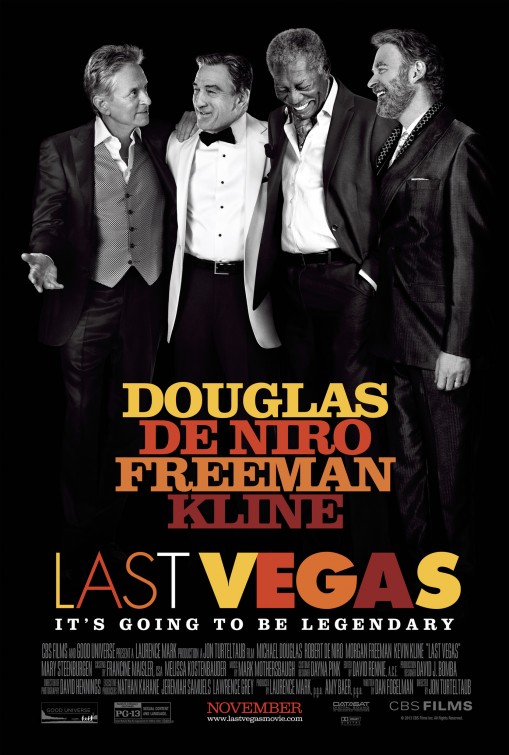
Last VegasMichael Douglas, Robert De Niro, Morgan Freeman and Kevin Kline. Between them they boast five Academy Awards and a further nine nominations. With Last Vegas the stars have aligned, enabling these four greats of the screen to come together and do the least ambitious work of their career. One can only assume that the lure of an easy pay cheque for a few weeks of not particularly demanding work with some old friends in Las Vegas was too good for them to turn down. However, just because they might have had fun making the film doesn’t mean that you are going to have fun watching it.

Billy, Paddy, Archie and Sam have been the best of friends since they were kids, but as they hit their twilight years, life has got a bit tougher. Paddy’s wife has passed, Archie has had a stroke, Sam has lost his spark. When Billy, the eternal bachelor, announces that he is engaged to a woman young enough to be his daughter, Archie and Sam decide that a bachelor party in Las Vegas is just what the group needs to put a bit of a spring back into their step. But such an event means bringing together Billy and Paddy, who have had a falling out.

Obviously trying to tap into the success of The Hangover (at least the first one) and Bridesmaids – two films which in their best moments were quite subversive – this tale of old men behaving badly sets the bar pretty low. Last Vegas is exactly what you imagine it is going to be and nothing more. You get bombarded with cheap laughs about bad hips, medication, poor hearing, obliviousness to popular culture and, of course, Viagra.

Douglas, De Niro and Freeman are all playing to type; Douglas as the sleaze, De Niro as the curmudgeon and Freeman as the irreverent old guy with a bit of perspective on life. It is only Kline who succeeds in creating a vibrant and engaging character, which is problematic as the lion’s share of screen time goes to the less interesting dramatic conflict between Douglas’s Billy and De Niro’s Paddy. Mary Steenburgen, as lounge singer who catches the eye of both Billy and Paddy, is quite charming and proves herself to have quite a voice.

You can’t help but feel the whole film is summed up in one particularly low moment which sees Robert De Niro, one of the absolute legends of the American cinema, sit uncomfortably while LMFAO singer and X-Factor Australia judge Redfoo thrusts his speedo clad crotch into his face. In the end the goodwill engendered by the quality cast only goes so far in disguising what is otherwise an entirely unremarkable piece of fluff.

Rating – ★★

Review by Duncan McLean

Review – Romeo & Juliet (2013)

Director: Carlo Carlei

Starring: Douglas Booth, Hailee Steinfeld, Ed Westwick, Kodi Smit-McPhee, Paul Giamatti, Damien Lewis, Stellan Skarsgard

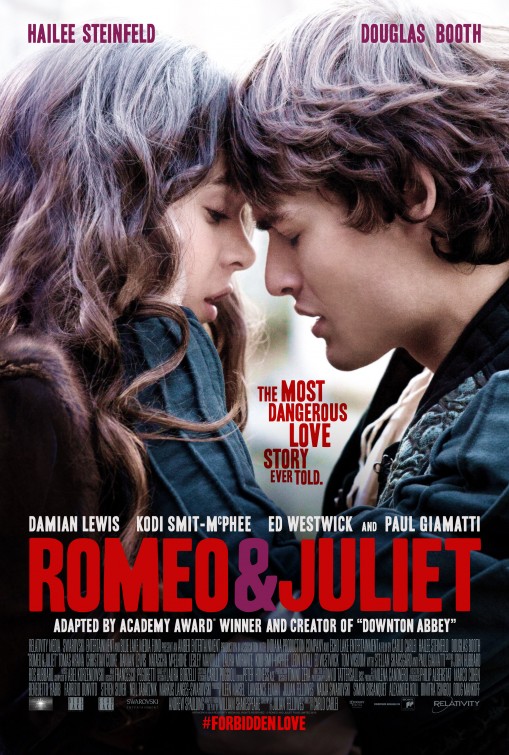
Romeo & JulietThe Bard is back on the big screen and with this latest adaptation of Romeo & Juliet producer Ileen Maisel – the driving force behind the project – has opted for something quite novel, a traditional telling. In recent times the fashion when it comes to adapting Shakespeare has been to use contemporary setting and dress, but Maisel believed that modern audiences had not been exposed to a traditional, romantic vision of Shakespeare’s most famous play. It has, after all, been 45 years since Franco Zeffirelli’s famous adaptation, still a classroom staple. So director Carlo Carlei’s vision of the greatest love story ever told takes us back to fair Verona in Italy and delivers beautiful mediaeval costumes.

A traditional retelling this may be, but a truly faithful adaptation it is not. The screenplay was adapted by Julian Fellowes of Gosford Park and Downton Abbey fame. Turning an approximately three-hour stage play into a two-hour movie requires a bit of script wrangling, but in addition to this work Fellowes has also carefully and covertly updated some of Shakespeare’s language. The aim was to prevent the language from excluding a younger audience without losing the poetic cadence of the original text. To the untrained ear it all still sounds Shakespearean, but every now and then Fellowes has dropped in a phrase which slightly grates – sayings like “strike while the iron is hot” and “the best intentions pave the way to hell sneak in, and at one point Juliet’s nurse compliments her on her “taste in men.”

Romeo & Juliet assembles a reasonably strong cast of British and American talent. Unfortunately, the two leads don’t quite hit the mark. Hailee Steinfeld established herself as one of Hollywood’s most promising young actresses with her Oscar-nominated debut performance as the headstrong Mattie Ross in True Grit. However, she isn’t nearly as well suited to playing the sweet, innocent Juliet. British actor Douglas Booth, best known for his work in the mini-series Great Expectations, is a very pretty man indeed but also very bland. Kodi Smit-McPhee, on the other hand, is quite good as Romeo’s friend Benvolio and arguably would have made a more interesting and age-appropriate, if less dreamy, lead. Without a doubt though, the film’s scene-stealing performance is Paul Giamatti as Friar Laurence. Giamatti makes the Romeo’s counsellor and the young lover’s co-conspirator the most vibrant and emotionally engaging character in the film.

While visually appealing, this largely uninspiring adaptation fails to unlock any new meanings in delivering the story to a new generation. It won’t have the cultural impact of Baz Luhrmann’s 1996 adapation, but could well become the go-to version for high school English classrooms around the world.

Rating – ★★☆

Review by Duncan McLean