
Review – 22 Jump Street (2014)

Directors: Phil Lord, Christopher Miller

Starring: Channing Tatum, Jonah Hill, Ice Cube, Amber Stevens, Wyatt Russell, Peter Stormare, Jillian Bell, Nick Offerman
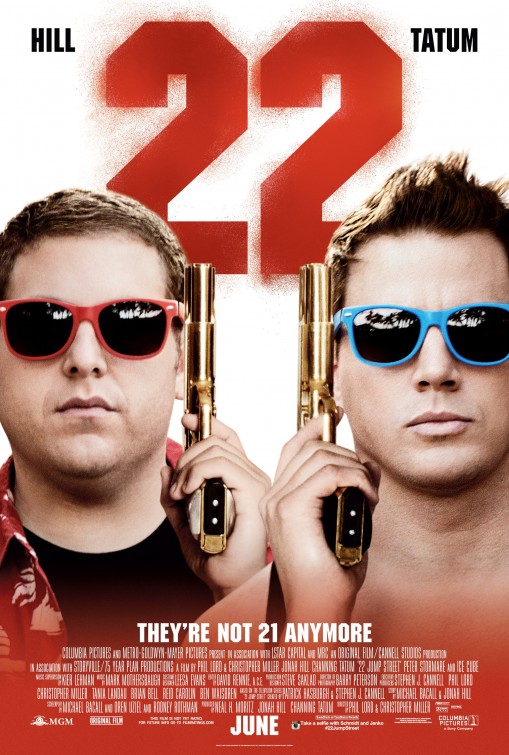
22 Jump StreetAt a time when we like our popular comedy dripping with irony, the directing partnership of Phil Lord and Christopher Miller is steadily rising to the top of the pack. After solid success with their debut feature Cloudy with a Chance of Meatballs, and surprising success with the television remake 21 Jump Street, Lord and Miller had a legitimate popular and critical hit earlier in the year with The Lego Movie. With all three of those films, the pair took a project which was far from a sure thing and turned it into a hit with their unique and clever style of humour. But 22 Jump Street marks their biggest challenge yet, a sequel.

Having successfully gone undercover at a local high school to blow open a drug ring, the odd-couple of Schmidt and Jenko are back to do it all again. Now too old to pose as high schoolers, the pair are off to college where a new drug known as WHY-PHY (Work Hard, Yes – Play Hard, Yes) has claimed its first life. However, just like last time, the social politics of student life puts pressure on their investigation and bromance as the two find themselves moving in different circles – Jenko with the football crowd and Schmidt with the art students.

The plot sounds repeated and generic, but the beauty of this movie is in its complete self-awareness. At the beginning of the film, the two cops are called into the office of Deputy Chief Hardy who informs them that his superiors were pleasantly surprised by the success of the rebooted Jump Street program so have decided to do it again. They want it to be exactly the same as last time, although because they know it can be successful, the department has been given a bigger budget. He also informs them that they have had to move out of the abandoned Korean church at 21 Jump St, but were able to find an abandoned Vietnamese church across the road at number 22, which will now be their base. All of this is pointless, he adds, because everyone knows that nothing ever works as well the second time around. By winking at the audience, 22 Jump Street is able to not only parody buddy cop movies and college movies, but also blockbuster sequels.

They weren’t kidding about the upped budget either. 22 Jump Street is a noticeably bigger film than the first one, with a number of large scale action sequences, chases and explosions. These scenes aren’t particularly exhilarating in themselves, but they are there to allow the film to joke about action-comedies like Bad Boys or Lethal Weapon rather than as part of a serious attempt to be one of these films. 22 Jump Street is first and foremost a comedy, and it manages to be quite clever, while still engaging in more than its fair share of pratfalls and crude humour (of the sexual rather than toilet variety).

Much of the success of the film, like the first instalment, is down to Jonah Hill and Channing Tatum. This seemingly unlikely pair displays an easy chemistry. They appear really comfortable riffing off one another and the film has a very loose style that allows them to do that. While Hill has always been known as a comic actor, Tatum’s comedic chops were a revelation in 21 Jump Street and he is again really charming here as the muscle bound doofus, Jenko.

While Marvel have, in recent years, made an art form out of the post credits teaser, 22 Jump Street uses its credit sequence to deliver one of its funniest scenes. Parodying the trajectory of blockbuster franchises, the credits deliver a series of teaser trailers for sequels from 23 through to about 40 Jump Street, with the pair going everywhere from dance school to beauty school to culinary school and various gimmicks and cast changes along the way. Amazingly, given that this sequel achieves the rare feat of exceeding the first instalment, you leave the film with the distinct impression that this franchise is not planning to outstay its welcome.

Rating: ★★★☆

Review by Duncan McLean

Have you seen 22 Jump Street? Leave a comment and let us know what you thought.
Review – Charlie’s Country (2013)

Director: Rolf de Heer

Starring: David Gulpilil, Peter Djigirr, Luke Ford

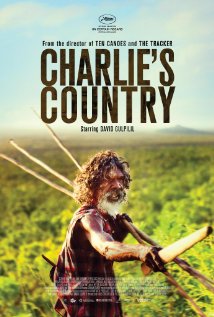
Charlie's CountryCharlie’s Country is the third collaboration between iconic Aboriginal actor David Gulpilil and director Rolf de Heer, after The Tracker and Ten Canoes. Together the three films form an informal trilogy, exploring the Indigenous experience at different points in Australia’s history. Charlie’s Country is the first of these films to be set in the present day and the most personal of the collaborations.

Charlie lives in a government controlled rural community in Arnhem Land. The first image we see in the film is a Liquor Act sign, declaring this to be an alcohol restricted community. While Charlie enjoys largely congenial relationships with the local white police, there is an undeniable tension simmering beneath the surface. He grows increasingly frustrated with the trying to live under the Intervention’s “white fella” rules. The white doctor tells Charlie that for the sake of his health he has to stop eating the white junk food, the only food available in town. But when Charlie goes hunting to catch his own food, “real food,” the white police confiscate his gun and fine him for recreational shooting. When he carves himself a spear, that too is confiscated as a dangerous weapon. In frustration, Charlie leaves the town to return to his country and live the old way, only to find that world no longer exists.

David Gulpilil’s performance as Charlie is the heart and soul of this film. It has been rightly earning critical praise around the world, including winning Best Actor at this year’s Cannes Film Festival. The actor delivers a captivating performance as a disenfranchised man, caught between two worlds, unable to exist in either. Gulpilil was a co-writer on the film and the character obviously draws heavily on his own life experience. The film was first formulated while Gulpilil was serving time in prison and subsequently in a drug and alcohol rehabilitation centre.

Charlie’s Country explores the tension that occurs when one culture is imposed over another. Where Warwick Thornton’s Samson and Delilah sought to shine a light without pointing a finger, Charlie’s Country is much more didactic. This film comes from a place of Indigenous frustration. In the colonialist world the film depicts, white influence is seen in the form of drugs, alcohol, guns, junk food and laws. While the first half of the film, set in Arnhem Land, is really engrossing, the second half, set in Darwin, is weaker and significantly less subtle in its exploration of these issues. A Darwin doctor asks if he can call Charlie by his first name because “I have difficulty pronouncing foreign names.” It’s a good line, but about as subtle as a sledgehammer.

A slow paced film – it feels longer than it is – Charlie’s Country is a pointed indictment of contemporary Australian Indigenous relations, highlighting the unworkable imbalance that exists between white law and Indigenous culture in the Northern Territory.

Rating: ★★★☆

Review by Duncan McLean

Have you seen Charlie’s Country? Leave a comment and let us know what you thought.
Review – The Rover (2014)

Director: David Michôd

Starring: Guy Pearce, Robert Pattinson, Scoot McNairy, David Field, Tawanda Manyimo

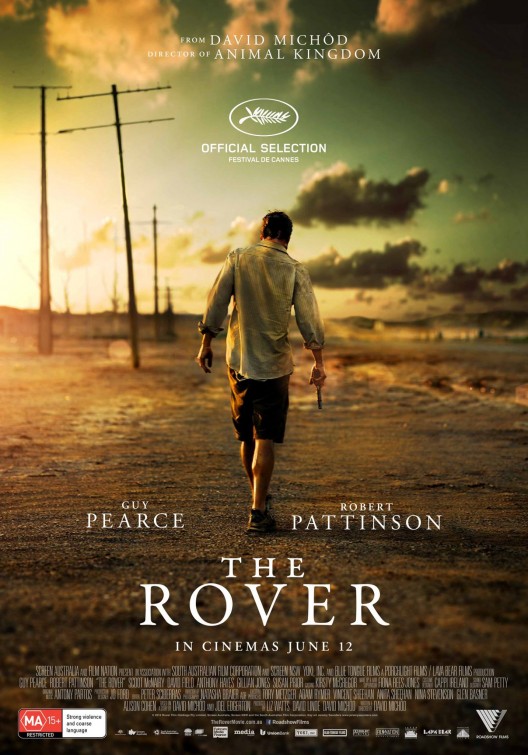
RoverIn 2010, writer-director David Michôd announced himself as the next big talent in the Australian cinema with his remarkable debut feature, Animal Kingdom. The gritty suburban gangster story earned international critical acclaim and even garnered an Oscar nomination for Jacki Weaver. Now, four years later, Michôd brings us his second feature, The Rover, which he describes as “a dark, dirty, violent fable.”

Ten years after an unspecified catastrophic event, referred to only as “the collapse,” a man, Eric, living in a rural Australian wasteland has his car stolen by a trio of men, seemingly on the run, who have just rolled their truck. Eric sets off in pursuit of his car and along the way he encounters Rey, the younger brother of one of the trio of thieves, who has been left for dead with a gunshot wound. To Eric, Rey is the means to find his car. To Rey, Eric is the means to being reunited with his brother. After tending to Rey’s wound, they form an uneasy alliance, with neither knowing what the other plans to do when they reach their destination.

The Rover paints a bleak, nihilist picture. Argentinian director of photography Natasha Braier brings an outsider’s eye to South Australia’s Flinders Ranges, giving a stark, menacing quality to this barren landscape, this vast emptiness. The film seems to have come from an angry place within Michôd. The temptation is to refer to it as a post-apocalyptic film, but to do so would not quite be accurate. “The collapse” which precedes the events of the film is not as the result of an external force. The implosion of society appears to have been its own doing. The fact that traders in the film refuse to accept anything other than US dollars suggests that there is an economic element to this collapse. The world that remains is a harsh one in which survival is the only priority.

At the heart of The Rover are gripping lead performances from Guy Pearce and Robert Pattinson. Pearce’s Eric is an unstoppable force. A man stripped of any remaining personality or morality, his pursuit of his car is single-minded and relentless and it is not until the very final moment of the film that we are given any insight into his motivation. Pearce and Michôd perform a delicate balancing act with Eric being at the same time the film’s protagonist and its most terrifying character. His ruthlessness and seeming disregard for human life is important though, because it serves to humanise Pattinson’s character, and draw us to him. Where we understand Eric as the type of man who can survive and even thrive in this bleak dystopia, the developmentally challenged Rey lacks that hardness. In what is undoubtedly the performance of Pattinson’s career thus far, he gives his character an underlying innocence and vulnerability despite his determination to appear threatening.

The Rover is a confrontingly violent film. This is not a reflection on the quantity of violence, but rather the coldness with which Michôd presents it. This world evidences a complete disregard for the sanctity of life. The first killing is quite shocking, because at that point we have not been prepared for the cutthroat way in which this society operates, but from there on it is a challenging, merciless film.

There have been numerous films in this dystopian wasteland genre, but none quite as nihilistic as this one. An unsettling but engrossing picture, in Michôd’s mind The Rover is a more hopeful film than Animal Kingdom. I would be surprised if audiences agree with him.

Rating: ★★★★

Review by Duncan McLean

Have you seen The Rover? Leave a comment and let us know what you thought.
Review – X-Men: Days of Future Past (2014)

Director: Bryan Singer

Starring: Hugh Jackman, James McAvoy, Michael Fassbender, Jennifer Lawrence, Peter Dinklage, Nicholas Hoult, Patrick Stewart, Ian McKellen, Ellen Page

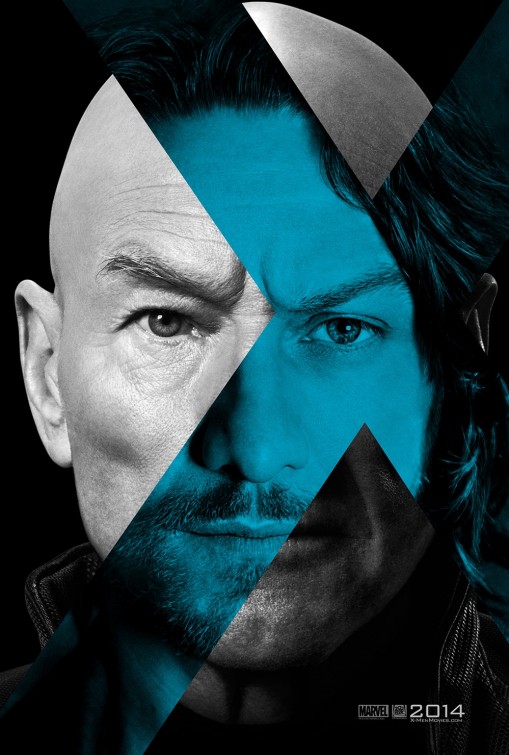
X-Men - Days of Future PastFive years ago, the X-Men franchise was looking like it might have run its course. X-Men: Last Stand had disappointed and X-Men Origins: Wolverine was widely panned. But Matthew Vaughn’s X-Men: First Class breathed new life into the series in 2011, and now Bryan Singer, the director who helped launch the franchise, is back at the helm for the much anticipated, and confusingly titled, X-Men: Days of Future Past.

We begin at the end. It is the year 2023 and we are in the final stages of a war between the mutants and giant robots known as Sentinels. But it is not so much a war as an extermination. Knowing they have nowhere left to hide, a small band of mutants – including among others, Wolverine, Professor X and Magneto, by this point an ally – devise a last ditch plan. Kitty Pryde uses her telepathic powers to send Wolverine’s consciousness back in time. Awaking in his 1973 body, Wolverine must seek out the young Professor X and Magneto, at this point sworn enemies, and with their help change the past in order to prevent this war from ever beginning.

X-Men: Days of Future Past feels like the continuation of a story. It feels like we are picking up where a previous film left off, but we are not. As a result the first half of the movie is chock full of exposition because there is a whole story that we have not seen which needs to be explained to us in order to understand what we are now seeing. We learn how in 1973 Mystique murders scientist Boliver Trask, inventor of the Sentinels, and that act cements the general public’s fear of the mutants and leads to the green-lighting of the Sentinel project. We learn how after being captured, Mystique’s shape-shifting DNA is incorporated into the design of the Sentinels making them highly adaptable and near impossible to defeat. We learn how the machines started out targeting mutants, but soon moved on to targeting mutant-sympathising humans and eventually all humans. We start the film at the culmination of this narrative and then return to the very beginning to try and stop it ever happening, but the result is the feeling that we’ve actually missed out on quite a good story.

X-Men: Days of Future Past continues the strongly allegorical nature of the series, exploring themes of intolerance, prejudice and the fear of the other. In Professor X and Magneto we are shown two different forms of leadership and two different approaches to combatting prejudice. Professor X is the Martin Luther King figure, preaching cooperation, unity and understanding, while Magneto is more Malcolm X, calling for a more militant, fight-the-power response. These important themes are explored effectively, but still in an entertaining package. There are some impressive action sequences and visual effects, and this film contains more fun and humour than we have seen in some of the previous installments in the series. That we experience the 1970s through the eyes of a character from the future means that the sights and sounds of that era – clothes, music, hair styles, lava lamps and waterbeds – can all be played up for comic effect.

X-Men: Days of Future Past does suffer a bit from character overload, with many being very thinly sketched. The X-Men universe contains so many characters and the temptation is always there to introduce new ones each film. In this film, the dual time period means that we have two casts of characters. There are just too many characters here for them all to be meaningfully represented. Of the new characters introduced, the teenage Quicksilver is a highlight. He is responsible for probably the film’s best scene, helping spring Magneto from a maximum security prison, but despite proving himself incredibly useful he is then inexplicably left behind.

The plot of X-Men: Days of Future Past provided an excellent opportunity to wrap up the series, but, unsurprisingly, that option was not taken and the film is clearly setting itself up for a sequel (talk is that X-Men: Apocalypse will be hitting screens in 2016). With this film’s rewriting of the past essentially throwing away the events and chronology of the previous four films in the franchise, it will be interesting to see what they choose to move forward with in the sequel.

There is plenty in X-Men: Days of Future Past to please returning fans of the series, but newcomers will find this a very difficult film to get up to speed with. While it has some quite strong moments, it is very messy in terms of its screenplay and narrative and doesn’t really live up to the high expectations that preceded it.

Rating: ★★☆

Review by Duncan McLean

Have you seen X-Men: Days of Future Past? Leave a comment and let us know what you thought.
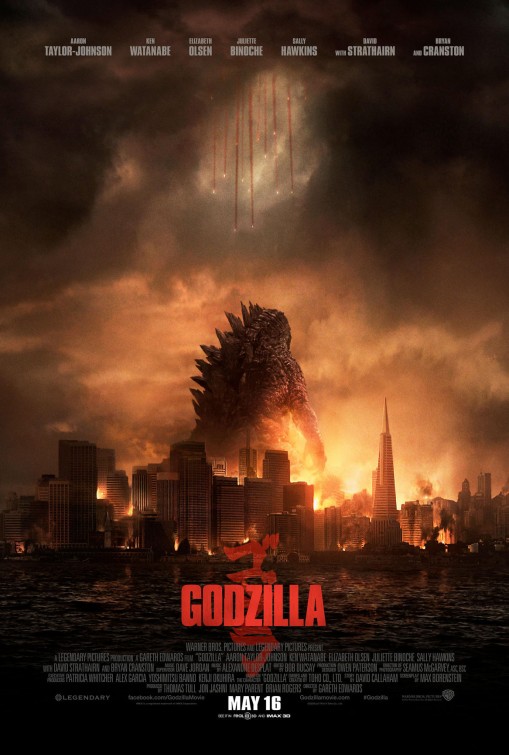
Review – Godzilla (2014)

Director: Gareth Edwards

Starring: Aaron Taylor-Johnson, Ken Watanabe, Elizabeth Olsen, Bryan Cranston, David Strathairn, Sally Hawkins, Juliette Binoche

GodzillaFor sixty years now Godzilla has been the undisputed king of movie monsters. Debuting in Ishiro Honda’s 1954 film, Godzilla, the legendary creature has appeared in 28 films for Japan’s Toho Company. Despite that legacy, only once, in Roland Emmerich’s much maligned 1998 effort, also called Godzilla, has he received the Hollywood blockbuster treatment. But sixteen years later, Hollywood is ready to give it another go: different studio, different director, same title – Godzilla.

Scientist Joe Brody is certain that the Japanese government is covering up the true nature of a nuclear power plant disaster which took his wife’s life fifteen years earlier. With his son, Ford, a Navy explosives expert, he discovers that rather than being the result of a natural disaster, it was an attack from a MUTO, a Massive Unidentified Terrestrial Object. That MUTO, and its mating pair, are now heading across the Pacific Ocean towards the west coast of the USA and their only hope appears to be an equally large and mysterious creature which is tracking them.

Godzilla is only Gareth Edwards’ second feature film, after the 2010 independent film Monsters. He does, however, have a background in visual effects and that really comes through in this movie. Clearly taking his lead from Spielberg in Jaws, Edwards is careful not to overexpose us to the monster – in fact with Godzilla not featuring prominently until the third act there is a fair argument to be made that we don’t see enough him. But when he does show us the star of the film, he makes it count. Godzilla looks fantastic. The combination of immense scale and intricate detail makes for a very impressive visual presence. Edwards avoids the quick-cutting, shaky-camera style that makes some of the action sequences in the Transformers films such a headache inducing mess, allowing us a really good look at creatures as they battle it out. The film retains the traditional shape and lumbering movement of Godzilla, so even with these brilliant effects there are still moments when you get that nostalgic feel of a man in a costume, which is fun.

One of the other things this movie does really well is give a classic film figure contemporary relevance. This is achieved through the clever way that the film’s narrative ties in with contemporary fears. The catalyst that gets everything rolling is a nuclear power plant disaster in Japan. There is a tsunami. We see crowded city streets enveloped by a cloud of dust as skyscrapers crumble, which feel very familiar to 9/11 footage. All of these moments engage our memories of real world events. Effectively pressing the emotional buttons of relatable, real world experiences serves to ground what is otherwise a fantastical story.

Unfortunately though, as much as there are some great things about Godzilla, the film also has some pretty glaring problems. Primary among them are the film’s human characters. They simply aren’t engaging. Bryan Cranston’s nuclear scientist, the film’s most compelling character, does not feature as prominently as the trailers would have you believe. Aaron Taylor-Johnson plays a pretty bland, cookie-cutter protagonist, serving his role adequately but failing to take us on any sort of emotional journey. Elizabeth Olsen, who is a really good young actress, is the most underutilised, getting little more to do than wait by the phone and worry about her husband. The blockbusters of the last few years have made audiences largely immune to watching cities being leveled. We need individual characters to care about, and this film doesn’t adequately give them to us.

These characters are also not helped by the fact that there is an unavoidable disconnect between the characters and the central narrative of the film. Classical film narrative uses characters as the primary causal agents which propel a cause-and-effect narrative towards its resolution. The actions of the protagonist are supposed to make things happen, to ultimately determine the outcome of the film. In Godzilla, the human characters have very little dramatic importance. The message of the film is that nature will find a way to correct imbalance. Thus, the events that the human characters are involved in are only side stories, having little bearing on the outcome of the film which is to be determined by the battle between Godzilla and the MOTUs.

Godzilla is a film that gets some things very right and some things quite wrong. It possibly takes itself more seriously than a film about a 350ft sea-lizard should, but as a piece of pure spectacle cinema it does the trick.

Rating: ★★★

Review by Duncan McLean

Have you seen Godzilla? Leave a comment and let us know what you thought.
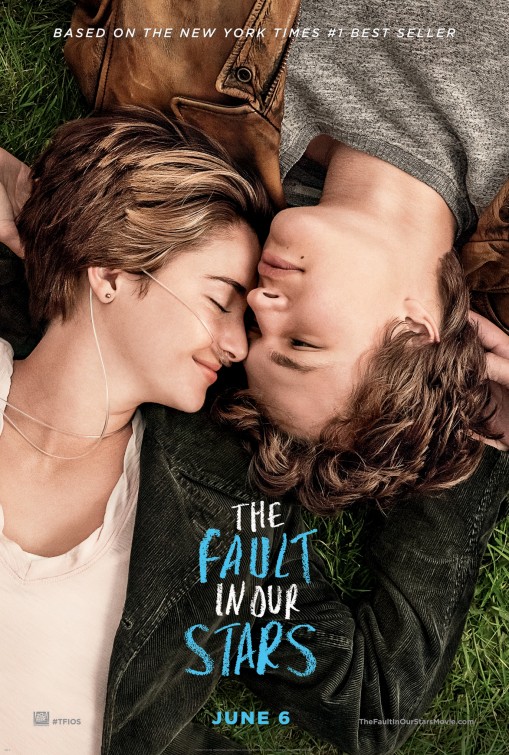
Review – The Fault in Our Stars (2014)

Director: Josh Boone

Starring: Shailene Woodley, Ansel Elgort, Laura Dern, Nat Wolff, Sam Trammell, Willem Dafoe

Fault in Our StarsIf the quality of a film was measured in the litres of tears its audience cried over it, then The Fault in Our Stars would be an instant classic. Though what else would you expect of a teen romance cancer tragedy?

Sixteen- year-old Hazel Grace Lancaster has cancer. What started as thyroid cancer has now spread to her lungs and as a result she requires constant oxygen and is forced to wheel around a tank with her. Her favourite novel is “An Imperial Affliction,” a book about a girl with cancer which vividly captures her own experience. At one of the support groups her parents insist she go to, she meets Augustus Waters. Charming and witty, Augustus is a cancer survivor, though has an artificial leg to show for his experience. Augustus falls for Hazel immediately, but Hazel resists becoming romantically attached, believing she is a ticking time bomb and only pain can come from getting involved with her. But Augustus is determined and pulls some strings to enable Hazel and him to travel to Amsterdam to meet the author of “An Imperial Affliction.”

Based on the best-selling 2012 novel of the same title by John Green, The Fault in Our Stars packs an emotional wallop. Its title is a reference to a line from Shakespeare’s Julius Caesar – “The fault, dear Brutus, lies not in our stars but in ourselves that we are underlings.” But sometimes the fault is in our stars. Sometimes people just get dealt a bad hand and there is nothing they can do to change it. This is a story about two young people who have been dealt such a hand, and know that this could be their only chance at a great love. Yet despite the spectre hanging over the film, The Fault in Our Stars shows that a short life can still be a full one.

Shailene Woodley is very much the up and coming it-girl of the moment and even at this early stage in her career has shown impressive diversity in films like The Descendents, The Spectacular Now and the sci-fi-adventure movie Divergent. She is very good in this film, delivering a performance as Hazel which seems to authentically capture the emotional experience of a young woman who knows she is sick and unlikely to ever get better. Her co-star Ansel Elgort (who, interestingly, played her brother in Divergent) is sure to make many a teenage girl swoon as the impossibly charming Augustus. But the fact that he is impossibly charming is a bit of a problem. His character doesn’t ring as true as hers. Where there is an authenticity to Hazel’s character and experience, Augustus doesn’t feel real. He feels like a teenage girl’s fantasy.

While the film will naturally resonate more with a teenage girl audience who can put themselves in Hazel’s shoes, The Fault in Our Stars explores some universal themes and is accessible to anyone. Those who react against being overtly manipulated by a film will struggle with The Fault in Our Stars, but the many fans of the book and those who are willing to be swept up in this journey will find it a melancholy, touching, yet still surprisingly funny experience. Just don’t forget your tissues.

Rating: ★★★

Review by Duncan McLean

Have you seen The Fault in Our Stars? Leave a comment and let us know what you thought.
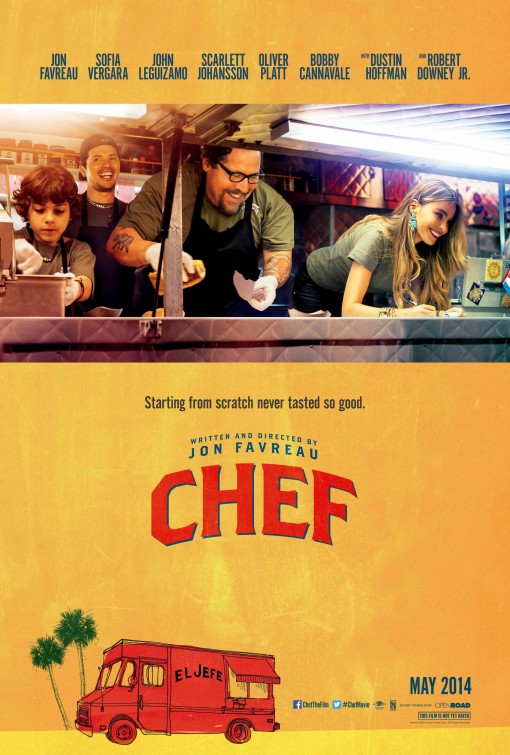
Review – Chef (2014)

Director: Jon Favreau

Starring: Jon Favreau, Emjay Anthony, John Leguizamo, Sofia Vergara, Bobby Cannavale, Scarlett Johansson, Oliver Platt, Dustin Hoffman, Robert Downey Jr.

ChefJon Favreau started his career as an indie sensation with Swingers and Made, but the overwhelming success of Iron Man in 2008 drew him into the world of the blockbuster. With Chef the talented writer/director/actor returns to his independent roots.

Favreau plays Carl Casper, a highly regarded but burned out Los Angeles chef. His career took off ten years earlier as a result of a glowing review from influential food critic Ramsey Michel, but since then he has fallen into a bit of a rut. The news that Ramsey is going to return to his restaurant for the first time since that original review inspires Casper to plan an exciting new menu especially for the critic. But the restaurant’s owner steps in, insisting that the chef cook the existing menu, that he play the hits. The result is a scathing review which starts a Twitter war between chef and critic, ending in Casper losing his job. On a trip to Miami to clear his head with his ex-wife, Inez, and son, Percy, Casper buys and refurbishes an old taco truck. With his son and sous chef, Martin, by his side he drives and cooks his way back to Los Angeles, via New Orleans and Austin.

It is hard not to read this film as at some level allegorical. Is this really the story of a successful movie director who longs to make films that inspire him and that he is proud of, but is convinced by the studios that pay the bills to stick to the tried and tested and give the people what they want, only to then be slammed by the critics for being tired and unoriginal? Whether Favreau intends for Chef to be read as somewhat autobiographical or not, one thing is for sure, his heart and soul are completely in this film.

Chef has the feel of a passion project. This is a film that was made because Favreau wanted to make it, needed to make it, not because any studio was demanding it. Clearly there have been some favours called in, with previous collaborators like Robert Downey Jr and Scarlett Johansson appearing in smaller roles and giving the film some weight by association. But that passion pays off. Chef is so vibrant and alive. The food, the flavours, and the Cuban inspired soundtrack all combine with Favreau’s passion to create a film with a real sense of joy.

A word of warning: Chef is not a film to see on an empty stomach. Favreau has clearly not only learned to cook food (he was tutored by Chef Roy Choi), he has also learned how to shoot food. The food in Chef looks amazing. There is even a scene where Casper makes a grilled cheese sandwich for Percy which is somehow made to look like the most delicious thing in the world.

Yet while Chef works as pure food porn, the film has enough heart to ensure that it is more than just that. As well as being a celebration of food and cooking, Chef is about the reconnection of a father and a son. There is a great chemistry between Favreau and Emjay Anthony, the young actor who plays his son. As writer, director and performer, Favreau clearly has a great affection for this character and delivers the best performance of his career, and the ten-year-old Anthony gives an impressively natural performance, particularly in the scenes with Favreau and Leguizamo which would appear to be quite improvised.

Once the truck has been collected Chef becomes a meandering road trip, a film about taking the time to engage with your family, your friends, and your passions. A deceptively simple story, the film finishes quite abruptly, but that is not surprising because there is very little that needs resolving. Chef is an endearing celebration of food, cooking, creativity, passion and family which you can’t help but embrace.

Rating: ★★★★

Review by Duncan McLean

Have you seen Chef? Leave a comment and let us know what you thought.
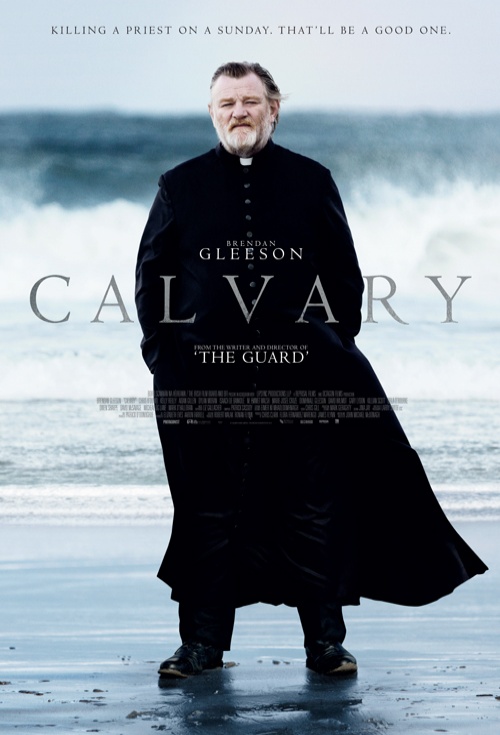
Review – Calvary (2014)

Director: John Michael McDonagh

Starring: Brendan Gleeson, Chris O’Dowd, Kelly Reilly, Aiden Gillen, Dylan Moran, M. Emmett Walsh

CalvaryThree years after his debut film The Guard became the most successful Irish film of all time at the domestic box office and earned rave reviews around the world, director John Michael McDonagh and his star Brendan Gleeson are back with Calvary. The second part of the director’s “Glorified Suicide Trilogy,” Calvary is a very different, but every part as brilliant, film. More serious and thought provoking, it none the less demonstrates the same wicked humour, gift for dialogue and strong sense of place that made The Guard a success.

Father James Lavelle, a good man, serves as the priest of a small County Sligo parish on the west coast of Ireland. One day, while hearing confession, one of his parishioners confides that he was sexually assaulted by a priest for a number of years in his childhood. With the priest in question having long since died, the victim has decided that he will gain retribution by killing Father James. The Father is to become the victim precisely because he is innocent. “There’s no point killing a bad priest. But killing a good one? That’d be a shock.” The unidentified man gives Father James a week to get his house in order, and they are to meet the following Sunday on the beach.

From the moment that Father James receives his threat, in the very first scene of the film, he knows who it is that has delivered it. He is, after all, a good priest who knows the voices of his parishioners. But in a clever decision by the filmmaker, this information is kept from us. The film then, on one level, becomes a reversal of the traditional whodunit – a who-is-going-to-do-it. However, with the priest already knowing the identity, his week is not spent investigating the threat. That is our concern, not his. So while we watch those around him carefully, looking for clues as to the identity of the would-be murderer, Father James continues performing his role as one trying to provide spiritual assistance and guidance to his small, detached community.

His is not the easiest flock to tend to. The Father – played brilliantly by Gleeson – is confronted by a spiteful and confrontational community, and saddened by their complete indifference to matters of faith. One of his parishioners takes perverse pleasure from flaunting her adultery, with another of his parishioners, before him. Her husband, while possibly beating her, has no problem with the unfaithfulness. An atheist doctor goads him whenever he is called upon to visit someone dying in hospital. The local publican vents his financial frustrations on the Father as a representative of the wealthy Catholic Church. The film provides insight into the life of a priest in a society that no longer values or respects his contribution.

Recent years have seen a number of films exploring narratives surrounding the past crimes and abuses of power by the Catholic Church and attacking the institution (consider last year’s Philomena for example). Calvary takes a different approach to the issue. McDonagh’s film explores the impact of these revelations on the church’s place in the community. It does not attempt to defend the perpetrators of those crimes, or the institution that protected them, but rather invites us to consider the plight of those remaining good people whose efforts to do good works in the world are hindered by being forced to bear the burdens of an institution that has failed them.

Calvary features the same dark humour which made The Guard so brilliant, but here it is in service of a more serious story. At some point during its narrative, Calvary transitions from being a black comedy to a quite profound modern passion play. Father James becomes the symbolic innocent who must bear the sins of others, in this case the sins of the institution that he represents. The week that we count down marks his own walk to Calvary, as he endures the torment and ridicule of those around him.

While at times still very funny, Calvary ends up being a poignant and powerful film. At a time when most movies tend to opt for the simple and straight forward, it is encouraging to see a thoughtful film which has something to say. It also confirms McDonagh and Gleeson as a collaboration very much worth keeping an eye on.

Rating: ★★★★☆

Review by Duncan McLean

Have you seen Calvary? Leave a comment and let us know what you thought.
Review – The Grand Budapest Hotel (2014)

Director: Wes Anderson

Starring: Ralph Fiennes, Tony Revolori, F. Murray Abraham, Mathieu Amalric, Adrien Brody, Willem Dafoe, Jeff Goldblum, Harvey Keitel, Jude Law, Bill Murray, Edward Norton, Saorise Ronan, Jason Schwartzman, Tilda Swinton, Tom Wilkinson, Owen Wilson

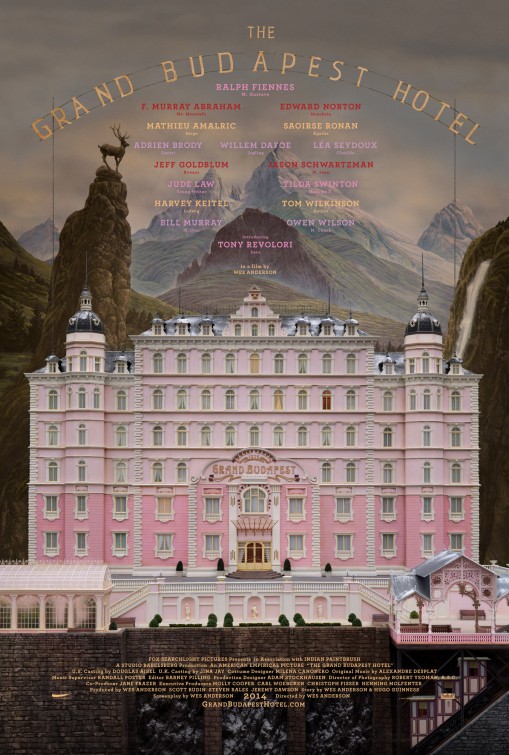
Grand Budapest HotelWes Anderson is probably the most distinctive cinematic voice in America today. An Indie darling, he has strong sense of aesthetic design and a quirky approach to narrative and character which he has been refining for almost two decades. With The Grand Budapest Hotel,Anderson’s eighth feature, we get his take on the 1930s caper movie, and in many ways the film his entire body of work has been building towards.

The Grand Budapest Hotel presents us with a Russian doll structure, with layer upon layer of prologue leading us in to the story. Each era, each layer of untrustworthy narration, is visually represented by a different aspect ratio. We start in the present day as a girl visits a park where there stands a monument to ‘The Author.’ She opens a book called ‘The Grand Budapest Hotel.’ From there we are taken to 1985, to the study of that author, who sets about narrating to us the story of his visit to the hotel. We then venture back to 1968 when the author, as a younger man, first arrived at the once great hotel and became intrigued by its wealthy owner, Zero Moustafa. Over dinner one evening, Mr. Moustafa begins to recount to the author the story of how he came to own the hotel. Finally, we come to rest in 1932 with the story of the young Zero, a humble lobby boy, and his mentor, M. Gustave. M. Gustave was the heart and soul of the Grand Budapest Hotel. A concierge, Gustave is at the beck and call of the many wealthy dowagers who are drawn to the Grand Budapest by, among other things, the ‘services’ he offers. When one of the older and wealthier of these clients, Madame D, expires, her will is found to bequeath a priceless artwork to Gustave. Her family is outraged and Gustave finds himself accused of murdering her. What results is a good old-fashioned caper farce.

At a time when so many mainstream comedies are built around rambling improvisation, there is something really striking about the meticulously crafted nature of Anderson’s films. The Grand Budapest Hotel is very carefully structured. The dialogue and performances are precisely delivered. The framing of each and every shot has an intentionality to it. The film is alive with Anderson’s trademark bright pastel colours, in this case particularly pinks and purples. This fictional Europe Anderson has created has a sense of fantasy to it (the titular hotel is not in fact located in the Hungarian capital but rather in the fictional country of Zubrowska), with some exterior scenes employ a sort of stop-motion animation style, with a similar mechanical feel to The Fantastic Mr. Fox. All performers speak in their own accents, creating an endearing hodge-podge of dialects.

The Grand Budapest Hotel boasts a truly star-studded cast. There are recognisable names playing even the smallest of roles. The Anderson regulars like Jason Schwartzman, Bill Murray and Owen Wilson, take a back seat in this one, filling only very minor roles. Previous collaborators like Willem Dafoe, Adrien Brody, Jeff Goldblum and Edward Norton are back for another go around to flesh out the cast, but at the centre of the film are four newcomers to the world of Wes; Ralph Fiennes, F. Murray Abraham, Jude Law and Tony Revolori. Across the board the cast is wonderful, but it is Fiennes who really shines.

Ralph Fiennes and Wes Anderson seems like a strange combination. But just as Anderson drew one of the great comedic performances out of Gene Hackman in The Royal Tenenbaums, Fiennes, despite not being known as a comedic performer, proves to be tremendous as the concierge-gigolo, M. Gustave. While still speaking and moving in accordance with Anderson’s rhythms, Fiennes brings a different presence to the film which enables the character to move beyond some of the constraints of a Wes Anderson character. M. Gustave is a more sexualised character than we are used to encountering in Anderson’s work. He also has these explosive outbursts of swearing, similarly out of character for an Anderson protagonist, but used to great comic effect when contrasted with his usual polished demeanour.

As a filmmaker, Wes Anderson is yet to make a serious misstep in his 20 year career, so expectations are always reasonably high when a new film is released. But The Grand Budapest Hotel is such a well-crafted, vibrant and fun film that it quite possibly could be his best film yet.

Rating: ★★★★★

Review by Duncan McLean

Have you seen The Grand Budapest Hotel? Leave a comment and let us know what you thought.
Review – Captain America: The Winter Soldier (2014)

Directors: Anthony Russo & Joe Russo

Starring: Chris Evans, Scarlett Johansson, Samuel L. Jackson, Anthony Mackie, Robert Redford, Sebastian Stan

Captain America - The Winter Soldier

Captain America: The First Avenger was the most divisive of the first phase of Marvel’s Avengers movies. While some people really liked its war-time narrative and the old-fashioned heroism the character represented, others, more drawn to the charismatic egotism of Favreau’s Iron Man or the brooding menace of Nolan’s The Dark Knight,struggled to get behind it.

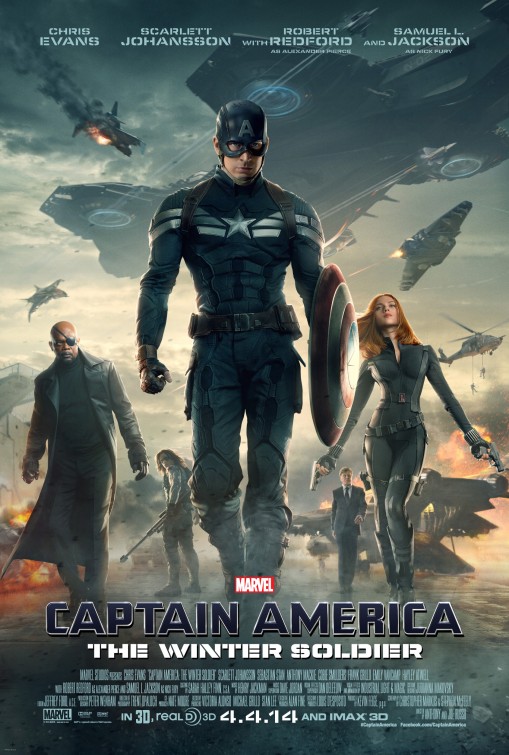
After being frozen for half a century, thawed out in the modern day, and having played a key role in The Avengers, Cap is back for his second solo outing. Still trying to get his head around the changed world he now finds himself in, Steve Rogers carries around a notebook in which he lists things he needs to catch up on. This list is different for different cinematic markets, with Australian audiences seeing a list that includes ACDC, Tim Tams and Skippy the Bush Kangaroo. With no family and few friends, he immerses himself in his work, protecting his country as SHIELD’s most devastating soldier. But when it becomes apparent that SHIELD has been compromised, and it looks like Nick Fury is involved, Rogers finds himself on the outer, not knowing who he can trust. Alexander Pierce, the Secretary of SHIELD, employs the full force of the organisation to try and bring Captain America in. This includes the mysterious Winter Soldier, a super-soldier who for decades has been believed to be the stuff of legend.

Captain America: The Winter Soldier is an interesting blend of the new and the old. It is very much a film for the post-9/11, war on terror world. Its central thematic discussion concerns the appropriateness of forfeiting freedom in the name of security, and the morality of pre-emptive strike justice, eliminating threats before they become threats. Yet while dealing with these quite current themes, the movie has the feel of a 1970s paranoid conspiracy thriller like Three Days of the Condor (which also starred Robert Redford) thanks to its narrative about the criminal infiltration of government institutions.

This blend of the new and the old is also evident in the characters. Steve Rogers is a man of the 1940s, confronted by a world which is more complex than the one into which he was born. It is not just culture and technology which he has to catch up with. His sense of morality is also challenged. Rogers is a moral absolutist. For him there is a clear right and wrong, and this causes him to butt heads with moral relativists like Nick Fury and Natasha Romanoff, for whom the ends tend to justify the means.

Where this film really stands out compared to some of the others in the franchise is in the chemistry between its stars. Evans, Johansson, Jackson and newcomer Anthony Mackie all play off each other quite well. The film also continues to develop those characters returning from previous adventures. In particular Scarlett Johansson’s Natasha ‘the Black Widow’ Romanoff, who has been a supporting character in Iron Man 2 and The Avengers, is really made a focus of the film and is fleshed out into quite an interesting character and a great foil for Captain America.

As is to be expected from these movies, the action sequences are top notch. Evenly scattered through the film, they never drag and are different enough from each other that they capture your interest. The film contains the expected nods to the other characters from the Avengers franchise, but where once these moments were cause for excitement, since The Avengers they only serve to make you wonder why it is those heroes being alluded to are not choosing to get involved in this particular international disaster. More interesting are a couple of nods to other films. In particular there is a little something in there for the observant Pulp Fiction fan which is really top notch.

In all though, the combination of good action, strong characters and a decent storyline makes Captain America: The Winter Soldier one of the better Marvel movies and ensures the franchise will continue to motor along.

Rating: ★★★★

Review by Duncan McLean

Have you seen Captain America: The Winter Soldier? Leave a comment and let us know what you thought.