Starring: Ben Affleck, Rosamund Pike, Carrie Coon, Kim Dickens, Tyler Perry, Neil Patrick Harris
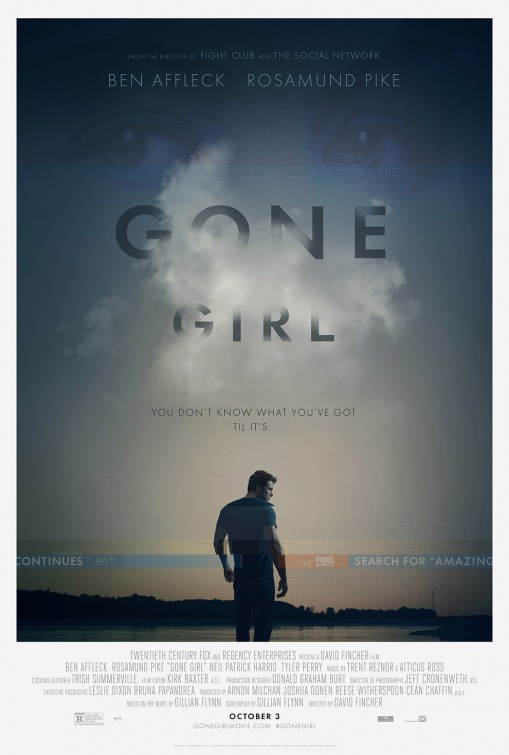
Gillian Flynn’s best-selling thriller Gone Girl was a literary sensation and was destined for the big screen. Flynn herself was given the task of streamlining the novel into a 150min screenplay, and with films like Se7en, Fight Club, The Social Network and Zodiac proving him to be a brilliantly methodical director and a master of misdirection, David Fincher was just the director to manage the various major twists and turns that Flynn’s story throws at us.
On the day of their fifth wedding anniversary, Nick Dunne arrives home to find his wife Amy missing. The police are called in but something doesn’t seem quite right. The kidnapping investigation soon becomes a murder investigation, and with an intensifying media circus that brings with it revelations big and small about their relationship, Nick finds himself the prime suspect.
Gone Girl looks at the role the media plays in turning investigations into sensations. We see the ease with which public perception is manipulated by the media, how little details and tangential titbits can be put under the spotlight and made to look incredibly significant. It is Nick’s inability to appropriately play the media game that causes him to look suspicious, and the court of public opinion judges accordingly. Ben Affleck is perfect casting in this regard. As we watch Nick being hounded by the press, and we see him breaking under the pressure of constantly being scrutinised and judged, knowing that Affleck has lived that experience adds to the character.
Gone Girl starts on the morning of Amy’s disappearance and follows the investigation from there, but we get flashbacks of their relationship narrated to us through excerpts from Amy’s diary. As such we experience Nick in an objective present, but Amy in a subjective past. What we see and know of Amy is determined by what she has written in her diary, and as the film progresses the reliability of her narration comes into question.
Unlike a traditional thriller, Gone Girl gives us its game changing reveal quite early. Barely halfway through the film we learn the truth about Amy’s disappearance. That revelation changes the focus of the film. For the audience, the investigation is no longer about working out what happened to Amy, but about revealing who Nick and Amy really are. More than just a mystery thriller, Gone Girl is a film about human relationships, and quite a cynical one at that. The film explores the place of narcissism in marriage, examining the way in which people play roles during courtship, pretending to be the person they want their partner to think that they are, or the person they think their partner wants them to be, and then how relationships break down and resentment builds when partners grow tired of playing those roles. Through its hyperbole it asks how well one can really know their partner when both are simply playing roles.
As good as Affleck is, it is British actress Rosamund Pike for whom this movie is a real breakout. Pike’s look perfectly suits Amy; the privileged, trust fund kid. We believe her intelligence, and we also believe her insecurity. After all, her trust fund is the result of a successful series of children’s books her mother wrote in which the lead character, Amazing Amy, lives out an idealised version of her own life. But there is also something mysterious and unreadable about Pike and as we start to discover more about her character she shows us something new and the film really becomes hers.
Gone Girl is an extremely interesting and engaging film, but it is not without its problems. Tonally it will cause some viewers difficulty. What starts out as a pretty straight drama gradually morphs into a tragicomedy, a perverse satire, without ever openly embracing a satirical tone. There are moments in the film that are quite brutal and others that are obviously being played for laughs. It is a very fine tonal balance that the Fincher is trying to strike, and he is not always completely successful in achieving it. Similarly, after an engrossing first and second act, the third act falls flat. Rather than building to a crescendo, Gone Girl reaches its peak at the end of the second act and then gently burns out. With a two-and-a-half hour runtime, it is in this third act that the film starts to feel long.
Gone Girl is the kind of smart, insightful, middle-budget (around $50 million) film which is few and far between in Hollywood these days. Well performed and expertly directed it is a peculiar and engrossing piece of filmmaking.
Rating: ★★★★
Review by Duncan McLean
Have you seen Gone Girl? Leave a comment and let us know what you thought.
Starring:Bill Hader, Kristen Wiig, Luke Wilson, Ty Burrell
They say you should never judge a book by its cover. It is equally true that you should never judge a film by its cast. With Saturday Night Live alumni Bill Hader and Kristen Wiig headlining, and Luke Wilson and Modern Family’s Ty Burrell in key supporting roles, one would assume The Skeleton Twins to be a flat out laugh riot. But Craig Johnson’s film has deeper, darker issues to explore.
The film opens with the concurrent unsuccessful suicide attempts of a twin brother and sister, Milo and Maggie. Milo is a gay, unemployed actor. Maggie is a married, discontented dental hygienist. His attempt fails; hers is interrupted by the news of his. Despite being thick as thieves as kids, they haven’t spoken each other in ten years. Rushing across the country to be by Milo’s side, Maggie insists that he move in with her and her husband Lance until he has recovered. Living under the same roof, these two troubled people reconnect, rediscovering the bond that they share, confronting old wounds and helping each other address their issues.
Obviously, The Skeleton Twins is not the light giggle-fest you might have expected. The movie is best described as a ‘dramedy.’ It explores some serious issues – depression, self-worth, the effects of suicide – in a serious way, but with the cast it possesses it can’t help but allow some humour to sneak in.
Covering some familiar thematic ground, Craig Johnson and Mark Heyman’s screenplay feels a bit paint-by-numbers indie. Over the last two decades of American independent film we have seen dysfunctional, estranged families and adults trying to deal with the scars inflicted by their parents explored ad nauseam. While The Skeleton Twins is an earnest film, it doesn’t offer us anything drastically different. While Johnson and Heyman succeed in creating strong, complex and largely believable characters, the narrative itself occasionally opts for the easy and conventional route.
The strength of the movie comes from the revelatory central performances from Hader and Wiig. Both are clearly heavily invested in the project and show impressive dramatic range which may surprise some given their improvisational comedy backgrounds. We’ve seen glimpses of what Wiig is capable of in dramatic moments in Bridesmaids and The Secret Life of Walter Mitty, but Hader’s film career has to this point been made up of supporting roles in broad comedies. He joked about himself in the James Franco roast, “Bill’s ok in the movies if you need a best friend’s best friend to ask an exposition question.” With one of Hader’s most beloved SNL characters being the ultra-camp Stefon, it is impressive to see that Hader’s Milo doesn’t fall back on lazy gay stereotyping but is a well-crafted and complex character.
Having worked together for so many years on SNL, there is a chemistry between the two which helps make them very believable as siblings. Milo and Maggie have a shared sense of humour and shorthand communication which is obviously natural to Hader and Wiig. While their performances in the film’s more dramatic moments which is what surprises, their comedic abilities are still pivotal. Their humour shines through in moments that break through the film’s bleakness but also serve to reinforce it. It emphasises the fact that these are two fun individuals who have been squashed by life.
The Skeleton Twins is moving, at times quite confronting, and at others very funny and reminds us of the special bond that siblings share.
Rating: ★★★☆
Review by Duncan McLean
Have you seen The Skeleton Twins? Leave a comment and let us know what you thought.
Starring:Jermaine Clement, Taika Waititi, Jonathan Brugh, Cori Gonzalez-Macuer, Stuart Rutherford, Ben Fransham
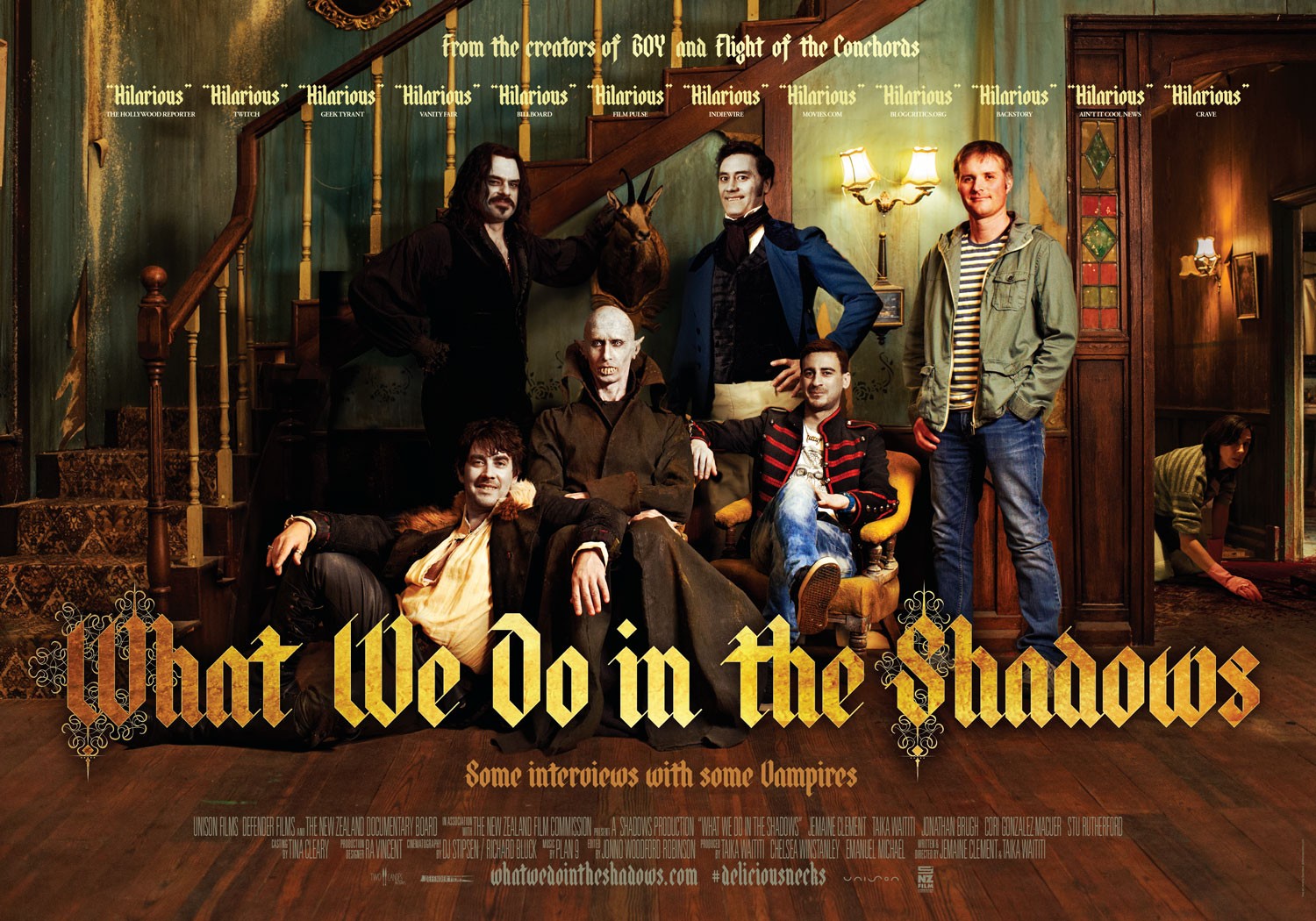
Kiwi duo Taika Waititi and Jermaine Clement do something quite surprising with their film What We Do in the Shadows. They take a subject, vampires, with which popular culture is teetering on the edge of overload, and combine it with a form, the mockumentary, which seems just as tired, and through the combination create a vibrant, original and downright funny movie.
A documentary crew observes a group of vampires flatting together in Wellington, New Zealand, in the months leading up to the undead community’s annual night of nights, the Unholy Masquerade. Viago is 379 years old. He’s an 18th century Dandy and the unofficial organiser of the house. The 862-year-old Vladislav the Poker is a legendary lothario and hypnotist, though his powers have dulled in recent years. Deacon is the young bad boy of the house, being that he is only 183. Down in the basement lives Petyr, an ancient vampire, 8000 years old, clearly modelled on Max Schreck from F.W. Murau’s legendary 1922 silent Nosferatu. In between catching and devouring virgin victims, the group deals with the usual politics of share house living. Their dynamic is challenged though when Petyr turns young kiwi Nick into a vampire. While they have much to teach Nick about being a vampire, he teaches them a thing or two about living in the modern world.
What We Do in the Shadows transcends the seeming limitations of its subject matter and form because of the slightly different sensibility the New Zealand sense of humour brings to the fold. An American version of this movie would in all likelihood have been horrible. The strength of Waititi and Clement’s screenplay (or perhaps their scenarios is a better term given the mockumentary form is so dependent on improvisation) is in the way that the film combines the extraordinary with the mundane. It is hilariously absurd watching vampires having flat meetings to discuss household chores – if someone is going to kill a victim in the living room, they should be considerate and lay down some towels first. The film also plays on the incongruity of a group of people who are so determined to keep their existence a secret allowing themselves to be the subject of a documentary.
All the best genre comedies take convention and turn it on its head. In the case of What We Do in the Shadows, there are centuries’ worth of vampire lore and mythologies to be played with. Waititi and Clement then plant these well-known conventions in a very ordinary context to explore the difficulties of being a vampire in the present day. How do you look after your appearance if you can’t check your reflection in the mirror? How do you enjoy a night out on the town when you can’t enter a venue without being explicitly invited in?
While Clement and Waititi are the headliners of this cast – Clement known as half of Flight of the Conchords and Waititi as the writer-director-actor behind the wonderful film Boy, the highest grossing New Zealand film at the domestic box office – Jonathan Brugh more than holds his own and even steals a few scenes as Deacon. There is also a great cameo from Rhys Darby as the alpha male of a group of werewolves who our vampires occasionally cross paths with.
Horror comedy isn’t the easiest genre balance to get right but What We Do in the Shadows is start-to-finish funny while still having enough schlock, gore and surprisingly impressive effects to keep genre fans happy. At just 85 minutes, the movie is short and sweet. It doesn’t stretch the premise beyond what it can support, and what you end up with is one of the most consistently funny comedies of the year.
Rating: ★★★★
Review by Duncan McLean
Have you seen What We Do in the Shadows? Leave a comment and let us know what you thought.
Starring:Mickey Rourke, Jessica Alba, Josh Brolin, Eva Green, Joseph Gordon-Levitt, Dennis Haysbert, Rosario Dawson, Powers Booth, Bruce Willis
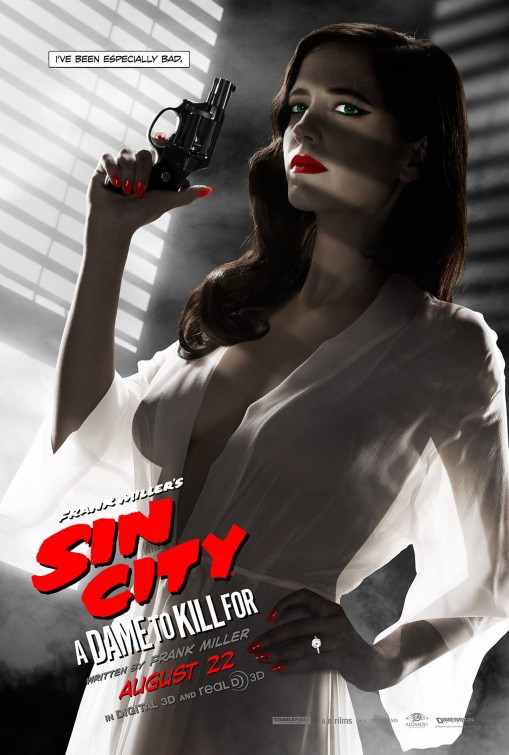
Released in 2005, Robert Rodriguez’s Sin City was a critical and popular hit, with its stylised violence and heightened neo-noir aesthetic. Pioneering in its use of green screen technology and digital settings, Sin City was among the first films which actively sought to reflect rather than disguise its graphic novel origins. Almost immediately there was talk of multiple sequels being in the pipeline with a number of big name stars supposedly attached. Yet somehow it has taken nine years for a follow up, Sin City: A Dame to Kill For, to hit the screens. Unfortunately, it has not been worth the wait.
As with the first film, Sin City: A Dame to Kill For is made up of interwoven but unconnected episodes. Entering into the shady world of Basin City, we jump from one protagonist to another. In “Just Another Saturday Night,” Marv struggles to remember a violent encounter with a group of frat boys which has, unsurprisingly, ended in carnage. “The Long, Bad Night” sees a cocky young gambler arriving in town to play some poker, with a view to taking down the big fish, Senator Rourke. In “A Dame to Kill For,” private investigator Dwight is manipulated by an old flame, Ava Lord, into committing a murder. While “Nancy’s Last Dance” reintroduces stripper Nancy Callahan, wallowing in grief and despair four years after the suicide of her saviour John Hartigan and determined to have her revenge.
Like its predecessor, the strength of Sin City: A Dame to Kill For lies in its visuals. The aesthetic, featuring high contrast black and white with splashes of colour, is still very striking and the incorporation of 3D only helps to immerse you into this comic book world. That said, striking visuals can only carry a film so far. They have to be in support of an engaging story and characters, and that is where Sin City: A Dame to Kill For falls short. Despite the new narratives and the introduction of new characters the film doesn’t manage to go anywhere new. It feels like a movie made up of deleted scenes from the original. So where the first Sin City felt exciting and fresh, this sequel gets old very quickly. When a movie feels longer than its 100 minute runtime, it is never a good sign.
As funny as it sounds given its aesthetic, Rodriguez and Miller’s film is crying out for some light and shade. Sin City: A Dame to Kill For entirely one note. There is no modulation of tone. Eventually the brutal violence and misogyny blurs together into an indeterminate mess. Bruce Willis’s character, Hartigan, served an important function in the first film. He was its hero and evidence of hope and morality in an immoral world. While Willis appears sporadically in the sequel as a ghost watching over Nancy, no character takes up this function. So we are presented with a world devoid of any sort of hope. Without even a glimmer of hope, we don’t engage as fully with the despair.
Returning to this world after nine years, it is challenging to draw connections between the original film and the sequel. This is partly the result of a number of roles being recast – Josh Brolin replaces Clive Owen, Dennis Haysbert replaces the late Michael Clarke Duncan, Jeremy Piven replaces Michael Madsen – but also the result of some confusing chronology. Some of the episodes obviously follow on from the events of the first film while others are prequels and there is no clear differentiation between them.
Frank Miller imagined Basin City as a man’s world and as a result the representation of women in Sin City: A Dame to Kill For is at best questionable, at worst downright misogynistic. Every female character is either a prostitute or a stripper, a femme fatale or a temptress. The filmmakers argue that they present strong female characters, assumedly on the grounds that some of them commit acts of violence rather than just being victims, but even these warrior women are presented as male fantasies for consumption by a male audience. You will lose count of the number of times a female character is introduced into a scene with a leering close up of her backside. The only female character with any real agency in the story is Ava Lord, who is brilliantly portrayed as the classic noir femme fatale by Eva Green (though more frequently nude than a classical Hollywood character would ever have been). But even in this case her power comes from her ability to manipulate men to do things for her rather than her ability to do anything for herself.
Nowhere is the film’s failure to match the nuance and subtlety of classic film noir as evident as in its faux-hard-boiled narration. First person narration, one of the hallmarks of film noir, is stretched to breaking point here. Sin City: A Dame to Kill For descends into a competition between gruff and growly men trying to out-husky-voice each other. The characters seemingly narrating every thought that goes through their head, leaving no room for subtext. Thankfully it eventually passes through being insufferable and just becomes white noise. It also serves as evidence that just because a line might work on the comic book page doesn’t mean it will translate to the screen.
With nothing new to say, Sin City: A Dame to Kill For is little more than a pale imitation of its predecessor and were it not for an engaging performance from Eva Green it would hardly have been worth returning to after nine years.
Rating: ★★
Review by Duncan McLean
Have you seen Sin City: A Dame to Kill For? Leave a comment and let us know what you thought.
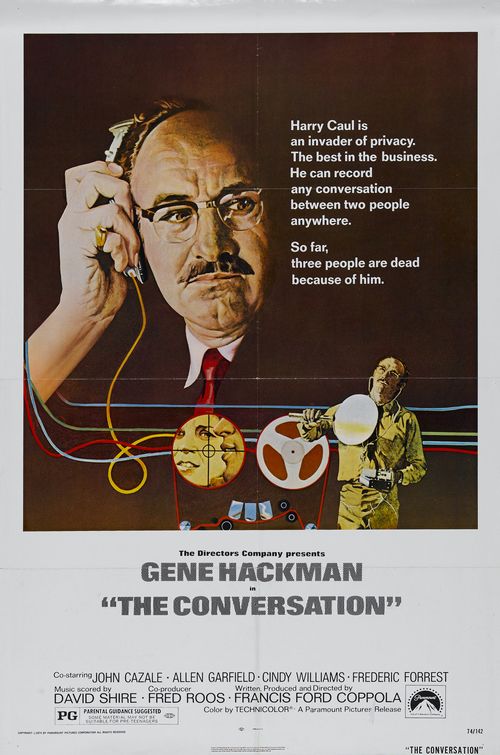
Starring: Gene Hackman, John Cazale, Allen Garfield, Frederic Forrest, Cindy Williams, Michael Higgins, Elizabeth MacRae, Teri Garr, Harrison Ford, Robert Shields, Robert Duvall
Francis Ford Coppola was flying high in the 1970s. Balancing incredible critical and popular acclaim, Coppola achieved a level of influence in Hollywood that few if any have equalled. In the middle this decade in which he directed three of the most celebrated classics of the American cinema – The Godfather, The Godfather Part II and Apocalypse Now – he also directed a small, personal film called The Conversation. This film, one of Coppola’s few original screenplays, represented the kind of small, personal filmmaking that he had always envisioned his career consisting of before it was side-tracked by the enormous success of The Godfather. As such Coppola consistently cites The Conversation as his favourite of his films.
Fascinated by technology and process, Coppola first came up with the concept behind The Conversation in the late 1960s after reading a Life magazine article about a surveillance technician who worked in San Francisco. Coppola thought it would be interesting to fuse this character with elements of Michelangelo Antonioni’s Blow-Up, a European art film which had been become a surprise box office hit in the US in 1966. The resulting film was a unique, disturbing and intelligent thriller.
Harry Caul, a wire tapper, the best in the business, is hired by the director of a large company to record a lunchtime conversation between a young man and woman in San Francisco’s busy Union Square. The contents of the conversation are seemingly innocuous until Harry uncovers a previously obscured line – “He’d kill us if he got the chance” – which changes everything. Are these young people in danger? Is it Harry’s employer who is a threat to them? As a professional, Harry doesn’t allow himself to get emotionally involved in his work. He tells his partner, Sal, “I don’t care what they say. I just want a nice, fat recording.” But as desperate as Harry is to believe that statement is true, he carries a heavy burden of responsibility for what is done with the information he provides. A job he did years earlier when working on the East Coast resulted in the three people being murdered, including a mother and child. Despite his outward denial of culpability, Harry is racked with guilt. When the tapes are stolen, and he is faced with the possibility that he could end up with blood on his hands again, Harry becomes determined to intervene.
Harry Caul at work
With The Conversation, Coppola wanted to make a film about a character that would usually be peripheral. Thus we have Harry Caul. He is the type of character who we would expect to appear anonymously in one or two scenes in a film, listening in to a phone conversation, perform a function and then vanish from the story. But here he is our protagonist. Harry has devoted his life to his unique line of work which has, as you might expect, left him obsessively protective of his own privacy. This impacts his ability to have genuine friendships and relationships with people, no matter how much he might long for them. He is an isolated and introverted man. Gene Hackman, himself appropriately ordinary looking, is tremendous in the role with a much more restrained and low key performance than is usually his style.
By far the most striking stylistic element of the film is its creative use of sound. Legendary sound designer Walter Murch created a prominent soundscape which plays a pivotal role in the narrative of the film, as well as establishing its uneasy tone. In the film’s masterful opening scene, shot by Haskell Wexler (the rest of the film was shot by Bill Butler), we see the conversation in question taking place in the crowded square as Harry’s team manoeuvre themselves to get their coverage. While the vision places us in the square with the players, the audio we hear is from the perspective of the various rooftop microphones. So there are elements of the conversation which are obscured to us on first viewing, replaced by the digital distortion of microphones. As Harry processes the recordings, we hear different excerpts of that conversation repeated again and again throughout the film. The recording comes to serve almost as a soundtrack for the film. As Harry replays the conversation over and over I his mind, the recording starts to interact with the visuals of the film: as Harry lies on his cot, we hear the woman in the recording commenting on a homeless man lying on a bench; as the prostitute Harry sleeps with leans in to whisper something in Harry’s ear, we hear the woman in the recording say “I love you.” Murch described this relationship as being almost musical.
For those familiar with Antonioni’s film, the influence of Blow-Up is obvious. Blow-Up told the story of a London photographer who discovers that he has inadvertently photographed a murder. The centrepiece of Blow-Up is a scene in which the protagonist, David, is developing his prints and, noticing details in them, he starts to expand them – blowing them up – to reveal what has happened. This scene is reflected in The Conversation where we watch Harry pouring over his recording, tweaking it and stripping it back until he reveals the pivotal line. Like most appropriations of European art cinema devices and narratives by US filmmakers, Coppola uses it as part of a much more conventional mystery narrative. Coppola largely puts to one side Blow-Up’s thematic focus on perception and reality in favour of an exploration of conscience and responsibility.
“He’d kill us if he got the chance.”
Like all of the best thrillers, The Conversation features a great twist: a moment when everything we thought we knew is turned on its head. And it is only appropriate that in this film sound should be key to that moment of revelation. After Harry discovers the director of the company, his employer, has been killed he is confused. It doesn’t make sense. As he has done the whole way through the film he thinks over the recording of the conversation and we hear a line which we have heard numerous times before, but this time delivered with a slightly different emphasis. “He’d kill us if he got the chance” becomes “He’d kill us if he got the chance.” It is subtle and brilliant and straight away we know what has happened. Everything falls into place. While this final revelation comes in a single moment, the beauty of The Conversation’s twist is in the deft way that it is set up throughout the film. It is all as a result of a very clever use of point of view. Walter Murch, who also served as the film’s supervising editor, describes The Conversation as having “one of the great unreliable narratives in film.”
The entire narrative is delivered to us from Harry’s perspective. Hackman’s character is in every single scene in the film. We are either watching him, or we are watching what he is watching. It is classic restricted narration. As viewers, we are only privy to the same information as our protagonist. We only know what he knows, we only see what he sees, and importantly, we only hear what he hears. Coppola and Murch use this point of view to trick the audience. Throughout the film, as Harry listens over and over to the recording, the film shows us vision of the original conversation, though these are not necessarily the same shots that we saw in the opening scenes. Piecing these images together with the repeated recording, we are inclined to interpret them as flashbacks, and therefore understand them as being objective. However, they are not objective, they are subjective. This is because they are not flashbacks at all. Rather, they are Harry’s recollections or Harry’s interpretations of what he is hearing. So the first time we see the “He’d kill us if he had the chance” vision, we are seeing something which didn’t actually happen. The visuals are imagined by Harry to accompany his misinterpretation of the sound. But, interpreting them as objective flashbacks, we don’t question them for a second. We heard it too. We just don’t realise that we are hearing it the way Harry hears it rather than the way it was actually said. It is subtle, but incredibly effective in leading us down a path and then setting up the reveal late in the film.
As well as functioning as an intelligent thriller, The Conversation is an important product of its time. The 1960s and early 1970s had seen a number of quite prominent events occur in the US which fostered an uneasy sense that oppressive forces were at work against individual liberty. For the first time in history, the US citizenry began questioning the trustworthiness of its government and institutions. President Kennedy had been assassinated in Dallas in 1963 and people had been left dissatisfied by the findings of the Warren Commission. The Vietnam War was a wildly unpopular conflict, and revelations in the Pentagon Papers that the US had enlarged the scale of war by knowingly bombing Cambodia and Laos compounded the venom. The Watergate scandal started with a break in at Democratic National Committee headquarters in 1972, escalated with revelations of bugged offices and other abuses of power, and resulted in dozens of convictions and the resignation of President Nixon in 1974. Add to these the revelations about US involvement in coups and assassination attempts abroad, and the public were losing faith in their government.
Out of this tumultuous political context arose a cycle of thrillers in the mid-1970s which were notable for their pervading sense of paranoia and their interest in conspiracy, both government and corporate. At the heart of this group of films were Alan J. Pakula’s trio Klute, The Parallax View and All the President’s Men, but the cycle also included the similarly themed Executive Action (David Miller), Three Days of the Condor (Sydney Pollack), Killer Elite (Sam Peckinpah) and Network (Sidney Lumet). With its pervading sense of paranoia and its focus on surveillance technologies, The Conversation was right at home in this very topical group of films. Released just a few months before Nixon’s resignation, The Conversation explored the moral ambiguity of surveillance and the limits of personal responsibility. Yet despite falling bang in the middle of this group of films, and seemingly drawing on the same societal anxieties, The Conversation actually predates the cycle. As mentioned earlier, the film was conceived of almost a decade before it was released, well before the revelations of Watergate. Coppola himself has actually stated, “I never meant it to be so relevant… I almost think the film would have been better received had Watergate not happened.”
Obviously The Conversation was dwarfed by Coppola’s other monumental achievements in the 1970s, and it failed to make a big impact at the box office, though it did manage to make $4.4 million at the box office off a budget of only US$1.6 million. It did, however, win the Palme d’Or at the 1974 Cannes Film Festival and was nominated for three Academy Awards in one of the strongest ever fields: Best Picture (which it lost out to Coppola’s other film that year, The Godfather Part II), Best Original Screenplay (in which it was pipped by Robert Towne’s script for Chinatown) and Best Sound (where it lost to the far less subtle Earthquake), and it remains one of the decade’s best films and one the true gems to come out of the Hollywood Renaissance period.
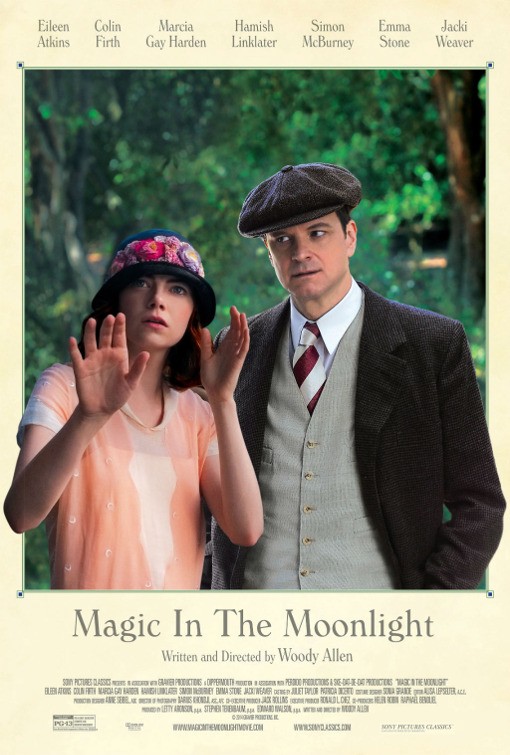
Starring:Colin Firth, Emma Stone, Simon McBurney, Hamish Linklater, Marcia Gay Harden, Eileen Atkins, Jacki Weaver
After being the most New York-centric of filmmakers for the first few decades of his career, Woody Allen continues his recent fascination with Europe by taking us to the French Riviera for Magic in the Moonlight.
Stanley Crawford is Europe’s most celebrated stage magician. As the Chinese mystic Wei Ling Soo he wows audiences all over the continent. But Stanley’s real passion is using his knowledge of the tricks of the trade to debunk phoney mediums and spiritualists. So when old friend and fellow magician Howard asks for his help exposing a young medium that has enchanted a wealthy widower and her son, he is only too happy to get involved. But in spending time with the lovely young Sophie, who catches Stanley’s eye as much as she confounds his intellect, this strict rationalist and vehement sceptic finds his worldview rocked by the notion that perhaps there is more to the world than meets the eye.
Like the incredibly successful Midnight in Paris, this light-hearted romantic comedy takes us back to the 1920s, a favourite era of Allen’s. But rather than just showing us a past world, the film actually feels like a movie from the 1920s. Magic in the Moonlight plays like an old screwball comedy; the kind made by Preston Sturges or Ernst Lubitsch. The characters are larger than life. Their emotional changes are sudden and drastic. Their banter is sharp and witty. The situations are wonderfully silly.
While the storyline is not overly taxing or complex – I successfully picked the ending quite early on – it does allow for some surprisingly heartfelt thematic explorations. The possibility that Sophie might be the real deal opens up the possibility that there is more to this life than meets the eye. The film explores the important role that faith plays as a source of comfort and in helping people get by. While Allen is himself openly agnostic, he seems to encourage us to pity Stanley for his closed view of the world which cannot accept the presence of anything unknowable or unexplainable.
Colin Firth and Emma Stone are not an obvious romantic pairing, and theirs is not a natural chemistry (perhaps because we imagine Sophie’s mother to be a more age appropriate partner for Stanley), but it does seem to work. The butting of heads between this mismatched pair is fun to watch. Firth is full of arrogant bluster and pomposity as a protagonist who is, for once, not an obvious Allen-surrogate, but much more indebted to Rex Harrison’s Henry Higgins in My Fair Lady. Stone is as enchanting and likeable as ever, and while she may not get the lines and zingers that Firth does, her comedic talents are still very much on display.
Woody Allen’s films tend to be broken down into either major- or minor-Allen – there are 44 of them after all – and there is no doubting that Magic in the Moonlight definitely falls in the minor-Allen category. It is never going to be part of a discussion of his most significant films. That said, it is none the less well performed, beautiful to look at and a nice piece of whimsical fun.
Rating: ★★★☆
Review by Duncan McLean
Have you seen Magic in the Moonlight? Leave a comment and let us know what you thought.
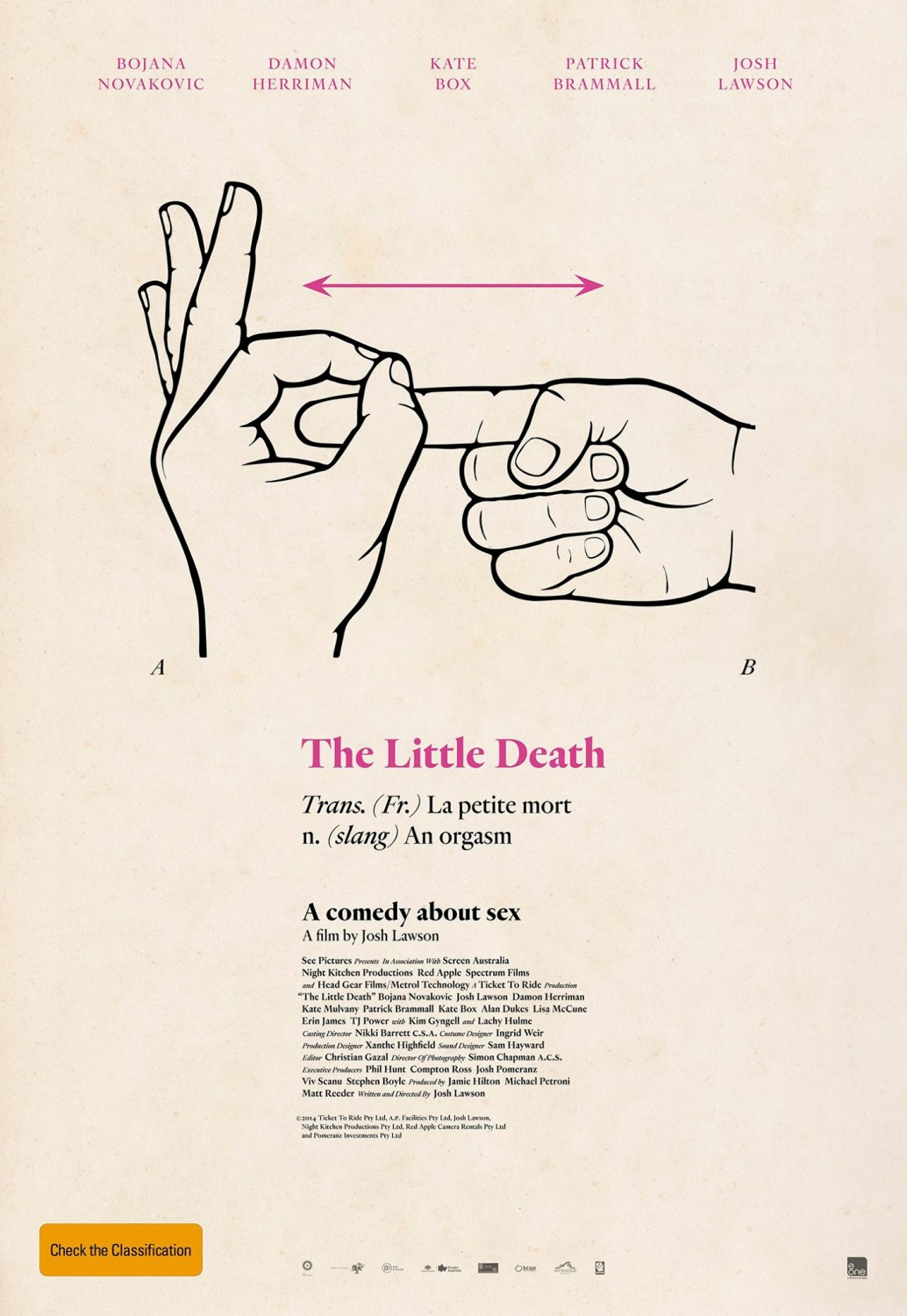
Starring: Josh Lawson, Bojana Novakovic, Damon Herriman, Kate Mulvany, Kate Box, Patrick Brammall, Alan Dukes, Lisa McCune, Erin James, TJ Power, Kim Gyngell, Lachy Hulme
The little death, la petit mort, is a French euphemism for an orgasm. Actor Josh Lawson’s directorial debut, The Little Death, a romantic comedy about sexual fetishes, explores some of the weird and wonderful ways people get to that point.
We follow four ordinary couples living in a Sydney neighbourhood, each dealing with their own sexual issue. For Paul and Maeve, it is sexual masochism. She reveals her fantasy about being forced into sex by a stranger, leaving mild mannered Paul to try and fabricate a situation in which he can surprise his wife with an attack. For Evie and Dan, their therapist has suggested role-playing may help them get in touch with their emotions, but the scenarios get side-tracked as Dan catches the acting bug. For Phil and Maureen it is somnophilia. Their marriage is on the rocks, but when Maureen accidentally takes one of Phil’s extra strong sleeping pills, he sees his wife still and silent and falls in love with her all over again, starting an evening affair. For Rowena and Richard it is dacryphilia. Their efforts to get pregnant has taken the passion out of sex, but when Richard receives some bad news, Rowena finds herself strangely aroused by his tears so must continually find ways to make him cry. These stories are all tied together by a man, new to the neighbourhood, who goes door to door, using homemade nostalgic biscuits to distract his new neighbours from his legally required pronouncement that he is a registered sex offender.
The Little Death is not your typical sex comedy. It manages to be frank and explicit without being gratuitous or childish. These are suburban middle-class folk in committed relationships, not randy frat boys, and while the film does get some big laughs out of its exploration of different fetishes, it also explores themes of morals, normality, and communication within a relationship. We see characters who are so ashamed of their fetish that they create elaborate lies and even admit to far worse accusations in order to hide the truth.
Lawson’s screenplay does walk a very fine line. There are some divisive elements which will leave some audiences conflicted. The most obvious of these is the inclusion of a woman’s rape fantasy. While Lawson treads carefully in this area, it is a controversial and confronting concept, and at the very least it would seem a misstep that this is the first couple, and thus first fetish, that is introduced.
As is common in these types of films, some of the storylines work better than others. Despite some beautiful and very funny moments, The Little Death does struggle a bit for rhythm in tying those scenes together. Lawson possibly tries a bit too hard to connect the different storylines together into a neat Love Actually package, with the attempts to intertwine the stories becoming messy when the thematic connection on its own is sufficient.
With so much effort having gone into weaving these four storylines together, it is then a surprise to find one scene, concerning a fifth pairing, which stands alone at the end of the film. Monica works as a translator at a service that makes phone calls for deaf people. Sam, a deaf-mute, Skypes in and requests that Monica call a phone sex line for him. While usually a scene that struggles to find its place would be destined for the cutting room floor, this scene ends up being hands down the best of the film. Riotously funny, the scene strangely becomes a genuinely touching and lovely moment of connection between two people. It is my favourite singular movie moment of the year.
While some audiences will struggle to get on board with the concept, and the film has peaks and troughs, when The Little Death is good it is very good, and there is more than enough in The Little Death to suggest that Josh Lawson could be an interesting comedic voice in the future.
Rating: ★★★
Review by Duncan McLean
Have you seen The Little Death? Leave a comment and let us know what you thought.
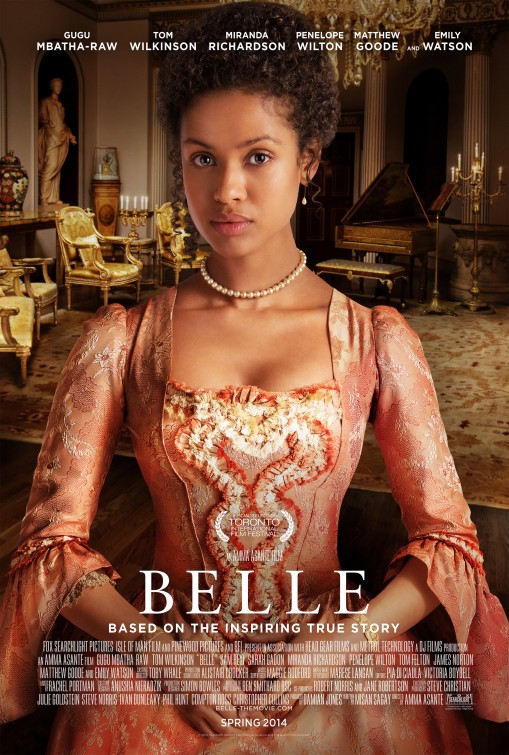
Starring: Gugu Mbatha-Raw, Tom Wilkinson, Sarah Gadon, Emily Watson, Sam Reid, Miranda Richardson, Matthew Goode
In Scone Palace in Scotland there hangs a very unique painting. It shows a pair of late 18th century society women, Dido Elizabeth Belle Lindsay and Elizabeth Murray. What makes it unique is that one of them, Dido, is black. It is believed to be the first painting to show a black and white person as equals. This painting inspired filmmaker Amma Asante to tell the story of this little known mixed-race aristocrat.
Dido is the illegitimate daughter of naval officer Sir John Lindsay and an African slave woman. While Lindsay loves his daughter, he must return to the sea, so he pleads with his uncle, Lord Chief Justice Mansfield, to honour Dido’s birthright and allow her to live under his roof. So Dido and her half-cousin Elizabeth grow up as surrogate daughters to Lord and Lady Mansfield. But Dido is caught between two worlds. She is too high in standing to dine with the servants, but too low to dine with her family and their guests. And what is to happen when she comes of age to marry?
With little detail being known of the historical Dido’s life, screenwriter Misan Sagay has applied a fair amount of poetic license in Belle. The result is a film that is part society costume drama, and part historical courtroom drama. Alongside the Austen-like narrative of young women seeking husbands, is a secondary narrative which sees Lord Mansfield presiding over an important court case concerning the slave ship Zong. The Zong’s crew had been forced by a shortage of water to throw over 100 African slaves overboard on their way back to England, and are now seeking to recoup from their insurer for their lost ‘cargo.’ The case – an amalgamation of two separate cases Mansfield presided over – has potentially great consequences for a nation taking its first steps towards the abolition of slavery, and it provides a dramatic parallel to Dido’s own experiences. Lord Mansfield is a man who interprets the rules, lives by the rules and tries to do what is right within the framework of those rules. Dido challenges him to move beyond the rules in search of true justice.
While issues of race are obviously foregrounded, one of Belle’s strengths as a film is that it explores oppression on a number of levels – race, class, gender. Upon the death of her father, Dido finds herself an heiress, an independently wealthy woman. On the other hand, Elizabeth, also illegitimate and not the Mansfields’ heir, has no money of her own. At a time where societal rules dictated that money should marry money, both girls have an advantage and a disadvantage. What is more important, bloodline or colour? What prejudice are people more willing to overlook? Belle explores this maze of societal conventions and hierarchies that Dido challenges on so many levels.
Belle has all the trimmings of a well-made period drama. It has grand sets and intricate costumes, and they are all beautifully photographed. However, the Austen-like construct of its format does make it slightly predictable. There are no surprises to be had in the narrative here. But engaging performances from Gugu Mbatha-Raw and the always excellent Tom Wilkinson, and a well organised exploration of social issues makes Belle well worth a look.
Rating: ★★★★
Review by Duncan McLean
Have you seen Belle? Leave a comment and let us know what you thought.
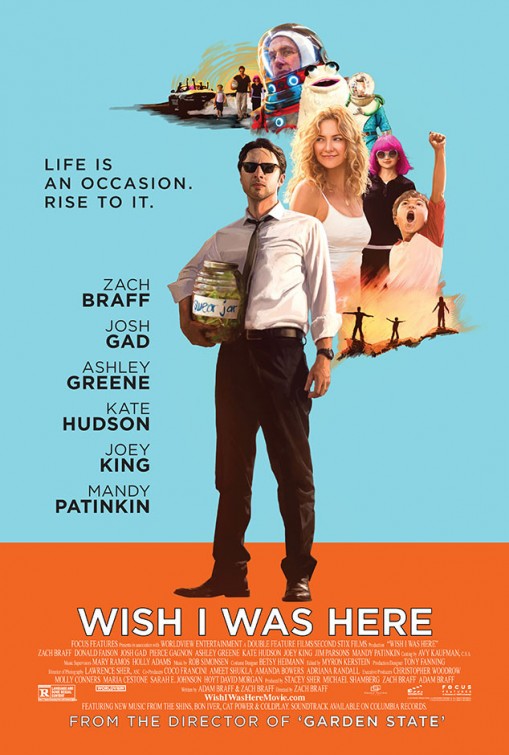
Ten years after his first film as a writer-director, the incredibly indie dramedy Garden State, former Scrubs star Zach Braff returns to cover similar territory in his second film, co-written with his brother Adam, Wish I Was Here.
Once again, Braff plays an aspiring actor. Aiden Bloom is 35, married with two children, and still struggling without success to achieve his acting dream. His wife Sarah works a horrible job to put food on the table and his father Gabe, with whom Gabe enjoys a uneasy relationship, pays for the children’s private Jewish school tuition. But when Gabe gets cancer and needs his money to pay for an experimental treatment, they have to pull the kids out of private school and the decision is made that Aiden will home school them.
Wish I Was Here sits comfortably as a companion piece to Garden State. Both tell stories of a young man – or in this case a man who is not as young as he used to be – who is drifting through life, ungrounded and uncertain. Both films share a similar existential angst, and awareness and fear of mortality.
Funding the film through Kickstarter – a controversial move which caused much debate about the appropriateness of well-paid stars using the crowd-sourcing website to fund their productions – meant that Braff enjoyed the freedom to make the film that he wanted. The result is obviously a very personal film, but at times it errs into self-indulgence. There are scenes in the film which only seem to be there out of a misguided belief that they are quite profound; two separate scenes in which a character recites poetry, and a repeated anecdote about Aiden and his brother’s childhood fantasies about being heroes who had to save the world. You get the feeling that the movie might have benefited from Braff having a bit more accountability as writer-director-star.
The film’s most jarring issue though is its protagonist. It is unclear how we are supposed to respond to Aiden, but he doesn’t come across as overly sympathetic. While his issues with his father play as authentic, the other problems he faces are very much of the “first-world” variety. They can’t afford to send their kids to a prestigious private school because Aiden won’t put his acting dream to one side to help provide for his family. Sarah even asks him at one point, “When did this relationship become solely about supporting your dream?” At best he comes across as oblivious, at worst, selfish.
One cannot doubt the earnest sincerity of the film, and despite its moments of pretention and its woe-is-me protagonist, there are some interesting thematic explorations in the movie. In his moment of personal crisis as he confronts his father’s mortality, we watch as Aiden struggles with what it means to be a man, to be a husband and to be a father.
Wish I Was Here is an uneven film, but there are enough laughs and touching moments to get it through.
Rating: ★★☆
Review by Duncan McLean
Have you seen Wish I Was Here? Leave a comment and let us know what you thought.
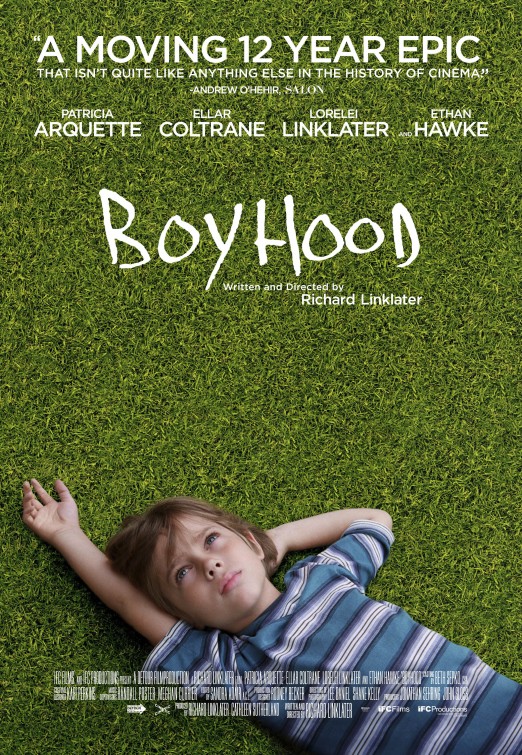
There has never been a film quite like Richard Linklater’s Boyhood. Wanting to make a coming of age film which truly captured the experience of childhood and adolescence, Linklater came up with a bold concept: he would cast a six year old boy, and over the next 12 years follow that character from the beginning of his school life to his leaving for college. While Michael Apted had done something similar with his Up series of documentaries, in which he has revisited the same subjects every seven years since 1964, no one had attempted to tell a fictional story in this fashion.
A unique concept required a unique approach. Shot in 39 days between 2002 and 2013, each year the cast and crew would gather together when their schedules permitted for three or four days of shooting. Rather than running from a set screenplay, they started with a basic structural blueprint, and then Linklater would write the film as they went, year by year, enabling it to grow organically as its cast did.
This approach to production meant that, in Linklater’s words, time became a collaborator on the film. Time brings with it change and uncertainty, not to mention risk. Changes in the young actors had to be taken into account as the screenplay evolved. Each year, Linklater would start the process by having a chat with his young lead, Ellar Coltrane, about where he was in his life, and that discussion would serve as inspiration for the character. Similarly, the world changed over the twelve years the film was in production, and the film navigates those cultural and political changes. So we see the Iraq War and the election of Barrack Obama, events which wouldn’t have been known at the commencement of the project, become a part of the story.
The result is a film which manages to be both epic in scope and incredibly intimate at the same time. With no strict narrative to speak of, Boyhood simply recounts an ordinary life. Mason’s family goes through their fair share of changes and trials, but these events are all presented devoid of any melodrama. Even without a central narrative thread to hook us in, the characters are so well formed that we care about what happens to them. Mason is a dreamer, a curious boy with a thoughtful, artistic temperament. We watch him shape himself into a young man, no doubt in opposition to the string of abusive, alpha-male types that his mother has coupled with since his parents’ divorce. The film is called Boyhood, so obviously is centred around Mason’s experience, but it has just as much to say about girlhood through his sister Samantha, and parenthood through the journeys of his mother and father.
Ultimately, the film works because there is something strangely fascinating about watching these characters actually grow up before your eyes. This ageing process is often subtle. Linklater opts not to telegraph the progress through time with captions letting us know when we have leapt forward a year, instead trusting his audience to work it out for themselves through the little details: changes in haircuts, music styles and personal electronics.
Incredibly ambitious and effectively executed, Boyhood is a unique and at times quite profound cinematic experience.
Rating: ★★★★☆
Review by Duncan McLean
Have you seen Boyhood? Leave a comment and let us know what you thought.

 Gillian Flynn’s best-selling thriller Gone Girl was a literary sensation and was destined for the big screen. Flynn herself was given the task of streamlining the novel into a 150min screenplay, and with films like Se7en, Fight Club, The Social Network and Zodiac proving him to be a brilliantly methodical director and a master of misdirection, David Fincher was just the director to manage the various major twists and turns that Flynn’s story throws at us.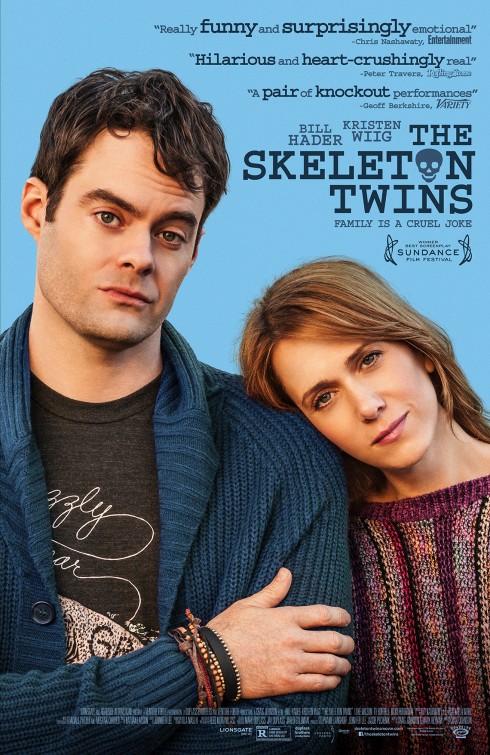


 Doctor of Movies
You must be logged in to post a comment.