
Category: Reviews
Review – Life of Pi (2012)
Director: Ang Lee
Starring: Suraj Sharma, Irrfan Khan, Rafe Spall
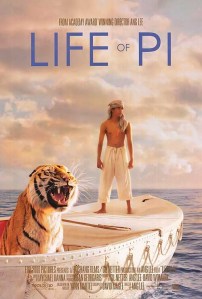 Yann Martel’s 2001 novel Life of Pi was a best seller and much loved. However the story of a young man’s spiritual journey whilst stranded in the Pacific Ocean on a lifeboat with a Bengal tiger was considered by many to be unfilmable. But Ang Lee, director of Crouching Tiger, Hidden Dragon and Brokeback Mountain, has proven that with the right director there is no such thing as unfilmable, creating a piece of art that is both highly spiritual and visually breathtaking.
I haven’t read Yann Martel’s novel so I can’t comment on how faithful an adaptation Lee’s film is, but I don’t really think it is important. I find it frustrating when people get hung up on the similarities and differences between novels and film adaptation and about which is better. A faithful adaptation of a novel does not necessarily make a good film. It is more important that the filmmaker use the novel as inspiration for his/her own take on the story. For example, Coppola’s The Godfather is a great film. Mario Puzo’s The Godfather is a great novel. But stylistically they are quite different, with Puzo’s novel being kind of pulpy, while Coppola’s film is grand and operatic. So its faithfulness to Martel’s Life of Pi isn’t as important as the fact that Ang Lee’s Life of Pi is a very good film in its own right.
At the beginning of the film the writer tells the adult Pi that he has sought him out because he has been told he “had a story that would make me believe in God.” It is this spiritual element which differentiates Life of Pi from Robert Zemeckis’s Cast Away and other survival stories we have seen – that and the Bengal tiger. A very spiritual man, Pi sees his journey as having a spiritual significance that goes well beyond a simple fight for survival.
Above everything else, Lee’s film looks amazing. Life of Pi is a stunning aesthetic achievement. With the use of digital technology Lee creates a heightened reality out at sea. Sometimes the sea is rough and choppy and looks very realistic, but at others it is so still and flat it is as though Pi’s boat is floating on nothing at all. This is one of the few films you should try and make sure you see in 3D. I’m not a huge fan of 3D movies, I think the vast majority of the time it is a gimmick used to inflate box office figures, but there are a handful of films which have really demonstrated the potential of the medium if used properly and Life of Pi is one of them.
Equal to the visual achievement as the film’s overall aesthetic is the believability of the tiger, Richard Parker. At the end of the day, the success or failure of the film was largely going to be determined by how successfully Lee made you believe that you were watching a boy and a tiger together on a boat. Richard Parker is created almost entirely with CGI, a wise move as it means there is a consistent look whereas had they tried to use a real tiger as much as possible, there would undoubtedly been jarring moments which would draw attention to the CGI tiger. The computer generated tiger looks brilliant though. You never doubt the reality of the beast before you. Credit should also go to Suraj Sharma, whose performance opposite a CGI tiger is pivotal in establishing the believability of the animal.
Life of Pi is a beautiful, thoughtful film which will be a definite player in the upcoming award season, particularly in the fields of visual effects, cinematography and directing.
Rating – ★★★★
Review by Duncan McLean
Review – The Hobbit: An Unexpected Journey (2012)
Director: Peter Jackson
Starring: Martin Freeman, Ian McKellen, Richard Armitage, Andy Serkis
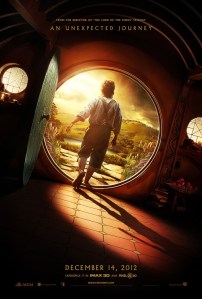 It is fun to be back in Middle Earth and the world of The Lord of the Rings again. It is great to see Ian McKellen back as Gandalf. Andy Serkis again steals the show as Gollum. It is nice, if completely unnecessary, to see Elijah Wood as Frodo again. But be warned, Lord of the Rings this is not, which is unfortunate as it is not going to be able to avoid comparisons.
The Hobbit: An Unexpected Journey follows the same narrative formula as The Lord of the Rings. Again we have a motley crew making their way across the countryside, encountering all manner of foe, on a journey to an ominous mountain. However, the problem for The Hobbit is that there just isn’t enough at stake in this story. In The Lord of the Rings you have these grand themes of good and evil at play, and the fate of the world rests on the shoulders of this small company on their mission. In The Hobbit we have a dozen dwarves who want their home and their gold back. It doesn’t quite compare. In The Lord of the Rings, they had no choice but to go on. In The Hobbit you feel like if things really got too hard they could just decide to give up and life would go on. The only times we get a sense of bigger themes at play are in scenes which point towards the events of the events of The Lord of the Rings trilogy. The difference between the two is that The Lord of the Rings is a genuine epic, whereas The Hobbit is a rollicking adventure story. But in trying to maintain a consistent tone, Jackson is trying to force an epic tone on The Hobbit when he may have been better served to have a bit more fun with it. It is a children’s book after all.
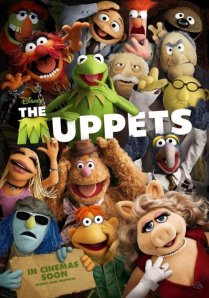
As an aside, I couldn’t help but notice the similarities between the poster below and that of The Muppets which I hoped may have indicated an attempt to lighten it up a bit, but outside of a couple of moments, not really.
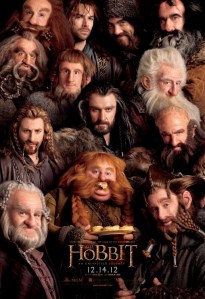
Martin Freeman is very likeable as Bilbo Baggins and the better scenes in the film, for mine, feature him prominently, in particular the scene with the three trolls deciding how they will cook up the band of dwarves they capture, and, of course, Bilbo and Gollum’s game of riddles. Richard Armitage is strong and moody as Thorin, but with the exception of a couple you will have trouble differentiating between the dozen dwarves in the band. Unlike The Lord of the Rings where each member of the fellowship had a distinct persona, in this case they are largely interchangeable.
When it was first announced that The Hobbit was going to be made as a two part film, and then later revised to three parts, eyebrows were raised. When Jackson made The Lord of the Rings, he took an enormous work, which was already a trilogy, and had to be really selective in terms of what he included and what he left out in order to fit it into a trilogy of films. With The Hobbit Jackson has taken one book, which is significantly shorter than The Lord of the Rings, and has stretched it out to three films, and unfortunately that stretching shows. At 169 minutes, the issue with The Hobbit: An Unexpected Journey is not so much that it is long, but that it feels unnecessarily long. It feels stretched out. I can’t see there being a special extended edition DVD of this film because it is hard to believe Jackson has chosen to leave anything out. Anyone who found the last half hour of Return of the King frustratingly drawn out will find themselves infuriated by how long it takes An Unexpected Journey to get started. First there is a prologue of about 20 minutes which seems to have been put in there solely to get Elijah Wood back on screen as Frodo, and that is followed by another 20 minutes of dwarves arriving at Bag End. So you are about 45 minutes into An Unexpected Journey before the unexpected journey begins. I wouldn’t be surprised if, when the trilogy is finished, a competent reader could read Tolkien’s novel in less time than it would take to watch the trilogy back to back.
I didn’t get to see the film in 48 frames per second, but have heard mixed responses to that format. Apparently it is wonderful for the landscape shots, offering beautiful clarity, but that same clarity has a negative effect on costumes and make-up.
While The Hobbit: An Unexpected Journey has copped a bit of flak from some critics, and doesn’t reach the heights of the incredibly successful Lord of the Rings trilogy, it is not Star Wars Episode I: The Phantom Menace by any stretch of the imagination. It feels a little drawn out, but once the story gets going there is a lot of fun to be had.
Rating – ★★☆
Review by Duncan McLean
Review – Les Misérables (2012)
Director: Tom Hooper
Starring: Hugh Jackman, Russell Crowe, Anne Hathaway, Eddie Redmayne, Amanda Seyfried, Samantha Barks, Aaron Tveit, Helena Bonham Carter, Sacha Baron Cohen
Les Miséra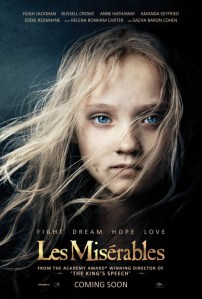 bles first appeared on stage on the West End in 1985 and in the 27 years since it has become one of the most successful musicals of all time. That said, it was still a bit of a risk for Tom Hooper to announce it as his next film project after winning an Oscar for The King’s Speech. It was always going to be a high profile event film, and let’s face it, history has shown us that when you get a big budget musical wrong it can be really, really bad. Hooper assembled a great cast lead by Hugh Jackman – amazingly making his first movie musical despite his strong musical pedigree. But early critical reviews were mixed. Some called it a mess, others heralded it as one of the year’s best. So I was really keen to see it for myself, particularly as I saw the stage production in London earlier in the year and loved it.
The big experiment with Les Misérables, and again part of what made it a risky project,was having the actors sing live. Usually when you make a musical one of the first things you do is get the cast into a recording studio and record an album. Then a couple of months later when it is time for the shoot, the actors simply lip-synch to the mastered recording. With Les Misérables, Tom Hooper decided that he wanted his actors to sing live on each take. The major advantage of doing it this way is it frees up the actors creatively. When you record the songs in advance, the actors are forced to make many of their acting choices well before getting on set, and once on set they are restricted by the necessity of matching up with the recording. This would be far from ideal for a musical like Les Misérables where so much of the emotional crux of the story is delivered through song. This greater level of freedom in performance for the actors has resulted in a musical which is not necessarily as brassy and robust as the stage show, but packs an incredible emotional punch.
This different approach was then complemented by the way the musical numbers have been shot. Unlike a traditional musical, Les Misérables only features one heavily choreographed number, the comical ‘Master of the House’ performed by Sacha Baron Cohen and Helena Bonham Carter’s grotesque tavern owners. The other numbers are shot very simply, often in close-up. The beauty of this approach is you get to see characters faces, something you don’t get on stage. Les Misérables is a very tragic, very emotional story, and the impact of being able to see the faces of characters as they sing is quite powerful. Never is this more apparent than when Anne Hathaway sings ‘I Dreamed a Dream,’ shot entirely in one shot, a medium close-up.
Hugh Jackman was always the logical choice to play Jean Valjean. With his baritone voice, his award-winning musical theatre experience, broad chest and handsome features, Jackman seems born to play the part. As Valjean, he carries much of the emotional weight of the film and he does it admirably, imbuing the character with a real strength and masculinity. The film’s other clear stand out is Anne Hathaway as Fantine. She delivers one of the most gut-wrenching performances you will ever see, demonstrating her versatility in a year which also saw her playing Catwoman in The Dark Knight Rises. While Jackman will be in the mix come award season, Hathaway can start deciding where she wants to put her Best Supporting Actress Oscar now.
One of the big questions in the lead up to the film was the singing ability of Russell Crowe. Everyone knew Jackman and Hathaway could sing, but the fact that Crowe used to have a band, Thirty Odd Foot of Grunt, not to mention his old Russ le Roq days, didn’t have people convinced he was the right man to tackle the demanding role of Javert. This concern was not helped by the fact that his voice was notably absent from a couple of the early trailers. As it turns out, he does alright. His voice is nowhere near as full as some of the others in the film, but you get used to it. He definitely looks the part, and still manages to give some emotional depth to the character.
Hooper’s film is a very faithful adaptation of the musical, plus the requisite new song, ‘Suddenly,’ so that they have something to submit for Award consideration. This faithfulness means that if there was anything in particular that irked you about the stage musical, it still will in the film. In my case, it is the fact that Cosette and Marius are still really boring. It also means that, as is the case with many film musicals, the critical reception will be varied. Musicals are really divisive. People tend to like them or they don’t and if you are someone who can’t get behind the concept of a musical, you’re never going to enjoy one. Even people who like movie musicals may struggle with this one as the ratio of dialogue to song is much closer to an opera than to a normal movie musical. So with a film like this it is difficult to make a general judgement. Instead, I can only speak as a person who enjoys musicals, and who particularly loves this one. I thought it was brilliant.
Rating – ★★★★
Review by Duncan McLean
Review – Following (1998)
Director: Christopher Nolan
Starring: Jeremy Theobald, Alex Haw, Lucy Russell
Before Christophe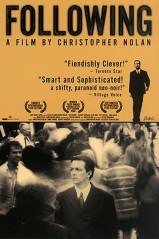 r Nolan was the man who reinvented the superhero movie with the brilliant Dark Knight Trilogy, before he was even “the guy who made that backwards movie with Guy Pearce” (Memento for those of you playing along at home), he made an interesting little noir-thriller called Following. It is the story of Bill, an aspiring writer who decides to start following people at random, just to see what they do, thinking it will give him special insight for his writing. When one of his targets, a burglar named Cobb who breaks into people’s homes not so much to steal things as to voyeuristically look into people’s lives, approaches him, Bill finds himself involved in a very strange relationship.
Nolan’s debut feature, Following is a no-budget film shot handheld in grainy, black-and-white. Nolan wrote, directed, produced and shot the film himself. For cast and crew, he used friends and acquaintances, with the picture being shot over a period of about a year, shooting on Saturdays whenever people were free. I quite enjoy watching the really early films from directors who go on to become big names – the Directors Suite released a great DVD of Martin Scorsese’s early short films which is really worth a look – because it is interesting to see what traces of the filmmaker they would become can be found in those early, often much smaller scale, works.
The primary feature of Following is its narrative structure. Nolan takes a linear story, divides it into four sections and then inter-cuts them, delivering to the viewer a non-chronological narrative which tells us the young man’s story through a series of flash backs and jumps forward. Innovations in the realm of narrative form have become one of Nolan’s chief attributes as a filmmaker, with films like Memento, The Prestige and Inception all playing with form and narrative structure different ways. Following gives us an early, and much simpler example of the kind of innovation Nolan would employ as his career progressed.
The other thing which is great about Following is that it is only 70mins long. In a time when it is becoming increasingly common for films to go well beyond the two-hour mark regardless of whether they really need to or not, it is refreshing to see a filmmaker show that a good story can be told in under 90 minutes.
If anything lets this film down, it is they quality of the performances. However this is to be expected given the amateur cast – none of whom have added many credits of substance outside of small cameos in later Nolan films – and the disjointed nature of the production.
There is also a nice little moment of Nolan serendipity for the movie nerds out there. After Bill and Cobb break into a man’s apartment, we see them leave through a front door which proudly displays a Batman logo.
While it was really his next film, Memento, which established Nolan as one of the upcoming filmmakers of the early 2000s, Following did win a few awards, most notably at the San Francisco Film Festival and the Slamdance Film Festival, and announced Nolan as someone to watch. Following has recently been released on Blu-Ray as part of the Criterion Collection, and includes a commentary from Nolan, an essay by film critic Scott Foundas and Nolan’s short film Doodlebug.
Rating – ★★★☆
By Duncan McLean
Review – The Amazing Spider-Man (2012)
Director: Mark Webb
Starring: Andrew Garfield, Emma Stone, Rhys Ifans, Dennis Leary, Martin Sheen, Sally Field
2012 has given us a n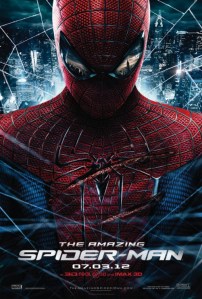 umber of high profile blockbusters which have just made you ask “why?” Most recently there was the simply awful remake of Paul Verhoeven’s Total Recall (1990)starring Colin Farrell. Prior to that you had Jeremy Renner starring in the very disappointing sequel (do you call it a sequel when the events are happening concurrently?) to the Bourne trilogy, The Bourne Ultimatum. And the film which started it all off was The Amazing Spider-Man.
The Amazing Spider-Man raised eyebrows when the project was first announced. When it became apparent that Sam Raimi and Tobey Maguire were not interested in making a fourth Spider-Man movie, Columbia and Marvel decided that rather than looking for someone to take over and continue the franchise, they would go back and start again. So what we ended up with was a reboot of the Spider-Man franchise hitting cinemas only five years after the final film Raimi’s trilogy, Spider-Man 3 (2007), and even more amazingly, only ten years after the first film in Raimi’s trilogy, Spider-Man (2002).
For a number of people, myself included, it instantly brought to mind comparisons with the two Hulk films released only five years apart, The Hulk (2003) and The Incredible Hulk (2008)… that is, beyond just the same approach of taking the old title and adding an adjective. However, there was a reason for the reboot here. Firstly, Ang Lee’s films, starring Eric Bana and Jennifer Connelly, had been a major disappointment both critically and commercially. More importantly, The Incredible Hulk was made as part of laying the foundations for this year’s superhero super-movie The Avengers (2012). So while The Incredible Hulk told a variation on the same origin story that The Hulk had, it was tying Bruce Banner’s story into that Avengers world.
But the same issues weren’t there with Spider-Man. While Spider-Man 3 had been a bit of a disappointment critically, Raimi’s films were still one of the most commercially successful trilogies in Hollywood history. Rather, the announcement of The Amazing Spider-Man appeared to be evidence of a condensing of time frames or a lack of patience in current day Hollywood. It makes you wonder how long it will be before the announcement of a Batman reboot. So that was a convoluted way of saying, I was intrigued to see what The Amazing Spider-Man had to offer. What would it be like? How would it be different?
This time round, they skew younger. Not yet a photographer at the Daily Bugle, Peter Parker is a seventeen year-old high schooler (slight suspension of disbelief required to accept the 28 year old Garfield as a teenager). Despite having appeared three times as the web slinging hero, Toby Maguire never really made the role his own. It was never impossible to think of anyone else as Spider-Man they way it is with Robert Downey Jr. as Iron Man or Hugh Jackman as Wolverine. So it is interesting to see Andrew Garfield bring a slightly different interpretation to the character. A teenage Peter Parker complete with parent issues opens up the role for a much more teen-angsty portrayal.
Webb employs a solid supporting cast. Since bursting onto the scene a couple of years ago Emma Stone has shown herself to be an incredibly versatile actress and she is doing something different again here, and does it impressively as always. Martin Sheen is one of those guys who just automatically makes a film better, and his role as Uncle Ben is no exception, with he and Sally Field adding a bit of gravitas to the roles of Peter Parker’s legal guardians.
Other than that, a lot is the same. Raimi’s films brought us “With great power comes great responsibility” and while that quote is never referenced in Webb’s film, the theme of responsibility is still there. Parker feels responsible for his uncle’s death. Parker feels responsible for the creation of his nemesis. It is a sense of responsibility, of duty, that compels him to do the things he does, and this juxtaposes quite nicely in this film with his teenage brashness when gifted with great power.
Coming out in the same year as The Dark Knight Rises (2012)and The Avengers, it was always going to take something very special for The Amazing Spider-Man to be doing anything more than fighting it out for the title of third-best comic book movie of the year, and ultimately there is nothing very special about it. It is an ok movie, which has its moments of being quite good. However, the fact that it is a reboot means that it is faced with a series of other questions. Is it better than the other Spider-Man movies? Possibly, though if it is – and a strong argument could be made for Spider-Man 2 (2004)– it isn’t better by much, probably not really enough to justify the reboot. That being said, the $262 million it made at the US box office is probably justification enough for some.
Rating – ★★☆
Review by Duncan McLean
Review – The Dark Knight Rises (2012)
Director: Christopher Nolan
Starring: Christian Bale, Tom Hardy, Gary Oldman, Anne Hathaway, Marion Cotillard, Michael Caine, Joseph Gordon-Levitt, Morgan Freeman
With the e xception of perhaps Ridley Scott’s Prometheus, no film released this year has had to contend with the immense weight of expectation that met The Dark Knight Rises, the final film in Christopher Nolan’s brilliant Dark Knight Trilogy, when it hit theatres in July. Nolan’s films had re-written the rules of comic-book movie-making, combining box office success with critical reverence.
The Dark Knight Rises sees Bruce Wayne living in self-imposed exile after the events of The Dark Knight. When the terrorist Bane releases thousands of Gotham’s most dangerous criminals from Blackgate Prison, and succeeds in prompting a class war which brings the city to its knees – all the while obscuring his even more devastating plan – it becomes apparent that Gotham has no other hope, and Wayne is forced to once again don the Bat-suit.
When the first film in the trilogy, Batman Begins, was released, much was said about this being a ‘darker’ approach to Batman. But the darkness wasn’t really anything new. Tim Burton’s films, Batman (1989) and Batman Returns (1992) had been dark. Frank Miller’s comic The Dark Knight Returns and Batman: Year One had been dark. Batman had always been a character who suited a dark, gothic interpretation. Rather, what made Nolan’s take on the Batman mythology different was his intent to ground it in the real world, asking the question “How would this work in real life?” This emphasis on grounding the action in the real world then allowed for the film to engage with real world issues.
While other comic book adaptations like The Avengers and Iron Man have been incredibly successful, their pure escapism lacks the real-world relevance of Nolan’s Dark Knight Trilogy. Batman Begins and The Dark Knight were both very much products of the War on Terror. The Dark Knight Rises draws on the Arab Spring and the Occupy Wall Street movement to deal with themes of revolution, capitalism and economic imbalance (as Nolan said in an interview, “You can’t really deal with Bruce Wayne without eventually acknowledging the massive wealth he’s a part of”).
Likewise, this grounding of the Batman story in a real world means that in Nolan’s films we see explorations of the consequences of Bruce Wayne’s decisions and actions. The Dark Knight Rises is a film about consequences – physical, emotional, psychological.
Each of Nolan’s three Batman films have been generically quite different. Batman Begins had a very mythological feel to it, with Bruce Wayne travelling to the farthest ends of the earth to learn his craft from a mysterious cult. The Dark Knight largely abandoned that mythological sensibility, and instead became an urban crime thriller (Nolan often compared the picture to Michael Mann’s Heat (1995)). The Dark Knight Rises again changes direction. This time Nolan is taking us into the world of the historical epic.
Whether or not you think that The Dark Knight Rises succeeds in what it is attempting, you can’t help but admire the ambition of the film. Nolan is attempting to tell a historical epic (not the persistant allusions to Dickens’ A Tale of Two Cities and the French Revolution) on an epic scale, resulting in filmmaking on a scale that has not been seen in Hollywood for a long, long time. The scale of the picture is immense, with this size emphasised by the fact that so much of it was shot in IMAX format. The magnitude of some of the set pieces, literally employing a cast of thousands, harks back to the epics of classical Hollywood and a style of filmmaking we just don’t see in the CGI era.
The Dark Knight Rises does not quite reach the lofty heights of its prequel, but then very few films have. It is, none the less, a very good film and a satisfying end to a very impressive trilogy. It is pleasing to see a filmmaker with the conviction to take a very popular film franchise and bring it to a close rather than giving in to the temptation to drag it out. In closing the story of Bruce Wayne with The Dark Knight Rises, Nolan has retained the integrity of what will undoubtedly be remembered as one of the key film franchises of the early 21st century.
Rating – ★★★★
Review by Duncan McLean


You must be logged in to post a comment.