
Tagged: Movie review
Review – American Sniper (2014)
Director: Clint Eastwood
Starring: Bradley Cooper, Sienna Miller
 Chris Kyle was the deadliest sniper in US military history, with 160 kills across four tours of duty in Iraq. For the Iraqi insurgents he was enemy number one – there was a $180,000 reward for killing him – for the US military he was their guardian angel. Knowing he was looking over them made them feel invincible. Kyle was a man that became a US military legend. Unfortunately, Clint Eastwood’s American Sniper is more concerned with showing us the legend than the man.
As a child Kyle’s father taught him there are three kinds of people in the world: sheep who won’t stand up for themselves and will be abused, wolves who seek to bully and harm others, and sheep dogs who are blessed with the gift of aggression and use it to protect the weak and innocent. Chris Kyle is a sheep dog. Inspired by the embassy bombings in East Africa he joins the Navy SEALS and before long finds himself in Iraq. As he grows in standing his missions become more specialised. Having been assigned to team to take out the infamous Al Qaeda operative known as ‘The Butcher,’ he also becomes obsessed with capturing an Iraqi sniper named Mustafa whose skills rival his own. Continue reading
Review – The Imitation Game (2014)
Director: Morten Tyldum
Starring: Benedict Cumberbatch, Keira Knightley, Matthew Goode, Mark Strong, Charles Dance, Rory Kinnear
 Used by the Nazis in the Second World War to obscure their communications, the Enigma Machine was the greatest encryption device in history. With 159,000,000,000,000,000,000 different combinations and a code that reset every evening, it appeared uncrackable. But a small group of British mathamaticians, linguists, chess champions and crossword enthusiasts did manage to achieve the impossible and their efforts are believed to have shortened the war by more than two years and saved up to 14 million lives. This amazing achievement was kept a military secret for 50 years, but now comes to the screen in The Imitation Game.
In 1939, MI6 brought together a small team of Britain’s best and brightest in Bletchley Park to try and decipher the Enigma Machine’s code. Among them was Professor Alan Turing. An infuriating character, Turing was brilliant but arrogant and horribly condescending. While the rest of the team immerse themselves in the futile work of trying to decipher the daily codes, Turing wants to invent a machine to crack Enigma. Continue reading
Review – The Water Diviner (2014)
Director: Russell Crowe
Starring: Russell Crowe, Olga Kurylenko, Yilmaz Erdogan, Jai Courtney, Dylan Georgiades, Cem Yilmaz, Ryan Corr
 Next year marks the centenary of the Gallipoli campaign, a First World War campaign which is for many a formative moment in our national history as it marked the first time that Australians fought as ANZACs rather than as part of the British military. With such a significant milestone on the horizon it is no surprise that we are seeing a return of Gallipoli to our screens, both big and small, with the latest offering being Russell Crowe’s directorial debut, The Water Diviner.
In 1919, in the aftermath of the Great War, Australian farmer Joshua Connor travels to Gallipoli to recover the bodies of his three sons who never returned from the campaign. All three were lost on the same day, 7th August, 1915. But after recovering two of the bodies he discovers that one of his boys was taken prisoner by Turkish soldiers, and with the help of Major Hasan of the Turkish army he attempts to trace the whereabouts of his remaining son.
The Great War marked the first time that attempts were made to recover and identify the bodies of fallen soldiers. The film’s story was inspired by a single line in a letter from a Colonel in the Imperial War Graves Unit which noted that an Australian man came to Gallipoli searching for his sons’ graves. However, from there the film takes some obvious dramatic license in telling this ‘true story.’ The title The Water Diviner is a reference to Joshua’s ability to locate the groundwater needed to run his farm in the punishing climate of the outback. Divining water is one thing – as strange as it sounds there are plenty of people who swear by the effectiveness of dowsing, as it is also known – but watching Joshua use this same method to locate the spot where his sons’ bodies are buried in the battlefield is quite a leap for an audience to take.
The Gallipoli campaign received its definitive cinematic treatment in 1981 with Peter Weir’s Gallipoli, but with The Water Diviner Crowe manages to bring a new perspective to this much mythologised moment in Australia’s history. The Water Diviner offers a far greater focus on the Turkish experience of the battle than has previously been offered to Australian audiences. This engaging of a different perspective starts as simply as acknowledging that the Turks don’t even call the site Gallipoli. Major Hasan reminds us that while 10,000 ANZACs fell there, 70,000 Turks lost their lives. On top of this, even in 1919 the war was not yet over for the Turks. As the rest of the world breathed a sigh of relief, the Turks were fiercely defending their territory as the Greeks carved away at the Ottoman Empire. As we watch the uneasy cooperation between Allied and Turkish military in the aftermath of the war we see both sides coming to terms with what has occurred. As Lt-Col Hughes concedes, “I don’t know if I forgive any of us.”
Alongside this exploration of Turkey in the aftermath of the war is an entirely unnecessary romantic subplot which sees Joshua making eyes at Ayshe, the woman who runs the hotel he is staying at in Istanbul. She is also grieving having lost her husband in the war, a fact she has not yet confessed to her son Orhan. This rather trite romantic subplot is nowhere near as interesting or engaging as the rest of the film and results in an uncomfortable clashing of tones, with one story being quite sombre and serious and the other being at times light and whimsical.
As a directorial debut, The Water Diviner does not blow you away, but it represents the sort of competent handling of the material you would expect from a man who has been an active collaborator for much of his 25 years as an actor. While some of its narrative elements are a bit naff, The Water Diviner’s invitation to consider the sacrifices made on both sides of this conflict makes it a notable contribution to the ever expanding exploration of the Gallipoli campaign.
Rating: ★★★
Review by Duncan McLean
Have you seen The Water Diviner? Leave a comment and let us know what you thought.
Review – Exodus: Gods and Kings (2014)
Director: Ridley Scott
Starring: Christian Bale, Joel Edgerton, Ben Kingsley, Aaron Paul, John Turturro, Sigourney Weaver, Maria Valverde
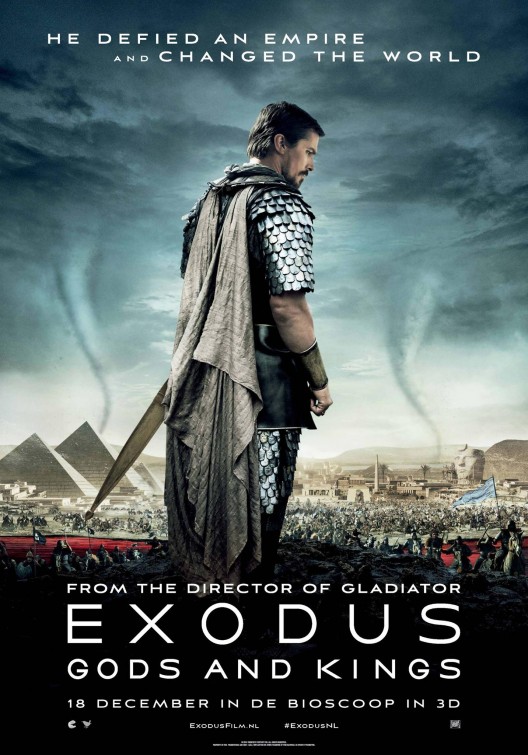 The Biblical epic used to be a staple genre of Hollywood in the 1950s and 1960s, with films like The Ten Commandments and The Greatest Story Ever Told being amongst the biggest productions in Hollywood. Over the last fifty years, with the marketplace becoming increasingly secular, the Biblical film has largely disappeared from the mainstream. It is therefore a peculiarity that 2014 has seen not one but two major films based on Old Testament narratives, first Darren Aronofsky’s Noah and now Ridley Scott’s Exodus: Gods and Kings.
While timing dictates that there will be comparisons made between Noah and Exodus: Gods and Kings, they are very different films. While Aronofsky’s film is very much a think piece, Scott’s is much more of a modern incarnation of the traditional Biblical epic – it is a big movie and all the main characters sport British accents. It has been 14 years since Scott breathed life into the swords-and-sandals epic with Gladiator, and Exodus: Gods and Kings employs a similar size and scale. The story of the son of Hebrew slaves raised as an Egyptian prince, who after a period of exile returns with the God of Israel behind him to free his people from 400 years of bondage provides opportunities for real spectacle with the various plagues, the cavalry’s pursuit of the Hebrews and the pièce de résistance, the parting of the Red Sea.
Christian Bale’s Moses is an interesting character. An intelligent and eloquent man, this Moses is not a spiritual man. As an Egyptian, he puts no stock in the advice of the mystics the Pharaoh consults. As a Hebrew, he is scolded by his wife for sowing seeds of doubt in their son’s mind. So when he encounters God at the burning bush, he must first confront the notion that there is a God before considering that God has a task for him. If Moses has faith in anything it is in his own abilities. As an experienced military general, he sets out to win his people’s freedom by training up their militia for guerrilla warfare, only to have God step in with a much faster and more drastic plan. As this plan escalates we see Moses becoming increasingly uncomfortable with the extent of the catastrophe. The question about Moses that isn’t quite answered, though, is what is his motivation? While he is shown to be a just man, he doesn’t have a particular devotion to the Hebrew people. Similarly, he is not presented as an obedient servant of God. We never really know why he is doing what he is doing, other than that is how the story goes.

Moses (Christian Bale)
Exodus: Gods and Kings has a peculiar relationship with the spiritual elements of the story, which is an odd statement to make about a Biblical film, but perhaps not surprising given the director’s agnosticism. The film toys with, without committing to, the idea that Moses’ interactions with God could be delusions. His first encounter with God, who is given the form of a mysterious 11 year old boy, occurs after he has been hit on the head and knocked unconscious during a landslide. Later we see him talking to God, and are then shown the point of view of other characters who see Moses seemingly in animated conversation with himself. This decision to give God the form of a child is also an interesting one. Obviously the booming voice from on high like in Cecil B. DeMille’s The Ten Commandments doesn’t cut the mustard anymore, but giving God the form of a child means that at those moments when God is shown to be angry and vengeful, it comes across as petulant. The film takes an awkward middle ground between embracing the idea that these events were miraculous and seeking to explain them as naturally occurring phenomena. There is no daily ultimatum to Rhamses to “Let my people go” between each plague. Instead the plagues are shown to be naturally escalating one to the next. The blood in the Nile kills all the fish and drives the frogs to the land, when the frogs die that brings the flies, the flies then bring the disease which kills the livestock and the boils which infect the people. Similarly, Moses plays no direct role in parting the Red Sea. Rather the water retreats as it would before a tsunami.
I don’t believe in criticising a film like this for deviating from its Biblical source material. As with any biographical or historical film, deviation in itself is not a problem if it has purpose. A filmmaker needs to be afforded some poetic license in their attempts to turn these well-known but often bare-bones stories into full and vibrant pieces of cinema. But the potentially lucrative Christian market at which this film is targeted can be a tough market to please. Noah was attacked earlier this year for deviating from the Biblical account even though it did so for a specific purpose, with Darren Aronofsky having a clear vision for that film and for the message that he was using the Noah narrative to communicate. Exodus: Gods and Kings, on the other hand, deviates seemingly without rhyme or reason and is sure to ruffle some feathers. This is indicative not of a Biblical accuracy problem, but of a basic story problem. It doesn’t seem to know what story it wants to tell.
There are numerous angles you can take in telling the story of Moses and the Exodus, but Exodus: Gods and Kings does not seem to have settled on any one particular approach. Four writers have been credited on the film – Adam Cooper, Bill Collage, Jeffrey Caine and Steve Zaillian – and this might go some way to explaining this narrative uncertainty. The result is not really a story of faith nor is it a story of a people. It is not quite a story of Moses’ development into a leader. The closest it comes to a focus is in being a story of two brothers, Moses and Rhamses – an interpretation that takes on particular significance when we see the film is dedicated to Ridley Scott’s late brother Tony – but even then it doesn’t completely invest in this take on the story.
Ultimately, the key test that Exodus: Gods and Kings fails is the “why” question. If you are going to remake a movie or revisit a story, particularly a story that has been told and retold as many times as that of Moses and the Exodus, there should be a reason. There should be something new you want to say, a new idea, a new interpretation, a new point of emphasis. But as much as Scott’s film nails the big spectacle elements – the plagues, the parting of the Red Sea, even just the recreation of ancient Egypt are all top notch – it lacks a clear central message and ends up just being a bit of a mess.
Rating: ★★
Review by Duncan McLean
Have you seen Exodus: Gods and Kings? Leave a comment and let us know what you thought.
Review – You’re Not You (2014)
Director: George C. Wolfe
Starring: Hilary Swank, Emmy Rossum, Josh Duhamel, Jason Ritter, Loretta Devine, Ernie Hudson, Julian McMahon
 Has there ever been a better time to release a movie about ALS (except maybe six months ago)? With the ice bucket challenge having been the viral video sensation of 2014, Amyotrophic Lateral Sclerosis hasn’t been so front and centre in people’s minds since Lou Gehrig famously told the Yankees faithful, “Today I feel like the luckiest man on the face of the Earth.” So enter George C. Wolfe’s tear-jerker You’re Not You.
On her 35th birthday, accomplished pianist Kate starts to notice a worrying tremble in her hand. It is the first signs of ALS, a neurodegenerative disease, and just 18 months down the track we find Kate wheelchair bound and requiring of constant care. Her doting and protective husband Evan advertises for a caregiver and from a pool of applicants Kate inexplicably chooses Bec, a directionless and horrendously underqualified young woman whose only credentials are that she cared for her ailing grandmother when she was younger. As Kate’s condition deteriorates, and her other relationships fall by the wayside, her friendship with Bec blossoms.
Built around this heartfelt relationship between an upper-class disabled person and their rough-around-the-edges carer, You’re Not You has definite shades of the hit French drama The Intouchables. However, in this case there are some serious holes in the storytelling and leaps in logic and motivation that you need to accept in order to go with the film. Chief among them is contrived nature of Bec’s hiring. It just doesn’t ring true. The only attempt made to justify the decision is that after a series of professional nurses Kate feels that Bec might be more likely to listen to her. Yet Bec is such a mess, so dysfunctional early on, that you struggle to believe she could last long enough in the job for their relationship to form.
But while there are definite problems in the execution, the strength of the film is its willingness to confront some of the hard questions about living with a degenerative disease like ALS, particularly the strains it can put on relationships and friendships. Kate becomes an outsider to her once close group of girlfriends. They don’t know how to relate to her. They want to offer simple comfort – “You’ll get better,” “It’ll be ok” – but knowing there is no cure, Kate refuses to let her situation be sugar-coated. At the same time, she is wracked with guilt for the way her disease has impacted her husband’s life.
A two-time Oscar winner, Hilary Swank is one of the finest actors going around and her performance as Kate is very impressive. She manages to not only capture the physical deterioration, as the disease progresses from affecting her movement to her speech to her breathing, but also the emotional impact of the disease, as this sharp-minded woman deals with the indignity of being incapable of caring for herself. What draws her to Bec, despite her many flaws, is that Bec makes her feel like a person rather than a patient.
This is a film that demonstrates that a love story doesn’t necessarily have to be a romance. The relationship between Kate and Bec is incredibly significant to both women. Bec becomes fiercely devoted to Kate, and caring for her gives Bec a sense of self-worth. For Kate, Bec allows her to retain a sense of her humanity.
There is a real predictability to You’re Not You’s storyline and on a couple of occasions the film tips into over-sentimentality, but it is none the less a satisfying weepy and features some engaging performances.
Rating: ★★★
Review by Duncan McLean
Have you seen You’re Not You? Leave a comment and let us know what you thought.
Review – Men, Women & Children (2014)
Director: Jason Reitman
Starring: Adam Sandler, Jennifer Garner, Rosemarie DeWitt, Judy Greer, Dean Norris, Ansel Elgort, Kaitlyn Dever, Olivia Crocicchia, Elena Kampouris, Emma Thompson
 Unplug your computers and throw away your phones because the internet is destroying white, middle-class existence as we know it. That seems to be the take home from writer-director Jason Reitman’s latest film, the off-puttingly alarmist Men, Women & Children.
Based on the novel of the same name by Chad Kultgen, Men, Women & Children is a movie about the way we live today, navigating both real life and an online existence with the latter increasingly impacting on the former. The film is an ensemble piece centred on the personal melodramas of the teens and parents of East Vista Texas High School in Austin, with each narrative strand introducing a different digital concern to be considered. Chris is a fifteen year old whose addiction to internet pornography has warped his perceptions of physical intimacy. Tim was a star high school athlete who reacted to his parents’ divorce by quitting football and immersing himself in online role-play games. Allison’s eating disorder and body image problems are encouraged by her connection to ‘pro-ana’ forums. Hannah’s quest for fame sees her uploading inappropriate images of herself for consumption by her ‘fans.’ Then you have the challenges of parenting in the digital era. Some parents are ignorant, some are enablers, some are militantly over-protective, like Brandy’s mother who insists on weekly spot-checks of her social media profiles and internet search history as well as screening all of her incoming and outgoing text and instant messages.
These cautionary tales raise some valid concerns. We do live in a world in which we seem to be at once more connected than ever before and yet more isolated from those around us. We can reach each other instantly, but seem incapable of genuine communication. We are in danger of becoming so overstimulated that we become numb to human intimacy. However, none of these messages are startlingly new. Despite its alarmist tone, this movie is not quite as shocking or revealing as it might have been eight years ago when social media was in its infancy.

A sea of faces absorbed in screens
What is missing from Men, Women & Children’s discussion is any form of counter-argument, any acknowledgement of positive impacts of social media and digital connectivity rather than just the damaging effects. The closest the film comes to this is when Brandy confesses to Tim that she has a secret Tumblr account which she feels is the only place where she can really express herself free from her controlling mother. Instead, Men, Women & Children feels like it is written by an outsider, someone with little direct experience of online community and connectivity who is simply frustrated by the sight of people engrossed in their screens. Given Reitman is only 37 years old, you would expect him to be more familiar with the world of social media than this often simplistic film gives the impression that he is.
Reitman seeks to give his exploration a grand, cosmic significance through an incredibly forced narration from Emma Thomson. This odd, uneasy framing device contrasts the events of the film with Voyager 1’s thirty year journey to the very extremes of our solar system and beyond. Apparently this contrast is intended to provide some perspective in the film, whether by drawing our attention to our own cosmic insignificance or by comparing the heights of technological achievement with the depths of what we now use it for. However, it just manages to feel awkward.
The deep, ensemble cast features some strong performances, particularly from some of the lesser known adolescent actors, but mostly the cast members are struggling to flesh out characters who are little more than thinly drawn caricatures. As such, Men, Women & Children becomes a film which you engage with on an intellectual level more so than an emotional one. The only plotline which seems to really hit an emotional chord is the budding romance between Brandy and Tim who, when together, actually appear to be genuine people.
The way technology has changed and continues to change human interaction and relationships is an area ripe for cinematic exploration, but it requires more nuance than the preachy and heavy-handed Men, Women & Children is willing to offer.
Rating: ★★
Review by Duncan McLean
Have you seen Men, Women & Children? Leave a comment and let us know what you thought.
Review – Nightcrawler (2014)
Director: Dan Gilroy
Starring: Jake Gyllenhaal, Rene Russo, Riz Ahmed, Bill Paxton
 As news outlets cut back their staff and refuse to pay overtime, late night footage gathering has become the realm of private operators. Known as nightcrawlers or stringers, these police-chasing cameramen listen in to their police scanners for car accidents, drive-by shootings, armed robberies and homicides, aiming to be first on the scene so they can sell their footage to highest bidding news network. With his darkly satirical Nightcrawler, writer-director Dan Gilroy takes us into this peculiar subculture.
Louis Bloom is an unemployed hustler, making a living by stealing and selling scraps and building materials. One evening, he happens upon a horrific car accident on the freeway and is fascinated by the nightcrawler who pulls up, takes a few seconds of gory footage and then disappears into the night. Seeing an opportunity, Louis buys himself a video camera and a police scanner and sets off on his new career. A fast-talker who sounds like a mix between a self-help book and an infomercial, Louis convinces the naive and desperate Rich to come on board as an unpaid intern and before you know it he is the intriguing new player in the industry. But Louis’s ruthlessness and unchecked ambition sees him willing to cross ethical lines in the name of good footage, and what starts with moving some items to create more compelling shots soon becomes something much more dangerous.
This film is built around a compelling lead performance from Jake Gyllenhaal, who appears in every scene of the film. Not a hero but also not a villain, Louis Bloom manages to be equal parts disturbing and disarming. Louis is overly polite and uncomfortably intense in his friendliness. He is a lonely man in need of connection, but incapable of naturally achieving it. Having lost a significant amount of weight for the role, Gyllenhaal’s hollowed out features take on an animalistic quality which is matched by an unblinking intensity in his performance.

Louis Bloom (Jake Gyllenhaal)
Nightcrawler doesn’t judge Louis. The film is less of an indictment of his character than it is of the system that rewards him. When Louis proudly delivers his first piece of footage to Channel 6, he is given the rundown from Nina Romani, the news director on the graveyard shift. White deaths are worth more than black deaths, wealthy is worth more than poor. What they want is urban crime creeping into the suburbs. The jackpot, he is told, is a wealthy white woman running down her suburban street, screaming having had her throat cut. This is ratings-driven news based on hype and hysteria. If a sociopath is defined by their lack of human empathy, surely the industry who lives off Bloom’s material is every bit at sociopathic as the man that gathers it.
Dan Gilroy is best known as a screenwriter and his screenplay here is really strong. What prevents this film from being just another anti-hero story is that Gilroy approaches his narrative from a different angle. He envisioned Louis Bloom’s story as a success story, in which an unemployed man, through his own determination and entrepreneurial spirit, founds his own business and builds it into a thriving company. As such, the film becomes a perverse take on the American capitalist dream.
An independently financed film with a budget small enough ($8.5 million) that it was free from the usual constraints and rules of Hollywood filmmaking, Nightcrawler is an unsettling but compelling piece of satire anchored by a brilliant lead performance.
Rating: ★★★★
Review by Duncan McLean
Have you seen Nightcrawler? Leave a comment and let us know what you thought.
 Doctor of Movies
You must be logged in to post a comment.