
Tagged: Comic Book Movies
Review – The Amazing Spider-Man (2012)
Director: Mark Webb
Starring: Andrew Garfield, Emma Stone, Rhys Ifans, Dennis Leary, Martin Sheen, Sally Field
2012 has given us a n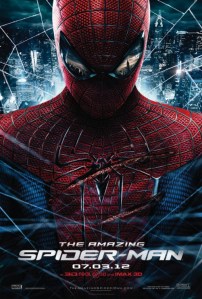 umber of high profile blockbusters which have just made you ask “why?” Most recently there was the simply awful remake of Paul Verhoeven’s Total Recall (1990)starring Colin Farrell. Prior to that you had Jeremy Renner starring in the very disappointing sequel (do you call it a sequel when the events are happening concurrently?) to the Bourne trilogy, The Bourne Ultimatum. And the film which started it all off was The Amazing Spider-Man.
The Amazing Spider-Man raised eyebrows when the project was first announced. When it became apparent that Sam Raimi and Tobey Maguire were not interested in making a fourth Spider-Man movie, Columbia and Marvel decided that rather than looking for someone to take over and continue the franchise, they would go back and start again. So what we ended up with was a reboot of the Spider-Man franchise hitting cinemas only five years after the final film Raimi’s trilogy, Spider-Man 3 (2007), and even more amazingly, only ten years after the first film in Raimi’s trilogy, Spider-Man (2002).
For a number of people, myself included, it instantly brought to mind comparisons with the two Hulk films released only five years apart, The Hulk (2003) and The Incredible Hulk (2008)… that is, beyond just the same approach of taking the old title and adding an adjective. However, there was a reason for the reboot here. Firstly, Ang Lee’s films, starring Eric Bana and Jennifer Connelly, had been a major disappointment both critically and commercially. More importantly, The Incredible Hulk was made as part of laying the foundations for this year’s superhero super-movie The Avengers (2012). So while The Incredible Hulk told a variation on the same origin story that The Hulk had, it was tying Bruce Banner’s story into that Avengers world.
But the same issues weren’t there with Spider-Man. While Spider-Man 3 had been a bit of a disappointment critically, Raimi’s films were still one of the most commercially successful trilogies in Hollywood history. Rather, the announcement of The Amazing Spider-Man appeared to be evidence of a condensing of time frames or a lack of patience in current day Hollywood. It makes you wonder how long it will be before the announcement of a Batman reboot. So that was a convoluted way of saying, I was intrigued to see what The Amazing Spider-Man had to offer. What would it be like? How would it be different?
This time round, they skew younger. Not yet a photographer at the Daily Bugle, Peter Parker is a seventeen year-old high schooler (slight suspension of disbelief required to accept the 28 year old Garfield as a teenager). Despite having appeared three times as the web slinging hero, Toby Maguire never really made the role his own. It was never impossible to think of anyone else as Spider-Man they way it is with Robert Downey Jr. as Iron Man or Hugh Jackman as Wolverine. So it is interesting to see Andrew Garfield bring a slightly different interpretation to the character. A teenage Peter Parker complete with parent issues opens up the role for a much more teen-angsty portrayal.
Webb employs a solid supporting cast. Since bursting onto the scene a couple of years ago Emma Stone has shown herself to be an incredibly versatile actress and she is doing something different again here, and does it impressively as always. Martin Sheen is one of those guys who just automatically makes a film better, and his role as Uncle Ben is no exception, with he and Sally Field adding a bit of gravitas to the roles of Peter Parker’s legal guardians.
Other than that, a lot is the same. Raimi’s films brought us “With great power comes great responsibility” and while that quote is never referenced in Webb’s film, the theme of responsibility is still there. Parker feels responsible for his uncle’s death. Parker feels responsible for the creation of his nemesis. It is a sense of responsibility, of duty, that compels him to do the things he does, and this juxtaposes quite nicely in this film with his teenage brashness when gifted with great power.
Coming out in the same year as The Dark Knight Rises (2012)and The Avengers, it was always going to take something very special for The Amazing Spider-Man to be doing anything more than fighting it out for the title of third-best comic book movie of the year, and ultimately there is nothing very special about it. It is an ok movie, which has its moments of being quite good. However, the fact that it is a reboot means that it is faced with a series of other questions. Is it better than the other Spider-Man movies? Possibly, though if it is – and a strong argument could be made for Spider-Man 2 (2004)– it isn’t better by much, probably not really enough to justify the reboot. That being said, the $262 million it made at the US box office is probably justification enough for some.
Rating – ★★☆
Review by Duncan McLean
Review – The Dark Knight Rises (2012)
Director: Christopher Nolan
Starring: Christian Bale, Tom Hardy, Gary Oldman, Anne Hathaway, Marion Cotillard, Michael Caine, Joseph Gordon-Levitt, Morgan Freeman
With the e xception of perhaps Ridley Scott’s Prometheus, no film released this year has had to contend with the immense weight of expectation that met The Dark Knight Rises, the final film in Christopher Nolan’s brilliant Dark Knight Trilogy, when it hit theatres in July. Nolan’s films had re-written the rules of comic-book movie-making, combining box office success with critical reverence.
The Dark Knight Rises sees Bruce Wayne living in self-imposed exile after the events of The Dark Knight. When the terrorist Bane releases thousands of Gotham’s most dangerous criminals from Blackgate Prison, and succeeds in prompting a class war which brings the city to its knees – all the while obscuring his even more devastating plan – it becomes apparent that Gotham has no other hope, and Wayne is forced to once again don the Bat-suit.
When the first film in the trilogy, Batman Begins, was released, much was said about this being a ‘darker’ approach to Batman. But the darkness wasn’t really anything new. Tim Burton’s films, Batman (1989) and Batman Returns (1992) had been dark. Frank Miller’s comic The Dark Knight Returns and Batman: Year One had been dark. Batman had always been a character who suited a dark, gothic interpretation. Rather, what made Nolan’s take on the Batman mythology different was his intent to ground it in the real world, asking the question “How would this work in real life?” This emphasis on grounding the action in the real world then allowed for the film to engage with real world issues.
While other comic book adaptations like The Avengers and Iron Man have been incredibly successful, their pure escapism lacks the real-world relevance of Nolan’s Dark Knight Trilogy. Batman Begins and The Dark Knight were both very much products of the War on Terror. The Dark Knight Rises draws on the Arab Spring and the Occupy Wall Street movement to deal with themes of revolution, capitalism and economic imbalance (as Nolan said in an interview, “You can’t really deal with Bruce Wayne without eventually acknowledging the massive wealth he’s a part of”).
Likewise, this grounding of the Batman story in a real world means that in Nolan’s films we see explorations of the consequences of Bruce Wayne’s decisions and actions. The Dark Knight Rises is a film about consequences – physical, emotional, psychological.
Each of Nolan’s three Batman films have been generically quite different. Batman Begins had a very mythological feel to it, with Bruce Wayne travelling to the farthest ends of the earth to learn his craft from a mysterious cult. The Dark Knight largely abandoned that mythological sensibility, and instead became an urban crime thriller (Nolan often compared the picture to Michael Mann’s Heat (1995)). The Dark Knight Rises again changes direction. This time Nolan is taking us into the world of the historical epic.
Whether or not you think that The Dark Knight Rises succeeds in what it is attempting, you can’t help but admire the ambition of the film. Nolan is attempting to tell a historical epic (not the persistant allusions to Dickens’ A Tale of Two Cities and the French Revolution) on an epic scale, resulting in filmmaking on a scale that has not been seen in Hollywood for a long, long time. The scale of the picture is immense, with this size emphasised by the fact that so much of it was shot in IMAX format. The magnitude of some of the set pieces, literally employing a cast of thousands, harks back to the epics of classical Hollywood and a style of filmmaking we just don’t see in the CGI era.
The Dark Knight Rises does not quite reach the lofty heights of its prequel, but then very few films have. It is, none the less, a very good film and a satisfying end to a very impressive trilogy. It is pleasing to see a filmmaker with the conviction to take a very popular film franchise and bring it to a close rather than giving in to the temptation to drag it out. In closing the story of Bruce Wayne with The Dark Knight Rises, Nolan has retained the integrity of what will undoubtedly be remembered as one of the key film franchises of the early 21st century.
Rating – ★★★★
Review by Duncan McLean
 Doctor of Movies
You must be logged in to post a comment.