
Tagged: Academy Awards
Golden Globe Nominations Announced
 We have arrived at the most wonderful time of the year to be a movie buff (unless you are a more high falutin cinephile who likes to think of lists and awards as being trivial and beneath them). December brings with it a flurry of top ten lists and the first round of nominations for the award season. The Hollywood Foreign Press Association has announced its nominees for the 2014 Golden Globe awards. As always the Golden Globes only give a slight indication of how things will pan out come Oscar time, particularly as the Globes divide categories between Drama and Musical or Comedy. However, we can none the less start in earnest to speculate as to who will be in the mix when Oscar nominations are announced on 16th January 2014.
Best Motion Picture – Drama
- 12 Years a Slave
- Captain Phillips
- Gravity
- Rush
- Philomena
If this award were to go to anything other than 12 Years a Slave or Gravity it can be considered quite an upset. It will be interesting to see which way this goes. There was no other film that got quite the overwhelming response that Gravity did, but 12 Years a Slave is also a brilliant and important film which is a much more traditional ‘Best Picture’ type.
My tip: 12 Years a Slave
Best Motion Picture – Musical or Comedy
- Nebraska
- American Hustle
- The Wolf of Wall Street
- Inside Llewyn Davis
- Her
Again, this would appear to be a two horse race between American Hustle and Inside Llewyn Davis, with these two films plus the two favourites from the other best picture category likely to be the four main contenders for the Oscar. The fact that Joel Coen didn’t get a directing nomination might swing things in the favour of David O. Russell’s film.
My tip: American Hustle
Best Director
- Alfonso Cuaron (Gravity)
- Steve McQueen (12 Years a Slave)
- David O. Russell (American Hustle)
- Paul Greengrass (Captain Phillips)
- Alexander Payne (Nebraska)
Where this category is usually dominated by the directors from the best drama field there is a bit more of a mix this year with David O. Russell and Alexander Payne representing the musical or comedy category. While it is yet to be seen if voters consider Gravity to be Best Picture material, there is no doubt that it is a directorial achievement and it is not without precedent to see directors rewarded for amazing technical achievements (see Ang Lee’s Oscar win last year). In all, this is probably the strongest contested field at this year’s Golden Globes.
My tip: Alfonso Cuaron (Gravity)
Best Actor – Drama
- Chiwetel Ejiofor (12 Years a Slave)
- Matthew McConaughey (Dallas Buyers Club)
- Tom Hanks (Captain Phillips)
- Robert Redford (All is Lost)
- Idris Elba (Mandela: Long Walk to Freedom)
An interesting field featuring veterans (Hanks and Redford), breakout performances (Ejiofor and Elba) and someone who is slowly but surely becoming quite an impressive actor (McConaughey). For mine, Redford’s work in All is Lost is the most impressive acting I’ve seen this year, but it also feels like the kind of film that will get overlooked. Don’t be surprised if momentum builds behind Tom Hanks and he’s an unbackable favourite by the time the Oscars come around.
My tip: Tom Hanks (Captain Phillips)
Best Actor – Musical or Comedy
- Bruce Dern (Nebraska)
- Leonardo DiCaprio (The Wolf of Wall Street)
- Christian Bale (American Hustle)
- Oscar Isaac (Inside Llewyn Davis)
- Joaquin Phoenix (Her)
It’s great to see an old dog in Bruce Dern back in the mix and Christian Bale’s amazing fluctuating weight gets him in the frame again, but Joaquin Phoenix was so impressive in Her, performing the majority of the film only with a disembodied voice to play off, so I’d be inclined to go that way.
My tip: Joaquin Phoenix (Her)
Best Actress – Drama
- Cate Blanchett (Blue Jasmine)
- Sandra Bullock (Gravity)
- Emma Thompson (Saving Mr. Banks)
- Judi Dench (Philomena)
- Kate Winslet (Labor Day)
There is a bit of a usual suspects feel to this category with every nominee being a previous Golden Globe and Oscar winner. Cate Blanchett would seem hard to beat in this category unless the voters go left field for something out of left field and opt for Dench.
My tip: Cate Blanchett (Blue Jasmine)
Best Actress – Musical or Comedy
- Meryl Streep (August: Osage County)
- Julia Louis-Dreyfus (Enough Said)
- Amy Adams (American Hustle)
- Julie Delpy (Before Midnight)
- Greta Gerwig (Frances Ha)
The amazing Meryl Streep gets her obligatory nomination here, but this one will likely come down to Amy Adams and Julia Louis-Dreyfus.
My tip: Amy Adams (American Hustle)
Best Supporting Actor
- Michael Fassbender (12 Years a Slave)
- Jared Leto (Dallas Buyers Club)
- Bradley Cooper (American Hustle)
- Daniel Brühl (Rush)
- Barkhad Abdi (Captain Phillips)
Michael Fassbender has done the best work of his career when under the direction of Steve McQueen and his performance as the violent Epps in 12 Years a Slave will likely see him edge out Brühl and Abdi for the honours.
My tip: Michael Fassbender (12 Years a Slave)
Best Supporting Actress
- Lupita Nyong’o (12 Years a Slave)
- Jennifer Lawrence (American Hustle)
- Julia Roberts (August: Osage County)
- June Squibb (Nebraska)
- Sally Hawkins (Blue Jasmine)
Lupita Nyong’o was very impressive in 12 Years a Slave, her first feature film role, and Sally Hawkins earned praise for her work opposite Cate Blanchett in Blue Jasmine, but 2013 has been Jennifer Lawrence’s year and her combination with David O. Russell should see her strike gold again.
My tip: Jennifer Lawrence (American Hustle)
Best Screenplay
- John Ridley (12 Years a Slave)
- Bob Nelson (Nebraska)
- Eric Warren and David O. Russell (American Hustle)
- Jeff Pope (Philomena)
- Spike Jonze (Her)
There are five very good screenplays nominated in this category but none is as bold as Spike Jonze’s for Her. His screenplay takes a scenario which could easily have been silly and makes it incredibly sincere and heartfelt and, as such, despite being an outsider I wouldn’t be at all surprised if he won.
My tip: Spike Jonze (Her)
Best Animated Feature
- Frozen
- The Croods
- Dispicable Me 2
This has to be the least inspiring collection of animated films in recent memory. It doesn’t help that there is no contribution from Pixar or Studio Ghibli, the two most consistently excellent producers of animation in recent years. As such, Disney’s Frozen, an old-fashioned feeling Disney movie, is probably favourite be default.
My tip: Frozen
Best Foreign Language Film
- Blue is the Warmest Color
- The Past
- The Hunt
- The Wind Rises
- The Great Beauty
This category lacks the out and out favourite it had last year in Amour, but there are a number of strong contenders. Blue is the Warmest Color, The Hunt and The Great Beauty have all made a bit of noise, winning numerous awards. It could go to any of those three, though Blue is the Warmest Color is probably the favourite at this stage.
My tip: The Hunt
The Golden Globes will be held on 12th January 2014
Aningaaq (2013)
In this year’s most immersive cinenamtic experience, Alfonso Cuarón’s Gravity, Dr. Ryan Stone (Sandra Bullock) is in a space station fast running out of oxygen trying to establish radio contact with ground control. Instead of ground control her distress message is picked up by a lone man, speaking an unknown language. Despite not being able to understand one another, the two share a touching moment as Stone comes to accept the fact that she is about to die. In the film, we only privy to Stone’s side of this conversation, but the director’s son Jonás Cuarón has made a short, seven-minute film in which we see the other side of that interaction. Originally intended to be a DVD extra for the film, Aningaaq has garnered strong critical attention and is now considered a possible Oscar contender in the Best Live Action Short category. If you have not yet seen it, it is a lovely and touching little film…
Review – Captain Phillips (2013)
Director: Paul Greengrass
Starring: Tom Hanks, Barkhad Abdi, Barkhad Abdirahman, Faysal Ahmed, Mahat M. Ali, Michael Chernus
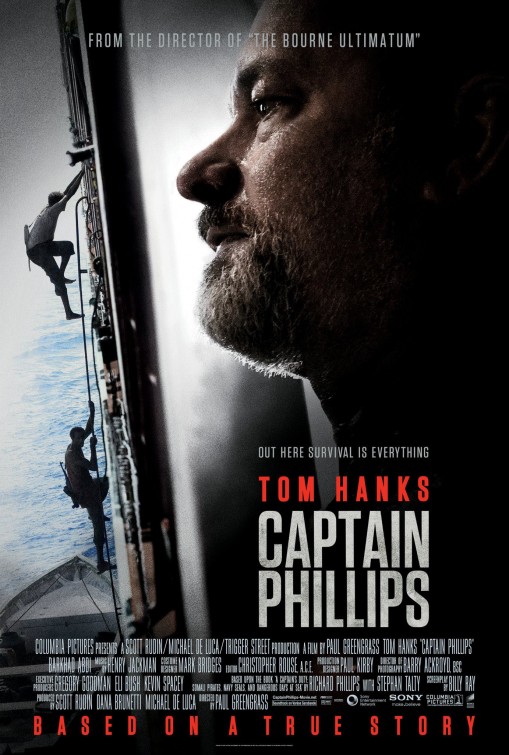 In 2009, international headlines were made when Richard Phillips, the captain of the cargo ship Maersk Alabama, was taken hostage by Somali pirates for four days before being rescued by the US Navy. He wrote a book about his experiences, Captain’s Duty: Somali Pirates, Navy SEALS, and Dangerous Days at Sea, and now Paul Greengrass – the director the of The Bourne Supremacy, The Bourne Ultimatum and, more relevantly, United 93 – has brought the story to the screen in the impressive Captain Phillips.
We have all heard about Somali pirates and how dangerous the journey around the horn of Africa can be for cargo ships without really knowing how it works. The notion of seafaring pirates seems so old-fashioned that it is, for the uninitiated, difficult to fathom how the practice still takes place in the present day. As such, part of what makes Captain Phillips so interesting is the procedural nature of the film. Almost a docu-drama, the film shows us how high seas piracy functions in the modern world. We get to see not only how a small group of pirates can take possession of a massive container ship, but also the processes the container ships go through in the face of a pirate threat. But don’t let Greengrass’ devotion to detail and process fool you into thinking this film is in any way bland. Captain Phillips is intense, gripping storytelling.
Emotionally, the film is carried by a strong leading performance from Tom Hanks. Phillips is a veteran seaman. When he is aboard he is all business. He likes to be prepared, and initially gets his crew offside by insisting on running emergency drills. But when those emergency threats become real as the boat is approached by a skiff containing four pirates armed with automatic weapons, there is no one the crew would rather have in charge. Alongside a strong sense of duty and responsibility, Phillips is a cool head under pressure and a quick thinker. He is a schemer. The brilliance of Hanks’ performance is that so much of it is about what the character is thinking. But what propels this performance to sit among the very finest work that Hanks has produced are the post-trauma scenes in which Phillips, who has to this point been so measured, is simply unable to process the incredible ordeal he has just been through. Those scenes are devastatingly effecing. Hanks is a certainty to earn a Best Actor nomination at next year’s Academy Awards and will be a real chance of joining Daniel Day Lewis in the three Oscars club.
Hanks is the only name in the cast unless you count the blink-and-you’ll-miss-it appearance from Catherine Keener as Phillips’ wife at the beginning of the picture. However his performance is complemented by some equally strong work from the supporting cast, most notably the four first time actors who deliver impressively nuanced performances as the Somali pirates.
One of the great strengths of Captain Phillips is the way that it chooses to humanise the Somali characters when it so easily could have presented them as a terrifying other. Greengrass breaks from Phillips’ point of view by subtitling the Somali characters, so that unlike Phillips we can always understand what they are saying. In doing so he gives us access to those characters. Instead of one collection of bad guys we see four distinctly different men, displaying different emotions and reacting to the experience, and to the figure of Phillips, in individual ways. Their captain, Muse, is a man acting out of desperation. Not just the desperation of poverty which compels him to steal and kidnap to stay alive, but the desperation to prove himself to the other men in his village who deride him for his slight build. He goes on his own emotional journey in the film as he attempts to prove himself as a leader, with the way he finds himself simultaneously drawn to and pushing away from Hanks’ Phillips because he possesses the leadership qualities Muse aspires to being really interesting. The humanising of the Somali pirates is helped by the fact that despite being the aggressors and as such the villains of the film, they are also consistently the underdogs, and as an audience there is something in us which is compelled to sympathise with the underdog.
It is always impressive when a film based on high profile actual events, and therefore with a well-known outcome, manages to create and maintain legitimate dramatic tension. With Captain Phillips, Greengrass goes much further than simply maintaining dramatic tension. He delivers one of the most intense, gripping and interesting films of the year.
Rating – ★★★★☆
Review by Duncan McLean
Oscars 2013 Recap
The Host
This year the most thankless job in Hollywood went to Family Guy creator Seth McFarlane, in a move which was obviously supposed to give the ceremony a bit of edginess and youth appeal (and on that front it was a success with the viewer numbers in the US up 20% from last year). The reviews of McFarlane’s performance have ranged from lightly positive to downright scathing. It’s a tough job at the best of times, but it was made all the tougher, as he alluded to, by the fact that Tina Fey and Amy Poehler had been so universally praised for the job they did at the Golden Globes a few weeks ago.
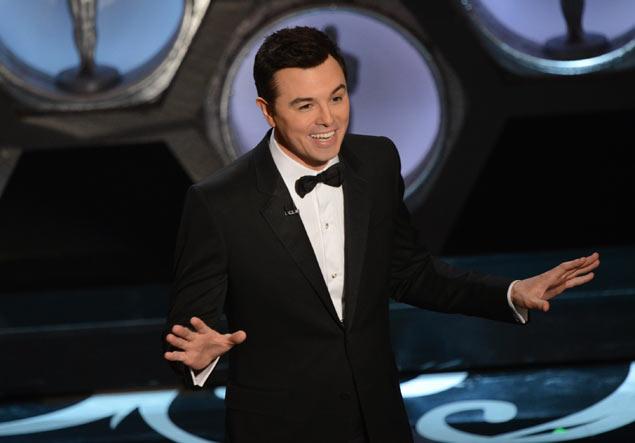
Oscars host Seth McFarlane
McFarlane was a bit hit and miss, as most hosts are, but was largely exactly what anyone who is familiar with him expected him to be. His opening bit, in which he conversed with William Shatner as Captain Kirk who was contacting him from the future to warn him against all the mistakes he was going to make as a host, came in at 19 minutes and was just way too long. There was a good idea there, but it was just stretched too far.
The humour in McFarlane’s television and film work comes from two sources: crossing the line of good taste and being inappropriate, and very specific pop-culture referencing. Both were on display on Oscar night. While it was apparent that he was reining himself in to some extent, McFarlane was always going to try and push things a little bit. Sometimes it worked and sometimes it crossed the line. The joke about no actor being able to get inside the head of Abraham Lincoln quite like John Wilkes Booth, was in typically poor taste but it got a good laugh. The “We Saw Your Boobs” song in his opening number didn’t go down so well, being just one of a number of incidents which led feminist commentators to accuse the host of misogyny (though as Family Guy co-writer Alec Sulkin pointed out on twitter, it seems slightly ironic to accuse the host of misogyny on a night that was also celebrating fifty years of James Bond).
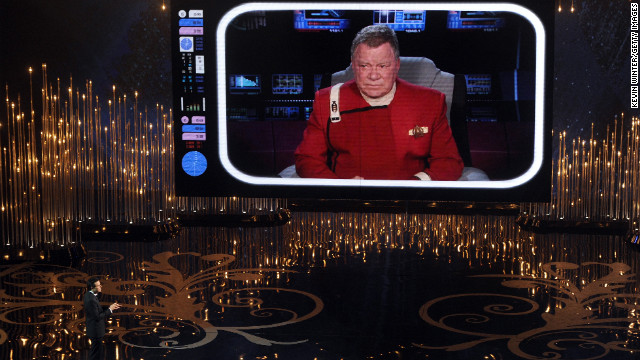
Captain Kirk helps out Seth McFarlane
McFarlane may have been better served to more heavily favour the pop-culture referencing, given he was in a room full of people who live and breathe movies and would therefore understand that kind of referencing and in-joking. His introduction of Christopher Plummer, in which he pointed to a side door to usher in the Von Trapp family singers only to have a young Nazi run in and exclaim “They’re gone!” went down a treat. A bit more of that sort of stuff and a bit less of jokes about nine-year-old Quvenzhané Wallis being a potential future girlfriend for George Clooney, and he may have got a more generally positive response.
The Presenters
This year it was really pleasing to see a bit of class return to the Academy Awards on the presenter front. The Oscars are an institution and an important part of maintaining that sense of grandeur is having big names presenting awards. In recent years the really big names have been notably absent, but this time around the presenters included screen legends such as Christopher Plummer, Michael Douglas, Jane Fonda, Meryl Streep (because she wasn’t actually up for an award this year) and Jack Nicholson. Their presence brought a bit of prestige to the event. That being said, I want to have one whinge. Jack Nicholson was brought out to present the Best Picture award, but had to hand over to Michelle Obama who appeared via a live video cross from the White House. Michelle Obama is a good get for the Academy, however, in this situation I don’t think she trumps Jack Nicholson (especially not on video). Jack is one of Hollywood’s absolute living legends, and being in the twilight of his career and not doing a lot of publicity means we don’t really see much of him. Michelle Obama tends to appear on the nightly news just about every day, so I felt that her presence was a waste of valuable Jack time.
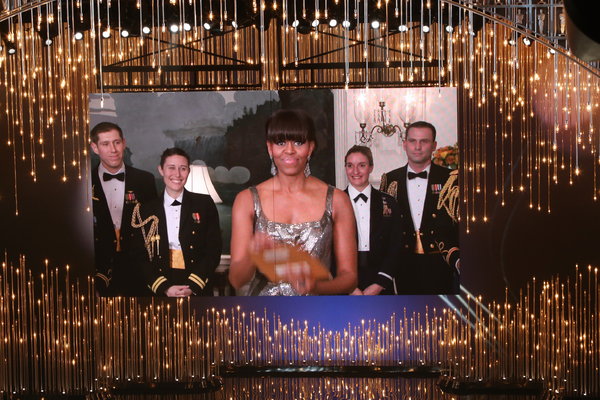
Not even Barack is as in love with Michelle Obama as the woman on her left
As always, the presenters were a bit hit and miss in their attempts at pre-announcement banter. Paul Rudd and Melissa McCarthy take the cake for least funny seemingly adlibbed jokes, and Kristen Stewart and Daniel Radcliffe have no business being on stage at an Academy Award ceremony at this point in their careers (Stewart was her usual grumpy self but at least this time had the excuse of an injured foot).
Moment of the night from a presenters point of view was Mark Wahlberg who had to present the Best Sound Editing category in which there was a tie. Clearly taken aback by what he was reading, Wahlberg felt he needed to convince the crowd that he wasn’t having them on, so in classic Boston fashion stated “No BS. We have a tie.” When I was saying before that the presenters brought back a bit of class to the event, I wasn’t so much thinking about Marky Mark.
The Awards
Despite the fact that this was one of the more open Academy Awards in recent history it ended up being a night almost entirely devoid of surprises on the awards front. Argo followed on from its dominance of the lead up awards to claim Best Picture. Daniel Day Lewis cemented his position as one of the all-time greats with his win for Lincoln making him the first man to win the Best Actor award on three occasions. Jennifer Lawrence tripped over on her way up to collect her Best Actress award. Christoph Waltz’s magic relationship with Quentin Tarantino continued as he claimed his second Best Supporting Actor Oscar from two collaborations. Anne Hathaway won the one award which was such an absolute lock you could have bet your house on it. In fact, the only major award in which the bookies’ favourite didn’t walk away with the statue was Best Director, in which Ang Lee pipped Steven Spielberg (but that category was a shambles from the moment Ben Affleck and Kathryn Bigelow were left off the nominations list).
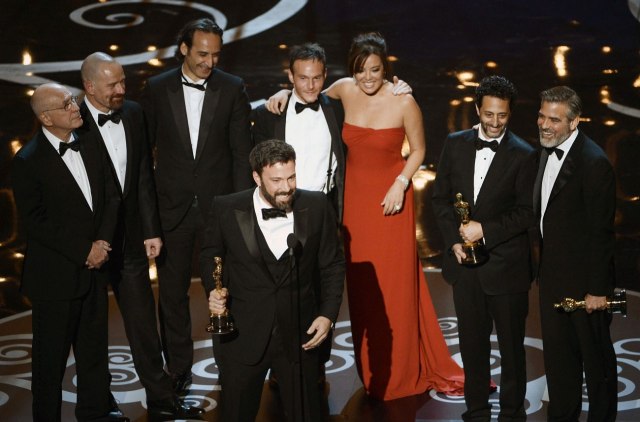
Argo takes out Best Picture
The speeches are always the least interesting part of an awards night. After the excitement of finding out who wins you then have to sit through a couple of minutes of them listing names of people you don’t know. In a nice, if not overly subtle, comic touch, the decision was made to replace the usual play-them-off music with the theme from Jaws, with John Williams’ ominous tones letting rambling recipients know that their time was up. As is always the case, there is a bit of a double standard when it comes to playing them off, with winners of lesser awards being cut while Quentin Tarantino was able to finish his speech, walk away from the microphone and then come back to say one more thing and have the music stop for him.
Christoph Waltz spoke beautifully, Adele spoke horribly (but that is more to do with the fact that her speaking voice is every bit as ghastly as her singing voice is wonderful). Daniel Day Lewis got big laughs for his revelation that he and presenter Streep had, after much thought, decided to switch roles, as he was originally meant to play Margaret Thatcher and she Abraham Lincoln. But for mine, best line of the night goes to Argo producer Grant Heslov who, standing between co-producers George Clooney and Ben Affleck, opened his acceptance speech with “I know what you’re thinking… three sexiest producers alive.”
The Musical Numbers
The “theme” for this year’s ceremony was a celebration of movie musicals, seemingly because Les Misérables had been nominated for Best Picture and because it was ten years since the last time a musical won Best Picture (Chicago). It was a bit of a shame, therefore, that a number of the musical numbers for the evening were a bit flat.
Both Shirley Bassey, singing ‘Goldfinger,’ and Adele, singing ‘Skyfall,’ appeared to be singing within themselves, not really punching the big notes, except for the last “Gold” which Dame Shirley hammered. The cast of Les Misérables came out to sing a number, an awkward mash-up of ‘Suddenly’ and ‘One Day More’ designed to give everyone a bit to sing, even if they are not in that scene, without going on too long, which just ended up sounding a bit messy.
While there was nothing spectacular about Barbara Streisand’s performance of ‘Memories’ as part of the In Memoriam section, it was still a reasonably big deal to see her on stage. But Jennifer Hudson was the absolute standout for the night and really brought the house down with her rendition of ‘And I Am Telling You I’m Not Going’ from Dreamgirls, appropriately receiving a standing ovation.
As it turns out, after it was all said and done the moment of the night didn’t even happen as part of the ceremony, but in the interviews after. Jack Nicholson, obviously agreeing with me that Michelle Obama got in the way of valuable Jack time, decided that he would interrupt Jennifer Lawrence’s interview with ABC. Classic Jack…
by Duncan McLean
Best Picture Breakdown
This year’s Best Picture race is one of the most open in recent memory, with no film being expected to dominate proceedings and take home a swag of awards. Obviously this means that it is going to be trickier than usual to tip the winner. When it comes to tipping Oscar winners it is important to remember that you are tipping who you think will win the award, not necessarily who you think should win the award. For that reason, sometimes it is more difficult to accurately tip award winners when you have seen a number of the films, because your own tastes and opinions tend to cloud your judgement. So what follows is a simple for and against for each of the nine nominees for this year’s Best Picture award. Then you can weigh up the arguments, see which you think is the most convincing, and then blindly guess the same way you do every year.
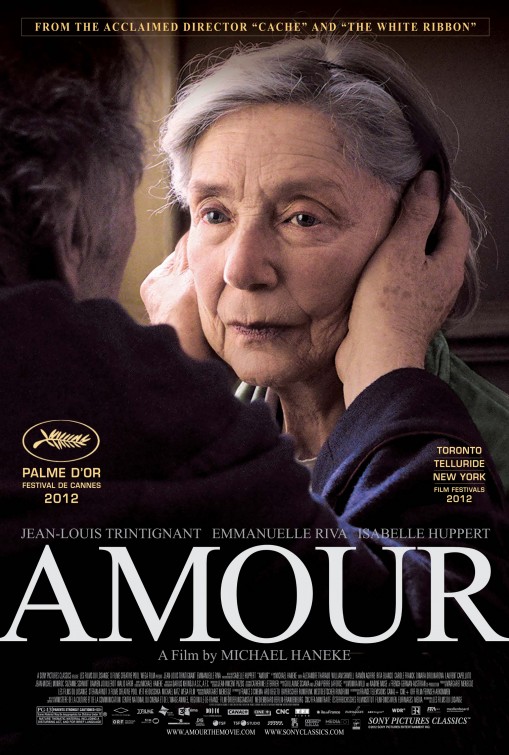
Amour
Five Nominations
Notable Awards: Cannes Film Festival Palme d’Or, BAFTA Best Film Not in the English Language, Golden Globe Best Foreign Language Film, European Film Awards Best Film, National Board of Review Best Foreign Film, National Society of Film Critics Awards USA Best Film
Why Amour will win: Amour is only the ninth foreign language film in 85 years to even get a nomination for the big award, and the fact that it has five nominations all up, including for Director (with Cannes Film Festival darling Michael Haneke making the cut ahead of the likes of Tarantino, Bigelow and Affleck) and Screenplay, two categories which usually go with a Best Picture win, suggests that the Academy sees this film as a legitimate contender, rather than just rewarding it with an also-ran nomination. And hey, a French film took home Best Picture last year. So it can happen.
Why Amour won’t win: You want to know how many times a foreign language film has won Best Picture at the Oscars? Zero. It has never happened. The closest you can get to foreign language winners are The Godfather Part II, The Last Emperor and Slumdog Millionaire which all won Best Picture and contained sequences of dialogue in Sicilian, Mandarin and Hindi respectively.
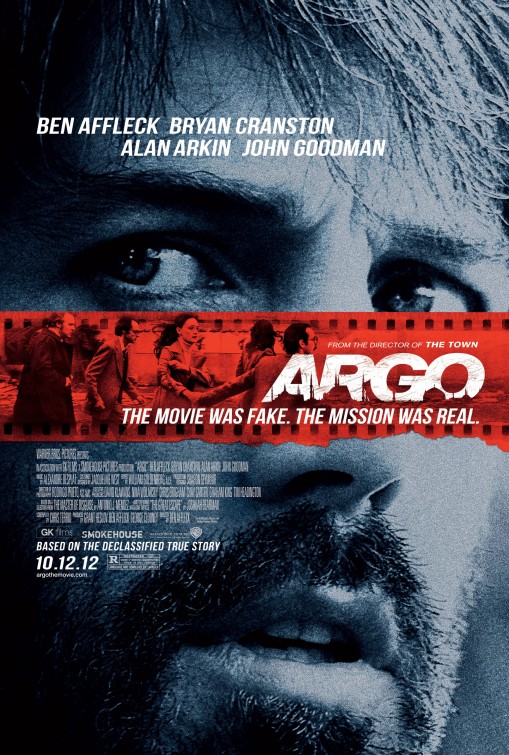
Argo
Seven Nominations
Notable Awards: Golden Globe Best Drama, BAFTA Best Film, DGA Outstanding Directorial Achievement in Motion Pictures, SAG Best Ensemble Cast in a Motion Picture, AFI Movies of the Year, National Board of Review Top Films
Why Argo will win: Momentum. After initial fears that Affleck missing out on a Best Director nod meant the film wasn’t really in the running, in recent weeks Argo has firmed as the favourite after taking out a number of lead up awards. Winning the Golden Globe isn’t always the best guide to picking the Oscar winner, but winning the Directors Guild of America Award is. Despite there being two best picture awards at the Golden Globes, one for drama and one for musicals or comedy, only four times in the last ten years has the winner of one of those two awards gone on to win Best Picture at the Oscars. On the other hand, nine out of the last ten films to pick up the Outstanding Directorial Achievement in Motion Pictures award at the DGA awards have gone on to win Best Picture at the Oscars that year (the only one to miss out was Brokeback Mountain which was pipped for the Oscar in a bit of a surprise by Crash in 2006). Hence the reason a number of eyebrows were raised when Ben Affleck won that award this year.
Why Argo won’t win: The big red flag next to Argo is the fact that Ben Affleck did not receive a nomination for Best Director. Across the previous 84 Academy Award ceremonies, only three times has a film won the top award despite its director failing to receive a best director nomination, with Driving Miss Daisy in 1990 being the only example since the early 1930s. Of course, in the last couple of years the Best Picture field has expanded from five nominees to up to ten. So whereas once it was the norm for the five Best Picture nominees to provide the five Best Director nominees, under the new system there will always be at least four or five Best Picture nominees that won’t be represented in the directing field. The temptation is to see those films which don’t also get a Director nod as the also-rans in the field.
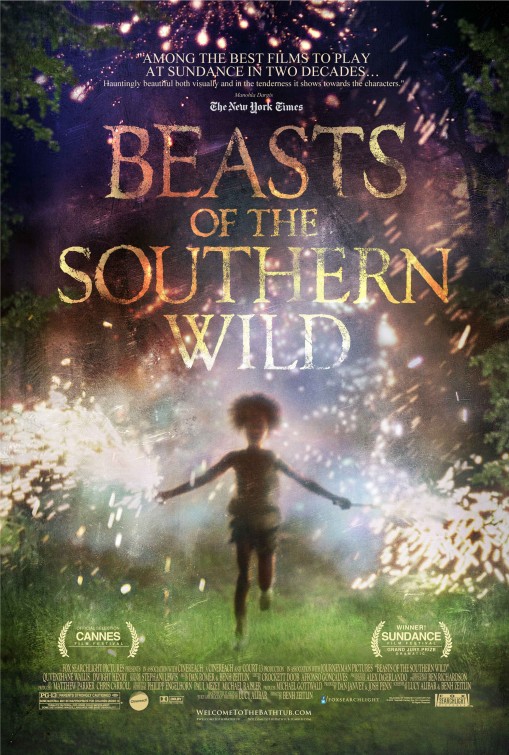
Beasts of the Southern Wild
Four Nominations
Notable Awards: Sundance Film Festival Grand Jury Prize, AFI Movies of the Year, NBR Top Films
Why Beasts of the Southern Wild will win: The Beasts of the Southern Wild is the little film that could. The surprise hit of the year, it came out of nowhere to feature prominently in a number of Best Films of 2012 lists. It definitely stands out in the field as something totally different. A small budget, artistic premise, a six-year-old leading lady and a debut director (both of whom have been nominated in their respective categories). Could the Academy voters get swept up in the fairytale of it all? It’s also not unheard of for a directorial debut to win Best Picture. Sam Mendes’ American Beauty, Kevin Costner’s Dances with Wolves and James L. Brooks’ Terms of Endearment are the most recent to have done it.
Why Beasts of the Southern Wild won’t win: Small indie films win festival awards, they don’t win Academy Awards.

Django Unchained
Five Nominations
Notable Awards: AFI Movies of the Year, NBR Top Films
Why Django Unchained will win: There is the feeling that Tarantino has been working his way towards Academy recognition. He is one of the most influential filmmakers of the last twenty years and the Academy don’t want to find themselves in the same situation that they had with Martin Scorsese where it wasn’t until almost forty years into his career, and after helming a number of films regarded as all-time greats, that he finally won a Best Picture and Best Director award. Inglourious Basterds got close. Could Django Unchained be the film the Academy recognises (even though Tarantino himself failed to get a nomination)? Also, Django Unchained really stands out in the field for its appeal to the youth demographic. The Academy Award ceremony has been trying hard for the last couple of years to appeal to the youth demographic, to maintain relevance and combat a declining viewership. Could the same thinking enter the voting process?
Why Django Unchained won’t win: Tarantino’s eighth feature film seemed to be firming as a real Oscar contender until the Sandy Hook Elementary School shooting happened. It changed the story. After that event rather than slavery or spaghetti westerns Tarantino found himself, once again, forced to talk about excessive violence in his cinema. He then failed to receive a Best Director nomination, and unlike Argo and Zero Dark Thirty which have maintained their relevance in this race despite missing Director nominations, Django Unchained seems to have fallen by the wayside. You could also argue that Django Unchained isn’t as good as Inglourious Basterds was and it is competing in a stronger field. So if the Academy wasn’t willing to favour Tarantino in 2010 it doesn’t look like they will in 2013.
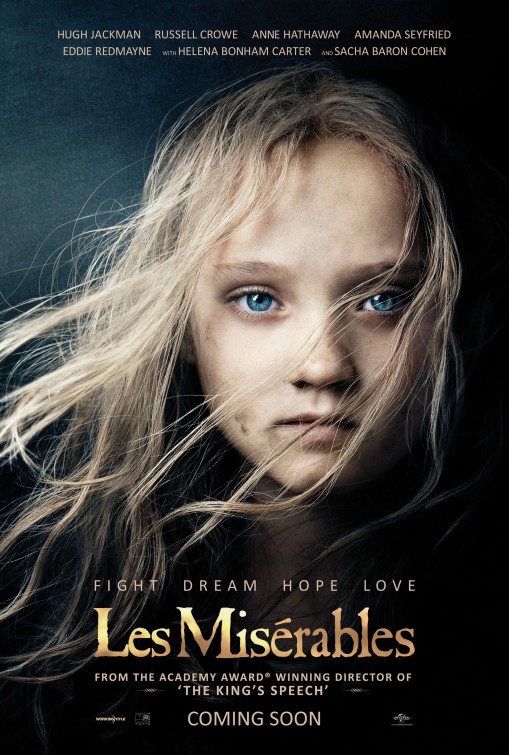
Les Misérables
Eight Nominations
Notable Awards: Golden Globe Best Musical or Comedy, AFI Movies of the Year, NBR Top Films
Why Les Misérables will win: Les Misérables seems like an obvious contender. You have one of the most popular stage musicals in history being finally brought to the screen with an all-star cast (two of whom have been recognised with acting nominations) by an Oscar-winning director. Tom Hooper followed up his surprise success with The King’s Speech by opting for this very ambitious project. It is a significant upping of scale from his previous films and could help with the perception of him progressing and evolving from his previous success. The other X-factor for the film was the unconventional approach to shooting the musical numbers, with the actors singing live on set rather than lip-synching to pre-recorded songs. Could this experimental approach, which allows much more performative freedom to the actors, be deemed as worthy of recognition from the Academy?
Why Les Misérables won’t win: In the 1960s there were four musicals that walked away with the Best Picture award: West Side Story, My Fair Lady, The Sound of Music and Oliver! In the 44 years since Oliver! won only one musical has the award, Chicago in 2002. That is a roundabout way of saying that musicals don’t tend to fare well in recent times. And Les Misérables isn’t even just a musical, it’s practically an opera. Also, Russell Crowe.
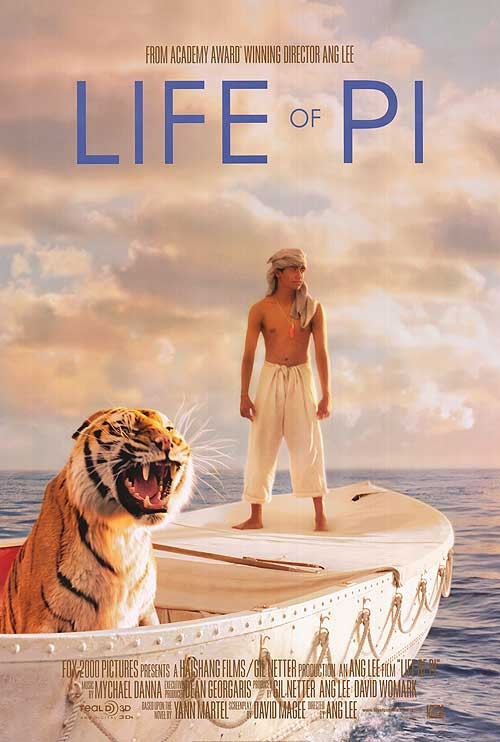
Life of Pi
Eleven Nominations
Notable Awards: AFI Movies of the Year
Why Life of Pi will win: Ang Lee, an Academy favourite, has taken a much-loved book which many thought was unfilmable and brought it to life, at the same time as showing the industry the potential of digital and 3D technologies. Life of Pi is tipped to be a major player in the Visual Effects and Cinematography fields, but the fact that the film also received nominations for Best Adapted Screenplay and Best Director suggests it is seen as more than just a technically impressive film. For a film which is at best being talked about as an outside chance, it is worth noting that Life of Pi has earned more nominations than any film other than Lincoln.
Why Life of Pi won’t win: With the film being tipped to do so well in the technical categories, there is the danger Academy voters will see Life of Pi’s primary achievement being technical, that it is first and foremost a beautiful looking film. Very rarely do films come out on top in the Best Picture category on the grounds of being amazing technical achievements. Titanic ? Maybe Lord of the Rings?
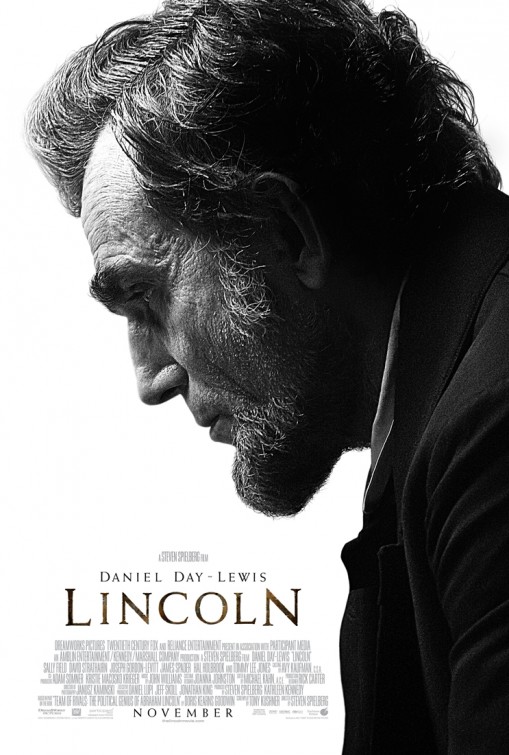
Lincoln
Twelve Nominations
Notable Awards: AFI Movies of the Year, NBR Top Films
Why Lincoln will win: Do I have to spell it out for you? A period drama about America’s most worshiped president, directed by the world’s biggest director, with an all-star cast led by arguably the finest actor of his, or any, generation. How could it not win?
Why Lincoln won’t win: For all the above reasons, Lincoln feels almost too good to be true. In the eyes of many people it just smells like Oscar bait, and sometimes the Academy reacts against that. Also, this film more than any other in the category had to deal with the weight of serious expectation when it came out. It is a fantastic film, but everyone expected it to be. Has it done enough to exceed people’s expectations and win voters over, or will the high expectations it had to deal with mean it gets overlooked in favour of one of the more “surprising” films.
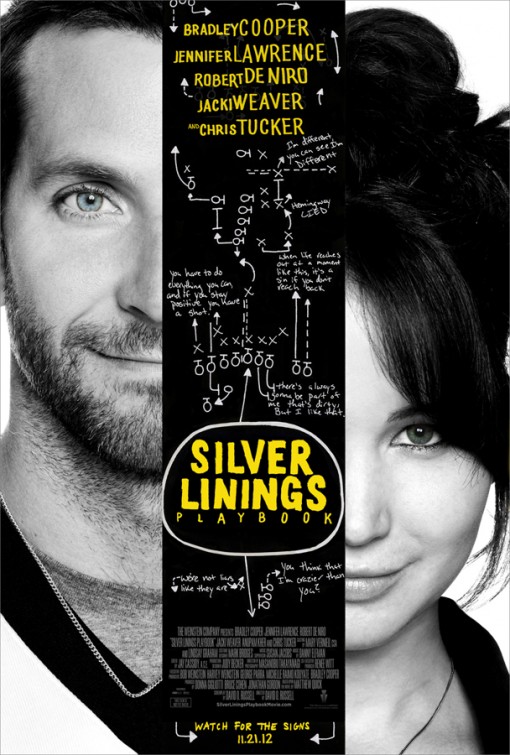
Silver Linings Playbook
Eight Nominations
Notable Awards: NBR Top Films
Why Silver Linings Playbook will win: While it’s eight nominations is not the most by any candidate this year, it is the categories they came in which is significant. Usually we talk in terms of the ‘Big Five’ categories (Picture, Director, Actor, Actress, and one of the Screenplay categories). In also getting nominations in the Supporting Actor and Actress categories, Silver Linings Playbook is the first film in 32 years (since Warren Beatty’s Reds in 1981) to get nominations in the Big Seven categories. It suggests that the Academy sees this as being an excellent achievement across the board. It also should be noted that the last three films to receive nominations in the big five categories (Million Dollar Baby, American Beauty, The English Patient) all went on to win Best Picture.
Why Silver Linings Playbook won’t win: While it feels unfair to pigeonhole Silver Linings Playbook as a romantic comedy, when it boils down to it that is what it is, a brilliantly written romantic comedy. And unfortunately for David O. Russell, comedies don’t traditionally fare well in this category. In the last thirty years the only two films which could be described as comedies to have won Best Picture are Shakespeare in Love in 1998 and The Artist in 2012. Also, despite scoring nominations across the big seven categories, it is really only Jennifer Lawrence who is considered among the favourites. So it is entirely possible that Silver Linings Playbook could be staring down a shutout.
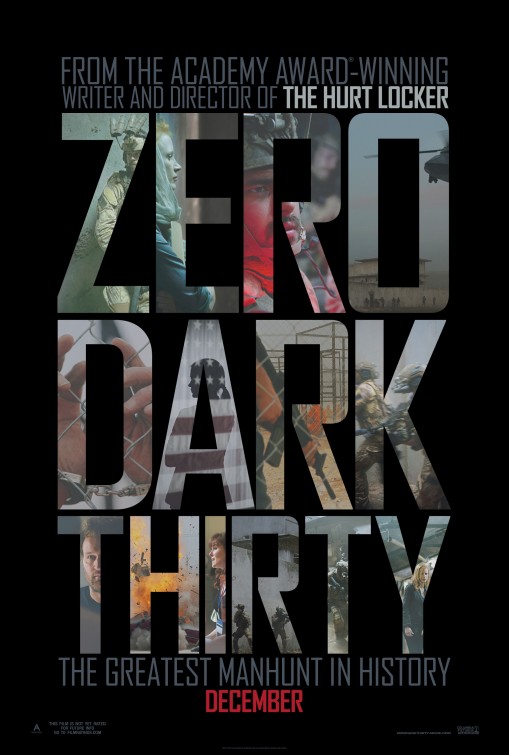
Zero Dark Thirty
Five Nominations
Notable Awards: NBR Best Film, AFI Movies of the Year
Why Zero Dark Thirty will win: Before it had even been released, Zero Dark Thirty had already won the New York Film Critics film of the year award, and early on it was seen as Lincoln’s primary competition for the Best Picture Oscar. In recent times its momentum has plateaued a bit, particularly with Bigelow failing to receive a Best Director nomination, but still remains among the serious contenders. The film is a harsh and unimpassioned look at the hunt for bin Laden and, as such, has an immediate political significance. As yet we haven’t seen an Oscar go to a film dealing directly with the events of 9/11 and its aftermath, but none of them have been as good as this one and perhaps the closure to the story that comes from the death of bin Laden means voters are ready.
Why Zero Dark Thirty won’t win: While Zero Dark Thirty is seen as one of the real contenders it has had to deal with some controversy surrounding the perceived messages it sends about the use of torture as an interrogation method. Is the film pro-torture? The Oscars are not a ceremony that tends to court controversy. There is nothing particularly edgy about the Academy. The hint of something being divisive could frighten off the voters.
——-
So with all that in mind, I think the nominees can be broken up into four categories…
The Contenders: Argo, Lincoln, Zero Dark Thirty
The Potential Dark Horses: Life of Pi, Silver Linings Playbook
The Outsiders: Amour, Django Unchained
Thanks for Coming: Beasts of the Southern Wild, Les Misérables
by Duncan McLean
Review – Zero Dark Thirty (2012)
Director: Kathryn Bigelow
Starring: Jessica Chastain, Jason Clarke, Kyle Chandler, Jennifer Ehle, Mark Strong, Chris Pratt, Joel Edgerton, James Gandolfini
“We got him.” Those were apparently the words President Obama uttered as confirmation came through that Osama bin Laden had been killed at 12:30am (‘zero dark thirty’ in military speak) on the 2nd May 2011 as part of a successful raid on a fortified compound in Abbottabad, Pakistan. Less than two years later, Academy Awards winning director Kathryn Bigelow has brought the story of that mission to the big screen. She was able to turn the movie around so quickly because it was already in development at the time bin Laden was killed, though significant rewrites were required as it was originally intended to be about the unsuccessful decade-long manhunt.
Maya is a young CIA analyst assigned to the operation to find bin Laden. When interrogation of a prisoner (more on that later) reveals the name Abu Ahmed a-Kuwaiti, supposedly a personal courier for bin Laden who everyone has heard of but no one can identify, Maya becomes fixated on the idea that finding him will lead them to bin Laden. But not only is Maya a woman in a man’s world, she is a young woman in an older man’s world, and as the search continues over a number of years, she consistently finds herself butting heads with male superiors whose Cold War era understanding of intelligence makes them difficult to convince.
Zero Dark Thirty is effectively a historical drama in the style of a thriller, set in the very, very recent past. This makes it a bit strange on two fronts. As a thriller, the fact that you already know the resolution creates an unusual dynamic, and as a historical drama, it feels odd watching a recreation of events which still feel like part of the present. The strangeness struck me in a moment when President Obama appeared on a television screen in the background of a shot. I’m used to seeing much older Presidents on television screens in movies; JFK, Nixon or Reagan, not the guy that I see on the news every night. Historical dramas usually require a bit of distance from the events they are trying to depict in order to gain some sort of objective perspective. For example, despite his impressive track record of historical dramas, Oliver Stone’s biopic W. was terrible, and one of the primary reasons for its shoddiness appeared to be that it was too biased and politicised a film. Released in late 2008, in the final months of Bush’s second term as president, the film had an obvious agenda leading into the election, which coloured its portrayal of characters and events. It is for this reason, among many others, that Bigelow’s film is a great achievement. Zero Dark Thirty manages to depict very recent events which are still hot-button topics with a sort of neutrality, without being preachy or didactic in any way.
It is this currentness of events that has landed the picture in a bit of controversy. One of the hottest political issues to come out of the hunt for bin Laden at the time was the role of torture and humiliation tactics in CIA intelligence gathering. The first third of Zero Dark Thirty contains some quite graphic and very confronting scenes of CIA interrogators using the torturing of prisoners as a means of getting them to divulge information. These depictions have prompted some commentators to accuse the film of endorsing the controversial practice. Others have come to the defence of the film, including Michael Moore who wrote this article for the Huffington Post.
Watching the film myself, I never felt that I was watching a pro-torture film. The film doesn’t shirk away from showing the central role torture played in early intelligence gathering, but when you think about it there was no other option. Could you imagine the equivalent shit-storm that would be surrounding the film if Bigelow had somehow tried to undersell the role of torture or even write it out of the history completely? It was such an ugly and public controversy that it had to feature prominently in the retelling of the story. However, as Bigelow herself has argued, depiction is not the same as endorsement. I would add to her point that a film containing characters, even protagonists, who endorse the practice of torture is not the same thing as the film itself endorsing the practice.
The scenes of torture, particularly the waterboarding, are very difficult to watch. And therein lies the key. They are difficult to watch because of where our empathy lies. As Moore alluded to in his argument, at no point do we find ourselves empathising with the interrogator, hoping that he can break the prisoner and make them talk. In these scenes we always find ourselves emotionally aligning ourselves with the tortured prisoner, even when we are told of their supposed role in the 9/11 attacks. That we find ourselves compelled to side with the ‘enemy’ in the scene suggests that the film is anti-torture.
After her critical success with The Hurt Locker, Kathryn Bigelow’s direction of Zero Dark Thirty cements her as the world’s premier director of films about modern warfare, a very different beast to the style of combat which has for so long been the staple of the war movie genre. The final raid on bin Laden’s compound is masterfully staged with a gritty realism. The methodical way the soldiers go about performing their task is very interesting and makes for a really engaging scene, even if it is not the big, high-octane payoff that a thriller usually ends with. The tension is impressive given the potential for the film’s third act to be a massive anti-climax with everyone knowing exactly what happens. Bigelow’s failure to be recognised with an Oscar nomination in the Best Director category was one of the bigger surprises of this year’s nominations.

Jessica Chastain as Maya
With Bigelow’s profile as a director meaning she is forced, whether she wants to or not, to wave the flag for women in film, it is also pleasing to see her direct a film with a female protagonist. Jessica Chastain delivers a very strong performance as Maya and is one of the favourites in the Best Picture category at this year’s Oscars. Over the last couple of years Chastain has emerged as a talented and versatile performer. She was delightful in The Help as the hopeless housewife and social outcast, Celia Foote, and also caught people’s attention as Brad Pitt’s wife in Terrence Malick’s The Tree of Life. As Zero Dark Thirty’s determined heroine, Maya, Chastain shows us something different again. Her roles in The Help and Tree of Life were both very emotionally open characters, here she plays her cards much closer to her chest. She is very closed off and methodical, living for the job.
Zero Dark Thirty is different to any thriller or war movie you have seen –our protagonist isn’t an action hero, she’s a desk jockey – but it is no less thrilling. It is a masterfully orchestrated film that takes you inside the intellectual process of finding the most wanted man in the world.
Rating – ★★★★
Review by Duncan McLean
Review – Silver Linings Playbook (2012)
Director: David O. Russell
Starring: Bradley Cooper, Jennifer Lawrence, Robert De Niro, Jacki Weaver, Chris Tucker
It’s not often that you encounter something truly original at the movies these days, particularly not in the ‘boy meets girl,’ romantic comedy genre, one of Hollywood’s most generic forms. But originality is exactly what we get from David O. Russell (director of Three Kings and The Fighter) in his latest film Silver Linings Playbook.
The originality starts with our unconventional, but incredibly engaging romantic pairing, Pat and Tiffany. Pat is bipolar and has just been released from a court ordered stint in an institution after he beat up a man he caught in the shower with his wife. He has moved back in with his parents and is determined to win back his wife, Nicki. Pat’s time in treatment has left him with a new outlook on life. He is all about positivity, “excelsior,” and finding the silver lining to the dark cloud that he is working through. Tiffany is a damages soul like Pat, though her scars are emotional rather than physiological, after losing her husband in a car accident. Both characters are frustrated, struggling to live with a support network that doesn’t understand them and a society that doesn’t trust them. But they understand each other, and they become friends.
We have never seen these characters before on the big screen, at least not presented in the way they are here. One of the great achievements of Silver Linings Playbook is that it removes the ‘otherness’ from mental illness. Through their characterisation, and some of the directorial choices of David O. Russell, the film encourages us to identify with Pat and Tiffany, rather than to identify with the other characters trying to deal with Pat and Tiffany – we empathise with them rather than merely sympathising. And in siding with the two supposedly “crazy” characters we start to see the insanity of the regular world. We notice the quirks, foibles and obsessions in other characters – some minor, some not so minor – which are deemed socially acceptable in a way that Pat’s and Tiffany’s are not.
Russell’s beautiful screenplay is brought to life by a series of really strong performances. In fact, Silver Linings Playbook became the first film in 31 years, since Warren Beatty’s Reds in 1982, to receive an Oscar nomination in all four acting categories.
Bradley Cooper is the real surprise. Cooper has been a movie star for a while now but has seldom been required to do much more than be charming and look handsome. His performance as Pat, a man struggling to deal with the unknown in himself, is a revelation, showing us something of his talent that I doubt many knew was there. Bipolar is all about extreme ups and downs, highs and lows. Pat alludes to the fact that even before he had been diagnosed, his mood swings had been something that had troubled and frustrated his wife. Cooper imbues Pat with a manic intensity, which makes his positivity every bit as intimidating as his moments of aggression. But the really impressive part of his performance is the way he, with the help of the director, manages to get you to switch between emotional responses very quickly. Pat doesn’t have a filter when he talks – as Tiffany notes, he says more inappropriate things than appropriate things – and this is the source of much comedy. But on a number of occasions you find yourself laughing at Pat and then, in a heartbeat, feeling really sorry for him, or defensive for him, or afraid of him.
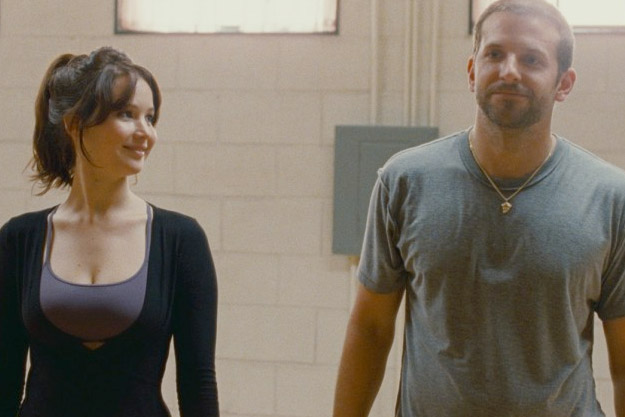
Tiffany (Jennifer Lawrence) and Pat (Bradley Cooper)
As Cooper’s foil, Jennifer Lawrence is every bit as impressive as Tiffany. The film really comes to life the moment that we are introduced to her. Pat and Tiffany’s meeting at an awkward dinner hosted by her sister is a fantastic scene and a preview of what is to come as the writer/director has fun with these two characters not bound by social conventions. As I said above, Tiffany’s scars are emotional rather than physiological, and as a result she is not as confused as Pat, but she is much angrier. She contrasts a real strength and willingness to stand up for herself with an extreme vulnerability. She is a sharp and abrasive, but at the same time likeable character. Lawrence burst onto the scene in 2010 when she earned an Oscar nomination for her work in Winter’s Bone. In the couple of years since she has done some more popcorn-style movies with a supporting role in X-Men: First Class and, of course, her leading role in The Hunger Games. But this performance in Silver Linings Playbook really cements her standing as one of the best young actresses out there, and of the four Oscar nominated performers in the film, for mine it is Lawrence that is most likely to take home a statue.
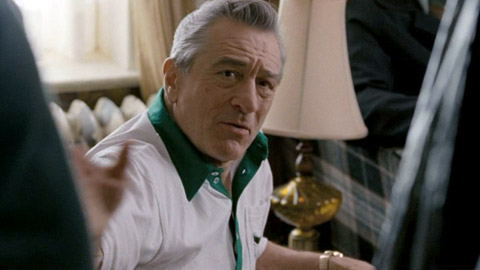
Robert De Niro as Pat Sr.
But the real treat for me was the performance of Robert De Niro. One of the absolute greats of the American cinema, it seems like decades since we have seen De Niro in a film which is worthy of his prodigious talent – you probably have to go all the way back to the mid-1990s when he did Heat, Casino and Jackie Brown. In recent times he has been reduced to playing caricatures of his own persona, often in reasonably uninspiring comedies: there was the gangster in therapy in Analyze This and Analyze That, psychotic retired CIA agent in the Meet the Parents series and, the lowest point of all, The Adventures of Rocky and Bullwinkle, where his role as Fearless Leader saw him spoof his own legendary “Are you talkin’ to me?” monologue from Taxi Driver. Finally, in the role of Pat Sr, De Niro has not only been given something he can really sink his teeth into, he has been given the chance to do something different. Pat Sr. is a bookmaker who is devoted above all to his favourite football team, the Philadelphia Eagles. He is superstitious to the point of being obsessive compulsive. He is willing to do anything within his power to not disrupt his Eagles’ juju, whether it is making sure the remotes are facing the right direction or making sure he has his lucky handkerchief. He is a loves his son, but lacks the knowledge of how to engage with him outside of the time they spend together watching football. It is a fun character, but not lacking in depth, and you can sense that De Niro is really engaged by in a way that he hasn’t been for some time.
I’ll admit I even really enjoyed Chris Tucker’s work in this movie, and that is quite a leap to make.
I referred to Silver Linings Playbook above as a romantic comedy, but I feel that kind of pigeon-holing really undermines the complexity and depth of this film. It is wickedly funny and at its centre is a relationship between a man and a woman, but it is also at different moments sad, uplifting, concerning, charming and poignant. It has been a while since I’ve loved a new film as much as I did this one. It is a beautifully crafted film that will really stay with you.
Rating – ★★★★★
Review by Duncan McLean
Review – Django Unchained (2012)
Director: Quentin Tarantino
Starring: Jamie Foxx, Christoph Waltz, Leonardo Dicaprio, Samuel L. Jackson, Kerry Washington
I’m a big fan of the Western genre. After an extended period of time in which it really went out of fashion in recent years we are starting to see a real re-emergence of the Western with quality productions like Andrew Dominik’s The Assassination of Jesse James by the Coward Robert Ford (2007), James Mangold’s remake of 3:10 to Yuma (2007), the Coen brothers’ remake of True Grit (2010) and, of course, the brilliant HBO series Deadwood (2004-2006). However, it is probably not since the 1950s that there has been a Western which has been greeted with as much popular anticipation as Quentin Tarantino’s Django Unchained.
Django Unchained again sees Tarantino doing what he does best, genre pastiche: taking past styles and forms of cinema that he loves and giving them the Tarantino twist. The result is kind of a Blaxploitation Spaghetti Western and it is ridiculously entertaining. Our setting is the deep south of the USA, in the years immediately preceding the Civil War. Our heroes are an unlikely duo, Django (Jamie Foxx) a slave, and Dr. King Schultz (Christoph Waltz), a onetime dentist now bounty hunter. The surprisingly conventional plot for a writer who made his name by tinkering with chronology and breaking his screenplays down into individual storylines and chapters, sees the two brought together when Schultz needs Django’s help to recognise a trio of wanted men. They stay together because Schultz feels compelled to help Django rescue his slave wife, Broomhilda von Shaft (Kerry Washington), from the horrible slave owner Calvin Candie (Leonardo DiCaprio).
Tarantino has been very intentional in his promotional interviews for Django Unchained about labelling the film as a “Southern” rather than a Western, emphasising the difference in the core conflict at the heart of his movie. The Western genre has always been racially charged, but it is usually white men and Indians, or white men and Mexicans. In Django Unchained we are focused on the tension between white and black in the Deep South (which does allow the writer/director to continue his fetishistic relationship with the N-word). We’ve seen movies about slavery before, but not quite like this. Tarantino isn’t looking to make any overt political statements about the plight of the African-American. Rather he does what only he seems to be able to do, taking a seemingly taboo subject from one of the darker periods in modern history and using it as the basis for a ridiculously entertaining and quite funny film. It was the formula which worked so effectively with Inglourious Basterds in 2009. In that case it was Wold War II Europe providing the setting for a revenge tale about a small group of American Jewish soldiers taking vengeance on the Nazis on behalf of a downtrodden people. In Django Unchained Tarantino does for 19th century American slavery what he did for the Holocaust three years ago. Again we have a revenge tale, but this time our avenging angel is one man and the oppressed people are the black slaves.

Christoph Waltz as Dr King Schultz
While Jamie Foxx is the first name billed and plays the title character, the real star of this film is Christoph Waltz. Tarantino is a lover of dialogue. There are few directors working in mainstream cinema who happily allow scenes of dialogue to extend for as long as Tarantino does. As an actor, Waltz manages to combine eloquence and a calm elegance with a genuine sense of menace which makes him the perfect vehicle for the director’s wordy but sharp dialogue. Waltz was a revelation in Inglourious Basterds. As a relative unknown his performance as Col. Hans Landa gave us one of the best screen villains of the decade and won him an Academy Award. His work in Django Unchained is every bit as good, and really blurs the line between a supporting and leading character. He has received an Oscar nomination in the supporting category, but I feel like he is the lead character, or at least the co-lead, for the first three quarters of the film. Either way, it is a tremendous performance, about as endearing as you can imagine a bounty hunter to be, and makes me hope for further collaboration between the Waltz and Tarantino in the future.
There are two other supporting roles which are worthy of comment, both due to the fact that they see highly regarded actors venturing outside of their usual character scope. Firstly we have Leonardo DiCaprio playing the villain, Calvin Candie. DiCaprio has always been known for his intensity of performance, but that intensity has never really been applied to a villainous role before. Outside of the things Candie does and says, there is so much about his character which just pushes your buttons. Whether it is the touch of boyishness in his face which makes you think of him as a spoilt child, the semi-incestuous relationship with his sister, or his rather uncivilised interests in blood sports and phrenology, there is just something that manages to make you uneasy in his presence.
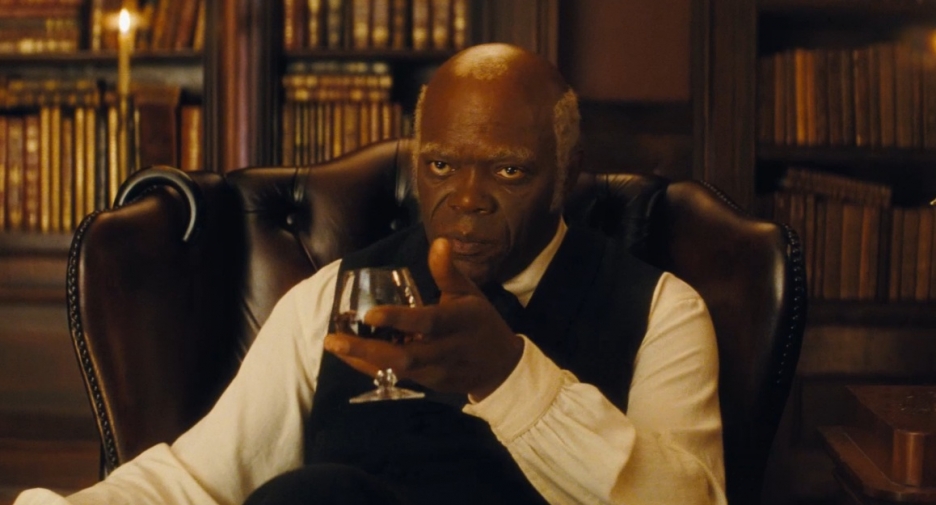
Samuel L. Jackson as Stephen
The other is Tarantino regular Samuel L. Jackson, and it is he who makes the greatest departure. In the same year that we saw him playing Nick Fury in The Avengers, Jackson delivers one of the performances of his career as Candie’s most trusted slave, Stephen. What makes the role so interesting, and challenging for us as viewers, is where Stephen sits in the racial divide that is at the centre of the film. Effectively Stephen is Candie’s chief of staff. He runs the house, is well dressed and treated by Candie with a level of respect not afforded to anyone else but his sister (there is a scene in which Candie and Stephen sit together drinking brandy which is indicative of their relationship). Stephen is a classic Uncle Tom figure, aligning himself with the white characters, seeing the other black characters as subservient and being an agent in their oppression. He believes in the status quo. Add to the fact that Jackson is playing an elderly man, weathered by many years of service, and it is quite an impressive achievement and has garnered some serious critical attention (if not the Oscar nomination he so openly hoped for).
Coming in at 165 minutes, while not excessive by current standards, Django Unchained is Tarantino’s longest film yet. Its main fault, which relates a bit to the runtime, is that at times it gets a little self-indulgent. Self-indulgence is always going to be a part of Tarantino’s cinema. So much of his style openly comes from his desire to engage with and replicate the things that he finds cool, in other words, indulging himself. So self-indulgence is not a problem in itself, but when it gets to the point of interfering with the flow of the picture it does become an issue. One scene in particular is representative of this. Towards the back end of the film there is a scene in which Tarantino makes a cameo appearance as one of the LeQuint Dickey Mining Company employees charged with transporting Django and some other slaves to the mines. For mine it is the worst scene of the film, though I’m sure some will point to the dancing horse at the films finale. Ignoring the fact that Tarantino’s performances in front of the camera have never come close to his prowess behind the camera, it is not his appearance in itself which makes the scene excessively self-indulgent. It is the fact that he is playing an Australian. One of the other workers in the scene is played by Australian actor John Jarratt of Wolf Creek fame. The Australian accents are quite jarring, and really make the scene stick out in a way that it wouldn’t have if they were playing Americans. Tarantino is a great admirer of Australian exploitation cinema (you can see him espousing his love in the wonderful 2008 documentary Not Quite Hollywood: The Wild, Untold Story of Ozploitation!) and it feels like the sole reason for the Australian characters, and much of the dialogue that flows from them, was that he wanted to have John Jarratt in his movie.
Django Unchained is the Western done Tarantino style, complete with a final bloody shootout to rival Peckinpah’s The Wild Bunch, and despite moments of self-indulgence it has the all requisite laughs, violence, cameo appearances and intertextual references to see that his legions of devoted fans will not be disappointed.
Rating – ★★★★☆
Review by Duncan McLean
Five Oscar Nomination Surprises
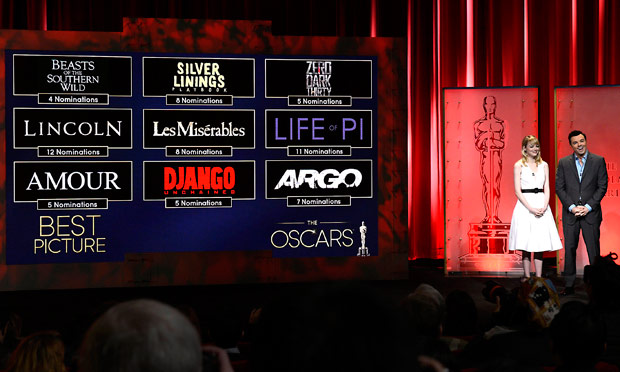
Seth MacFarlane and Emma Stone announce the nominees for Best Picture
At 5:30am Los Angeles time, Oscars host Seth MacFarlane and Emma Stone announced the nominees for the 85th Academy Awards. While there were a few categories which panned out exactly as expected, the nominations did throw up more than the usual number of surprises. Here are five of the biggest…
1) Only 9 in the Best Picture
There were a few notable omissions in the Best Picture category. Moonrise Kingdom, The Master, The Sessions and, to a lesser extent, Skyfall had all been talked about as Best Picture contenders but all were notably absent from the nominees announced. What makes that even more surprising is the Academy chose only to give out nine of a possible ten nominations. So it wasn’t even that these films were simply squeezed out by other worthy pictures, rather they were deemed not worthy of a nomination.
2) Amour gets some love
It is not often that a foreign language film gets Academy recognition outside of the Best Foreign Language Film category. So it was somewhat of a surprise to see Michael Haneke’s Palme d’Or winner, Amour, pick up five nominations including Best Picture and Best Director. If nothing else it means that Amour will be the shortest of short priced favourites to win the Best Foreign Language Film category.
3) Big names missing in the Best Director field
It was the Best Director nominations which contained the biggest surprises, primarily as a result of who wasn’t there. Ben Affleck, Quentin Tarantino and Kathryn Bigelow had all been talked about as serious contenders to take the award home, yet none of them managed to get a nomination. The most obvious beneficiaries of these ‘snubbings’ are the surprise – unexpected but not undeserved – nominations of Michael Haneke and Behn Zeitlin (Beasts of the Southern Wild).
4) Silver Lining Support
The surprise nominations in both the Supporting Actor and Actress categories both came from Silver Linings Playbook. Robert De Niro had only received a handful of lead up nominations, none of them major, for his role as Pat Sr. His surprise nomination means that there wasn’t room for some more fancied possible nominees, particularly Django Unchained’s Leonardo DiCaprio and Samuel L. Jackson. Australian Jackie Weaver came from right out of left field to score a nomination in the Supporting Actress category having not received any lead up nominations, other than as part of an ensemble cast. The Golden Globes and SAG nominations had opted for Nicole Kidman (The Paperboy) or Maggie Smith (Best Exotic Marigold Hotel) to round of their fields, but neither seem any more deserving than Weaver.
5) The Dark Knight does not rise
While I don’t think anyone was realistically expecting The Dark Knight Rises to earn a best picture nomination, most would have expected it to figure somewhere (maybe in visual effect?), but instead it became the highest profile film to be completely overlooked by the Academy this year.
Review – Les Misérables (2012)
Director: Tom Hooper
Starring: Hugh Jackman, Russell Crowe, Anne Hathaway, Eddie Redmayne, Amanda Seyfried, Samantha Barks, Aaron Tveit, Helena Bonham Carter, Sacha Baron Cohen
Les Miséra bles first appeared on stage on the West End in 1985 and in the 27 years since it has become one of the most successful musicals of all time. That said, it was still a bit of a risk for Tom Hooper to announce it as his next film project after winning an Oscar for The King’s Speech. It was always going to be a high profile event film, and let’s face it, history has shown us that when you get a big budget musical wrong it can be really, really bad. Hooper assembled a great cast lead by Hugh Jackman – amazingly making his first movie musical despite his strong musical pedigree. But early critical reviews were mixed. Some called it a mess, others heralded it as one of the year’s best. So I was really keen to see it for myself, particularly as I saw the stage production in London earlier in the year and loved it.
The big experiment with Les Misérables, and again part of what made it a risky project,was having the actors sing live. Usually when you make a musical one of the first things you do is get the cast into a recording studio and record an album. Then a couple of months later when it is time for the shoot, the actors simply lip-synch to the mastered recording. With Les Misérables, Tom Hooper decided that he wanted his actors to sing live on each take. The major advantage of doing it this way is it frees up the actors creatively. When you record the songs in advance, the actors are forced to make many of their acting choices well before getting on set, and once on set they are restricted by the necessity of matching up with the recording. This would be far from ideal for a musical like Les Misérables where so much of the emotional crux of the story is delivered through song. This greater level of freedom in performance for the actors has resulted in a musical which is not necessarily as brassy and robust as the stage show, but packs an incredible emotional punch.
This different approach was then complemented by the way the musical numbers have been shot. Unlike a traditional musical, Les Misérables only features one heavily choreographed number, the comical ‘Master of the House’ performed by Sacha Baron Cohen and Helena Bonham Carter’s grotesque tavern owners. The other numbers are shot very simply, often in close-up. The beauty of this approach is you get to see characters faces, something you don’t get on stage. Les Misérables is a very tragic, very emotional story, and the impact of being able to see the faces of characters as they sing is quite powerful. Never is this more apparent than when Anne Hathaway sings ‘I Dreamed a Dream,’ shot entirely in one shot, a medium close-up.
Hugh Jackman was always the logical choice to play Jean Valjean. With his baritone voice, his award-winning musical theatre experience, broad chest and handsome features, Jackman seems born to play the part. As Valjean, he carries much of the emotional weight of the film and he does it admirably, imbuing the character with a real strength and masculinity. The film’s other clear stand out is Anne Hathaway as Fantine. She delivers one of the most gut-wrenching performances you will ever see, demonstrating her versatility in a year which also saw her playing Catwoman in The Dark Knight Rises. While Jackman will be in the mix come award season, Hathaway can start deciding where she wants to put her Best Supporting Actress Oscar now.
One of the big questions in the lead up to the film was the singing ability of Russell Crowe. Everyone knew Jackman and Hathaway could sing, but the fact that Crowe used to have a band, Thirty Odd Foot of Grunt, not to mention his old Russ le Roq days, didn’t have people convinced he was the right man to tackle the demanding role of Javert. This concern was not helped by the fact that his voice was notably absent from a couple of the early trailers. As it turns out, he does alright. His voice is nowhere near as full as some of the others in the film, but you get used to it. He definitely looks the part, and still manages to give some emotional depth to the character.
Hooper’s film is a very faithful adaptation of the musical, plus the requisite new song, ‘Suddenly,’ so that they have something to submit for Award consideration. This faithfulness means that if there was anything in particular that irked you about the stage musical, it still will in the film. In my case, it is the fact that Cosette and Marius are still really boring. It also means that, as is the case with many film musicals, the critical reception will be varied. Musicals are really divisive. People tend to like them or they don’t and if you are someone who can’t get behind the concept of a musical, you’re never going to enjoy one. Even people who like movie musicals may struggle with this one as the ratio of dialogue to song is much closer to an opera than to a normal movie musical. So with a film like this it is difficult to make a general judgement. Instead, I can only speak as a person who enjoys musicals, and who particularly loves this one. I thought it was brilliant.
Rating – ★★★★
Review by Duncan McLean
 Doctor of Movies
You must be logged in to post a comment.