
Category: Reviews
Review – Red Dawn (2012)
Director: Dan Bradley
Starring: Chris Hemsworth, Josh Peck, Josh Hutcherson, Adrianne Palicki, Isabel Lucas, Connor Cruise, Will Yun Lee
 A remake of the 1984 Patrick Swayze movie, Red Dawn tells the story of a group of high schoolers who, under the guidance of a young marine recently returned from Iraq played by Chris Hemsworth, become guerrilla soldiers when their home town is overrun by a North Korean invading force. Taking on the mascot of their high school, the Wolverines become Spokane, Washington’s version of the Vietcong, terrorising the occupying forces with their superior knowledge of the local terrain, and giving hope to an imprisoned people.
If you want to enjoy Red Dawn it is important that you leave your brain at the door, because if you let yourself think about it even for a second the whole premise unravels. Whether it is little questions like how is it that the Wolverines seem to be able to move in and out of the town with such ease, or bigger ones like how can a well-drilled North Korean invading force be so easily and consistently out-skilled and out-strategised by a group of high schoolers after only a couple of weeks (the time periods are intentionally kept vague) of basic training from an early-career marine, the film just doesn’t stand up to logic. It’s pretty ludicrous stuff.
In the 1984 original, it was the Soviets who were invading, and despite the premise being the same, Cold War anxiety made the whole thing a bit more acceptable. This time around it is the North Koreans. I always find it a bit awkward when a non-historically based film speculates about a war between two actual countries. Most films of this kind will give the enemy a fictional name or leave them anonymous while subtly or unsubtly alluding to a real life country. But in this case the studio has obviously figured that they weren’t going to damage the film’s international box office potential by getting North Korea offside. Interestingly, the film had to be re-edited with certain scenes reshot, as the invading force was originally identified as Chinese. Obviously China was too big a potential market to alienate.
Directed by Dan Bradley, a stuntman, it heavily favours action over psychological insight. Only for the briefest of moments is attention given to the thought that a teenager might be psychologically conflicted by being required to take another person’s life. For Australian readers who will understand the reference, Red Dawn is Tomorrow When the War Began done American style. It’s the same concept but with a much higher ammunition and explosives budget.
Rating – ★★
Review by Duncan McLean
Review – The Perks of Being a Wallflower (2012)
Director: Stephen Chbosky
Starring: Logan Lerman, Emma Watson, Ezra Miller, Mae Whitman, Melanie Lynskey, Paul Rudd
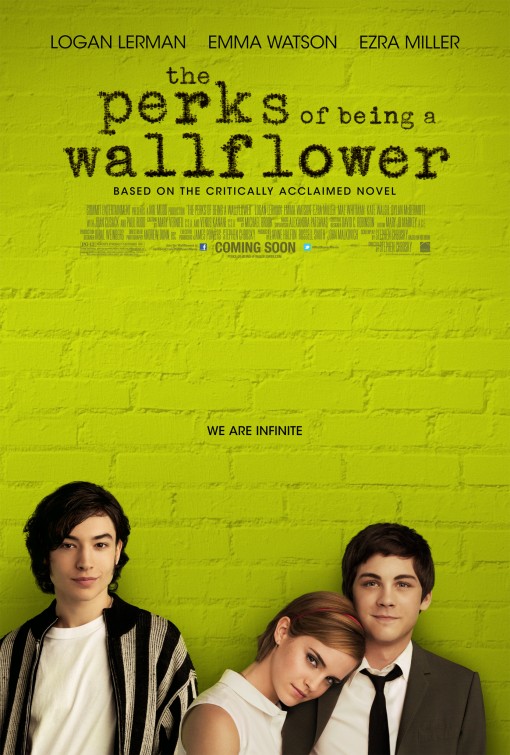 With the rise of hipster culture in recent years it has never been cooler to be uncool, and in that regard Stephen Chbosky’s film The Perks of Being a Wallflower couldn’t have come at a better time.
The Perks of Being a Wallflower is a coming-of-age story set in the early 1990s. Emotionally scarred Charlie has always felt invisible. He’s always been on the outside looking in. On his first day of high school he is already counting down the days until it’s over. But when he is taken in by a group of equally misfit seniors, he finds himself in a situation he has never been in before, he has friends, and through them he is able to take the first steps towards putting his past behind him.
Chbosky wrote the cult, young-adult novel of the same title in 1999, and made the rather bold decision to direct the film adaptation himself, despite his experience as a director being limited to one film almost two decades ago. However, his bold decision really seems to have paid off.
While there is a certain level of pretentiousness in their desire to be alternative, it still has an incredible authenticity. For example, the fact that Sam takes such pride in her good taste in music, yet along with Charlie spends the whole film trying to identify David Bowie’s ‘We Can Be Heroes’ seems to ring true of an eighteen year old know-it-all who despite her best efforts still has enormous gaps in her knowledge and experience. That authenticity is really important. So much of contemporary hipster culture is artifice, simply adhering to a set of conventions in order to be cool, even if they are a non-traditional set of conventions. If that was all The Perks of Being a Wallflower work was it would be an incredibly frustrating film, and this group of teens would probably come across as obnoxious and unlikeable. But it isn’t. There is an authenticity to their lifestyle. Their alternativeness doesn’t come from a desire to identify as being different. It comes from the acceptance and embracing of the fact that they are different. Whether as a by-product of their sexuality (Patrick), or as a result of childhood trauma (Charlie) or abuse (Sam), their lives have conspired against them to make them outsiders. Yet they manage to find a place with other different people (the inclusion of The Rocky Horror Picture Show as one of the group’s defining activities speaks volumes).
The performances of the film’s leading trio are fantastic. Logan Lerman’s is impressive as Charlie, providing the film’s emotional centre in a part that either makes or breaks the film. Lerman manages to make Charlie instantly likeable despite his closed off and troubled personality. As Patrick, Ezra Miller provides a fun and flamboyant character without forfeiting his humanity. Emma Watson delivers a career-changing performance which may well become her post-Harry Potter calling car – which is important for her career given that was a decade’s worth of employment she gained on the basis of being a talented ten year old.
There is one element in the story which distracted me. Charlie is a freshman (first year of high school) while the rest of his friends are seniors (final year). That is quite a sizeable age difference for a school context, but it is never really suggested in the film that this is in any way unusual. It is simply not an issue. Yet in real life it would be an issue. Why would a bunch of eighteen year olds want to hang around with a fourteen year old?
Some critics have complained that this film lacks originality, and it is true that there isn’t really anything here we haven’t seen in some form before, but a well-made coming-of-age story will find a way to connect with audiences and it is no surprise that The Perks of Being a Wallflower managed to sneak onto a few best films of 2012 lists. It’s a gem.
Rating – ★★★★☆
Review by Duncan McLean
Review – Shadow Dancer (2012)
Director: James Marsh
Starring: Andrea Riseborough, Clive Owen, Domhnall Gleeson, Aiden Gillen, Brid Brennan, David Wilmot, Gillian Anderson
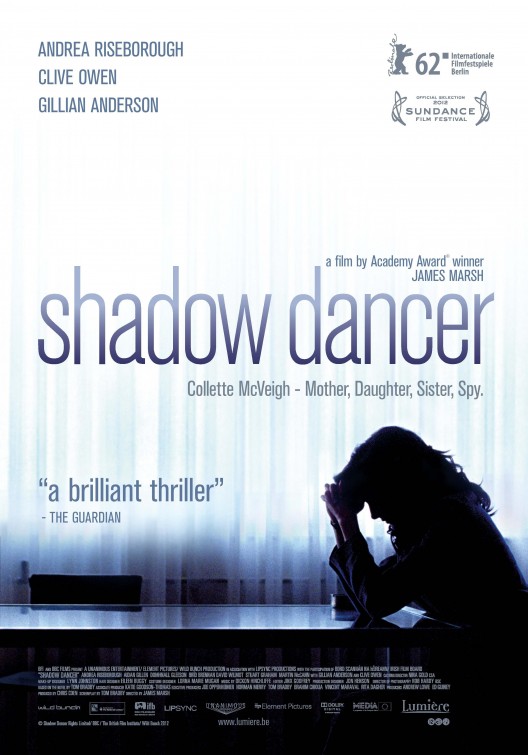 Colette McVeigh, a single mother with connections to the IRA, is picked up and interrogated by Mi5 agents after failing to go through with mission to plant a bomb on the London Underground. She is given a choice between a long prison sentence and separation from her young son, or agreeing to share information on the IRA cell in which her brother is a key member. She reluctantly chooses the latter and Shadow Dancer – a title which won’t make sense until a revelation late in the film – then follows the relationship between Colette and her Mi5 controller, Mac, as she goes about the dangerous business of being an informant.
If you want to think about it in generic terms, Shadow Dancer would be categorised as a spy thriller. But you would have to throw out a number of your preconceived notions of what a spy thriller is. Like Tomas Alfredson’s Tinker Tailor Soldier Spy in 2011, Shadow Dancer is a slow burning film with a steadily escalating tension rather than a roller coaster ride we expect from the majority of spy thrillers which follow the conventions established by James Bond films. Shadow Dancer moves at a very slow pace, to the point that it will be very off-putting for some viewers.
The performances are quite strong, even if the motivations for some characters are not always clear. In particular, Andrea Riseborough has earned some acclaim for her central performance as Colette. The key to her performance is the way that, while allowing us to see some of her anxieties and concerns, she manages to retain a moral mystery which means we never really know where she stands in terms of the larger conflict. Is she a believer in the IRA cause or obliged to play a role out of a sense of family duty or guilt? But I will admit to struggling with her character at times. I found her character so closed off, so internalised, that it became difficult to empathise with her.
Director James Marsh’s background is in documentary making – he won the Best Documentary Oscar in 2009 for Man on a Wire – and Shadow Dancer is a revealing picture in the way that it exposes the danger and volatility of life in Belfast in the 1990a. However, it fails to really give a sense of the socio-political context which explains that violence and volatility, and as a piece of entertainment it can be a really hard slog.
Rating – ★★
Review by Duncan McLean
Review – Gangster Squad (2013)
Director: Ruben Fleischer
Starring: Josh Brolin, Ryan Gosling, Sean Penn, Emma Stone, Giovanni Ribisi, Robert Patrick, Michael Peña, Anthony Mackie, Nick Nolte
 Warner Brothers is the spiritual home of the gangster picture. Back in the golden era of the 1930s and 1940s it was Warner Brothers who gave us the early classics of which helped established the genre, films like The Public Enemy, Little Caesar, Angels with Dirty Faces, The Roaring Twenties and White Heat. Fast-forward to the 1960s and it was Warner Brothers who gave us the film which redefined the genre, Bonnie and Clyde, and their association continued through Martin Scorsese. While he has worked with a number of different studios through his career, it is no coincidence that it is with Warner Brothers that he made Mean Streets, Goodfellas and The Departed.
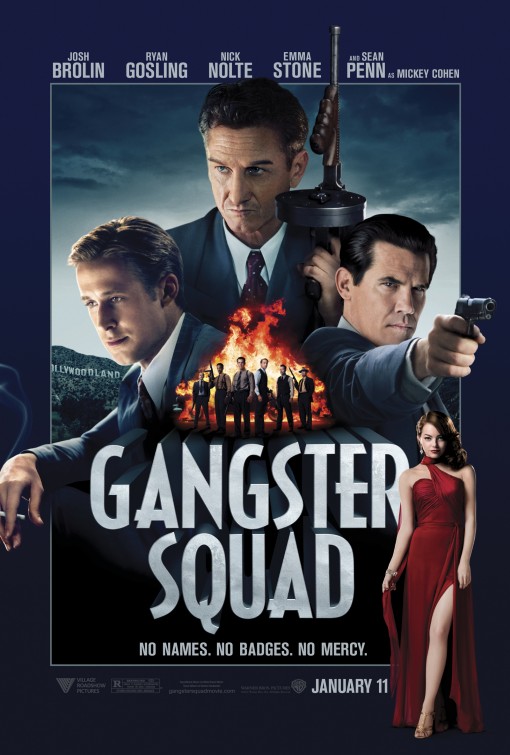
Warner Brothers’ latest offering in the genre, Gangster Squad, returns to the classic formula. Director Ruben Fleischer, best known for his comic work in films like Zombieland, takes us to post-war Los Angeles, a city that has lost its innocence inhabited by men who, having returned from the battlefield, can’t stop fighting. Los Angeles is under the thumb of Mickey Cohen, and Sgt. John O’Mara is given orders to put together a crack squad and go to war with him. However, despite its rather classic premise, unfortunately Gangster Squad will not be joining the list of classic Warner Brothers’ gangster films.
Gangster Squad has been getting a tough rap from critics – an unfairly tough rap in my opinion – primarily for two reasons; its lack of originality and shoddy writing.
First, the writing. The screenplay is indeed pretty terrible. Based on Paul Lieberman’s book of the same title, Gangster Squad is the first feature film for screenwriter Will Beall, a former LAPD officer whose only previous writing credits were a handful of episodes of Castle, and it does sound a bit like a first time screenwriter. The film is overly reliant on clichéd dialogue and scenes (there is actually a scene where a pensive police officer throws his badge into the ocean). The substandard writing is a shame because it means that the film doesn’t get to take full advantage of the quite stellar cast that they’ve managed to assemble. The actors all seem to be trying their hearts out but the chemistry isn’t quite there on the screen because it obviously wasn’t there on the page.
The primary cause for accusations of unoriginality is that Gangster Squad plays exactly like The Untouchables. If you are in any way familiar with De Palma’s film you can’t help but seeing the parallels as the movie goes along. Both movies have a city at the mercy of a corrupt gangster. In both cases that gangster is played by a big name, respected actor – Robert DeNiro as Capone and Sean Penn as Cohen. Both movies involve an honourable, Irish detective putting together a special squad to take down that gangster. In both cases that squad ends up being a bit of a motley crew. The parallels continue, but I don’t want to get into spoiler territory. When the parallels are so constant, you can’t help but compare the two and, unfortunately for Gangster Squad, The Untouchables is a great movie, well written and performed, and as such Fleischer’s film suffers by comparison.
Visually, Fleischer and Aussie cinematographer Dion Beebe (Chicago, Memoirs of a Geisha) have given us a stylised version of the classic gangster aesthetic. You still have all the iconography you expect, and that beautiful Art Deco vibe that drops you straight into the era, but through the combination of some interesting camera angles, a colour palate that is dominated by blues, and some digital alteration, you end up with something that looks a bit like a cross between a classic gangster film and The Watchmen. I’m not really sure if I liked it or just noticed it, but it is distinctive.
As I said before though, I think the harshness with which some critics have met this film has been a bit excessive. Gangster Squad is pure escapism and suffers in the eyes of some because so many great gangster films before it have aspired to more than just escapism. But there has always been a place for escapism at the movies. It is not a hugely original story, but the foundation of the genre system is the joy of familiarity. If you are a lover of gangster movies, as I am, there is an enjoyment that comes from revisiting a traditional gangster premise and seeing today’s stars playing roles straight out of old Hollywood. You don’t always need to be rewriting the rules and breaking new ground. Gangster Squad is not going to rock your world, but it’s not a bad way to spend a couple of hours.
Rating – ★★★☆
Review by Duncan McLean
Review – Liberal Arts (2012)
Director: Josh Radnor
Starring: Josh Radnor, Elizabeth Olsen, Richard Jenkins, John Magaro, Allison Janney, Zac Efron, Elizabeth Reaser
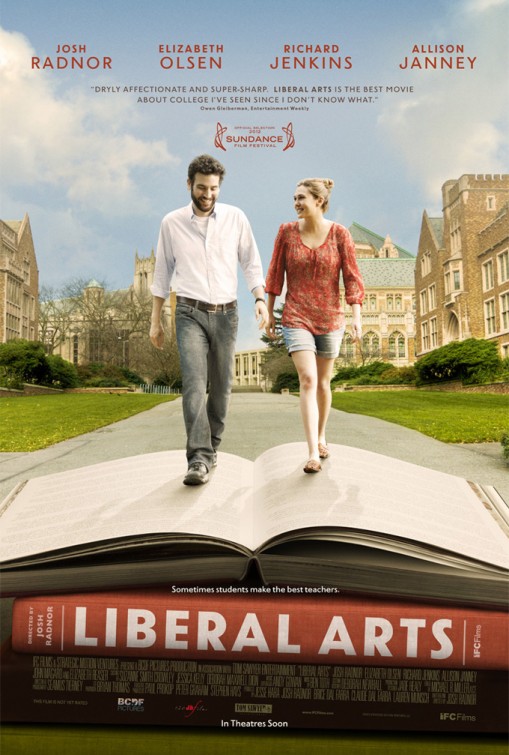 Plenty of films have been made about nostalgia for the glory days of college, but invariably they are most concerned with partying and responsibility-free living. Rarely do you find a film which considers the university years with the same level of earnest idealism as does Liberal Arts.
Jesse Fisher is a 35 year old liberal arts graduate who is working as an admissions officer in a New York college. He accepts and invitation to return to his alma mater in Ohio for the retirement dinner of one of his favourite professors from his time there. While back on campus he strikes up a friendship and romance with a 19 year old drama student named Zibby (short for Elizabeth), a relationship that at the same time manages to make Jesse feel young and remind him of how old he is.
At its heart, Liberal Arts is a film about growing up, and the college becomes a metaphor for youth, and all the opportunity and boundless potential that entails. Jesse is overwhelmed with excitement to get back to his alma mater and really wants to once again feel like he did back then. However, for all his excitement at getting back to college, we also get, as a contrast, the perspectives of two lifelong academics; one whose passion has been replaced by bitterness and resentment, the other who, facing retirement, is concerned that like a prisoner he has become an ‘institution man’ and won’t be able to function in the outside world.
It takes you a while to get on board with Jesse and Zibby’s relationship. Initially, it doesn’t quite seem plausible. You don’t understand her interest in him. It just seems to happen. But once it is established it starts to make more sense. With the sixteen year age gap being so prominent – there is a great little scene where Jesse tries to get his head around their age difference by working out how old she was or will be at different stages of his life – Jesse and Zibby’s relationship also ties into this theme of growing up. He sees her as a way back to the hopeful young man that he was, someone with whom he can have the lofty, intellectual conversations which were once so important to him but have since become absent in his life. For her, frustrated by the calibre of male in her peer-group, he is a chance to fast-forward into adulthood.
The film also contains a few subplots, the most interesting and authentic of which is Jesse’s relationship with a manic depressive boy he meets on campus – another relationship Jesse just seems to fall into. The two bond over reading, and Jesse becomes a surrogate father figure for this brilliant but troubled young man.
Liberal Arts is written and directed by its star, Josh Radnor. It is Radnor’s second film as a writer/director after 2010’s Happythankyoumoreplease, another film about growing up. Radnor would be most familiar to viewers as Ted Mosby from How I Met Your Mother, and viewers of that show will struggle not to see him playing a version of the same character here. Elizabeth Olsen – the younger sister of twins Mary-Kate and Ashley – is quite good as Zibby, and is definitely one of the young actresses to watch over the next couple of years.
At times Liberal Arts can briefly cross the line into pretentiousness, but no more than you would expect from a screenplay trying to capture the vibe of young, faux-intellectual liberal arts students. But despite this, the film is quite charming, will appeal to people who have had that particular experience of college, and does enough to suggest that Radnor could develop into quite an interesting filmmaker.
Rating – ★★★
Review by Duncan McLean
Review – Between the Devil & the Deep Blue Sea (2011)
Director: David Schmidt
Starring: Jessie Taylor, Ali Reza Sadiqi
 Arguably the biggest political and humanitarian issue facing Australia over the last decade is that of asylum seekers, or “boat people” as they are un-affectionately known. The discourse over this issue is made up of voices from all sides; the left and the right, shock-jocks, politicians, activists and journalists. But the one group of voices that we consistently don’t hear from are the boat people themselves. David Schmidt’s documentary Between the Devil & the Deep Blue Sea seeks to make those voices heard, to humanise this issue and in doing so explore the question of what compels a person to become a boat person.
Young Melbourne lawyer Jessie Taylor and her friend and interpreter Ali Reza Sadiqi, himself a refugee, travel to Indonesia, the doorstep to Australia for asylum seekers, in order to meet with the men, women and children contemplating making the dangerous journey. Their stories expose us to not only the horrifying situations they are fleeing from – situations made all the more horrifying when they are being explained to you by children – and hopeless inefficiency of the official channels they are trying to follow.
Mostly the film is made up of on-location talking-head footage, but we also get to see footage taken inside a detention centre by a concealed camera Taylor wore under her headscarf. For mine though, the most harrowing image of the film is that of a rickety smugglers boat packed with people being pummeled against the rocks by rough seas.
The filming took place over two years, which means that we are able to get an idea of the progress of the journey. The picture finishes by taking us through all of the people we have heard from in the preceding hour with on-screen titles informing us which have since been resettled in Australia, which have had their claims denied, which are now missing and which have drowned at sea.
Schmidt doesn’t do anything too stylistically complex. He doesn’t experiment with the documentary form. But a film like Between the Devil & the Deep Blue Sea doesn’t need to. By far the most powerful way you can present an issue like this is to simply put the faces of the asylum seekers on the screen and let them tell their story. Any artifice would run the risk of detracting from their impact. Schmidt is smart enough to understand this and thus keeps it relatively simple.
Between the Devil & the Deep Blue Sea is not in cinematic release but has been touring around the country. Visit www.deepblueseafilm.com for more information on how you can see this potent, insightful and important documentary.
Rating – ★★★☆
Review by Duncan McLean
Review – Snitch (2013)
Director: Ric Roman Waugh
Starring: Dwayne Johnson, Barry Pepper, Jon Bernthal, Susan Sarandon, Michael K. Williams, Rafi Gavron, Melina Kanakaredes, Nadine Velazquez, Benjamin Bratt
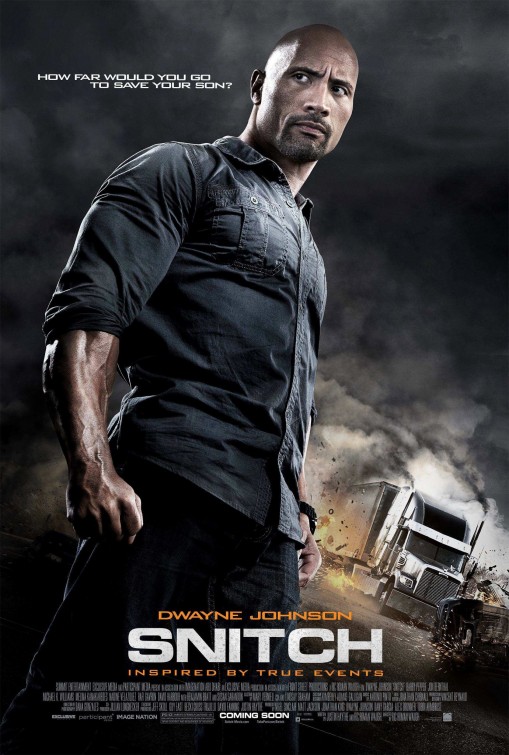 Snitch, the new movie for Dwayne ‘The Rock’ Johnson, is not quite what you expect it to be. Johnson plays John Matthews, owner of a trucking freight company and father of a young man who has been arrested for intent to deal drugs. While his involvement in the process was nothing more than reluctantly agreeing to accept a Fed-Ex package for a friend, the mandatory minimum laws mean that he is facing at least ten years in prison. His only hope of reducing his sentence is to give up information which leads to the conviction of other drug dealers, but he doesn’t know any.
About half-an-hour into this movie I am wondering what on earth ‘The Rock’ is doing there. This seems like the part for a dramatic actor, not an action hero. But then it starts to become clear. Matthews goes to the U.S. Attorney’s office with a proposal. While his son might not be able to name any drug dealers, what if Matthews can go out and find some? A deal is struck and John Matthews is now an undercover drug-dealer hunter. With his access to semi-trailers an attractive proposition for dealers it doesn’t take long before Matthews is deeper involved than either he or the U.S. Attorney ever imagined he would be.
As an action movie, Snitch is less in the Arnold Schwarzenegger/Sylvester Stallone tradition, where you would expect a wrestler-turned-actor to make their home, and more in Mel Gibson/Harrison Ford vein. The film even culminates in a semi-trailer chase sequence which is reminiscent of Mad Max 2, minus the post-apocalyptic wasteland. Instead of being non-stop explosions and whammies, director Ric Roman Waugh, whose background is as a stuntman, delivers a film with decent narrative pacing and balance and a surprising amount of genuine emotion. The problem this presents though is that Dwayne Johnson as your leading man sometimes lacks the dramatic range to pull off some of the film’s more human moments.
You don’t often hear this said about an action movie, but Snitch has a really interesting musical score. Composed by Brazil’s Antonio Pinto, the score consists primarily of strings and percussion, and prominently features a single cello, which gives the sound a real Deadwood feel. The music ends up being the most surprising and original aspect of the film.
Waugh and Johnson, who is also one of the film’s producers, appear to have intended for this film to be seen as a political comment about the problems with the mandatory minimum system – the film finishes with captions giving figures comparing mandatory minimum drug sentence lengths to those of murder and rape convictions – but I don’t know that many viewers will engage with the movie on that level. However, if you are capable of suspending your disbelief and accepting the storyline before you, you will find Snitch to be a reasonable action film.
Rating – ★★
Review by Duncan McLean
Review – The Intouchables (2011)
Directors: Olivier Nakache, Eric Toledano
Starring: François Cluzet, Omar Sy, Anne Le Ny, Audrey Fleurot
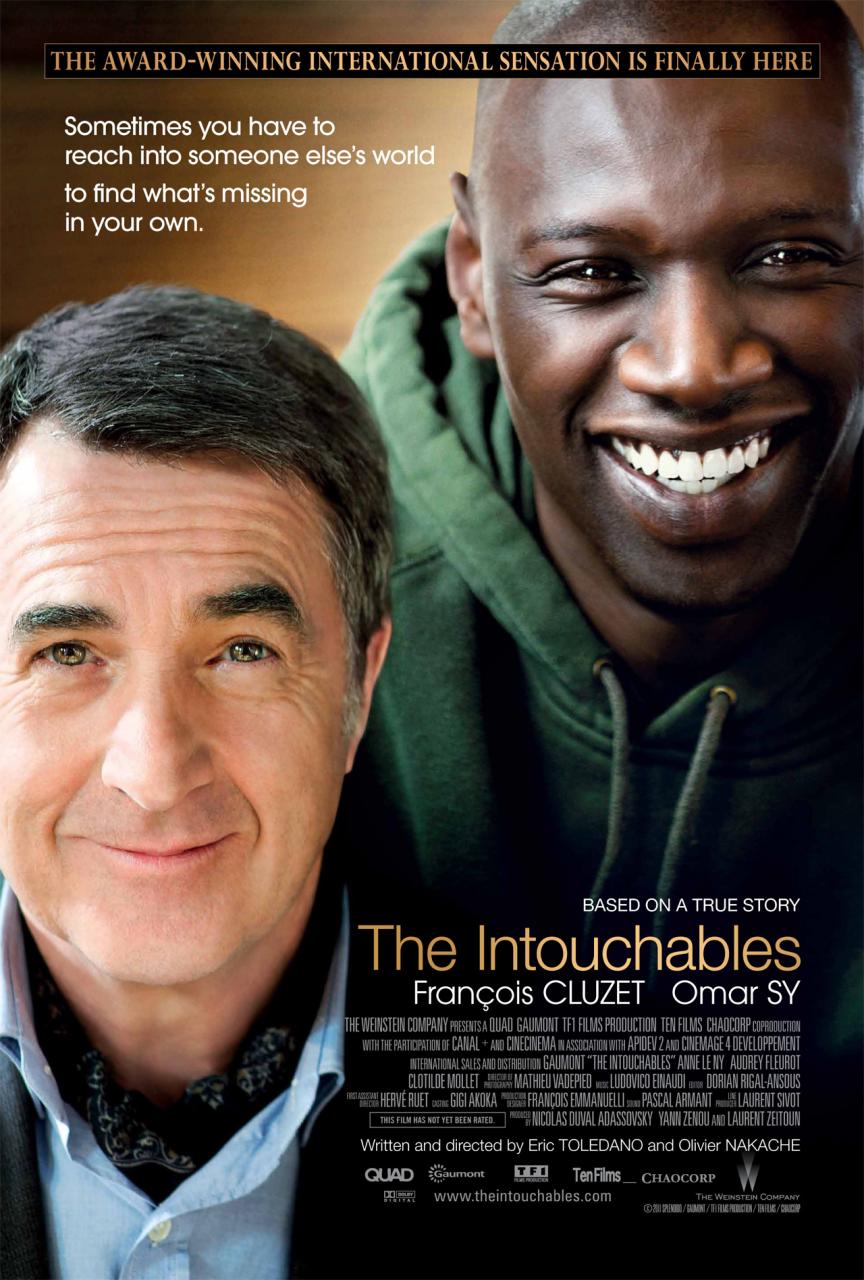 One of the biggest surprises in the world of cinema last year was the amazing success of the French film Intouchables. The story of an unlikely friendship between an aristocratic quadriplegic, Philippe, and the young, black man from the projects, Driss, who he hires as his caretaker became the second highest grossing film in the history of the French cinema after only eight weeks in cinemas. And armed with the hybrid English/French title The Intouchables (I assume they wanted to avoid being mixed up with Brian De Palma’s The Untouchables), it would go on to conquer the world, taking almost $300 million at the international box office and becoming one of the year’s most loved films.
The Intouchables is an uplifting experience. Based, loosely, on a true story (though we’ve seen similar concepts before in films like Driving Miss Daisy and Scent of a Woman), this story of a friendship that transcends socio-economic, class and race barriers makes you see the potential for good in humanity. That’s why people have responded so strongly to it. That’s why people love it.
The success or failure of a buddy movie invariably comes down to the chemistry between the two protagonists, and The Intouchables has it in spades. Both François Cluzet and Omar Sy put in magnificent performances. Cluzet, who is a dead ringer for Dustin Hoffman, has the added hurdle of being restricted to only acting from the neck up, but he manages to brilliantly embody the frustrations of a man trapped in a useless body. Sy, a French comedian, is very charismatic as Driss, who brings some colour and life into Philippe’s world. Sy won best actor at the César Awards, France’s equivalent to the Oscars, edging out not only Cluzet, but also Jean Dujardin for his work in The Artist which would go on to win him an Oscar.
There has been an interesting discrepancy between the public response to this film, which has been huge, and the critical response, which has been lukewarm. As an example of this, if you go to The Intouchables’ IMDb page you will see the film has an impressive user rating of 8.6/10, but right next to it is its Metacritic rating (a rating devised from the positivity or negativity of reviews in major American publications) which is only 57/100. The primary reason I can see for this is that as you watch The Intouchables you can feel your buttons being pushed. It is a very calculated film in how it goes about engaging you emotionally. Of course, every film manipulates your emotions. The filmmaker uses the tools at their disposal to try and elicit a certain emotional response from the viewer. The key, though, is to do it subtly, so the viewer feels the emotion without feeling the manipulation (George Lucas once said, “Emotionally involving an audience is easy. Anybody can do it blindfolded. Get a little kitten and have some guy wring its neck”). At times The Intouchables lacks that subtlety. There are scenes, moments and events which you can tell are there solely to make you feel something. For most casual viewers, that doesn’t really matter, but for a cynical critic who spends their life watching and analysing films, seeing it so blatantly could be off-putting.
As lovely, positive and compassionate as this film is, there is one thing which I feel cannot pass without comment. Beneath the film’s feel-good qualities, you find something quite troubling: how much it indulges in racial stereotyping. As loveable a character as Driss is, and as much as the film encourages to like him, it doesn’t change the fact that we are presented with a black character who is unemployed (seemingly by choice), uncultured, a thief, a drug user, prone to using physical aggression to intimidate people, irreverent, lecherous and, of course, a great dancer (not all stereotypes are negative). All of this in a world full of white people who are largely none of those things. Now you may be tempted to point to the fact that the film is “based on a true story” and argue therefore that if that is what he was like then that is what he was like. The problem with that argument is that it doesn’t appear that that is what he was like. At the end of the film we are shown a short glimpse of the real life men who the characters of Philippe and Driss are based on and, guess what? The man who inspired Driss is not black. He is an Arab named Abdel Sellou from the former French colony of Algeria. This prompts some awkward questions, particularly in a film as calculated in the way it engages with your emotions as The Intouchables is. Even if it is an accurate portrayal, with Sellou being exactly like Driss is portrayed in the film, the decision was still made at some point to recast him as a black man, with his blackness then becoming a key aspect of his identity in the film. Why? Was a black character deemed more marketable than an Arab character? Did they feel there was more comedy in a black character than an Arab character? Was it just that they wanted to cast Omar Sy? I don’t know the answer to the question, just that is it a troubling question that presents itself.
While some people may avoid French films, expecting them to be too arty and weighty, The Intouchables is really accessible. Awkward potential racism aside, it is a delightful story of the most unlikely of friendships. It is feel-good, warm-the-cockles-of-your-heart filmmaking at its finest.
Rating – ★★★★
Review by Duncan McLean
Review – The Magic of Belle Isle (2012)
Director: Rob Reiner
Starring: Morgan Freeman, Emma Fuhrmann, Virginia Madsen, Madeline Carroll, Nicolette Pierini, Ash Christian, Fred Willard, Kenan Thompson, Kevin Pollak
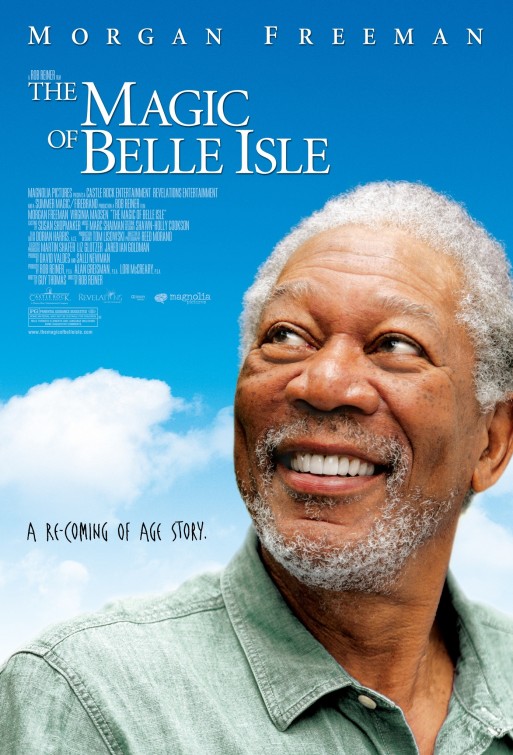 Monte Wildhorn is a grumpy old man. Once a respected author of Western epics, he has not written a word since the death of his wife. Instead, the wheelchair-bound curmudgeon has devoted himself fulltime to his drinking. One summer his nephew organises him a summer house in the small town of Belle Isle for him to stay at and clear his head. The house comes with a dog and neighbours – a recent divorcee and her three young daughters. As the summer goes on, Monte lets down his guard and with the help of some new friends this old and broken man rediscovers the will to write, to live and to love.
The Magic of Belle Isle is a reunion for Morgan Freeman and director Rob Reiner, who previously worked together on The Bucket List, another exploration of growing old. Reiner is, unfortunately, not the filmmaker he was in the late 1980s and early 1990s when he put together one of the most impressive and diverse bodies of work you’ll see from a Hollywood director. What was impressive about Reiner at his peak was his versatility. In an eight year period between 1984 and 1992, Reiner directed the greatest mockumentary ever made, This is Spinal Tap; a great coming-of-age tale, Stand by Me; a much loved children’s fantasy story, The Princess Bride; one of the best romantic comedies of its era, When Harry Met Sally; a Stephen King horror/thriller, Misery; and a courtroom drama, A Few Good Men. Not only is that a streak of great diversity, it is a streak of really high quality filmmaking. In recent times though, Reiner seems to have lost that versatility or at least lost the desire to try different things. He now tends to favour overly sentimental schmaltz (see the aforementioned The Bucket List), and this is more of the same. The Magic of Belle Isle is pretty uninspiring work from a once-impressive filmmaker.
But being uninspiring doesn’t mean the film is unenjoyable. Morgan Freeman possesses everybody’s favourite speaking voice and his character, being an author, is quite eloquent. So, one of the real pleasures of this film is simply listening to Morgan Freeman saying some quite lovely things. The relationships that Monte forms with the adventurous nine-year-old next door, a local young man with a mental illness and the old Labrador he reluctantly finds himself responsible for, are all fun to watch develop.
The Magic of Belle Isle can be sickly-sweet and predictable, but it is still warm and affectionate. Despite its present day setting it feels like it takes place in a simpler time, when people actually had time for one another. It is a lovely, feel-good story, simply told. It is not going to challenge you or make you think and it probably won’t stay with you, but for the hour-and-three-quarters that you spend with it you will be smiling.
Rating – ★★★
Review by Duncan McLean
Review – To Rome with Love (2012)
Director: Woody Allen
Starring: Woody Allen, Alec Baldwin, Roberto Benigni, Penélope Cruz, Judy Davis, Jesse Eisenberg, Ellen Paige
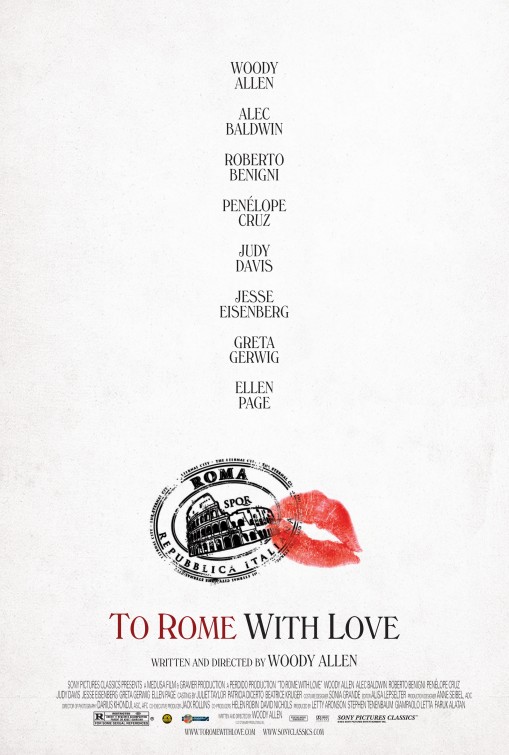 The most New York-centric of filmmakers for the first forty years of his career, in the last decade Woody Allen has discovered the rest of the world. At least, he’s discovered Europe. In recent years he has made films set in London (Match Point), Barcelona (Vicky Christina Barcelona) and Paris (Midnight in Paris). And now, with To Rome with Love, we get Woody Allen’s ode to the Eternal City.
Midnight in Paris was a great success, it was far and away Allen’s biggest box office earner, it earned an Oscar nomination for Best Picture, and it introduced a whole new audience to Woody Allen’s filmmaking. It also put a great deal of expectation on his next film, which at a glance looked like it followed the same formula. As it turns out, To Rome with Love is a much more typical Woody Allen film, and unfortunately it fails to reach the heights of his previous effort.
The film consists of four separate but interwoven storylines, with varying degrees of absurdity. There is the record producer who discovers an amazing opera singer who can only sing in the shower; the ordinary man who, for no apparent reason, becomes incredibly famous overnight; the man who is forced to spend the day pretending that the prostitute who came into his hotel room by accident is actually his wife; and the young man who is falling for his girlfriend’s best friend while his spirit guide, an older version of himself that he meets in the street, tries to convince him it is a bad idea. This format of separate story threads is reasonably common now, but in the better executions of it we expect the threads to connect somehow, either through their narratives becoming intertwined or through some thematic consistency. But that doesn’t happen here. The only connection is that they are all taking place in Rome.
All four storylines are based on funny little ideas, but none of them really has the substance to become a full story in its own right, though some do better than others. Because Allen doesn’t seem to know where to take them, the movie really loses its way and fizzles out towards the end. A filmmaker who makes as many films as Woody Allen does – roughly one a year for almost fifty years – is going to be a bit hit and miss, and this is one of the misses.
But despite all that, what really carries this film is the city of Rome itself. Allen has a tourist’s eye for the city and as such it never becomes just another city, just another location. It is always Rome, the Eternal City. So when storylines start to wear thin, or when jokes fall a bit flat (as happens more than a couple of times), Rome, in all its beauty, is still engrossing.
Rating – ★★☆
Review by Duncan McLean


You must be logged in to post a comment.