
Category: Reviews
Review – The Lone Ranger (2013)
Director: Gore Verbinski
Starring: Johnny Depp, Armie Hammer, William Fitchner, Tom Wilkinson, Ruth Wilson, Helena Bonham Carter, Barry Pepper, James Badge Dale
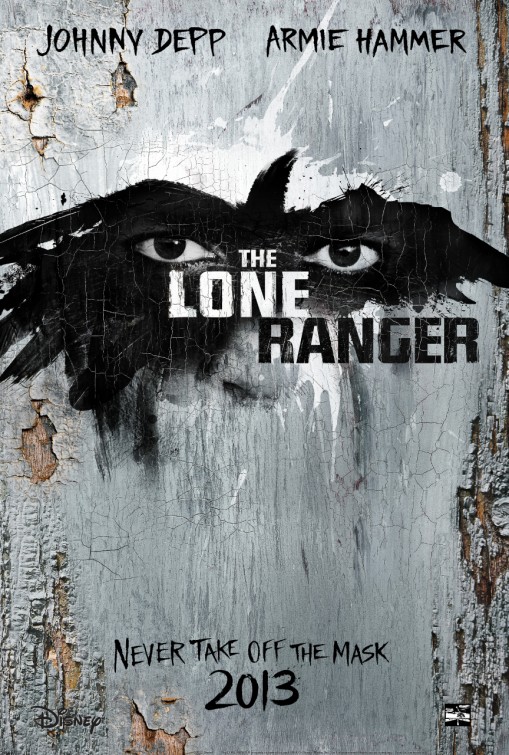 The Bruckheimer, Verbinski, Depp trio which brought you the Pirates of the Caribbean series is back and this time they are taking us to the Wild West with a remake of the classic serial The Lone Ranger.
The Lone Ranger and his trusty sidekick Tonto date back to a radio serial from the early 1930s and have since appeared in novels, comics, television series and numerous films, both features and shorts. But the young demographic the film is targeted at are a couple of generations removed from those who grew up with the Lone Ranger, so the film really has a clean slate in introducing these much-loved characters to a new audience.
We are taken back to the beginning, with idealistic young lawyer John Reid is caught in an ambush by the horrible Butch Cavendish and his gang, having been deputised a Texas Ranger by his sheriff brother. While the rest of the posse is killed, Reid is brought back from death’s door by a peculiar Comanche named Tonto, who teaches him that sometimes in a corrupt society the only way to serve justice is to operate as an outlaw.
Our story teller is an elderly Tonto, recounting the story of the Lone Ranger – or as he knows him, Kemosabe – to a young boy. That we hear the story from Tonto’s point of view turns him from a sidekick into arguably the central character. This is a move obviously designed to make the most of Johnny Depp’s star presence, which sees him largely playing a variation of Jack Sparrow as an Indian. Tonto is also given his own back-story, which explains his kookiness without merely resting on unfortunate racial stereotypes that would not be as easily accepted now as they were in the 1930s and 1940s. That we first meet the elderly Tonto standing in a Wild West sideshow exhibition display entitled “The Noble Savage” suggests an awareness on the part of the writers of the problematic tradition that characters like Tonto have come out of.
The writers do a good job in staying true to the characters and elements that fans will expect, while making the required adjustments to give it a fresh and contemporary feel. They are also willing to acknowledge that some things just don’t quite work as well for a 2013 audience as it did for a 1933 audience. The picture finishes with a good laugh at the expense of the Lone Ranger’s catchphrase, “Hi ho, Silver! Away!”
While the Western has experienced somewhat of a return to relevance in recent years with films like True Grit and, of course, Django Unchained, The Lone Ranger represents something entirely different. This is a $250m studio blockbuster, making it far and away the most expensive Western ever made, and indicates a level of faith in the genre that hasn’t been present in major studio Hollywood since the 1950s. It is also a return to the matinee style, Wild West adventure, and is definitely the most fun that has been had with the Western for quite a while.
With the producer, director and star of the Pirates of the Caribbean series joining forces again, it is unsurprising that The Lone Ranger has a very similar feel to that incredibly successful franchise. You get that blockbuster-friendly blend of action, adventure and comedy. Every dollar of that estimated $250m budget has ended up on the screen. The Lone Ranger is a big movie with big action. It may not have been based on a ride like Pirates of the Caribbean was, but it still feels like one.
For much of its two-and-a-half hour run-time, The Lone Ranger feels uneven. Verbinski seems to struggle to find a balance between the light-heartedness that comes from a slightly bumbling hero with a quirky sidekick, and some moments that are surprisingly dark and disturbing. But the movie really hits its straps in the last 45 minutes, finishing on a high with an enormous action sequence featuring horses and trains and horses on trains. Add to that the iconic William Tell Overture, and you’ll have a hard time not smiling.
Rating – ★★★☆
Review by Duncan McLean
Review – Man of Steel (2013)
Director: Zack Snyder
Starring: Henry Cavill, Amy Adams, Michael Shannon, Russell Crowe, Diane Lane, Kevin Costner, Laurence Fishburne
 After successfully resurrecting the dormant Batman franchise with his Dark Knight Trilogy, DC Comics and Warner Brothers turned to Christopher Nolan with a far greater challenge: Superman. At a time when audiences seem to prefer their heroes flawed, either with a sense of damage and menace (Batman) or an overly well-developed ego (Iron Man), was there still a market for an idealistic boy scout in a blue suit who fights for truth, justice and the American way?
Whereas the last attempt to resurrect the franchise, Bryan Singer’s Superman Returns, tried to follow on from the Christopher Reeve series, Man of Steel takes us back to the beginning. Rather than working chronologically, the film jumps back and forth, relying heavily on flashbacks to fill in the story of how Kal-El became Clark Kent and then Superman – a handy device to avoid the usual origin story problem of requiring the audience to wait too long before Superman starts being super. No sooner has Clark learned the truth about his heritage, he is called upon to protect his adopted home from invaders from his ancestral home, with the banished Kryptonian military leader General Zod mounting an invasion of Earth, with the intention of establishing it as a new Krypton.
The “invaders from outer space” nature of the threat in Man of Steel makes it feel more akin to Transformers or Independence Day than other spandex-clad superhero movies. That is the biggest difference between this and previous screen adaptations: Man of Steel is a science-fiction movie rather than a fantasy. It looks like a science fiction movie, with the ice-crystal set designs of the Christopher Reeve films abandoned for a design seemingly more inspired by Ridley Scott’s Alien, and it sounds like a science-fiction movie, complete with terrible dialogue about world engines, codexes and Phantom drives.
Like many a Superman adaptation before it, Man of Steel flirts with the allusion of Superman as a Christ figure – an ironic tradition given the hero was the product of Jewish creators Jerry Siegel and Joel Shuster. Our hero’s father, Jor-El, tells his son, “You will give the people of Earth an ideal to strive towards. They will race behind you. They will stumble. They will fall. But in time they will join you in the sun. In time you will help them accomplish wonders.” The Christ allusions in Man of Steel aren’t as overt as they have been in the past – in Superman Returns he was “the light to show them the way,” literally sacrificing himself for the sake of humanity only to be resurrected a couple of days later – instead preferring to focus on the idea of Superman being a symbol of hope.
With Nolan acting as producer, directorial duties were given to Zack Snyder, who is known for his highly stylised use of digital effects in films like 300, Sucker Punch and Watchmen. While he sticks to a pretty simple aesthetic here, his experience with digital effects results in the most visually impressive Superman film yet made, with the little touches – like the way you see the sound barrier being cracked when Superman flies away – being more impressive than the huge effects we are used to seeing in this kind of movie.
A big movie like this one presented as an epic story needs a big-time cast to carry it. British actor Henry Cavill makes for a good Superman, with the appropriate combination of broad chest, chiselled jaw and trustworthy eyes. Amy Adams gets more to work with than past Lois Lanes, with her incarnation of the plucky journalist being courageous, resourceful, and finally intelligent enough to be able to recognise the object of her affection even when he puts on glasses. But it is the depth and quality of the supporting cast which really helps to give the film an epic quality, with the likes of Russell Crowe, Diane Lane, Kevin Costner and Lawrence Fishburne all putting in solid supporting turns.
While it is certain to perform strongly at the box office, ultimately Man of Steel runs into the same issues that Superman stories always seem to: that the build-up is more interesting than the climax. In this case the interest is in the existential journey of a young Clark Kent who is trying to work out who he is, why he is here and what he should do with his abilities, and in the way people respond to him and what he represents. But an adventure story climax requires a level of threat that is hard to muster when your hero is practically invincible. In this case he has an adversary who is equally invincible, and watching two of them hitting each other starts to get a bit tedious after a while.
Rating – ★★★☆
Review by Duncan McLean
Review – To the Wonder (2012)
Director: Terrence Malick
Starring: Ben Affleck, Olga Kurylenko, Javier Bardem, Rachel McAdams
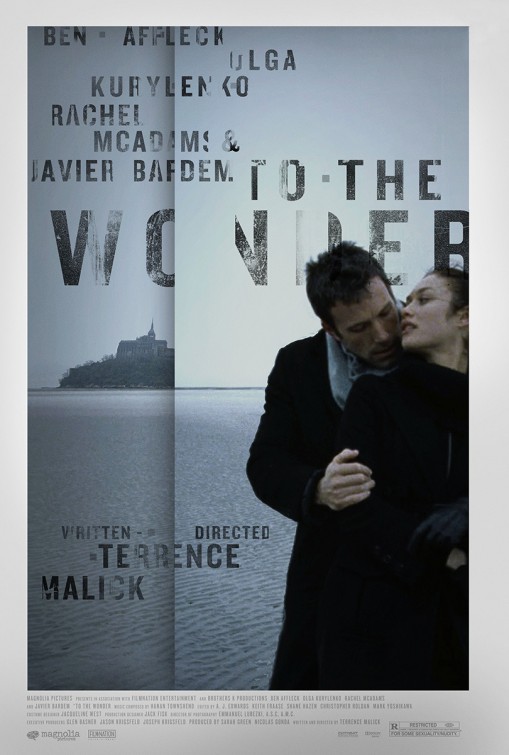 Terrence Malick is not your usual filmmaker. He was a philosophy student at Harvard who graduated summa cum laude before heading to Oxford as a Rhodes Scholar. He was teaching at Massachusetts Institute of Technology before deciding to enrol at the American Film Institute. Since then he has had an intriguing 40 year career as a director which has amazingly only resulted in six feature films. While he left academia a long time ago, that philosophical streak still exists in his work, and as he has grown older his films have become increasingly contemplative and esoteric.
His last film, The Tree of Life, divided critics and audiences alike with some declaring it the film of the year while others found it excessively self-indulgent and pretentious. His new picture, To the Wonder is a similar style of film to Tree of Life, though likely a step further away from the mainstream and less well executed.
As a filmmaker, Malick is growing increasingly disinterested in narrative. So while To the Wonder has a narrative of sorts it is not really the primary focus of the film. We meet two outsiders living in Oklahoma. Marina is a Ukranian single mother who has moved to America from Paris after falling in love with an American, Neil. Father Quintana is a Hispanic Catholic priest who moved to the area to minister. Both have been compelled to move their by love, but both now find themself feeling increasingly isolated and distant from that love. The picture contrasts Marina’s relationship difficulties with Quintana’s crisis of faith.
For this exploration of love in its different forms, Malick is more interested in evoking than describing. Instead of getting scenes, we simply glimpse moments. Instead of having passages of dialogue, we capture a sentence here or there. The prominence of the musical score over dialogue means the film can feel almost like a silent movie.
Like The Tree of Life, To the Wonder is a visual and aural experience with an ethereal quality. The cinematography of Emmanuel Lubezki, who has worked twice before with Malick, is breathtaking. Whether in the streets of Paris, the plains of Oklahoma or the humble homes of Bartlesville, Lubezki and Malick give us beautiful, emotive images. However unlike its predecessor, To the Wonder doesn’t have the substance to support its style. The combination of these stunning images, an expressive score, and a narration of philosophical whisperings in French and Spanish has led more than one critic to liken the film to a high end perfume commercial.
An impressive principal cast including Olga Kurylenko, Ben Affleck, Rachel McAdams and Javier Bardem suggests that the chance to work with Malick is obviously a draw card for actors. But don’t come expecting to see movie stars because Malick’s camera doesn’t treat them that way. Case in point is Ben Affleck, who despite being a big name star, constantly finds himself on the periphery of the frame, often with his head cut out of the picture. In the film’s first passages in Paris Affleck hardly says a word. We assume this is because his character doesn’t speak French, but then when the film migrates to America we still don’t hear from him.
To the Wonder has an impassioned spirituality. You can’t help but feel that there is an autobiographical element to Father Quintana’s longing to again experience the presence of Christ in the world around him. Unfortunately though, the film lacks clarity, with the vagueness of its events, characters and themes more likely to leave you scratching your head than deep in philosophical reflection.
Rating – ★★
Review by Duncan McLean
Review – The Great Gatsby (2013)
Director: Baz Luhrmann
Starring: Leonardo DiCaprio, Tobey Maguire, Carey Mulligan, Joel Edgerton, Elizabeth Debicki, Isla Fisher, Jason Clarke, Jack Thompson
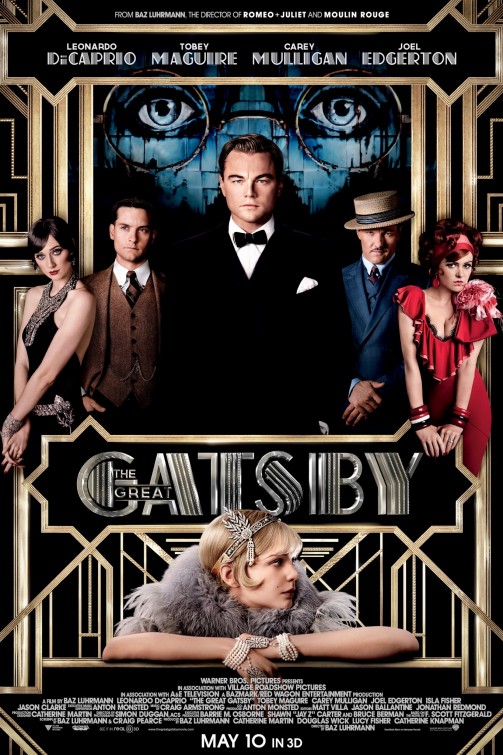
F. Scott Fitzgerald’s The Great Gatsby, often referred to as ‘the great American novel,’ is arguably the sacred text of American literature. The tale of the mysterious millionaire Jay Gatsby who returns to reclaim his long lost love, provides a snapshot of the opulence and extravagance of the roaring Twenties, and an insight into the darker side of the great American Dream of the self-made man. Multiple attempts have been made over the years to bring Fitzgerald’s story to the screen, but none have really satisfied. The level of reverence towards the source material means that any film adaptation is going to encounter a certain amount of pushback from an audience with a strong idea in their head of what the story is supposed to look like.
Australian director Baz Luhrmann is not the type to shy away from the challenge of taking on a literary giant. After all, this is the man who made his name with his non-traditional approach to Shakespeare’s Romeo and Juliet, and literary figures don’t come much bigger than William Shakespeare. With The Great Gatsby, what we get from the director is his interpretation rather than merely an adaptation. While he retains a high level of respect for the source material and sticks very closely to Fitzgerald’s narrative – with the exception of adding a framing device which sees our narrator Carraway recounting the events to his therapist – Luhrmann is not content to simply provide the images for Fitzgerald’s words. He gives us “Baz Luhrmann’s The Great Gatsby,” the Gatsby that only he could make. He takes a chance in that regard, but he needed to. The 1974 version of the film – directed by Jack Clayton and starring Robert Redford and Mia Farrow – is a very conservative adaptation of the story and the result is an incredibly boring film. Love him or hate him, Baz brings something to the fold.
Luhrmann is, of course, a specialist in artifice, and with his production designer wife Catherine Martin, he provides a visual and aural extravaganza. The Great Gatsby is a period drama unlike any other you’ve seen. It is a feast of art deco style, with design and costume coming straight out of the 1920s – as an aside, you are looking at the early Oscar frontrunner in the Best Costume Design category. This period design is then contrasted with an overt digital element, used both to enhance the set design and geography, as well as in the cinematography. Luhrmann and cinematographer Simon Duggan employ a style of digital cinematography we are more used to seeing in action blockbusters like The Avengers, employing a number of impossible, artificial camera angles and swooping cinematography.
While the film’s visual style sets it apart from most period dramas, by far its most controversial element is its soundtrack. While the films diegetic music (music whose source is within the world of the film, like a radio or record player) is all in keeping with the era, the non-diegetic music (the soundtrack laid over the onscreen action) draws primarily from contemporary music, particularly RnB. The soundtrack includes the likes of Jay Z (also an executive producer on the film), Beyonce, Jack White, SIA, NEYO, will.i.am and Lana Del Rey. Much like the 3D photography, the use of contemporary music on the soundtrack is a device that is meant to draw you into the film. Hearing contemporary RnB music at Gatsby’s parties gives them a certain familiarity, making them a more relatable and as a result more immersive and overwhelming experience. But while it is an interesting device, I can’t help but feel the music is one element of the films which is not going to date well. There will come a time, and it won’t be too far into the future, when the film’s soundtrack feels neither of the period nor contemporary and as such just seems strange.
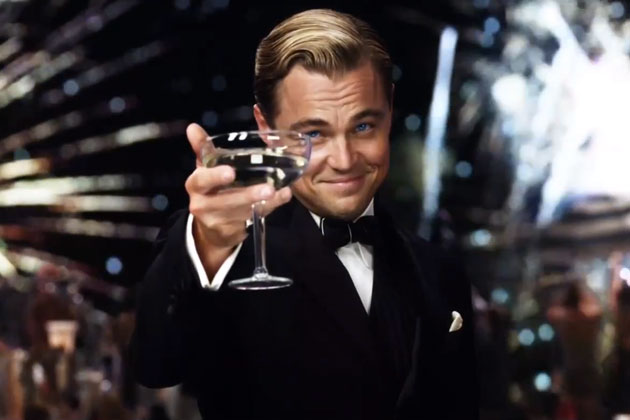
DiCaprio showing he can still do heartthrob
In the midst of this swirling visual and aural experience are four strong performances. Gatsby is, after all, a story built about relationships. Tobey Maguire as Nick Carraway provides the film’s centre and the audience’s eyes and ears, with Luhrmann sticking to Fitzgerald’s device of telling the story from Carraway’s point of view. Luhrmann once described Carey Mulligan as “the actress of her generation,” and while Daisy is not really a meaty enough part to allow her to live up to that hype, she does bring an innocence to the role. DiCaprio, as the mysterious Gatsby, does not appear until half an hour into the film. But in the moment of his entrance, to the soaring tones of Gershwin’s ‘Rhapsody in Blue,’ he shows that despite not having really done it since Titanic, Leo can still play Hollywood heartthrob. The most eye-catching performance of the picture though is from Joel Edgerton. Playing Daisy’s brutish husband, Tom Buchanan, Edgerton is at times an almost hulking presence. Yet despite being ostensibly the villain of the film, and despite treating Daisy horribly, Edgerton brings just enough nuance to Buchanan that you feel something for him as he watches his wife being stolen away by Gatsby.
Luhrmann’s Gatsby has polarised critics, as Luhrmann’s films are want to do. But coming on the back of numerous other failed attempts at adapting Fitzgerald’s novel – at least four others by my count – I can’t help but wonder does the question needs to be asked, are the elements which make Fitzgerald’s novel great not ones which can easily be translated to the screen? Does the brilliance of Fitzgerald’s novel come from something other than simply its narrative or its characters? Or is it simply the case that the right filmmaker hasn’t attempted it yet?
In the meantime, Baz Luhrmann has given us a characteristically glitzy and visually extravagant take on the classic story which is sure to please audiences and make a pile of money, even if it does leave the literary purists slightly dissatisfied.
Rating – ★★★☆
Review by Duncan McLean
Review – The Internship (2013)
Director: Shawn Levy
Starring: Vince Vaughn, Owen Wilson, Rose Byrne, Aasif Mandvi, Josh Brener, Max Minghella, Dylan O’Brien, Tiya Sircar, Tobit Raphael
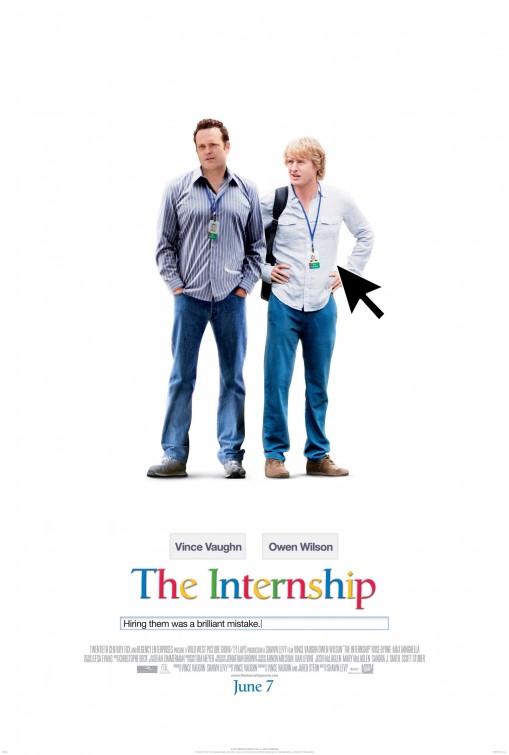 When are the limits of product placement? With The Internship, Google pushes them.
When watch salesmen Billy and Nick lose their jobs because their industry becomes obsolete (no one wears watches anymore, they just look at their phones), Billy decides to go for a long shot and arranges for an interview for the two of them to enter an internship program with Google. Despite their complete lack of computer knowledge they somehow manage to secure a position in an program, where they are thrown together with a team of misfits to compete against the other interns in a week-long series of challenges in which the “Nooglers” (that’s new Googlers) must demonstrate their “Googliness.” At the end of the week only the best team earn jobs at Google.
There is the temptation to see The Internship as one, massive piece of product placement. Throughout the picture we are told about all the wonderful products and services Google has to offer its consumers, with one character even going so far to say that she believes Google makes the world a better place. But Product placement tends to imply something more sneaky and subliminal – James Bond flashing his Omega watch while ordering a Heineken, the Men in Black wearing Ray Ban shades. That’s not what we are getting in The Internship, because Google is as central and essential to the film as any of its stars. Would the film have worked if it was any other tech company that Billy and Nick would have been equally out of place at? Not really. The film uses the established idea we already have of Google as “the best place in the world to work,” the computer nerd’s paradise on earth.
What saves this movie from feeling too much like an ad is that it has a heart. Billy and Nick are not only 20 years older than all of the other interns, but 20 years older than a lot of the Google staff running the program. This generation gap is the source of much of the film’s comedy (Billy’s continuous efforts to inspire his team through references to Flashdance), and also what gives the film that heart, with both generations have something to teach and something to learn from each other.
Vince Vaughn and Owen Wilson are not quite the box office draw they were eight years ago when the teamed up for Wedding Crashers, but they are still a really likeable duo with have an easy rapport, who working well off each other. So between them and a feel-good if generic storyline, The Internship musters just enough goodwill to win you over by the end, allowing you to look put aside the cynic inside you which feels like you’ve just watched a two hour Google ad disguised as entertainment.
Rating – ★★★
Review by Duncan McLean
Review – Fast & Furious 6 (2013)
Director: Justin Lin
Starring: Vin Diesel, Paul Walker, Dwayne Johnson, Michelle Rodriguez, Tyrese Gibson, Sung Kang, Gai Gadot, Ludacris, Luke Evans, Gina Carano
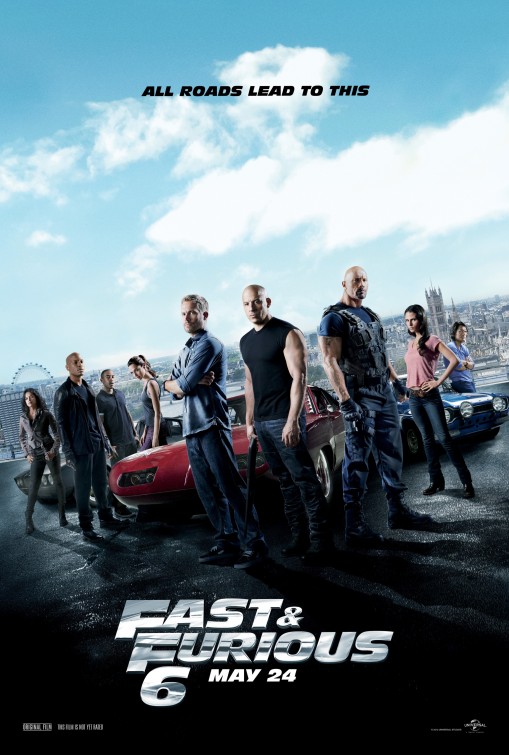 Amazingly, as the Fast & Furious franchise extends into its sixth instalment, rather than fizzling out as it tries and squeeze every last dollar out of the concept, it appears to have found a second wind and is getting stronger. By most every measure of quality, Fast & Furious 6 is terrible, except for one… it is heaps of fun.
Adversaries become allies and the hunted become the hunters when Federal Agent Hobbs is forced to turn to Toretto and his team to help catch Owen Shaw, a terrorist he has been tracking across the globe who leads an elite mercenary team of drivers. But what is in it for Toretto and his team? Why would they abandon the high life they are all living having made off with $100m at the end of Fast Five to assist their nemesis? Because one of Shaw’s crew is none other than Toretto’s lost love Letty, who we all thought died in Fast & Furious (the fourth one, not to be confused with The Fast and the Furious, the original). Oh, and she has amnesia… seriously.
The strength of this franchise, particularly with this film and the last, is that it knows exactly what it is. This movie is completely ridiculous, but it revels in it. Fast & Furious 6 is director Justin Lin’s fourth film in the series, having come on board for The Fast and the Furious: Tokyo Drift, and he delivers a very self-assured film. He knows what this film is, he knows who its audience is and what they are there to see, and he delivers it.
The plot is farcical. The acting is wooden. The dialogue is horrendous. But none of that matters because the there are plenty of laughs (about half of which are intentional) and the action is second-to-none. Lin gives us four major car-chase sequences, each one better than the last and each one good enough to be the climax of most action movies. Of particular note are the chase on a coastal bridge in Spain which features an army tank, and the climactic chase involving a cargo plane on a military base which must have the longest runway in the world.
There’s a great little post-credit scene which is going to blow the minds of fans, and assure they are all counting down for number seven.
Rating – ★★★
Review by Duncan McLean
Review – Star Trek Into Darkness (2013)
Director: J. J. Abrams
Starring: Chris Pine, Zachary Quinto, Zoe Saldana, Karl Urban, Simon Pegg, John Cho, Benedict Cumberbatch, Anton Yelchin, Peter Weller, Bruce Greenwood
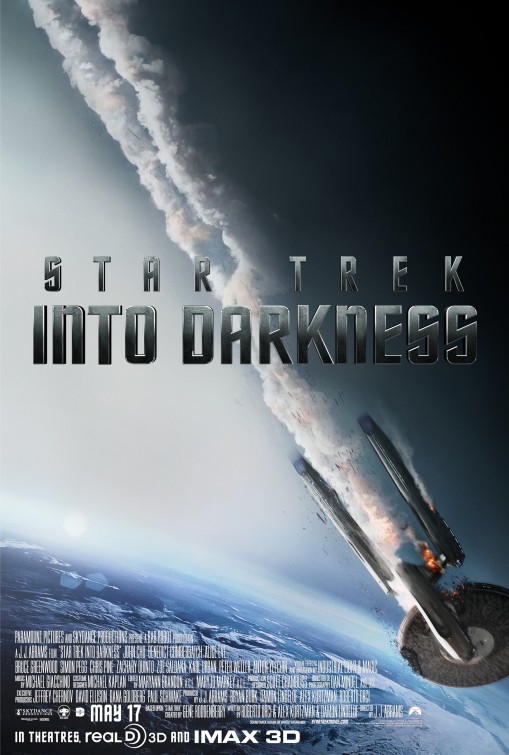 In 2009, J.J. Abrams reboot of the Star Trek franchise wildly exceeded everyone’s expectations, taking almost $400m at the worldwide box office, and establishing Abrams as the next big thing in blockbuster moviemaking. Almost immediately talk started about a sequel, and four years later we get Star Trek Into Darkness, a title seemingly in dire need of some punctuation (Seriously, doesn’t Star Trek: Into Darkness just look more right).
This second instalment continues on from where the 2009 film left off, again acting as a sort of prequel to the original television series and subsequent films. After Star Fleet headquarters are attacked by terrorist John Harrison, Kirk and his crew are sent on a revenge mission to blast Harrison the smithereens. However Harrison is hiding out on Kronos, and their mission risks sparking an all-out war with the volatile Klingons, so Spock persuades Kirk instead to attempt to take Harrison prisoner and make him stand trial. They capture Harrison and bring him aboard the Enterprise unaware that there is more to him than they knew and that aboard the Enterprise is exactly where Harrison wanted to be (If only Kirk, Spock and the gang had seen The Dark Knight… or The Avengers… or Skyfall).
At the heart of Star Trek Into Darkness, as with the previous film, is the symbiotic relationship between Captain Kirk and Commander Spock. They are completely different from one another. One is impulsive and instinctual. The other is logical and calculated. Both frustrate the hell out of the other, but both are also dependent on the strengths of the other to make up for their own deficiencies. They are mutually dependent. While the first film told the story of how these two met each other and came to be a team, this film deals with how they came to truly respect one another and see the value of each other. Both Kirk and Spock at key moments in the film must force themselves to think and act like the other in order to tackle a situation. That Abrams is able to effectively keep human relationships at the centre of such a large scale sci-fi blockbuster is what separates him from contemporary blockbuster makers like Michael Bay (Really, did anyone care about the human characters in Transformers?) and leads to the inevitable comparisons with Spielberg.
Abrams strikes the perfect balance, respecting the established lore of the Star Trek universe without being constrained by it. He homages classic characters and story elements, but isn’t afraid to take some creative liberties to freshen up the story. This may frustrate a hardcore Trekkie, but for the rest of us it gives the film a sense of newness and freshness. This combination of respect for existing lore with a willingness to take ownership bodes well for his next project, the seventh instalment in the Star Wars series.
In the Trekkie community the Star Trek franchise has one of the most devoted followings you will find. But rather than merely seeking to cater to the existing fan base, when Abrams set out to reboot the Star Trek franchise he looked to broaden its appeal and introduce these classic characters to a new audience. And again, Star Trek Into Darkness is big budget blockbuster filmmaking that will appeal to more than just the devoted Trekkies. It is a big movie, containing some top notch action sequences and terrific special effects, on par with anything you will find in blockbuster sci-fi cinema. Add to that a healthy smattering of humour, mostly courtesy of Simon Pegg who has a slightly larger role as Scotty, and you end up with a film that really is everything a great popcorn movie should be.
Rating – ★★★★
Review by Duncan McLean
Review – Iron Man 3 (2013)
Director: Shane Black
Starring: Robert Downey Jr, Gwyneth Paltrow, Don Cheadle, Guy Pearce, Ben Kinsley, Jon Favreau
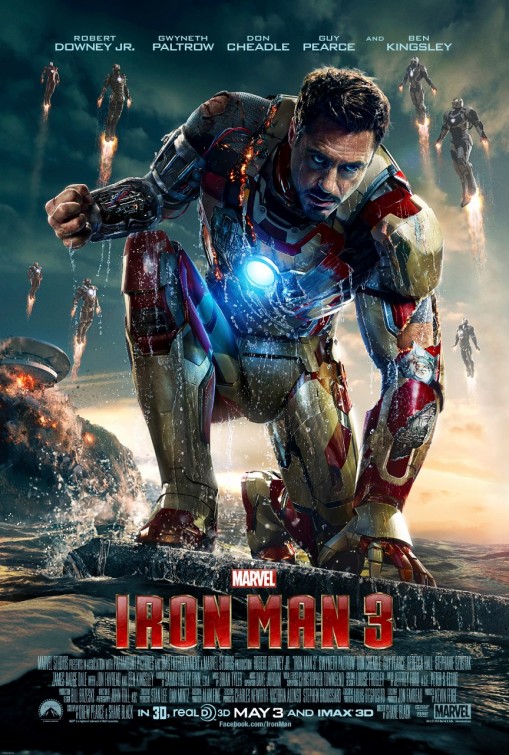
Iron Man 3 provides our first look at ‘Phase Two’ of Marvel’s Avengers plan – that is, the movies that come between The Avengers and its sequel – and our first insight into how that process is going to work.
For starters, there is continuity from the events of The Avengers into this next Tony Stark adventure. However, these events have resulted in a logical shift within realism of the ‘Iron Man universe.’ For the first two films in the trilogy, Stark existed in a world that was more or less realistic. Our heroes and villains may have been ultra-rich and incredibly smart, but they were always basically human beings transformed into superheroes and villains through the use of technology. But The Avengers broke this realism by introducing aliens and gods, alternate dimensions and portals. Iron Man 3 acknowledges this shift in reality, giving a prominent narrative place to Tony Stark and other characters coming to terms with what they experienced in New York (“In New York” becomes code for the things that happened in The Avengers). Stark himself is traumatised by the events to the point that he suffers from anxiety attacks.
This shift in reality also allows for a scaling up of the threat in Iron Man 3. Our villain this time is the mysterious terrorist, the Mandarin, played menacingly by Ben Kingsley with a voice that is some combination of Richard Nixon and Heath Ledger’s Joker. The Mandarin is resourced by jaded scientist Aldrich Killian, continuing the tradition from the first two films of it being a battle of the brains. However rather than resourcing him with weapons or super-suits, Killian resources him with an army of genetically modified super soldiers. Therein lays the break in realism which would not have been acceptable without The Avengers.
Of course, not all our questions are answered. The primary one being, when the world comes under threat again, why does Tony Stark have to face this particular challenge on his own? At what point does a catastrophe become significant enough to warrant getting the band back together?
For this third instalment in the Iron Man trilogy, Jon Favreau has handed over directorial duties to Shane Black. Black’s only previous directorial experience was 2005’s Kiss Kiss Bang Bang, a brilliant if under-appreciated film which represented a very important step the comeback of Robert Downey Jr. which ultimately culminated in Iron Man. Black had made his name as a screenwriter of action-comedies, most notably the Lethal Weapon series, making him a pretty good fit for Iron Man 3. And Black does what he does best in this film, ramping up the laughs and the sense of fun in the film without undermining its drama and tension. Black taking over as director has also enabled Jon Favreau’s character, Stark’s body guard Happy Hogan, to take on a much larger role than he did in the first two films.
For a film about a superhero who wears a mechanical suit, Drew Pearce and Shane Black’s screenplay surprisingly sees Tony Stark spending the vast majority of the film, including a number of the action sequences, not suited up. That they felt the freedom to do this is indicative of the fact that over the span of this franchise the writers have successfully achieved what all superhero scribes wish for; they have got the audience invested in Tony Stark as a person, not just as Iron Man. When Christopher Nolan and David Goyer set about writing Batman Begins, one of their primary goals was to get the audience to care about Bruce Wayne as a person so that they weren’t just killing time until he put on the suit. In the case of the Iron Man franchise, you could almost go so far as to argue that audiences have a greater investment in the character of Tony Stark, and the charisma of Robert Downey Jr.’s portrayal of him, than they do in the figure of Iron Man. Downey Jr. as Tony Stark is the trump card this franchise has to play, so it makes sense that Black set out to give him as much screen time as possible. This is further assisted from within the unfolding narrative of the series, with the constant evolution of the suit now seeing it as a piecemeal set of armour, which enables him to have any combination of his arms, legs and torso suited up without necessarily having to have his face covered.
Amazingly, Iron Man 3 represents Downey Jr.’s fifth appearance as Tony Stark – the Iron Man trilogy, The Avengers and a brief cameo The Incredible Hulk. This is staggering considering that the first Iron Man film was only released in 2008. It took Bruce Willis 25 years to appear five times as John McClane. Stark is now without a doubt the role with which Robert Downey Jr. will be forever associated. The way in which he has brought this character to life could also be arguably his greatest acting achievement, although he is excellent in Chaplin. It does not necessarily go hand in hand that the role for which an actor is remembered is also their best work, so he is quite fortunate there.
Iron Man 3 also contains a very brave plot twist, which I’ve been careful not to give away here. Brave in the sense that it is in equal parts fantastic and disappointing, and has thus far left audiences very divided.
Where Iron Man goes from here is anyone’s guess. We know there is going to be a sequel to The Avengers, there is no way that Marvel will let that not happen, and Iron Man 3 finishes with a Bond-esque “Tony Stark Will Return,” but it also has a sense of wrapping up which makes gives the impression that this may be the last solo Iron Man adventure. If that ends up being the case, Iron Man 3 is a fitting completion to a rollickingly fun trilogy.
Rating – ★★★★
Review by Duncan McLean
Review – A Good Day to Die Hard (2013)
Director: John Moore
Starring: Bruce Willis, Jai Courtney, Sebastian Koch, Yuliya Snigir, Rasha Bukvic, Mary Elizabeth Winstead
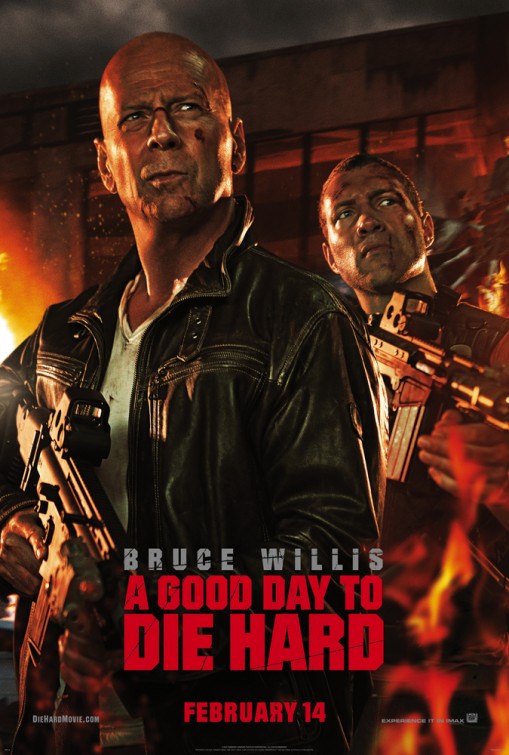 In the 1980s Hollywood was overtaken by blockbuster fever, and a major beneficiary of the studios’ quest for the perfect high concept franchise was the action movie. The 1980s saw action cinema at the peak of its prominence. Films like The Terminator, Predator and the Rambo trilogy had made Schwarzenegger and Stallone among the biggest stars on the planet. But arguably the best movie to come out of the 1980s action cinema was John McTiernan’s Die Hard. Released in 1988 it propelled Bruce Willis into mega-stardom and really raised the bar in terms of quality for action movies. It introduced a blue-print which would be followed by big and loud Hollywood action movie from then on, the one-man army. We were introduced to John McClane, an engaging and charismatic hero, a modern American cowboy who was never short of a witty wise-crack (it is interesting to see the way that McClane’s trademark “yippee-ki-yay motherfucker” starts out with a context, coming out of villain Hans Gruber’s suggestion that he is just playing cowboy, and as the series goes on it is reduced to a simple catchphrase). That hero was then placed in story with a simple but effective premise. He just happened to be in the building that was taken over by terrorists. That building then becomes a labyrinth in which a game of cat-and-mouse can take place. The original Die Hard is a legitimately great movie.
While the sequels released over the 25 years since have steadily declined in quality, the character of John McClane remains, and it is the audience’s goodwill towards this character which keeps them coming back, each time hoping against hope that this one will be better than the previous slightly underwhelming sequel. Unfortunately, this is where A Good Day to Die Hard really drops the ball. In Skip Woods’ screenplay, John McClane is practically reduced to a supporting character in his own movie. The film sees McClane travel to Moscow in order to bring home his estranged son, Jack, who he discovers has been arrested. However, it turns out that his son is actually a CIA agent on a covert mission to rescue a prisoner named Komorov who knows some rather damning information about a Russian politician. After Jack breaks Komorov out, McClane joins his less charismatic son on his mission, and spends most of the remaining screentime following his son around. As a result, the one-man-army which had been the central structure of the previous four Die Hard films is not in place here.
So rarely has a good sequel ever been built around the introduction of a child for our hero. It was worked fine in Live Free or Die Hard (known in some countries as Die Hard 4.0), where the introduced child was his daughter, who mainly served as a motivation for our hero. She was the thing he needed to rescue. But introducing a child to serve as the next generation of hero only ever seems to frustrate audiences, yet lazy writers continue to go back to that well.
Of course, the other staple of the Die Hard series is explosive action, and that is still very much present. John Moore makes sure he gives his audience the requisite amount of carnage, with a major car chase, some quite impressive sequences with a helicopter, and lots and lots of guns. Some of the action sequences do employ digitally generated shots, which can be slightly jarring, not because they are poorly executed, simply that they are stylistically inconsistent with the aesthetic of the other films in the series.
I so badly wanted this movie to be good, or at least good enough, but while it had its moments and there is plenty for the fan of large-scale, explosive action, only the most blindly devoted Die Hard fan will be really satisfied with this one.
Rating – ★★
Review by Duncan McLean
Review – God Bless America (2011)
Director: Bobcat Goldthwait
Starring: Joel Murray, Tara Lynn Barr
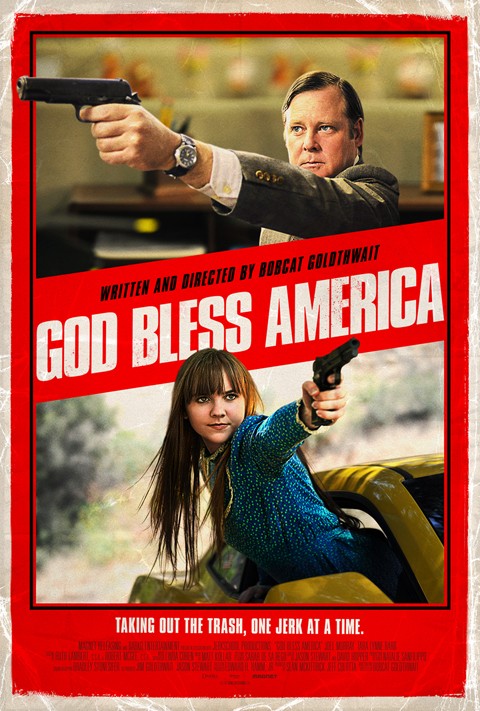 The fifth film from comedian turned writer/director Bobcat Goldthwait, God Bless America is the blackest of black comedies. It is also a really strong piece of satire, commenting on the downward spiral of American culture. Goldthwait laments a society which has come to celebrate the loudest, the meanest, the dumbest and the shallowest.
Joel Murray – Bill Murray’s brother (he must hate that every reviewer feels that it is necessary to mention his more famous brother) – plays Frank. Frank’s life is going down the toilet. He is divorced, with a young daughter who doesn’t want to see him. He is diagnosed with a brain tumour. He has grown tired of an American civilisation that is no longer interested in being civilised. Not only does the world around him celebrate cruelty and bigotry, kindness and generosity are treated with suspicion. When he tries to make a nice gesture by sending a bunch of flowers to a woman from work who he thinks looks like she could use some cheering up, he is fired for sexual harassment. It all becomes too much to bear for Joel, and he decides to take his own life. But before going through with it, he comes to the realisation that perhaps the world would be better served if rather than killing himself he killed those who deserved to die. So, joined by an equally disenfranchised teenage girl named Roxy, he travels around the country knocking off reality TV stars, shock jocks and spoilt brats.
What makes Goldthwait’s satirical observations about the state of American culture so effective is that they aren’t exaggerated. They simply don’t need to be. We recognised the degrading reality television programs, the hate-mongering political commentators, the bigoted and intolerant religious conservatives and the general lack of common courtesy in the day to day interactions. When Joel and Roxy rattle off a list of all the groups of people and traits that irritate them you can’t help but nod in agreement (and occasionally sheepishly recognise they are talking about you). Goldthwait doesn’t need to hyperbolise. He doesn’t need to fabricate something that isn’t there. He just puts what we have become used to up in front of our eyes and forces us to acknowledge it.
However, despite the validity of his observations, it could be argued that the execution – pardon the pun – of the satire is slightly flawed. Is the intolerance of our protagonists any different to the intolerance of those they can’t tolerate? The idea that some people deserve to die, even if presented ironically like in this film, is always going to raise problems. Is Joel and Roxy’s course of action, a killing spree that is here presented as a solution, only representative of another troubling aspect of American culture? This question raises another point, and what I think is the number one issue facing Goldthwait’s film.
Sometimes the reception of a movie is impacted by events well beyond the control of its makers, and that is definitely the case here. While God Bless America is a very clever film, and very justified in its social commentary, you can’t help but feel conflicted while watching it. In light of recent events, now more than ever it is difficult to laugh at the idea of Americans shooting each other. Being the kind of film that it is, God Bless America was never destined to be a popular success – it slandered the very audience it would have to have pandered to if it wanted to succeed at the box office – but even within its niche of the market the way it is received will be influenced.
Rating – ★★★★
Review by Duncan McLean


You must be logged in to post a comment.