
Category: Reviews
Review – Riddick (2013)
Director: David Twohy
Starring: Vin Diesel, Jordi Molla, Matt Nable, Katee Sackhoff, Dave Bautista
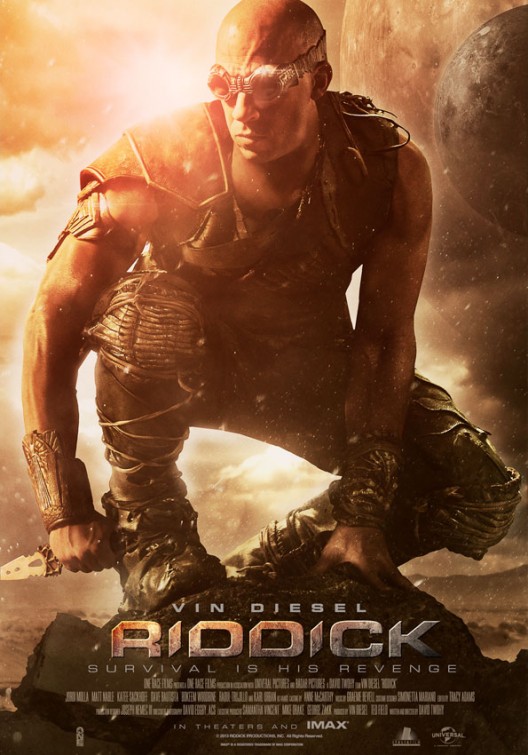 For all the limitations Vin Diesel may possess as an actor, he definitely has a talent for getting sequels made. In the same year that saw the sixth instalment in the Fast & Furious franchise we also get Riddick, the third in the sci-fi thriller series that started back in 2000 with Pitch Black.
After an unpopular detour into the fantasy genre with 2004’s The Chronicles of Riddick, Riddick attempts a return to the simple formula which made Pitch Black a hit. Once again, the Furyan killing machine Richard B. Riddick is fighting for survival on an unknown hostile planet. In the films overly long opening passage, we watch a lone Riddick employing his survival skills in dangerous desert terrain. We see him fight off aggressive aliens, treat his own injuries, and adopt an alien dog as his companion. This dull opening passage is accompanied by awful narration. This narration is absent from the films later passages where things are actually happening, and seems clearly to be the director’s acknowledgement that what we are seeing is not sufficient to maintain our interest.
Eventually Riddick stumbles across an abandoned supply station and activates a distress beacon. The signal, identifying the wanted Riddick as its source, draws two groups of respondents. One is a group of bounty hunters after his head, the other is a military squad after information. At this point the film undergoes a change in point of view. Our primary focus now becomes these respondents. After being the central focus of the first section of the film, Riddick becomes an ever present yet unseen menace who torments – and in some cases slightly more than torments – these new arrivals, in his efforts to commandeer one of their ships to escape. It is this passage of the film, where Riddick is the hunter seen only in glimpses, that is most engaging.
But time is not on Riddick’s side. A storm is coming and bringing with it a plague of giant scorpion-like aliens. So Riddick and his would-be captors have no choice but to join forces. As the plague of aliens descend on the characters cooped up in the small supply station, Riddick becomes very derivative of Aliens. Note that I specified Aliens, James Cameron’s gun-heavy, subtlety free sequel, rather than Ridley Scott’s suspense fuelled masterpiece Alien. Transitioning from the middle passage in which the danger, Riddick, could be anywhere, to this finale where the danger, aliens, is everywhere takes all of the tension out of the film. Your only reason to engage is if you care about the characters, and unfortunately even this late into the film you have been given no reason to.
Riddick is a film almost devoid of any likeable characters. There is no one you can comfortably side with. It is an action movie without a hero. Riddick himself is so violent in both his actions and his manner, and seems to take such joy from that violence, that it would be overly generous to suggest that he even qualifies for the status of an antihero. Even the decision to give him a dog, usually a sure fire way of humanising a character, can only do so much.
Not one for those with delicate sensibilities, Riddick is graphically violent and at times is downright offensive, particularly in the way it treats its only female character of substance, the military officer Dahl (played by Battlestar Galactica’s Katee Sackhoff), who despite being one of the most capable soldiers there is constantly subject to sexual baiting from all sides. This seems to be a movie to appease the fans who felt let down nine years ago by The Chronicles of Riddick, but won’t hold much interest for anyone else.
Rating – ★☆
Review by Duncan McLean
Review – All is Lost (2013)
Director: J.C. Chandor
Starring: Robert Redford
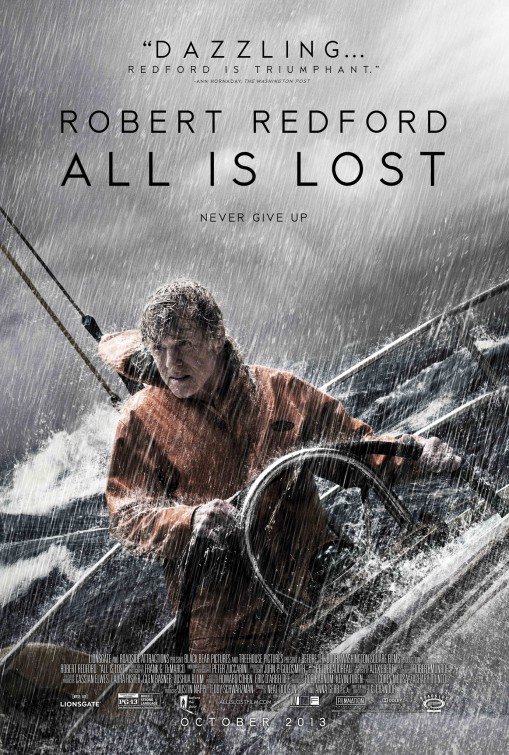 It was once said that all a film needs for drama is two people having a conversation. Writer/director J.C. Chandor (Margin Call) seeks to prove that one of those people is redundant in his second feature, All is Lost, the tale of an ageing man alone at sea.
Our man is on a solo voyage in the Indian Ocean when his yacht collides with a shipping container that has fallen off a cargo ship. With his communications and navigational equipment ruined and his vessel taking on water, the resourceful man finds himself fighting to survive and at the mercy of the ocean.
All is Lost is a minimalist film. There is no fat on it. The film starts at the moment that the Virginia Jean starts to take on water and it finishes at the moment that we discover his final fate. It is a film unburdened by context and backstory. We know very little about this character outside of his immediate circumstances. We don’t know why he is out there. We don’t know if he has a family or not. We don’t know if he is a good person or a bad person. We don’t even know his name. All we know is that he is a human being and he is fighting for his life. And you know what? That is enough. That is all we actually require to care about this man and become invested in his situation. In a time where every reality television contestant comes complete with a tragic backstory of a hurdle they’ve overcome, a relative with terminal illness or a child they’re hoping to inspire, all designed to manipulate the emotions of an audience and cynically tug at their heart strings, it is refreshing to see the way that Chandor trusts his audience. He trusts his audience to care without needing to over-emotionalise the situation.
As the film’s lone character – credited simply as ‘Our Man’ – Robert Redford is compelling to watch. With no other characters to talk to, he hardly speaks a word in the film. Chandor’s faith in the audience to work things out for themselves means he doesn’t resort to having the character talk to himself. Nor does he include a narration to explain what he is thinking and feeling. Instead it is up to Redford’s face and his actions to do the talking. Where a more insecure actor may have given into the temptation to overact, Redford maintains an incredible subtlety. Our man is stoic and unemotive, which makes those moments when his resolve does break all the more powerful. But despite this stoicism we can always see that his mind is working, that he has a plan. It is a masterful performance from a Hollywood legend which should see him in the mix come award season.
All is Lost screened out of competition at the Cannes Film Festival this year, with Redford receiving a standing ovation for his performance. It is the type of film that is more likely to make its presence felt at film festivals than at the box office. The nature of Chandor’s film means that it is a less commercially attractive prospect than last year’s lost at sea film – the equally brilliant Life of Pi – but it is a powerful piece of filmmaking which really sticks in your mind.
Rating – ★★★★☆
Review by Duncan McLean
Review – Elysium (2013)
Director: Neill Blomkamp
Starring: Matt Damon, Jodie Foster, Sharlto Copley, Alice Braga, Diego Luna, Wagner Moura, William Fichtner
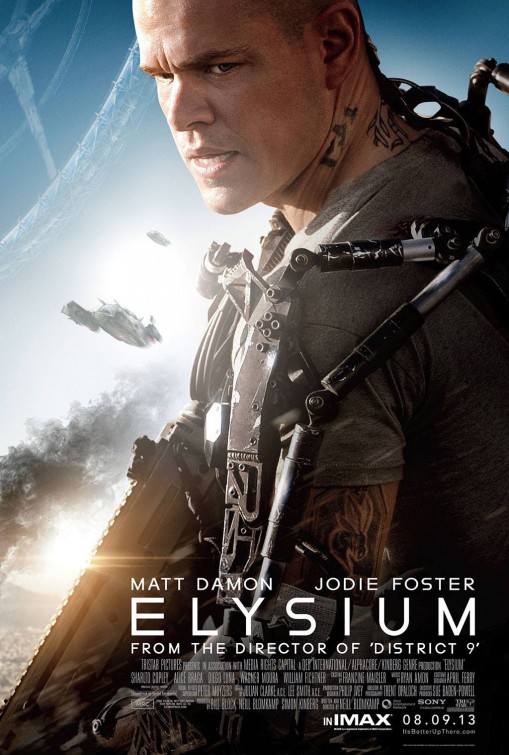 Writer/director Neill Blomkamp made the world sit up and take notice in 2009 with District 9, a powerful allegory for apartheid era South Africa and one of the most original science fiction films in recent memory. The success of that film – it took $210 million worldwide off a $30 million budget – has afforded him a larger canvas for his second film, Elysium.
The year is 2154 and Earth is in ruins. Those who can afford it have moved off-planet, taking residence on a man-made habitat in Earth’s orbit called Elysium, where they protect their standard of living by using what’s left of Earth’s resources and protecting their borders from undesirables. On Earth we meet Max, a career criminal trying to live straight. A work accident sees him exposed to a severe dose of radiation, the result of which is he only has five days left to live. His only chance at making it is to get to Elysium.
Despite being a genuine Hollywood movie this time around (the budget is estimated at $115 million) with an A-list cast, Elysium maintains a similar feel to District 9. Again, Blomkamp is engaging in socially conscious science fiction. While Elysium is not as specific and allegorical in its focus as District 9, the film seeks to engage with a number of prominent social issues including the gap between the haves and have-nots, illegal immigration and the seeking of asylum, and the necessity of universal healthcare. It is difficult to imagine that a more overtly socialist Hollywood blockbuster has ever been made.
The film looks amazing. While Blomkamp mainly gets praised for his narrative and broader aesthetic, he is an adept user of CGI. Naturally, as a big-budget sci-fi blockbuster, Elysium contains its share of spectacle, but it is the subtle, unobtrusive way that the film employs CGI which is most impressive. One of the most effective uses of CGI is in the simple way that in the scenes on Earth we can see the distant figure of Elysium hanging in the sky. It has a strange beauty and you can imagine how its constant presence could serve as a torturous reminder to Earth’s impoverished inhabitants of the good life that is just out of reach.
This time around the story is set in America but Blomkamp retains the international flavour which was such a point of difference in District 9. The rundown Los Angeles setting, actually shot in Mexico City, possesses a similar dustbowl aesthetic to the Johannesburg shantytowns of District 9, and stands in stark contrast to the lush greenness of life on Elysium. Both on Earth and Elysium we hear multiple languages spoken. Sharlto Coply, the star of District 9 who is back as the vicious agent Kruger, is even allowed to speak in his natural South African accent.
Blomkamp had a hard act to follow after the success of District 9. Not only was that film so clever and brilliantly executed, it also had the advantage of being a complete surprise. Elysium, as one of the year’s most anticipated blockbusters, has no such luxury. Blomkamp’s offering doesn’t exceed expectations, but it does enough to satisfy them and is definitely the most original and interesting of the big-budget event movies we’ve seen this year.
Rating – ★★★★
Review by Duncan McLean
Review – There Be Dragons (2011)
Director: Roland Joffé
Starring: Charlie Cox, Wes Bentley, Dougray Scott, Olga Kurylenko, Rodrigo Santoro
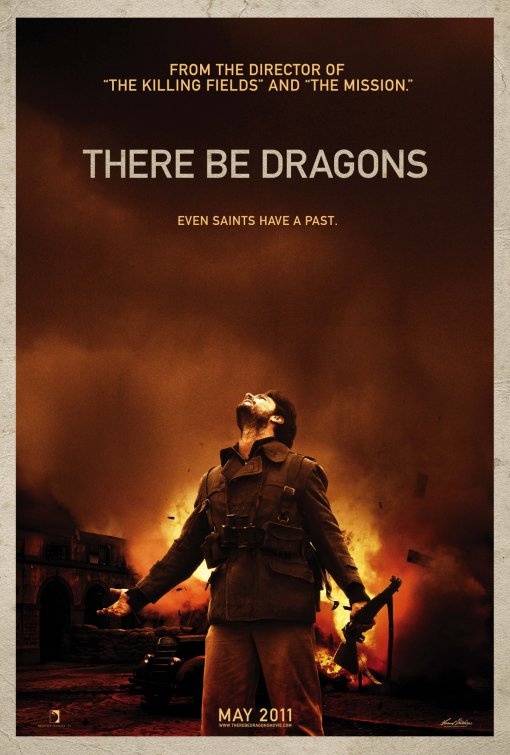 Opus Dei, meaning “the work of God,” is a secretive and somewhat controversial Catholic order whose public image has not been helped by its portrayal in Dan Brown’s The Da Vinci Code. The confusingly titled There Be Dragons provides an alternate, positive portrayal largely through its focus on the early life of the order’s founder, Saint Josemaria Escriva. This sympathetic portrayal is unsurprising given two of the film’s producers are Opus Dei members.
British director Roland Joffé hasn’t been at his best since the mid-1980s when he made The Killing Fields and The Mission back to back, getting Oscar nominations for both. But he has always been willing to explore Christian and spiritual themes in his filmmaking, particularly against historical backdrops. This made There Be Dragons, which explores themes of forgiveness, conscience and the morality of war against the backdrop of the Spanish Civil War, a perfect match for him.
There Be Dragons parallels the stories of two childhood friends, one a saint and one a sinner, during the Spanish Civil War: Josemaria Escriva, a priest forced to flee Spain over the Pyrenees in order to escape persecution, and Manolo Torres, a spy who has infiltrated a group of fascist rebels. Of the two it is Manolo, a fictional character introduced by Joffé, who becomes the real protagonist despite being unlikeable. This is problematic as his character lacks clarity, you don’t know what motivates him, and therefore he is difficult to emotionally engage with. Escriva is also a very simplistic, two-dimensional character. He never seems to be conflicted about making what should be difficult decisions to do the right thing in the face of terrible situations, which reduces the emotional impact of the stance he takes.
There Be Dragons struggles to overcome a convoluted story which lacks context and clarity. The Spanish Civil War was a complicated conflict involving fascists, communists and anarchists, but There Be Dragons doesn’t give you enough insight into the ideology of the conflict. So unless you have the required prior knowledge, you don’t really understand where our central characters fit on the ideological spectrum. Similarly, unless you already have an understanding of Opus Dei, it is not until the epilogue that you are informed about the significance of Escriva. So while the picture has some quite impressive moments, particularly visually, the fact that you don’t gain any particular insight into either Opus Dei or the Spanish Civil War is disappointing.
Rating – ★☆
Review by Duncan McLean
Review – The Place Beyond the Pines (2012)
Director: Derek Cianfrance
Starring: Ryan Gosling, Bradley Cooper, Dane DeHaan, Emory Cohen, Eva Mendes, Ben Mendelsohn, Rose Byrne, Ray Liotta
 In 2010 Derek Cianfrance announced himself as a rising filmmaker to watch with the critical hit Blue Valentine, an intimate and emotional exploration of the beginning and the end of a marriage. His latest film, the sombre drama The Place Beyond the Pines – which takes its title from the Mohawk Indian name for Schenectady, the location of the films events – is a very ambitious project. The film is an epic, multi-generational morality tale of guilt, responsibility and consequence told in three distinct but interrelated sections.
The first section, and the most engaging of the three, concerns stunt motorcycle rider Luke played by Ryan Gosling. When Luke’s circus pulls into Schenectady, he discovers that he has an infant son in the town from his visit a year earlier. This discovery sparks a paternal instinct in him and, determined to provide for his child, he sets about robbing banks, with his skills on a motorbike provng handy for getting away. Gosling and Cianfrance worked together on Blue Valentine and they appear to bring out the best in each other, as Gosling is engrossing to watch in this role.
In the second section Luke is left behind and our focus turns to young policeman Avery Cross played by Bradley Cooper. A chance encounter with Luke thrusts Cross into the spotlight. An ambitious man, Cross finds himself on a path which will lead all the way to the office of District Attorney, along which his morals are constantly being tested. Bradley Cooper showed in Silver Linings Playbook that he does possess some acting chops and his performance as a conflicted and guilt-ridden man, while not as electric as Goslings, carries the middle section of the film.
Unfortunately Cianfrance’s film loses some momentum with its final section. Set fifteen years later, this section focuses on the sons of Luke and Avery, exploring the ways in which the influences of their fathers’ actions play out in their lives. The storyline becomes messier in this closing section. You feel a narrative shift as what had been an organic story seems to make way for what the filmmaker wants to tell us. With the focus in this closing episode being shared between the two young characters, AJ and Jason, as well as an older Avery in the process of running for District Attorney, it lacks the concentrated focus of the earlier sections.
The Place Beyond the Pines is beautifully shot by Sean Bobbitt and through these four male characters it offers an interesting exploration of masculinity, but ultimately this admirable film doesn’t quite achieve Cianfrance’s lofty ambitions. It appears to be a case of the filmmaker’s reach exceeding his grasp. Some of the lines and narrative connections the film draws just feel a bit too neat. Is the destiny of the two sons as inescapable as the film wants us to believe? Can what the film wants us to accept as fate at times be more appropriately attributed to coincidence? The attempt to engage with the age old concept of the sins of the father being visited upon the son means that what starts out seemingly as a realist story ends up becoming something more akin to classical tragedy.
Rating – ★★★☆
Review by Duncan McLean
Review – Act of Valor (2012)
Directors: Mouse McCoy, Scott Waugh
Starring: Nestor Serrano, Alex Veadov, Jason Cottle
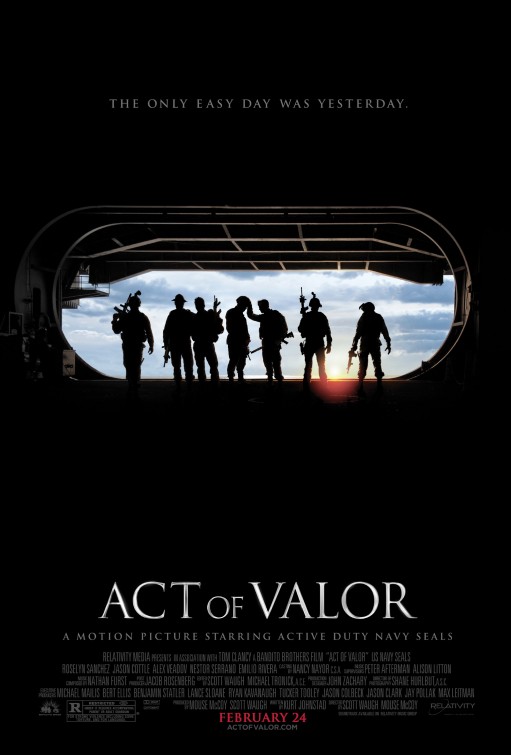 Act of Valor is a propaganda film in disguise, and not much of a disguise at that. Originally intended as a recruitment film before developing into a more traditional war film, it was made with the participation of the US Navy SEALs and is dedicated to all those Navy SEALs that have died in active duty since 9/11 (and their names all appear on screen).
The story – a fictional tale based on “real life acts of valor” but at the same time seemingly taken straight from the big book of war movie clichés – follows an elite team of Navy SEALs whose covert mission to recover a kidnapped CIA agent becomes a mission to stop a terrorist attack on the USA.
The involvement of the military in the film is really Act of Valor’s defining feature. All of the marketing for the film emphasises the fact that the Navy SEAL characters in the film are played by real life Navy SEALs, as though that were a good thing. While this means they are very comfortable doing soldier things, other aspects like character development and dramatic tension are lacking as a result of some of the most wooden acting you’ll ever see.
The strength of this film, however, is the authenticity of its action sequences. The battle and procedural sequences are impressive in a non-Hollywood kind of way. The authenticity – or what appears to be authenticity to someone who wouldn’t really know what authentic military action looks like – is where the involvement of the Navy SEALs really brings something to the film. The film captures some quite impressive manoeuvres involving helicopters, boats, trucks and submarines. The action sequences do, however, feature a great deal of first-person camera angles making it look like a videogame, which has me thinking perhaps it was intended specifically to recruit Call of Duty gamers.
While this sense of authenticity guarantees that Act of Valor does have some redeeming features, the extreme hands-on-hearts American patriotism will likely be off-putting for most non-American viewers.
Rating – ★
Review by Duncan McLean
Review – Jesus Henry Christ (2012)
Director: Dennis Lee
Starring: Jason Spevack, Toni Collette, Michael Sheen, Samantha Weinstein
 Over the last decade and a bit the quirky, dysfunctional family ‘dramedy’ has been a staple of the American Indie cinema. With the provocatively titled Jesus Henry Christ, writer and director Dennis Lee again ventures into this familiar territory.
The film revolves around four suitably oddball characters. Henry is a child genius who has the amazing ability to remember perfectly everything he has ever seen. He lives with his over-protective single mother, who he simply calls Patricia, whose cautiousness results from having lost her mother and elder siblings to a series of ridiculous accidents. Henry’s quest to discover the identity of his father brings them into contact with Dr. Slavkin O’Hara, the university professor who is potentially Henry’s sperm donor father, and his daughter Audrey, a stone-faced teenager suitably messed up after having been used as a real life subject in her father’s research on the social programming of gender.
Beneath this surface level of quirky characters and witty dialogue, at the heart of the film is a comparatively straight forward central theme: the importance to family to one’s sense of identity. All of these four central characters are suffering as a result of a missing connection to a father or mother or sibling.
Obviously shooting for a deadpan vibe somewhere between Little Miss Sunshine and the films of Wes Anderson, where Jesus Henry Christ falls short is that its relentless pursuit of quirkiness and wit doesn’t allow for any believability. If a film can’t get you to suspend your disbelief enough to accept what you are seeing as being on some level real you simply won’t care about the characters enough to truly empathise, and unfortunately that is what happens here.
Jesus Henry Christ just doesn’t quite hit the mark. It is quirky and oddball without every really being funny and it is thought provoking without ever being really moving.
Rating – ★★
Review by Duncan McLean
Review – The Big Wedding (2013)
Director: Justin Zackham
Starring: Robert De Niro, Diane Keaton, Susan Sarandon, Katherine Heigl, Amanda Seyfried, Topher Grace, Ben Barnes, Robin Williams
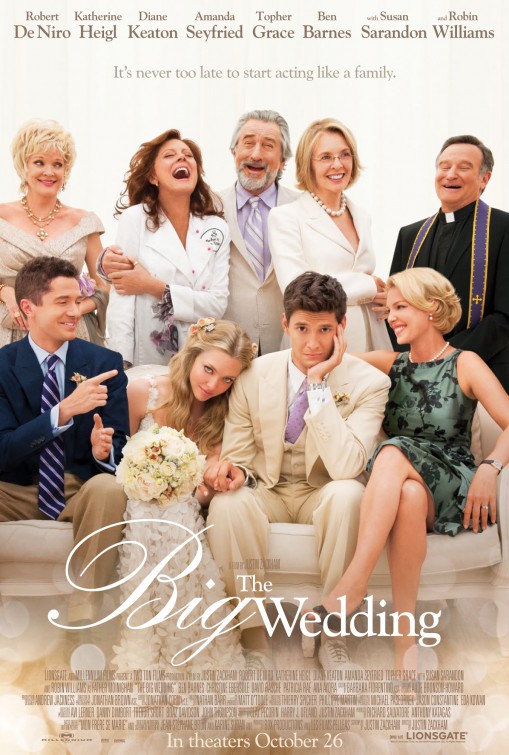 There was a time when a film starring Robert De Niro, Diane Keaton, Susan Sarandon and Robin Williams would have raised a bit of interest. But with recent all-star comedies like Valentine’s Day and New Year’s Eve consistently underwhelming and proving to be considerably less than the sum of their parts, it is understandable that The Big Wedding is approached with a great deal of scepticism. While Justin Zackham’s remake of the 2006 French Film Mon frère se marie (My Brother is Getting Married) is more of a traditional farce than yet another multiple-plotline, Love Actually imitation, the scepticism is unfortunately warranted.
Long divorced couple Don and Ellie Griffin are forced to pretend to be happily married once again when their adopted son Alejandro announces that his ultra-conservative Catholic biological mother is unexpectedly flying in from Columbia for his wedding, and confesses that he never informed her of their separation for fear of offending her beliefs. Add in a step mother who is now forced to move out of her home to maintain the illusion, a sister who is experiencing relationship troubles of her own, a brother who finds himself rather attracted to Alejandro’s biological sister and a slightly racist soon-to-be mother-in-law who is unsure about the “beige babies” the union will result in and you have all the ingredients for an eventful wedding celebration.
If the combination of the scenario, the age of some of the principal cast, and the similarity in title to My Big Fat Greek Wedding lead you to expect a gentle comedy for the whole family you could be in for a bit of a shock. From the very first scene the filmmakers seem determined to try and tap into the recent success of more ‘adult’ comedies and as such The Big Wedding is surprisingly crude, having been slapped with an MA15+ rating for strong coarse language and sexual references. The result is part screwball comedy, part American Pie-style sex-romp except that rather than being sixteen our protagonists are in their sixties.
Crudeness aside, the screenplay is reasonably witty. There are some good comic moments and while none of the cast members really shine like we know they can, they each have their moments and no one is bad. Ultimately however, where you want a good farce to build to an absurd crescendo, this one seems to get overwhelmed as the layers of ridiculousness are piled on. A film like this needs a straight character in amongst all the chaos to act as the audience’s surrogate and point of view. In this case it is likely supposed to be the betrothed couple, played by Ben Barnes and Amanda Seyfried, but they aren’t featured prominently enough to perform the function, likely due to their incredible blandness.
Incredibly predictable but entertaining enough, this comedy about seniors behaving badly is the latest in a growing tradition of Hollywood remakes of French comedies that just seem to lose something once they’re Americanised.
Rating – ★★★
Review by Duncan McLean
Review – Peace, Love and Misunderstanding (2011)
Director: Bruce Beresford
Starring: Jane Fonda, Catherine Keener, Elizabeth Olsen, Nat Wolff, Jeffrey Dean Morgan

When New York lawyer Diane’s husband surprises her with a request for a divorce, her response is to take her two children to visit her mother with whom she has not spoken for twenty years. It sounds like the set up for a tense family drama until you add a couple of details. The mother, Grace, is an ageing hippie living in Woodstock and their estrangement was as a result of her being arrested for selling marijuana at Diane’s wedding.
Thematically, Peace, Love and Misunderstanding is a film about parents and children, specifically the need for children to accept the humanity of their parents. However, Australian director Bruce Beresford chooses not to delve too deeply into these themes, seemingly happy to let the film simply be a charming light comedy.
The film relies on heavily on stereotypical characters and formulaic situations. The fact that Diane, her daughter Zoe and son Jake all manage to meet their respective love interests within 24 hours of arriving in Woodstock is nothing if not convenient. It’s these sorts of things which leave you always feeling like you know exactly where the film is going.
Jane Fonda, who returned to acting in the mid-2000s after a 15 year retirement, here plays the hippie activist Grace, obviously a caricature of her own activist public persona. It’s a character we’ve seen many times before in films, as is Keener’s uptight lawyer, but the fact that it is Jane Fonda playing the role adds a great deal to the character by association.
Peace, Love and Misunderstanding is very formulaic and not particularly deep, but it isn’t trying to be anything more than it is. It is a charming picture with some likeable characters. Good harmless fun.
Rating – ★★☆
Review by Duncan McLean
Review – Kick-Ass 2 (2013)
Director: Jeff Wadlow
Starring: Aaron Taylor-Johnson, Chloë Grace Moretz, Christopher Mintz-Plasse, Jim Carrey, Morris Chestnut
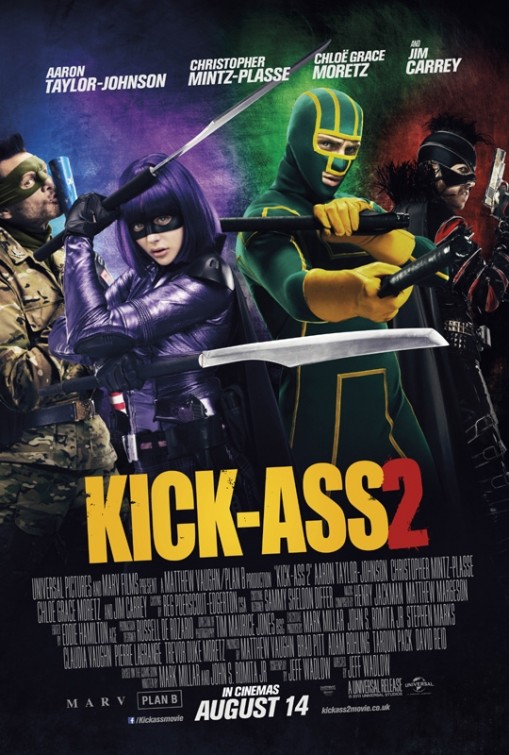 In 2010, amidst a flurry of superhero comic book adaptations, Kick-Ass managed to capture the public’s attention by creating a little controversy. An adaptation of the comic book series by Mark Millar and John Romita Jr, this story of an average high school student who wonders why no one has ever tried to be a superhero before and decides to give it a go not only featured quite graphic violence, but a foul-mouthed vigilante played by a then 11-year-old Chloë Grace Moretz. Three years later Kick-Ass and Hit Girl are back in a film which provides more of the same.
Like a number of superhero sequels before it, Kick-Ass 2 is primarily a film about escalation. After his mob boss father was killed by Kick-Ass at the end of the first film, Chris D’Amico is bent on revenge. Abandoning his superhero persona, the Red Mist, in favour of a new name that isn’t fit for print he decides to become the world’s first super villain, assembling a squad of costume clad henchmen to help him take down Kick-Ass. At the same time, the emergence of Kick-Ass has inspired numerous others of varying degrees of skill and sanity to don costumes and join him as vigilante crime fighters.
It is in its approach to these characters that Kick-Ass 2 is quite interesting. Where other superhero stories ask what prompts someone to become a superhero, the Kick-Ass films ask a slightly different question of their characters. What type of person chooses to put on a costume and fight crime? The film then presents us with two groups. The first are the incredibly naïve but well intentioned, who are ill-equipped for what they are endeavouring to do and are ultimately a danger to themselves. The second group are the psychotic, who have no appreciation for appropriate action, just a black and white concept of justice, and are ultimately a danger to everyone.
After being a scene stealing support character in the original, Chloe Gracë Moretz’s Hit Girl becomes the co-lead character in this sequel and once again she provides the movie’s x-factor. Now 15 years old, Mindy Macready promises her new guardian that she will turn her back on crime fighting. Her subplot, which delivers many of the films laughs, delves into an idea that will be common knowledge to many teenagers, that the social world of high school can be every bit as savage as anything you might come across in a dark alley in the bad part of town.
While Kick-Ass 2 lacks some of the shock value of the original, it is still a very violent film, though it is notable that martial arts and hand-to-hand combat seems to have replaced the gun violence that was so prominent in the original. Kick-Ass 2 was also not without controversy in the lead-up to its release. Jim Carrey, who had joined the cast as vigilante Colonel Stars and Stripes, announced on Twitter in June that he would not be taking part in any promotion for the film as he had experienced a change in heart in light of recent events – most notably the Sandy Hook high school shooting which occurred only a few weeks after he filmed his scenes – and could no longer “support that level of violence.” The course language has also been dialed up. Obviously a 15-year-old has to go further to confront you with language than an 11-year-old does.
Fans of the first film will still find plenty to like about this sequel – the action sequences are well done and there are more than a handful of laughs – but ultimately despite being every bit as violent and profane as the first it is neither as shocking or as clever.
Rating – ★★★
Review by Duncan McLean


You must be logged in to post a comment.