Review – Life of Pi (2012)

Director: Ang Lee

Starring: Suraj Sharma, Irrfan Khan, Rafe Spall
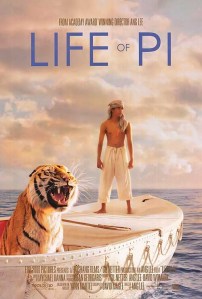
Life of PiYann Martel’s 2001 novel Life of Pi was a best seller and much loved. However the story of a young man’s spiritual journey whilst stranded in the Pacific Ocean on a lifeboat with a Bengal tiger was considered by many to be unfilmable. But Ang Lee, director of Crouching Tiger, Hidden Dragon and Brokeback Mountain, has proven that with the right director there is no such thing as unfilmable, creating a piece of art that is both highly spiritual and visually breathtaking.

I haven’t read Yann Martel’s novel so I can’t comment on how faithful an adaptation Lee’s film is, but I don’t really think it is important. I find it frustrating when people get hung up on the similarities and differences between novels and film adaptation and about which is better. A faithful adaptation of a novel does not necessarily make a good film. It is more important that the filmmaker use the novel as inspiration for his/her own take on the story. For example, Coppola’s The Godfather is a great film. Mario Puzo’s The Godfather is a great novel. But stylistically they are quite different, with Puzo’s novel being kind of pulpy, while Coppola’s film is grand and operatic. So its faithfulness to Martel’s Life of Pi isn’t as important as the fact that Ang Lee’s Life of Pi is a very good film in its own right.

At the beginning of the film the writer tells the adult Pi that he has sought him out because he has been told he “had a story that would make me believe in God.”  It is this spiritual element which differentiates Life of Pi from Robert Zemeckis’s Cast Away and other survival stories we have seen – that and the Bengal tiger. A very spiritual man, Pi sees his journey as having a spiritual significance that goes well beyond a simple fight for survival.

Above everything else, Lee’s film looks amazing. Life of Pi is a stunning aesthetic achievement. With the use of digital technology Lee creates a heightened reality out at sea. Sometimes the sea is rough and choppy and looks very realistic, but at others it is so still and flat it is as though Pi’s boat is floating on nothing at all. This is one of the few films you should try and make sure you see in 3D. I’m not a huge fan of 3D movies, I think the vast majority of the time it is a gimmick used to inflate box office figures, but there are a handful of films which have really demonstrated the potential of the medium if used properly and Life of Pi is one of them.

Equal to the visual achievement as the film’s overall aesthetic is the believability of the tiger, Richard Parker. At the end of the day, the success or failure of the film was largely going to be determined by how successfully Lee made you believe that you were watching a boy and a tiger together on a boat. Richard Parker is created almost entirely with CGI, a wise move as it means there is a consistent look whereas had they tried to use a real tiger as much as possible, there would undoubtedly been jarring moments which would draw attention to the CGI tiger. The computer generated tiger looks brilliant though. You never doubt the reality of the beast before you. Credit should also go to Suraj Sharma, whose performance opposite a CGI tiger is pivotal in establishing the believability of the animal.

Life of Pi is a beautiful, thoughtful film which will be a definite player in the upcoming award season, particularly in the fields of visual effects, cinematography and directing.

Rating – ★★★★

Review by Duncan McLean
The Doctor of Movies’ Top 10 of 2012

Argo

1. Argo (Ben Affleck)

People have to stop talking about Ben Affleck “being on a hot streak” or “enjoying a purple patch” as a director and accept that perhaps he is just a really talented director. Maybe he didn’t ride Matt Damon’s coattails to that screenwriting Oscar for Good Will Hunting all those years ago like so many joked. Argo, Affleck’s third film, is the year’s best thriller and mixes moments of extreme tension with some great laughs. Alan Arkin and John Goodman are fantastic as the CIA’s Hollywood collaborators.

Hugo

2. Hugo (Martin Scorsese)

A few eyebrows were raised when it was announced that Scorsese was going to adapt a children’s book as his next project, but with David Selznick’s The Invention of Hugo Cabret it made perfect sense. Hugo was Scorsese’s love letter to the early cinema. A visually stunning film it is also one of the few films that have been made which have convinced me there may be some merit to 3D.

Artist

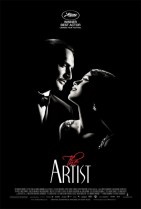
3. The Artist (Michel Hazanavicius)

Of course, Hugo was not the only film in cinemas this year which celebrated the early days of cinema. Michel Hazanavicius’ The Artist went one step further, engaging with the long-lost art of silent storytelling. This was such an ambitious project, but it was just so endearing and charming that it won people over. It also came out at exactly the right time for me as I’d recently been watching a lot of Charlie Chaplin films and my interest in silent cinema was peaking.

Skyfall

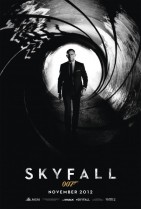
4. Skyfall (Sam Mendes)

With MGM’s financial troubles we were forced to wait four years to see James Bond back on our screens after the disappointing Quantum of Solace, but boy was it worth the wait. Skyfall had everything you want in a Bond film, some great action sequences, a bit of humour, a fantastic villain. But on top of that,  having a real filmmaker in Sam Mendes at the helm meant that the film also had an attention character development and an emotional depth that we’d never seen in a Bond before. Skyfall is not just a great Bond film, it is a great film.

Les Miserables Poster

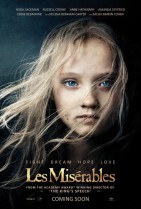
5. Les Misérables (Tom Hooper)

This was not going to be everyone’s cup of tea just because of the sheer volume of singing, but Tom Hooper’s ambitious film is a cinematic achievement, successfully translating one of the West End’s most successful and most tragic musicals to the screen. Hugh Jackman and Anne Hathaway gave two of the year’s best performances in this gut-wrenching story of poverty and injustice, rebellion and redemption.

Tinker Tailor Soldier Spy

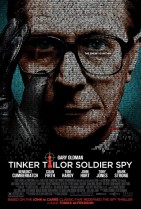
6. Tinker, Tailor, Soldier, Spy (Tomas Alfredson)

The thing that struck me about this adaptation of John Le Carre’s novel was its stillness and quietness. You feel like it is moving slowly, but when you stop and think about you realise that a lot has been happening. We are so used to seeing spy movies in the James Bond mould, that the stillness Tinker, Tailor, Soldier, Spy is quite intriguing. An absolute all-star British cast led by a great performance from the chameleon-like Gary Oldman.

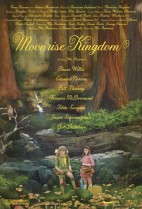
Moonrise Kingdom

7. Moonrise Kingdom (Wes Anderson)

Moonrise Kingdom is a Wes Anderson film through and through, which means some people will love it and others will hate it. Many of his usual collaborators are back with the key additions of Bruce Willis and Edward Norton. Anderson’s films are always deadpan and contain a touch of darkness, but this ups the ante on that. As always, the use of music, in this case Benjamin Britten and Hank Williams, is very clever. But for me, the sight of Harvey Keitel in shorts alone makes this film noteworthy.

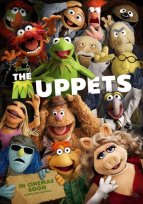
Muppets

8. The Muppets (James Bobin)

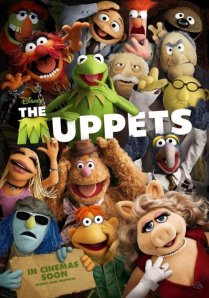
This may look like a strange pick alongside the other films on this list but The Muppets was a hard film not to love. No other film this year projected pure joy the way The Muppets did, and that should be celebrated. Jason Segel and Nicholas Stoller’s screenplay showed a real love for these classic characters and, along with Bret McKenzie’s songs, found the perfect balance between nostalgia and contemporary comedy.

Looper

9. Looper (Rian Johnson)

There is nothing better than being genuinely surprised (in a positive way) by a film, and for mine Rian Johnson’s Looper was the surprise movie of the year. I saw it on a whim, expecting it to be a reasonably run of the mill sci-fi romp but what I got was the most original and interesting science fiction movie since District 9. The story of an assassin from two different periods in time going head to head with himself also engaged with that moral conundrum “If you could go back in time to when Hitler/Stalin/Pol Pot was a baby, would you kill them to save the world future suffering?”

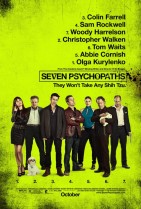
Seven Psychopaths

10. Seven Psychopaths (Martin McDonagh)

Martin McDonagh’s comedy isn’t going to appear on a lot of Top 10 lists but this is my list, dammit, so I’m including it. This sharply written comedy about a screenwriter who finds himself in a tough situation after his friend kidnaps the beloved dog of a local crime boss is a strong follow-up to McDonagh’s 2008 debut In Bruges. Yes there are some holes and some problems, but there are also some big laughs, with terrific comic performances from the always brilliant Sam Rockwell and the always quirky Christopher Walken carrying the film.

Not far off: The Master (Paul Thomas Anderson), The Dark Knight Rises (Christopher Nolan), Shame (Steve McQueen), The Girl with the Dragon Tattoo (David Fincher), The Avengers (Joss Whedon)

The Worst Movie of the Year: Act of Valor (Mike McCoy, Scott Waugh). Not even close really. This military propaganda film in disguise (and not much of a disguise at that) proudly trumpeted the fact that all the major characters were played by real life Marines as though that were a good thing. It wasn’t.

Cinematic Highlight of the Year: Getting to see Steven Spielberg’s Jaws on the big screen as part of its high definition re-release. It was the movie which started the whole blockbuster movement, and which launched Spielberg into stardom, and it still holds up. Similarly, it was good to see Titanic on the big screen again. While the 3D transfer didn’t do much for me it was interesting to see that enough time has passed that we are all over our anti-Titanic bias and can accept that, while it has its faults, it is actually a very good film.

Review – The Hobbit: An Unexpected Journey (2012)

Director: Peter Jackson

Starring: Martin Freeman, Ian McKellen, Richard Armitage, Andy Serkis

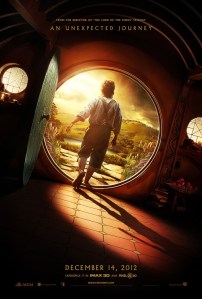
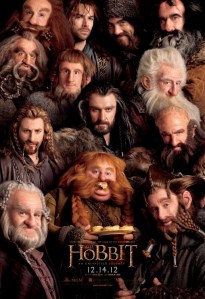
Hobbit - An Unexpected JourneyIt is fun to be back in Middle Earth and the world of The Lord of the Rings again. It is great to see Ian McKellen back as Gandalf. Andy Serkis again steals the show as Gollum. It is nice, if completely unnecessary, to see Elijah Wood as Frodo again. But be warned, Lord of the Rings this is not, which is unfortunate as it is not going to be able to avoid comparisons.

The Hobbit: An Unexpected Journey follows the same narrative formula as The Lord of the Rings. Again we have a motley crew making their way across the countryside, encountering all manner of foe, on a journey to an ominous mountain. However, the problem for The Hobbit is that there just isn’t enough at stake in this story. In The Lord of the Rings you have these grand themes of good and evil at play, and the fate of the world rests on the shoulders of this small company on their mission. In The Hobbit we have a dozen dwarves who want their home and their gold back. It doesn’t quite compare. In The Lord of the Rings, they had no choice but to go on. In The Hobbit you feel like if things really got too hard they could just decide to give up and life would go on. The only times we get a sense of bigger themes at play are in scenes which point towards the events of the events of The Lord of the Rings trilogy. The difference between the two is that The Lord of the Rings is a genuine epic, whereas The Hobbit is a rollicking adventure story. But in trying to maintain a consistent tone, Jackson is trying to force an epic tone on The Hobbit when he may have been better served to have a bit more fun with it. It is a children’s book after all.

As an aside, I couldn’t help but notice the similarities between the poster below and that of The Muppets which I hoped may have indicated an attempt to lighten it up a bit, but outside of a couple of moments, not really.

Hobbit - An Unexpected Journey1Muppets

Martin Freeman is very likeable as Bilbo Baggins and the better scenes in the film, for mine, feature him prominently, in particular the scene with the three trolls deciding how they will cook up the band of dwarves they capture, and, of course, Bilbo and Gollum’s game of riddles. Richard Armitage is strong and moody as Thorin, but with the exception of a couple you will have trouble differentiating between the dozen dwarves in the band. Unlike The Lord of the Rings where each member of the fellowship had a distinct persona, in this case they are largely interchangeable.

When it was first announced that The Hobbit was going to be made as a two part film, and then later revised to three parts, eyebrows were raised. When Jackson made The Lord of the Rings, he took an enormous work, which was already a trilogy, and had to be really selective in terms of what he included and what he left out in order to fit it into a trilogy of films. With The Hobbit Jackson has taken one book, which is significantly shorter than The Lord of the Rings, and has stretched it out to three films, and unfortunately that stretching shows. At 169 minutes, the issue with The Hobbit: An Unexpected Journey is not so much that it is long, but that it feels unnecessarily long. It feels stretched out. I can’t see there being a special extended edition DVD of this film because it is hard to believe Jackson has chosen to leave anything out. Anyone who found the last half hour of Return of the King frustratingly drawn out will find themselves infuriated by how long it takes An Unexpected Journey to get started. First there is a prologue of about 20 minutes which seems to have been put in there solely to get Elijah Wood back on screen as Frodo, and that is followed by another 20 minutes of dwarves arriving at Bag End. So you are about 45 minutes into An Unexpected Journey before the unexpected journey begins. I wouldn’t be surprised if, when the trilogy is finished, a competent reader could read Tolkien’s novel in less time than it would take to watch the trilogy back to back.

I didn’t get to see the film in 48 frames per second, but have heard mixed responses to that format. Apparently it is wonderful for the landscape shots, offering beautiful clarity, but that same clarity has a negative effect on costumes and make-up.

While The Hobbit: An Unexpected Journey has copped a bit of flak from some critics, and doesn’t reach the heights of the incredibly successful Lord of the Rings trilogy, it is not Star Wars Episode I: The Phantom Menace by any stretch of the imagination. It feels a little drawn out, but once the story gets going there is a lot of fun to be had.

Rating – ★★☆

Review by Duncan McLean

Review – Les Misérables (2012)

Director: Tom Hooper

Starring: Hugh Jackman, Russell Crowe, Anne Hathaway, Eddie Redmayne, Amanda Seyfried, Samantha Barks, Aaron Tveit, Helena Bonham Carter, Sacha Baron Cohen

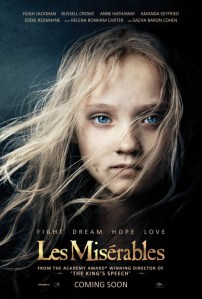
Les MiséraLes Miserables Posterbles first appeared on stage on the West End in 1985 and in the 27 years since it has become one of the most successful musicals of all time. That said, it was still a bit of a risk for Tom Hooper to announce it as his next film project after winning an Oscar for The King’s Speech. It was always going to be a high profile event film, and let’s face it, history has shown us that when you get a big budget musical  wrong it can be really, really bad. Hooper assembled a great cast lead by Hugh Jackman – amazingly making his first movie musical despite his strong musical pedigree. But early critical reviews were mixed. Some called it a mess, others heralded it as one of the year’s best. So I was really keen to see it for myself, particularly as I saw the stage production in London earlier in the year and loved it.

The big experiment with Les Misérables, and again part of what made it a risky project,was having the actors sing live. Usually when you make a musical one of the first things you do is get the cast into a recording studio and record an album. Then a couple of months later when it is time for the shoot, the actors simply lip-synch to the mastered recording. With Les Misérables, Tom Hooper decided that he wanted his actors to sing live on each take. The major advantage of doing it this way is it frees up the actors creatively. When you record the songs in advance, the actors are forced to make many of their acting choices well before getting on set, and once on set they are restricted by the necessity of matching up with the recording. This would be far from ideal for a musical like Les Misérables  where so much of the emotional crux of the story is delivered through song. This greater level of freedom in performance for the actors has resulted in a musical which is not necessarily as brassy and robust as the stage show, but packs an incredible emotional punch.

This different approach was then complemented by the way the musical numbers have been shot. Unlike a traditional musical, Les Misérables only features one heavily choreographed number, the comical ‘Master of the House’ performed by Sacha Baron Cohen and Helena Bonham Carter’s grotesque tavern owners. The other numbers are shot very simply, often in close-up. The beauty of this approach is you get to see characters faces, something you don’t get on stage. Les Misérables is a very tragic, very emotional story, and the impact of being able to see the faces of characters as they sing is quite powerful. Never is this more apparent than when Anne Hathaway sings ‘I Dreamed a Dream,’ shot entirely in one shot, a medium close-up.

Hugh Jackman was always the logical choice to play Jean Valjean. With his baritone voice, his award-winning musical theatre experience, broad chest and handsome features, Jackman seems born to play the part. As Valjean, he carries much of the emotional weight of the film and he does it admirably, imbuing the character with a real strength and masculinity. The film’s other clear stand out is Anne Hathaway as Fantine. She delivers one of the most gut-wrenching performances you will ever see, demonstrating her versatility in a year which also saw her playing Catwoman in The Dark Knight Rises. While Jackman will be in the mix come award season, Hathaway can start deciding where she wants to put her Best Supporting Actress Oscar now.

One of the big questions in the lead up to the film was the singing ability of Russell Crowe. Everyone knew Jackman and Hathaway could sing, but the fact that Crowe used to have a band, Thirty Odd Foot of Grunt, not to mention his old Russ le Roq days, didn’t have people convinced he was the right man to tackle the demanding role of Javert. This concern was not helped by the fact that his voice was notably absent from a couple of the early trailers. As it turns out, he does alright. His voice is nowhere near as full as some of the others in the film, but you get used to it. He definitely looks the part, and still manages to give some emotional depth to the character.

Hooper’s film is a very faithful adaptation of the musical, plus the requisite new song, ‘Suddenly,’ so that they have something to submit for Award consideration. This faithfulness means that if there was anything in particular that irked you about the stage musical, it still will in the film. In my case, it is the fact that Cosette and Marius are still really boring. It also means that, as is the case with many film musicals, the critical reception will be varied. Musicals are really divisive. People tend to like them or they don’t and if you are someone who can’t get behind the concept of a musical, you’re never going to enjoy one. Even people who like movie musicals may struggle with this one as the ratio of dialogue to song is much closer to an opera than to a normal movie musical.  So with a film like this it is difficult to make a general judgement. Instead, I can only speak as a person who enjoys musicals, and who particularly loves this one. I thought it was brilliant.

Rating – ★★★★

Review by Duncan McLean
Review – Following (1998)

Director: Christopher Nolan

Starring: Jeremy Theobald, Alex Haw, Lucy Russell

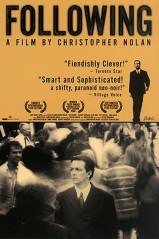
Before ChristopheFollowing Posterr Nolan was the man who reinvented the superhero movie with the brilliant Dark Knight Trilogy, before he was even “the guy who made that backwards movie with Guy Pearce” (Memento for those of you playing along at home), he made an interesting little noir-thriller called Following. It is the story of Bill, an aspiring writer who decides to start following people at random, just to see what they do, thinking it will give him special insight for his writing. When one of his targets, a burglar named Cobb who breaks into people’s homes not so much to steal things as to voyeuristically look into people’s lives, approaches him, Bill finds himself involved in a very strange relationship.

Nolan’s debut feature, Following is a no-budget film shot handheld in grainy, black-and-white. Nolan wrote, directed, produced and shot the film himself. For cast and crew, he used friends and acquaintances, with the picture being shot over a period of about a year, shooting on Saturdays whenever people were free. I quite enjoy watching the really early films from directors who go on to become big names – the Directors Suite released a great DVD of Martin Scorsese’s early short films which is really worth a look – because it is interesting to see what traces of the filmmaker they would become can be found in those early, often much smaller scale, works.

The primary feature of Following is its narrative structure. Nolan takes a linear story, divides it into four sections and then inter-cuts them, delivering to the viewer a non-chronological narrative which tells us the young man’s story through a series of flash backs and jumps forward. Innovations in the realm of narrative form have become one of Nolan’s chief attributes as a filmmaker, with films like Memento, The Prestige and Inception all playing with form and narrative structure different ways. Following gives us an early, and much simpler example of the kind of innovation Nolan would employ as his career progressed.

The other thing which is great about Following is that it is only 70mins long. In a time when it is becoming increasingly common for films to go well beyond the two-hour mark regardless of whether they really need to or not, it is refreshing to see a filmmaker show that a good story can be told in under 90 minutes.

If anything lets this film down, it is they quality of the performances. However this is to be expected given the amateur cast – none of whom have added many credits of substance outside of small cameos in later Nolan films – and the disjointed nature of the production.

There is also a nice little moment of Nolan serendipity for the movie nerds out there. After Bill and Cobb break into a man’s apartment, we see them leave through a front door which proudly displays a Batman logo.

While it was really his next film, Memento, which established Nolan as one of the upcoming filmmakers of the early 2000s, Following did win a few awards, most notably at the San Francisco Film Festival and the Slamdance Film Festival, and announced Nolan as someone to watch. Following has recently been released on Blu-Ray as part of the Criterion Collection, and includes a commentary from Nolan, an essay by film critic Scott Foundas and Nolan’s short film Doodlebug.

Rating – ★★★☆

By Duncan McLean

Golden Globe Nominations Announced

Only one day after we got the SAG nominations, the Hollywood Foreign Press Association have announced the nominations for the 70th Annual Golden Globe Awards. There are more categories here than there are in the SAGs as we are looking beyond just acting, so it gives us our first real taste of who will be Oscar contenders. And there are a couple of differences already between what we saw yesterday and what the HFPA announced today.

Best Motion Picture – Drama

  • Argo
  • Django Unchained
  • The Life of Pi
  • Lincoln
  • Zero Dark Thirty

One of the things which makes the Golden Globes a tricky guide for Oscar form is that films are separated into dramas and musicals/comedies. That means, in this case, Les Miserables and Silver Linings Playbook are both in a different category to most of the other films they will be battling it out with come Oscar time. While Django Unchained was notably absent in the SAG nominations, it is there for the Golden Globes and should be a major player. Again, The Master is notably absent, and after so much hype when it first hit the festival circuit it may end up falling by the wayside. That being said, the Oscars have ten nominations in the Best Picture category, and only two or maybe three of the films in the next category are a realistic chance of a Best Picture Oscar nod so The Master may sneak in. Zero Dark Thirty is creating some great buzz before it’s cinematic release, already topping a few best of 2012 lists, but I can’t help but feel that this might be the year that Tarantino gets the recognition that has eluded him thus far.

My Tip: Django Unchained

Best Motion Picture – Musical or Comedy

  • The Best Exotic Marigold Hotel
  • Les Miserables
  • Moonrise Kingdom
  • Salmon Fishing in the Yemen
  • Silver Linings Playbook

For mine, this list involves a top three – Les Miserables, Moonrise Kingdom and Silver Linings Playbook – and then there is quite a drop off to the also-rans.

My Tip: Les Miserables

Best Director

  • Ben Affleck (Argo)
  • Kathryn Bigelow (Zero Dark Thirty)
  • Ang Lee (The Life of Pi)
  • Steven Spielberg (Lincoln)
  • Quentin Tarantino (Django Unchained)

Unsurprisingly, the best director nominations list lines up perfectly with the best picture – drama nominations. Ben Affleck has proven himself to be one of the brightest young directorial talents going around following Gone Baby Gone and The Town with Argo, and it is great to see him getting recognition, but I can’t see him winning this category. I find it interesting that Kathryn Bigelow is establishing herself as the best director working in the war/combat genre. For mine this category will come down to Tarantino vs Bigelow. Spielberg could be a player, but I get the feeling that Lincoln is a bit too much of an ‘award bait’ picture and that might turn some voters off.

My Tip: Quentin Tarantino

Best Actor – Drama

  • Daniel Day-Lewis (Lincoln)
  • Richard Gere (Arbitage)
  • John Hawks (The Sessions)
  • Joaquin Phoenix (The Master)
  • Denzel Washington (Flight)

My Tip: Daniel Day-Lewis

Best Actor – Musical or Comedy

  • Jack Black (Bernie)
  • Bradley Cooper (Silver Linings Playbook)
  • Hugh Jackman (Les Miserables)
  • Ewan McGregor (Salmon Fishing in the Yemen)
  • Bill Murray (Hyde Park on Hudson)

My Tip: Hugh Jackman

Best Actress – Drama

  • Jessica Chastain (Zero Dark Thirty)
  • Marion Cotillard (Rust and Bone)
  • Helen Mirren (Hitchcock)
  • Naomi Watts (The Impossible)
  • Rachel Weisz (The Deep Blue Sea)

It is interesting that four of the five nominations for best actress at the SAG awards fall into this category. I still think it comes down to Cotillard or Chastain.

My Tip: Marion Cotillard

Best Actress – Musical or Comedy

  • Emily Blunt (Salmon Fishing in the Yemen)
  • Judi Dench (The Best Exotic Marigold Hotel)
  • Jennifer Lawrence (Silver Linings Playbook)
  • Maggie Smith (The Quartet)
  • Meryl Streep (Hope Springs)

Jennifer Lawrence is the only one from this field who earned a SAG nomination (technically Maggie Smith did but it was for a different performance), and she’s up against a couple of Dames and the most nominated actress of all time in Meryl Streep. It would be a surprise, to say the least, if Meryl was to win here.

My Tip: Jennifer Lawrence

Best Supporting Actor

  • Alan Arkin (Argo)
  • Leonardo DiCaprio (Django Unchained)
  • Philip Seymour Hoffman (The Master)
  • Tommy Lee Jones (Lincoln)
  • Christoph Waltz (Django Unchained)

For the supporting awards the categories are not divided into dramas and musicals/comedies. This is the category where Django Unchained was most notably absent in the SAG nominations and, lo and behold, we see both DiCaprio and Waltz making their way into the field.

My Tip: Philip Seymour Hoffman

Best Supporting Actress

  • Amy Adams (The Master)
  • Sally Field (Lincoln)
  • Anne Hathaway (Les Miserables)
  • Helen Hunt (The Sessions)
  • Nicole Kidman (The Paperboy)

Amy Adams comes into the field that was nominated for SAGs at the expense of Maggie Smith.

My Tip: Anne Hathaway

Best Screenplay

  • Argo – Chris Terrio
  • Django Unchained – Quentin Tarantino
  • Lincoln – Tony Kushner
  • Silver Linings Playbook – David O. Russell
  • Zero Dark Thirty – Mark Boal

Similar to the best picture – drama field, except that David O. Russell’s Silver Linings Playbook screenplay comes in for The Life of Pi.

My Tip: Django Unchained

Best Animated Feature

  • Brave
  • Frankenweenie
  • Hotel Transylvania
  • Rise of the Guardians
  • Wreck-it-Ralph

This is an interesting year for this category because, for once, Pixar failed to live up to expectations. Brave lacked Pixar’s usual spark and as such this category is wide open.

My Tip: Wreck-it Ralph

Best Foreign Language Film

  • Amour
  • Kon-Tiki
  • The Intouchables
  • A Royal Affair
  • Rust and Bone

The Intouchables will no doubt be the popular favourite in this category. It has been a huge box-office success and one of the feel-good movies of the year. However, the critical response has not quite been as unanimous as the popular praise so I wouldn’t be surprised if it was passed over.

My Tip: Amour

The Golden Globes will be held on 13th January 2013

SAG Nominations Announced

The Hollywood award season is fast upon us and the first major date on the road to the Oscars was 12th December for the announcement of the nominees for the Screen Actors Guild awards. The Screen Actors Guild was the union which represented actors in the American film and television industries. I say ‘was’ because earlier this year SAG membership voted to merge with the American Federation of Television and Radio Artists to create SAG-AFTRA. But the SAG awards have remained and this years nominations have produced a few surprises.

Best Ensemble Cast:

  • Argo
  • The Best Exotic Marigold Hotel
  • Les Miserables
  • Lincoln
  • Silver Linings Playbook

I was quite surprised to see The Best Exotic Marigold Hotel score a nomination in this category. Obviously it had the names in the cast, but I didn’t find that it wowed me, and when you consider some of the casts that missed out on nominations it becomes an even more peculiar decision. Django Unchained, Zero Dark Thirty and Moonrise Kingdom have all been regular appearances on best films of 2012 lists and all boast impressive ensemble casts. It may well be the case that Django Unchained and Zero Dark Thirty have hit cinemas just a bit too late to gain the attention of the guild, but Moonrise Kingdom being overlooked is surprising. It was never going to happen, but I would have quite liked to see Seven Psychopaths in this category. Sam Rockwell and Christopher Walken are both sensational, Colin Farrell is very good and you’ve also got Woody Allen and Tom Waits putting in nice performances.

My Tip: Les Miserables

Best Actor:

  • Bradley Cooper (Silver Linings Playbook)
  • Daniel Day-Lewis (Lincoln)
  • John Hawkes (The Sessions)
  • Hugh Jackman (Les Miserables)
  • Denzel Washington (Flight)

This is a really strong field, but again there is at least one surprising omissions. Where is Joaquin Phoenix? His performance as the damaged sailor Freddie Quell in The Master is very powerful. He really makes you squirm. The other name that is missing which I thought was notable was Anthony Hopkins for Hitchcock. It is not so much a case that he deserved to be there over anyone in particular, just that Hitchcock, like The Iron Lady last year, looked like classic Oscar bait.

My Tip: Daniel Day-Lewis

Best Actress:

  • Jessica Chastain (Zero Dark Thirty)
  • Marion Cotillard (Rust and Bone)
  • Jennifer Lawrence (Silver Linings Playbook)
  • Helen Mirren (Hitchcock)
  • Naomi Watts (The Impossible)

Beasts of the Southern Wild wasn’t made under a guild contract which meant that its impressive young star, Quvenzhane Wallis, didn’t qualify for a SAG nomination. Other than that this list looks pretty good, though it is strange to not have Meryl Street in there somewhere.

My Tip: Marion Cotillard

Best Supporting Actor:

  • Alan Arkin (Argo)
  • Javier Bardem (Skyfall)
  • Robert De Niro (Silver Linings Playbook)
  • Philip Seymour Hoffman (The Master)
  • Tommy Lee Jones (Lincoln)

I haven’t looked into it but surely this is the first time someone has received a major nomination for playing a Bond villain? This is a very strong category, probably the strongest of the five feature film categories for mine. It is great to see De Niro doing something worthwhile for the first time in years. Alan Arkin was a scene stealer in Argo and it is good to see him recognised for that. Again there are notable absences though. There is a lot of positive talk about Leonardo DiCaprio’s performance in Django Unchained, but as mentioned before he could be a victim of timing here and come into play later in the award season. Again, I think Sam Rockwell could have got a nod for Seven Psychopaths.

My Tip: Philip Seymour Hoffman

Best Supporting Actress:

  • Sally Field (Lincoln)
  • Anne Hathaway (Les Miserables)
  • Helen Hunt (The Sessions)
  • Nicole Kidman (The Paperboy)
  • Maggie Smith (The Best Exotic Marigold Hotel)

Like the Best Supporting Actor category, if you just looked at the names on this list you could be forgiven for thinking it was a lead acting category. Only one of them hasn’t already won at least one Oscar. Surprising to see Kidman’s name on this list given the not overly positive critical response to The Paperboy. The only noteworthy omission in this category is Amy Adams for her role in The Master.

My Tip: Anne Hathaway

The Screen Actors Guild Awards will take place on 27th January 2013.

New ‘Man of Steel’ Trailer Arrives

Yesterday the first full trailer for Zack Snyder’s Superman movie Man of Steel hit the internet, and it made for some interesting viewing.

For mine, this is an excellent trailer. It’s bold and operatic. It gives you a sense of what the film is about thematically without giving away any of the narrative. If you didn’t know what you were watching, you could get about a minute into the trailer before realising it was Superman.

Christopher Nolan is a producer on the film, and it appears that they have taken a leaf out of his Batman blue-print. He has said in a number of interviews that one of the primary goals of Batman Begins was to get the audience to care about Bruce Wayne and not just be impatiently waiting for him to put the suit on. It appears Snyder is taking a similar approach here with Man of Steel, trying to get us invested in Clark Kent as a person. Even in this first trailer we are being confronted with the questions and decisions facing this young man.

We get little glimpses of what is a very impressive supporting cast – Russell Crowe, Amy Adams, Kevin Costner, Diane Lane, Laurence Fishburne and Michael Shannon – but really, this trailer is all about Henry Cavill, and he definitely looks the part (apart from one awkward shot where he looks a bit made up).

The film is due out mid-2013 and I’ll be very interested to see how it goes. The big question for me, which is still hasn’t really been answered, is can they make Superman an interesting, complex and flawed enough character for a 21st century audience to get behind. Look at the superhero movies that have succeeded over the last few years. Nolan’s Batman is an emotionally damaged vigilante. Jon Favreau’s Iron Man is a arrogant, narcissistic playboy. Is Superman, as a concept, too perfect for contemporary audiences? And is the rest of the world still interested in a superhero who fights for “Truth, Justice and the American way”?

AFI’s Top Ten of 2012

As the end of the year draws closer the top ten lists from different critics, magazines and institutions are coming thick and fast. Today the American Film Institute named its top ten for the year and there were a couple of surprises. The list was unranked, and looks like this:

Argo (Ben Affleck)

Beasts of the Southern Wild (Benh Zeitlin)

The Dark Knight Rises (Christopher Nolan)

Django Unchained (Quentin Tarantino)

Les Misérables (Tom Hooper)

The Life of Pi (Ang Lee)

Lincoln (Steven Spielberg)

Moonrise Kingdom (Wes Anderson)

The Silver Linings Playbook (David O. Russell)

Zero Dark Thirty (Kathryn Bigelow)

There are two major surprises for mine, one an inclusion and one an exclusion. The Dark Knight Rises making the list was a bit of a shock. It was undoubtedly one of the most anticipated and most ambitious films of the year, but it didn’t quite reach the heights a lot of people were hoping for and has been absent from most of the other top tens that I’ve seen.

The big absence is Paul Thomas Anderson’s The Master. An intensely interesting film, whose links to Scientology guaranteed a level of controversy and exposure a film of this kind would not otherwise have received, The Master has been a bit of a critical darling. It won gongs at the Venice Film Festival (Best Director for Anderson and shared Best Actor between Juaquin Phoenix and Philip Seymour Hoffman) and is talked about as a big time Oscar contender, and has appeared in a lot of top ten lists already, including topping that of the prestigious British film journal Sight and Sound. So it’s failure to rate a mention from the AFI is notable.

The other thing about this list that is exciting for myself and other movie lovers on this side of the world is that so many of these films haven’t come out yet. With Django Unchained, Les Misérables, The Life of Pi, Lincoln, The Silver Linings Playbook and Zero Dark Thirty all due to hit screens in the next couple of months, we have a quality summer of movies to look forward to.