Review – Silver Linings Playbook (2012)

Director: David O. Russell

Starring: Bradley Cooper, Jennifer Lawrence, Robert De Niro, Jacki Weaver, Chris Tucker
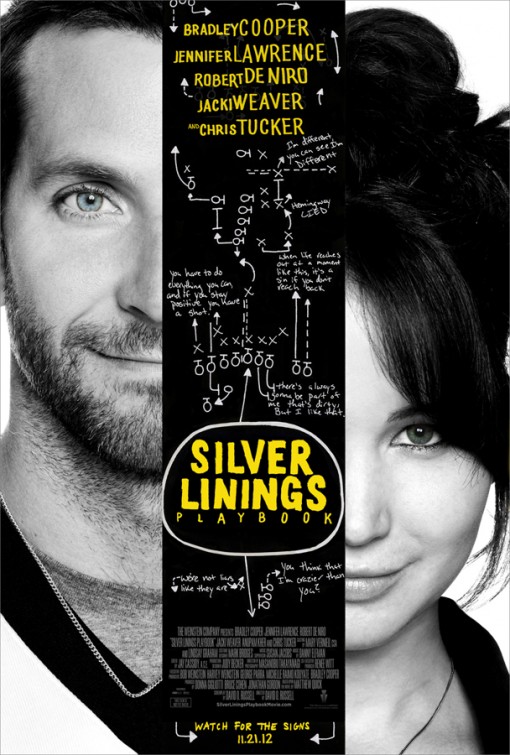
Silver Linings PlaybookIt’s not often that you encounter something truly original at the movies these days, particularly not in the ‘boy meets girl,’ romantic comedy genre, one of Hollywood’s most generic forms. But originality is exactly what we get from David O. Russell (director of Three Kings and The Fighter) in his latest film Silver Linings Playbook.

The originality starts with our unconventional, but incredibly engaging romantic pairing, Pat and Tiffany. Pat is bipolar and has just been released from a court ordered stint in an institution after he beat up a man he caught in the shower with his wife. He has moved back in with his parents and is determined to win back his wife, Nicki. Pat’s time in treatment has left him with a new outlook on life. He is all about positivity, “excelsior,” and finding the silver lining to the dark cloud that he is working through. Tiffany is a damages soul like Pat, though her scars are emotional rather than physiological, after losing her husband in a car accident. Both characters are frustrated, struggling to live with a support network that doesn’t understand them and a society that doesn’t trust them. But they understand each other, and they become friends.

We have never seen these characters before on the big screen, at least not presented in the way they are here. One of the great achievements of Silver Linings Playbook is that it removes the ‘otherness’ from mental illness. Through their characterisation, and some of the directorial choices of David O. Russell, the film encourages us to identify with Pat and Tiffany, rather than to identify with the other characters trying to deal with Pat and Tiffany – we empathise with them rather than merely sympathising. And in siding with the two supposedly “crazy” characters we start to see the insanity of the regular world. We notice the quirks, foibles and obsessions in other characters – some minor, some not so minor – which are deemed socially acceptable in a way that Pat’s and Tiffany’s are not.

Russell’s beautiful screenplay is brought to life by a series of really strong performances. In fact, Silver Linings Playbook became the first film in 31 years, since Warren Beatty’s Reds in 1982, to receive an Oscar nomination in all four acting categories.

Bradley Cooper is the real surprise. Cooper has been a movie star for a while now but has seldom been required to do much more than be charming and look handsome. His performance as Pat, a man struggling to deal with the unknown in himself, is a revelation, showing us something of his talent that I doubt many knew was there. Bipolar is all about extreme ups and downs, highs and lows. Pat alludes to the fact that even before he had been diagnosed, his mood swings had been something that had troubled and frustrated his wife. Cooper imbues Pat with a manic intensity, which makes his positivity every bit as intimidating as his moments of aggression. But the really impressive part of his performance is the way he, with the help of the director, manages to get you to switch between emotional responses very quickly. Pat doesn’t have a filter when he talks – as Tiffany notes, he says more inappropriate things than appropriate things – and this is the source of much comedy. But on a number of occasions you find yourself laughing at Pat and then, in a heartbeat, feeling really sorry for him, or defensive for him, or afraid of him.
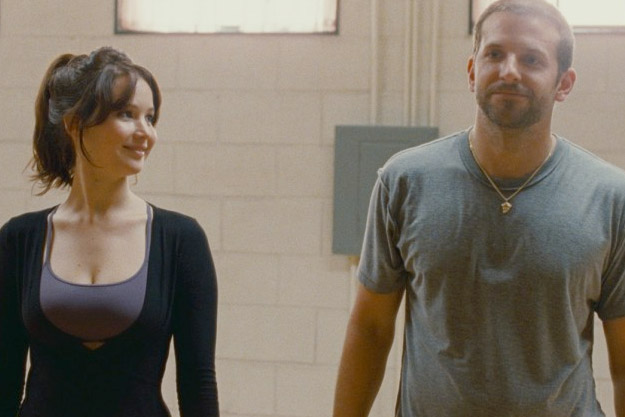
Tiffany (Jennifer Lawrence) and Pat (Bradley Cooper)

Tiffany (Jennifer Lawrence) and Pat (Bradley Cooper)

As Cooper’s foil, Jennifer Lawrence is every bit as impressive as Tiffany. The film really comes to life the moment that we are introduced to her. Pat and Tiffany’s meeting at an awkward dinner hosted by her sister is a fantastic scene and a preview of what is to come as the writer/director has fun with these two characters not bound by social conventions. As I said above, Tiffany’s scars are emotional rather than physiological, and as a result she is not as confused as Pat, but she is much angrier. She contrasts a real strength and willingness to stand up for herself with an extreme vulnerability. She is a sharp and abrasive, but at the same time likeable character. Lawrence burst onto the scene in 2010 when she earned an Oscar nomination for her work in Winter’s Bone. In the couple of years since she has done some more popcorn-style movies with a supporting role in X-Men: First Class and, of course, her leading role in The Hunger Games. But this performance in Silver Linings Playbook really cements her standing as one of the best young actresses out there, and of the four Oscar nominated performers in the film, for mine it is Lawrence that is most likely to take home a statue.
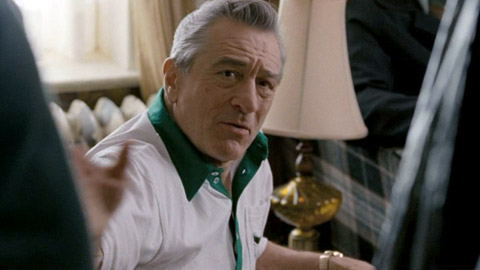
Robert De Niro as Pat Sr.

Robert De Niro as Pat Sr.

But the real treat for me was the performance of Robert De Niro. One of the absolute greats of the American cinema, it seems like decades since we have seen De Niro in a film which is worthy of his prodigious talent – you probably have to go all the way back to the mid-1990s when he did Heat, Casino and Jackie Brown. In recent times he has been reduced to playing caricatures of his own persona, often in reasonably uninspiring comedies: there was the gangster in therapy in Analyze This and Analyze That, psychotic retired CIA agent in the Meet the Parents series and, the lowest point of all, The Adventures of Rocky and Bullwinkle, where his role as Fearless Leader saw him spoof his own legendary “Are you talkin’ to me?” monologue from Taxi Driver. Finally, in the role of Pat Sr, De Niro has not only been given something he can really sink his teeth into, he has been given the chance to do something different. Pat Sr. is a bookmaker who is devoted above all to his favourite football team, the Philadelphia Eagles. He is superstitious to the point of being obsessive compulsive. He is willing to do anything within his power to not disrupt his Eagles’ juju, whether it is making sure the remotes are facing the right direction or making sure he has his lucky handkerchief. He is a loves his son, but lacks the knowledge of how to engage with him outside of the time they spend together watching football. It is a fun character, but not lacking in depth, and you can sense that De Niro is really engaged by in a way that he hasn’t been for some time.

I’ll admit I even really enjoyed Chris Tucker’s work in this movie, and that is quite a leap to make.

I referred to Silver Linings Playbook above as a romantic comedy, but I feel that kind of pigeon-holing really undermines the complexity and depth of this film. It is wickedly funny and at its centre is a relationship between a man and a woman, but it is also at different moments sad, uplifting, concerning, charming and poignant. It has been a while since I’ve loved a new film as much as I did this one. It is a beautifully crafted film that will really stay with you.

Rating – ★★★★★

Review by Duncan McLean
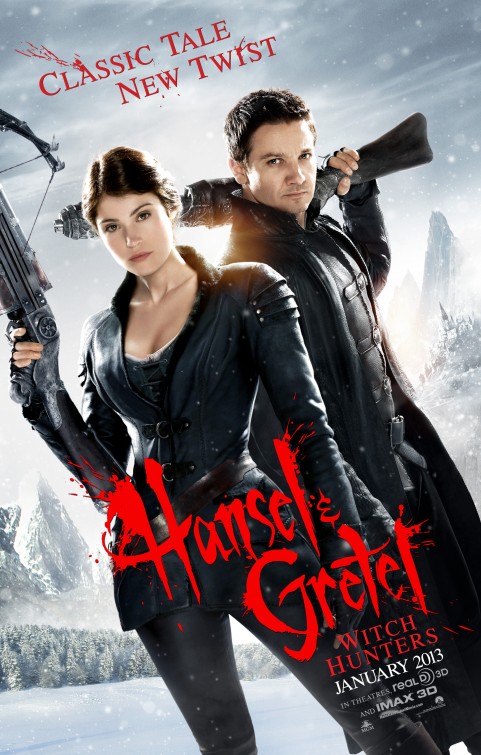
Review – Hansel & Gretel: Witch Hunters (2013)

Director: Tommy Wirkola

Starring: Jeremy Renner, Gemma Arterton, Famke Janssen, Pihla Viitala, Thomas Mann, Peter Stormare

Hansel & Gretel - Witch HuntersIf there’s something strange in your neighbourhood, who you gonna call? Hansel and Gretel: Witch Hunters. That’s right, the little boy and girl who got lost in the woods and found themselves in a witches cottage made of candy are all grown up, and armed with an arsenal of medieval machine guns and crossbows they travel the countryside ridding towns of their witches.

The Brothers Grimm’ tale is the latest in a growing number of traditional fairy tales to get Hollywood revisions in recent years. In 2011 we had Red Riding Hood, last year we had a double dose of Snow White with Mirror Mirror and Snow White and the Huntsman, and Jack the Giant Slayer is due to hit our screens in March. In actuality Hansel & Gretel: Witch Hunters was shot two years ago and Paramount have been waiting for the right moment to let it out. This provides some answers for those people wondering what on earth Jeremy Renner was doing in this after appearing in genuine blockbusters like The Avengers, Mission Impossible: Ghost Protocol and The Bourne Legacy.

The first time I saw a poster for this movie I shook my head. When I saw the trailer it just made me a bit sad. Surely this had to be one of the most ridiculous premises for a movie yet, I thought. But then I saw it and guess what, it is ridiculous… but it isn’t terrible.

Don’t get ahead of yourself, it is far from being good, but it isn’t terrible. Where it drops the ball is that it doesn’t seem to realise that it is ridiculous. Ridiculousness in itself is not a bad thing. Had the filmmakers embraced the ridiculousness of the notion that Hansel and Gretel might grow up to be arse-kicking supernatural bounty hunters they could have played it up a bit, earned a bit of camp appeal and maybe even gathered a cult following. Instead the movie seems to take itself a bit too seriously, surprising given that Will Ferrel and Adam McKay of Anchorman fame are among its producers.

While most of the movie is pretty inane, there are moments of cleverness. For example, not only did their childhood experience set them on the path to their present day profession, it has also left Hansel a diabetic, suffering from “the sugar sickness” and requiring regular insulin injections.

In a movie that is so predictable that you feel like you know what is around every corner, the one thing that is surprising about Hansel & Gretel: Witch Hunters is how schlocky it is. While the premise seems to suggest a very light gothic horror, the movie has a lot of blood, a surprising amount of coarse language and even a little bit of nudity. As a result it has been given an MA15+ rating (R in the USA) which will surely only serve to restrict the access of the primary demographic who might have been persuaded to think Hansel & Gretel: Witch Hunters sounded like a good idea.

Rating – ★★

Review by Duncan McLean

Review – Casa de mi Padre (2012)

Director: Matt Piedmont

Starring: Will Ferrell, Genesis Rodriguez, Diego Luna, Gael Garcia Bernal, Efren Ramirez, Adrian Martinez, Nick Offerman

Casa de mi PadreWill Ferrell is probably the biggest name going around in comedy movies at the moment, so it seems amazing that a Will Ferrell comedy could fly under the radar as much as Casa de mi Padre (‘My Father’s House’) has. That is, until you see it. Then it all makes sense.

Ferrell plays Armando, the simple son – simple both in terms of intellect and in terms of what he wants out of life – of a Mexican rancher. One day his more successful brother, Raul, his father’s favourite, returns home with a new fiancée in tow. But Raul brings trouble with him as unbeknownst to the family, his success has come as a result of his work in the drugs trade, and his fiancée is the runaway neice of the local drug lord, Onza.

What makes this movie different from every other Will Ferrell movie, and provides both the movie’s primary point of interest and the number one reason that it has nowhere near the profile of his other work, is that it is almost entirely in Spanish. Casa de mi Padre pretends to be some cross between a cheap, Mexican B-movie Western and a Telemundo Spanish soap opera. Credit should be given to Ferrell who spent a month working with a dialect coach to get his Spanish dialogue down pat and appears to hold his own alongside a cast of native Spanish speakers, albeit in the opinion of a non-Spanish speaker.

For what is clearly meant to be a comedy though,  there aren’t really that many gags. Instead the film relies on that premise – that it is pretending to be a poorly made Mexican melodrama – to get its laughs. So we get constant breaks in continuity, obvious painted backdrops, bad puppets in place of animals and actors being replaced by mannequins at for dangerous moments. There is even a moment where in place of a scene we get a letter from the 2nd Assistant Cameraman apologising that we won’t get to see a particularly exciting scene due to a terrible accident that resulted from poorly trained animals. While this premise might work quite well for a sketch, or even a series of sketches, on Saturday Night Live, it has been stretched really thin to reach even the relatively short runtime of 84 minutes. As a result the laughs are few and far between.

Rating – ★

Review by Duncan McLean

Review – Django Unchained (2012)

Director: Quentin Tarantino

Starring: Jamie Foxx, Christoph Waltz, Leonardo Dicaprio, Samuel L. Jackson, Kerry Washington

I’m a big fan Django Unchained Posterof the Western genre. After an extended period of time in which it really went out of fashion in recent years we are starting to see a real re-emergence of the Western with quality productions like Andrew Dominik’s The Assassination of Jesse James by the Coward Robert Ford (2007), James Mangold’s remake of 3:10 to Yuma (2007), the Coen brothers’ remake of True Grit (2010) and, of course, the brilliant HBO series Deadwood (2004-2006). However, it is probably not since the 1950s that there has been a Western which has been greeted with as much popular anticipation as Quentin Tarantino’s Django Unchained.

Django Unchained again sees Tarantino doing what he does best, genre pastiche: taking past styles and forms of cinema that he loves and giving them the Tarantino twist. The result is kind of a Blaxploitation Spaghetti Western and it is ridiculously entertaining. Our setting is the deep south of the USA, in the years immediately preceding the Civil War. Our heroes are an unlikely duo, Django (Jamie Foxx) a slave, and Dr. King Schultz (Christoph Waltz), a onetime dentist now bounty hunter. The surprisingly conventional plot for a writer who made his name by tinkering with chronology and breaking his screenplays down into individual storylines and chapters, sees the two brought together when Schultz needs Django’s help to recognise a trio of wanted men. They stay together because Schultz feels compelled to help Django rescue his slave wife, Broomhilda von Shaft (Kerry Washington), from the horrible slave owner Calvin Candie (Leonardo DiCaprio).

Tarantino has been very intentional in his promotional interviews for Django Unchained about labelling the film as a “Southern” rather than a Western, emphasising the difference in the core conflict at the heart of his movie. The Western genre has always been racially charged, but it is usually white men and Indians, or white men and Mexicans. In Django Unchained we are focused on the tension between white and black in the Deep South (which does allow the writer/director to continue his fetishistic relationship with the N-word). We’ve seen movies about slavery before, but not quite like this. Tarantino isn’t looking to make any overt political statements about the plight of the African-American. Rather he does what only he seems to be able to do, taking a seemingly taboo subject from one of the darker periods in modern history and using it as the basis for a ridiculously entertaining and quite funny film. It was the formula which worked so effectively with Inglourious Basterds in 2009. In that case it was Wold War II Europe providing the setting for a revenge tale about a small group of American Jewish soldiers taking vengeance on the Nazis on behalf of a downtrodden people. In Django Unchained Tarantino does for 19th century American slavery what he did for the Holocaust three years ago. Again we have a revenge tale, but this time our avenging angel is one man and the oppressed people are the black slaves.

Christoph Waltz as Dr King Schultz

Christoph Waltz as Dr King Schultz

While Jamie Foxx is the first name billed and plays the title character, the real star of this film is Christoph Waltz. Tarantino is a lover of dialogue. There are few directors working in mainstream cinema who happily allow scenes of dialogue to extend for as long as Tarantino does. As an actor, Waltz manages to combine eloquence and a calm elegance with a genuine sense of menace which makes him the perfect vehicle for the director’s wordy but sharp dialogue. Waltz was a revelation in Inglourious Basterds. As a relative unknown his performance as Col. Hans Landa gave us one of the best screen villains of the decade and won him an Academy Award. His work in Django Unchained is every bit as good, and really blurs the line between a supporting and leading character. He has received an Oscar nomination in the supporting category, but I feel like he is the lead character, or at least the co-lead, for the first three quarters of the film. Either way, it is a tremendous performance, about as endearing as you can imagine a bounty hunter to be, and makes me hope for further collaboration between the Waltz and Tarantino in the future.

There are two other supporting roles which are worthy of comment, both due to the fact that they see highly regarded actors venturing outside of their usual character scope. Firstly we have Leonardo DiCaprio playing the villain, Calvin Candie. DiCaprio has always been known for his intensity of performance, but that intensity has never really been applied to a villainous role before. Outside of the things Candie does and says, there is so much about his character which just pushes your buttons. Whether it is the touch of boyishness in his face which makes you think of him as a spoilt child, the semi-incestuous relationship with his sister, or his rather uncivilised interests in blood sports and phrenology, there is just something that manages to make you uneasy in his presence.

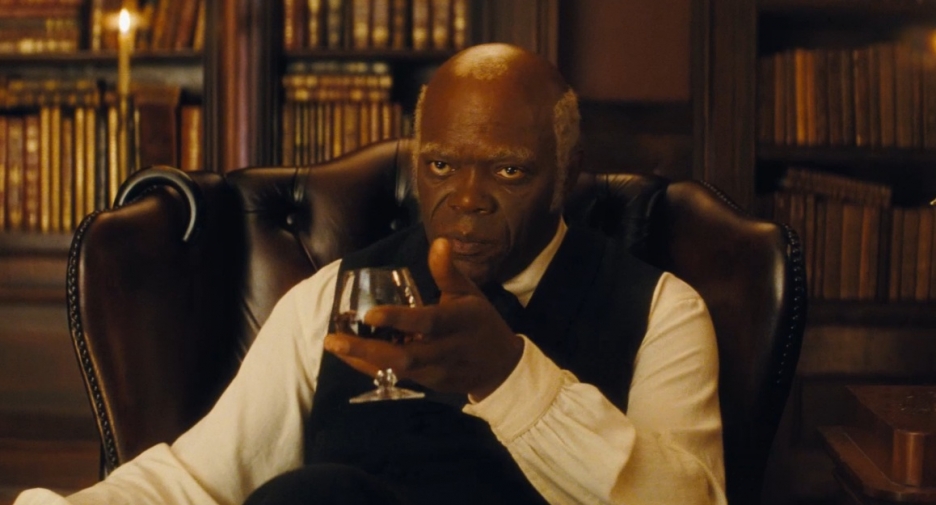
Samuel L. Jackson as Stephen

Samuel L. Jackson as Stephen

The other is Tarantino regular Samuel L. Jackson, and it is he who makes the greatest departure. In the same year that we saw him playing Nick Fury in The Avengers, Jackson delivers one of the performances of his career as Candie’s most trusted slave, Stephen. What makes the role so interesting, and challenging for us as viewers, is where Stephen sits in the racial divide that is at the centre of the film. Effectively Stephen is Candie’s chief of staff. He runs the house, is well dressed and treated by Candie with a level of respect not afforded to anyone else but his sister (there is a scene in which Candie and Stephen sit together drinking brandy which is indicative of their relationship). Stephen is a classic Uncle Tom figure, aligning himself with the white characters, seeing the other black characters as subservient and being an agent in their oppression. He believes in the status quo. Add to the fact that Jackson is playing an elderly man, weathered by many years of service, and it is quite an impressive achievement and has garnered some serious critical attention (if not the Oscar nomination he so openly hoped for).

Coming in at 165 minutes, while not excessive by current standards, Django Unchained is Tarantino’s longest film yet. Its main fault, which relates a bit to the runtime, is that at times it gets a little self-indulgent. Self-indulgence is always going to be a part of Tarantino’s cinema. So much of his style openly comes from his desire to engage with and replicate the things that he finds cool, in other words, indulging himself. So self-indulgence is not a problem in itself, but when it gets to the point of interfering with the flow of the picture it does become an issue. One scene in particular is representative of this. Towards the back end of the film there is a scene in which Tarantino makes a cameo appearance as one of the LeQuint Dickey Mining Company employees charged with transporting Django and some other slaves to the mines. For mine it is the worst scene of the film, though I’m sure some will point to the dancing horse at the films finale. Ignoring the fact that Tarantino’s performances in front of the camera have never come close to his prowess behind the camera, it is not his appearance in itself which makes the scene excessively self-indulgent. It is the fact that he is playing an Australian. One of the other workers in the scene is played by Australian actor John Jarratt of Wolf Creek fame. The Australian accents are quite jarring, and really make the scene stick out in a way that it wouldn’t have if they were playing Americans. Tarantino is a great admirer of Australian exploitation cinema (you can see him espousing his love in the wonderful 2008 documentary Not Quite Hollywood: The Wild, Untold Story of Ozploitation!) and it feels like the sole reason for the Australian characters, and much of the dialogue that flows from them, was that he wanted to have John Jarratt in his movie.

Django Unchained is the Western done Tarantino style, complete with a final bloody shootout to rival Peckinpah’s The Wild Bunch, and despite moments of self-indulgence it has the all requisite laughs, violence, cameo appearances and intertextual references to see that his legions of devoted fans will not be disappointed.

Rating – ★★★★☆

Review by Duncan McLean

Review – Flight (2012)

Director: Robert Zemeckis

Starring: Denzel Washington, Kelly Reilly, Bruce Greenwood, Don Cheadle, John Goodman

FlightCaptain ‘Whip’ Whitaker is piloting a commercial flight from Orlando to Atlanta when an equipment malfunction causes the plane to nosedive from 30,000 feet. Whitaker manages to perform a miraculous manoeuvre to clear a residential area and bring it down in a field. Only six of the 102 souls on board lose their life and Whitaker is hailed as a hero. However, routine toxicology reports after the crash reveal something that Whitaker has managed to keep secret his whole career. Whip Whitaker is an alcoholic and a drug user, a revelation that could have a devastating effect on his career.

Flight sees director Robert Zemeckis return to live action filmmaking after a decade in which he was an industry leader in the exploration of motion capture. It also marks a departure for the director in terms of tone. Zemeckis started his career as a Steven Spielberg protégé and with films like Back to the Future, Forrest Gump, Who Framed Roger Rabbit and The Polar Express his body of work has maintained that whimsical, Spielbergian sense of fun. Flight goes somewhere much darker, tackling the serious subjects of alcoholism and addiction. Despite a couple of moments that lacked a bit of subtlety, Zemeckis handles the material very competently.

Flight doesn’t over-simplify Whip’s alcoholism, but allows for complexity in the exploration of a complex issue. The film would have been much more straightforward, and much less interesting, had Whip’s alcoholism been the cause of the crash. But as it is, screenwriter John Gatins makes Whitaker the hero of the incident. He is an excellent pilot. It is on the ground, in his private life, that he can’t function.

Most of the noise around Flight has concerned the performance of Denzel Washington, who gives a powerful performance as Whitaker and has rightfully been nominated for a Best Actor award at the upcoming Oscars. Playing believable drunk without going over-the-top is not as easy as you’d imagine. Aside from his incredible talent, what really makes his performance work is the brilliant ‘against type’ casting. As an audience we associate Denzel Washington’s characters with qualities like honour, strength of character, courage and determination. His performance as quite an unsympathetic character in Flight works against all those associations we have and leaves us really conflicted by Whip. Working against type is something Washington has done before with great success, most notably in his Oscar winning performance in Training Day.

There are also some strong supporting performances. Most notable is Kelly Reilly who plays Nicole, a drug addict who Whip meets in hospital and befriends. Nicole becomes the emotional centre of the film. Her character is so important because she provides the contrast to Whip. Despite struggling with the same issues of addiction that Whip is, their approaches are completely different. She is determined to get better. He lives in denial. She is open. He is defensive. Nicole is as sympathetic a character as Whip is unsympathetic. Also, John Goodman – one of the best character actors working today – provides some humour in his role as Whip’s friend and supplier.

Flight is a good film carried by a great leading performance. It is a powerful exploration of the impact of alcoholism on a person and those people around them.

Rating – ★★★★

Review by Duncan McLean

Review – Lockout (2012)

Directors: James Mather, Stephen St. Leger

Starring: Guy Pearce, Maggie Grace, Vincent Regan, Joseph Gilgun, Peter Stormare

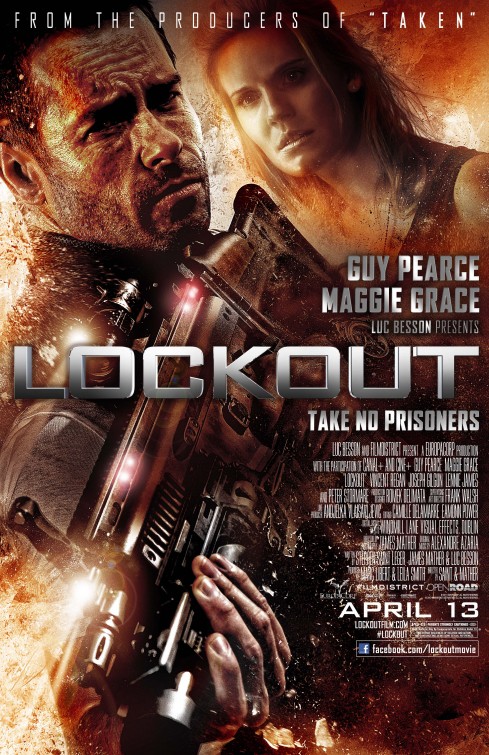
LockoutIt is the year 2079 and the President’s daughter has been sent on a goodwill mission to inspect a maximum security prison on a space station orbiting Earth when something goes horribly wrong. All the prisoners, the worst of the worst, are awoken from stasis and overtake the prison. With an all-out attack on the prison far too risky, the only way to save the First-Daughter is to send in one man, disgraced agent Snow, to get her out.

There is nothing new about the central premise to Lockout (it is effectively Escape from New York in space). There are a couple of thinly written subplots – one about the prisoners having brain experiments done on them, the other about the location of a mysterious briefcase which may be able to prove Snow’s innocence – but neither really grab your attention. It is really just that classic story of lone hero rescuing damsel in distress from maximum security space prison.

In this case our lone hero, Agent Snow, is played by Guy Pearce who tries his heart out but still doesn’t quite convince as an action hero. Unfortunately, the character is victim to some of the worst over-writing you will ever see. The tough guy wise crack is a staple of the genre, for sure, but in Lockout the writers seem to have set themselves a challenge to come up with a Snow wise crack reply for every single line of dialogue in the movie. After about 10 minutes he has smashed through loveable rogue and is just getting a bit ridiculous. It must have been particularly difficult for Pearce as he has been in some really well written films over the years (Memento, L.A. Confidential) so would have been only too aware how bad the material he was working with was.

I feel like I’ve seen Lockout many times before, but that not really a problem. Familiarity in films can sometimes be a good thing, particularly in this type of genre movie. The fun is in knowing the formula and seeing how the adhere to it or break from it. The problem with Lockout is that all the movies it reminds you of are better movies than Lockout (I’m thinking about Escape from New York, Die Hard, Alien). If Lockout was a just a bit worse it could have the potential of becoming a cult hit. As it is I think it will just be a below average film which will slip into obscurity.

Rating – ★☆

Review by Duncan McLean

Review – This is 40 (2012)

Director: Judd Apatow

Starring: Paul Rudd, Leslie Mann, Maude Apatow, Iris Apatow, Megan Fox, Albert Brooks, John Lithgow, Jason Segal, Chris O’Dowd

This is 40In the last ten years, Judd Apatow has really established himself as the comedy auteur of the moment, through both as a director and as a producer (his most recent success being backing Lena Dunham in the production of the HBO series Girls which just cleaned up at the Golden Globes). One of the defining features of Apatow’s work as a director, and what differentiates him from, say, Todd Phillips (Old School, The Hangover, Due Date), is that Apatow’s films combine big laughs derived from sexual and sometimes stoner humour, with a real human sincerity. Apatow’s best films, namely The 40 Year Old Virgin and Knocked Up, are surprisingly heartfelt and honest and you really care about the characters. Interestingly, when Apatow is slightly below his best, as he is in This is 40, it is the laughs which tend to be missing rather than the sincerity.

The film was marketed as the “sort of sequel” to Knocked Up. Paul Rudd and Leslie Mann reprise their supporting characters from Knocked Up. It’s a few years down the track, Pete and Debbie’s little children are a bit older, their marriage is a bit more dysfunctional and they are both on the cusp of turning forty. That’s the scenario and it is all you really need to know because this is not a film about narrative and plot, it is a film about characters. Rather than a structured storyline we just get a series of vignettes, some funnier than others, taking place over a period of a couple of weeks.

In Knocked Up Rudd and Mann were fantastic. While they were only supporting characters, the little glimpses we got into their lives were fantastic and funny because they seemed so real. For Allison (Katherine Heigl) and Ben (Seth Rogen) they represented everything that was terrible, but at the same time everything that was appealing about the prospect of having children. The problem that This is 40 has is that while Debbie and Pete become the focus of the film, we don’t really gain any further insight into their characters. Instead, the shtick which was funny for the 30-40 minutes of screen time they got in Knocked Up is just dragged on and repeated, stretched over 135 minutes which is half an hour too long.

This is 40 is a bit one-note. Because there isn’t a storyline as such, we don’t get real character progression and development. The fights and arguments you see at the 90 minute mark of the film are very similar to the fights and arguments you saw 15 minutes in. This lack of progression, lack of sense that either character is learning from their experiences means they actually start to become very frustrating in certain situations. This is quite an achievement given Paul Rudd has to be the most likeable man on the planet.

The “sort of sequel” thing is problematic too, because it raises certain questions. Primary among them is where are Ben and Allison, our protagonists from Knocked Up? In reality we know that there was a massive falling out between Apatow and Katherine Heigl which meant that there was not chance she was ever going to appear in the film, but still, at a narrative level it is an awkward absence. Particularly as Alison is supposed to be Debbie’s younger sister, which makes her unreferenced absence from the birthday party at the end of the film notable. Jason Segal is back, again playing a character called Jason who I think we are supposed to assume is the same character as he played Knocked Up, though he has progressed from being Ben’s stoner housemate to being a personal trainer.

This has all sounded a bit negative so far, but This is 40 isn’t that bad. As has been the case in much of his previous work, it is the supporting characters which really bring this film to life. You have great supporting performances from Albert Brooks and John Lithgow as Pete and Debbie’s respective fathers. Brooks in particular is a treat as a mooching father. I love when Judd Apatow uses his daughters, Maude and Iris, in his films. He writes really funny dialogue for them. While Maude’s character Sadie suffers a bit from being a one-dimensional angry teenager, Iris’s Charlotte is lovely and the one character that you consistently side with and feel for. There are also great cameos from Chris O’Dowd, Melissa McCarthy, Megan Fox, Charlyne Yi, Jason Segal and Lena Dunham.

This is 40 feels much closer to Funny People than it does to 40 Year Old Virgin or Knocked Up, which is a shame. It probably suffers a bit from audience expectations that it is going to be a riotous comedy, which it isn’t trying to be. The humour in this film doesn’t come from gags or crazy situations. It comes from recognising some element of our own lives on the screen. There are a number of laugh out loud moments in This is 40, but most of the time they are jokes that make you smile or jokes that make you nod rather than jokes that make you laugh.

Rating – ★★★

Review by Duncan McLean

Five Oscar Nomination Surprises

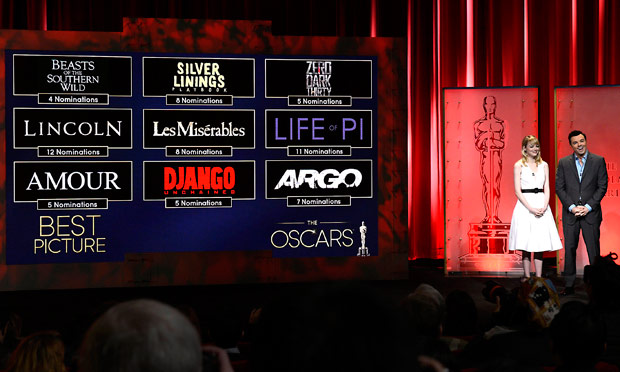
Seth MacFarlane and Emma Stone announce the nominees for Best Picture

Seth MacFarlane and Emma Stone announce the nominees for Best Picture

At 5:30am Los Angeles time, Oscars host Seth MacFarlane and Emma Stone announced the nominees for the 85th Academy Awards. While there were a few categories which panned out exactly as expected, the nominations did throw up more than the usual number of surprises. Here are five of the biggest…

1) Only 9 in the Best Picture

There were a few notable omissions in the Best Picture category. Moonrise Kingdom, The Master, The Sessions and, to a lesser extent, Skyfall had all been talked about as Best Picture contenders but all were notably absent from the nominees announced. What makes that even more surprising is the Academy chose only to give out nine of a possible ten nominations. So it wasn’t even that these films were simply squeezed out by other worthy pictures, rather they were deemed not worthy of a nomination.

2) Amour gets some love

It is not often that a foreign language film gets Academy recognition outside of the Best Foreign Language Film category. So it was somewhat of a surprise to see Michael Haneke’s Palme d’Or winner, Amour, pick up five nominations including Best Picture and Best Director. If nothing else it means that Amour will be the shortest of short priced favourites to win the Best Foreign Language Film category.

3) Big names missing in the Best Director field

It was the Best Director nominations which contained the biggest surprises, primarily as a result of who wasn’t there. Ben Affleck, Quentin Tarantino and Kathryn Bigelow had all been talked about as serious contenders to take the award home, yet none of them managed to get a nomination. The most obvious beneficiaries of these ‘snubbings’ are the surprise – unexpected but not undeserved – nominations of Michael Haneke and Behn Zeitlin (Beasts of the Southern Wild).

4) Silver Lining Support

The surprise nominations in both the Supporting Actor and Actress categories both came from Silver Linings Playbook. Robert De Niro had only received a handful of lead up nominations, none of them major, for his role as Pat Sr. His surprise nomination means that there wasn’t room for some more fancied possible nominees, particularly Django Unchained’s Leonardo DiCaprio and Samuel L. Jackson. Australian Jackie Weaver came from right out of left field to score a nomination in the Supporting Actress category having not received any lead up nominations, other than as part of an ensemble cast. The Golden Globes and SAG nominations had opted for Nicole Kidman (The Paperboy) or Maggie Smith (Best Exotic Marigold Hotel) to round of their fields, but neither seem any more deserving than Weaver.

5) The Dark Knight does not rise

While I don’t think anyone was realistically expecting The Dark Knight Rises to earn a best picture nomination, most would have expected it to figure somewhere (maybe in visual effect?), but instead it became the highest profile film to be completely overlooked by the Academy this year.

Review – Arbitrage (2012)

Director: Nicholas Jarecki

Starring: Richard Gere, Susan Sarandon, Tim Roth, Brit Marling, Laetitia Casta, Nate Parker

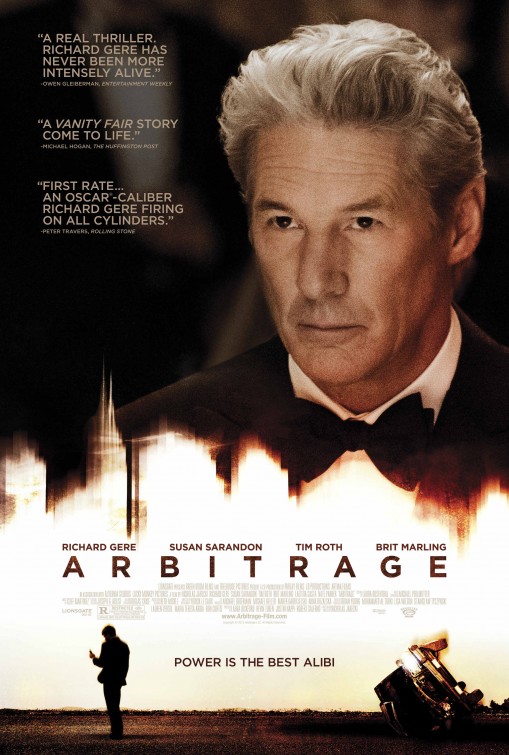
ArbitrageOne of the wonderful things about cinema is that a well-made film can get you to identify with almost anyone. Obviously, it is easy to encourage an audience to identify with a protagonist that is charismatic, honourable, heroic and, above all, good. But sometimes a filmmaker will challenge an audience by making them identify with deplorable character. This is the case in Nicholas Jarecki’s impressive debut feature Arbitrage.

Richard Gere plays Robert Miller, a Wall Street legend who is in the process of selling off his company. Miller is sweating on an audit that could reveal he has cooked the books to cover up losses in the hundreds over millions of dollars. As it turns out, the audit is not the only thing that threatens to derail the deal.

Most films of this type would start out showing the central character enjoying the fruits of their extravagant lifestyle, living it up without a care in the world, and then further into the movie things would start to unravel. In Arbitrage we don’t see this first part. We are never given the outsiders view of Robert Miller. From almost the very beginning, we know that Robert Miller is in trouble, and the film that follows is the escalation of that trouble and Miller’s attempts to protect the deal, his family and, most importantly, himself.

Despite the fact that Miller is a deplorable character, a selfish man who believes the world can be bought and sold and seems to have little regard for other people, we find ourselves strangely hoping that he succeeds, hoping that he gets away with it. That is what is special about Arbitrage and that is what is impressive about Jarecki and Gere’s achievement. Gere puts in a very strong performance and has already started collecting award nominations. He leads an impressive cast that includes Susan Sarandon and Tim Roth.

Arbitrage got a pretty low profile cinematic release, it wasn’t a big movie, but is very much worth seeing. An impressive achievement for a first time feature film director, it is one of the better films of 2012.

Rating – ★★★★

Review by Duncan McLean

Review – Dark Shadows (2012)

Director: Tim Burton

Starring: Johnny Depp, Michelle Pfeiffer, Eva Green, Helena Bonham Carter, Chloe Grace Moretz

Dark ShadowsI was once a big Tim Burton fan and still have a soft spot for him in my heart, but I must admit that in recent years I approach every new Burton film with a great deal of cautiousness. Despite being one of the best known directors in Hollywood today, Tim Burton hasn’t quite been on song in the last decade. After making some really original and brilliant movies in the 1990s (Edward Scissorhands, Batman, Ed Wood), in recent years his movies tend to have underwhelmed. Movies like Charlie and the Chocolate Factory and Alice in Wonderland didn’t really need to be seen because they were exactly what you imagined when you first read that Tim Burton was going to make them. There wasn’t a surprise. While Dark Shadows doesn’t really see Burton breaking any new ground – which will be fine by his many fans, but frustrating to those growing tired of the usual Burton/Depp shtick – it does prove to be a bit of a return to form.

An adaptation of a cult 1960s supernatural soap opera, Dark Shadows is the latest in the line of recent Burton adaptations and re-imaginings following on from Alice in Wonderland, Charlie and the Chocolate Factory and Sweeney Todd. The film follows the story of Barnabas Collins, a vampire whom having been buried alive for almost 200 years is dug up in 1972 and sets about trying to restore his family’s seafood business to its former glory after it has been run into the ground by business rival Angelique, who also happens to be the witch who turned Barnabas into a vampire.

Burton and Depp were both great fans of the series in their youth, so unlike some of the other adaptations which feel like they’ve just applied the Tim Burton formula to a pre-existing story, in this case the affection they clearly have for the source material really comes across. The contrast between the garish sights and sounds of the 1970s and the more gothic elements of the story really plays to Burton’s style, which has always been a mix of gothic and kitsch. Depp plays Barnabas as an old-fashioned, Romantic-era vampire, and much comedy is drawn from Barnabas struggling to get his head around 1970s culture. Dark Shadows is easily Burton’s funniest film since Ed Wood, possibly ever.

For someone who was getting used to being disappointed with Tim Burton’s films, Dark Shadows was a pleasant surprise. This is not Tim Burton at his absolute best, but it is as close as he’s been for a number of years.

Rating – ★★★★

Review by Duncan McLean