Great Movies – The Graduate (1967)

Director: Mike Nichols

Starring: Dustin Hoffman, Anne Bancroft, Katharine Ross, William Daniels, Elizabeth Wilson, Murray Hamilton
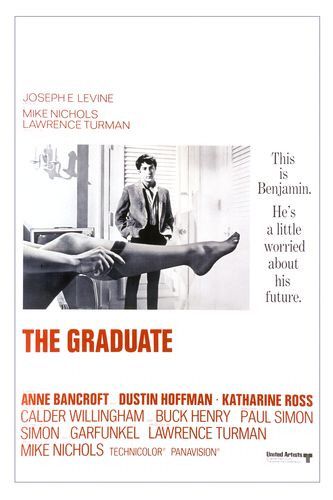
GraduateThe late 1960s and early 1970s saw something unusual happen in the American cinema. A number of factors converged to create a window of opportunity for a different type of cinema to emerge from the Hollywood studios. For a period of just under a decade there was a mainstream American art cinema, with Hollywood studios producing youth-oriented films which borrowed stylistically from the art cinema of Europe and took advantage of recent changes in censorship laws to push the boundaries of sex, drugs, nudity and violence. This period, which came to be known as the New Hollywood or the Hollywood Renaissance, would provide some of the most celebrated films in the history of American movies, one of the best of which is Mike Nichols’ The Graduate. Together with another 1967 film, Arthur Penn’s Bonnie and Clyde, it marked the starting point of the New Hollywood period for most critics and film historians.

The Graduate tells the story of a disillusioned young man who returns home from college and commences an affair with the wife of his father’s business partner only to then fall in love with her daughter. Produced for $3m, it would become the highest grossing film of 1967, taking $49m at the US domestic box office. The key to its success was its ability to tap into the burgeoning youth market at a time when Hollywood’s traditional audience demographic, the family, had become less dependable. One audience survey found that 96% of viewers of The Graduate were less than 30 years of age. 72% under 24. The Graduate was a film which spoke to the Baby Boomer generation through its thematic content, its sexual frankness, its visual style and its use of music.

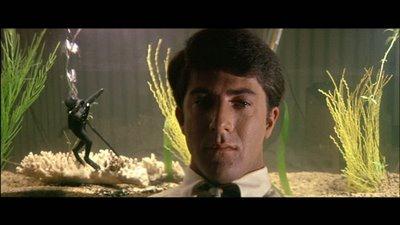
Thematically, The Graduate is about the head on collision between two generations. Benjamin’s parents are post-war parents. They know what they want from life and they’ve fought for it. Benjamin is a Baby Boomer. He has come into a readymade world and doesn’t know where he fits into it. He represents a youth that are dreaming about a future that they haven’t yet defined. Trying to explain this to his father Benjamin states, “I want my life to be… different.” He doesn’t know what he wants but he knows it isn’t this.
"I want my life to be... different."

“I want my life to be… different.”

Benjamin represents the burgeoning counter-culture. New Hollywood cinema is full of counter-culture characters, but usually when we think of them we are drawn to the extremes – the long haired, drug taking, hippies of Easy Rider for example. These are characters that consciously identify themselves as being something different. Benjamin doesn’t have than self-awareness. However, in his unwillingness to simply accept the world as it is, even though he doesn’t yet know what he wants it to be, he becomes the counter-culture figure. Not just a counter-culture figure, but a more identifiable counter-culture figure for the vast majority of viewers. Benjamin is an alienated character. Again, it is a different type of alienation to what we saw in other films of that year (Bonnie and Clyde, Cool Hand Luke), but likely an alienation which is more in line with what a lot of young, middle class Americans were experiencing.
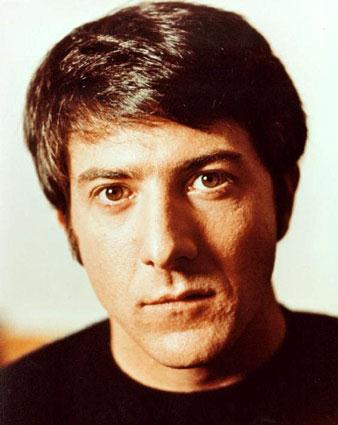
Dustin Hoffman is Benjamin Braddock

Dustin Hoffman is Benjamin Braddock

Hoffman’s performance in The Graduate is fantastic. He so perfectly encapsulates the awkwardness and uncertainty of a young man who doesn’t know who he is. He underplays the character beautifully, whispering rather than speaking, nudging rather than moving. Until Elaine comes into his life he doesn’t do anything with conviction.

Given how iconic Hoffman’s performance has become, it is interesting to note that he was not the obvious choice for the role that he seems to us now.

In the 1963 Charles Webb novel from which the film was adapted, the central characters are all WASPs (White Anglo Saxon Protestants). Benjamin is described as a blonde haired, blue eyed, six foot tall athlete, “a surfboard” is how co-screenwriter Buck Henry described him, and a far cry from the Benjamin we come to see on the screen. It was originally Nichols’ intention to stick with this vision. His vision for the film saw Benjamin being played by Robert Redford, Elaine by Candice Bergen and Mrs. Robinson by Doris Day. While Doris Day turned down the part as it “offended [her] sense of values,” both Redford and Bergen read for the parts.
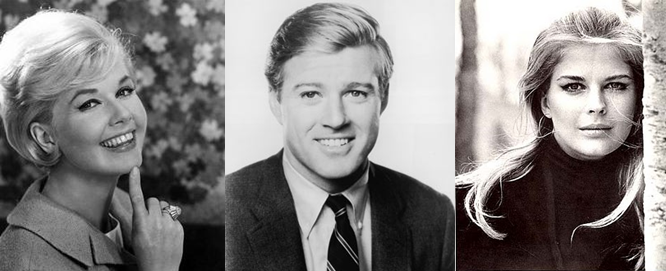
The original vision: Doris Day, Robert Redford and Candice Bergen

The original vision: Doris Day, Robert Redford and Candice Bergen

But Nichols’ instincts told him something was off. He explained, “When I saw the test I told Redford that he could not, at that point in his life, play a loser like Benjamin, ‘cause nobody would ever buy it. He said, ‘I don’t understand,’ and I said, ‘Well let me put it to you another way: Have you ever struck out with a girl?’ And he said, ‘What do you mean?’ It made my point.”

Hoffman had done a screen test for the part and despite not being the look they had been envisioning, all present were in agreement his test had been the most interesting. So Nichols’ made the decision to change the family from WASPs to Beverly Hills Jews and cast Dustin Hoffman. Rather than the strapping, stereotypical All-American boy that Benjamin was written to be, Hoffman became a sort of genetic throwback in the family line.

Prior to The Graduate Hoffman had done nothing of significance on screen. His only screen credit was 19th billing in Hap (1967). But Buck Henry had seen him on stage in a play called Harry Noon and Night in which he played a crippled, German transvestite. Henry said his performance had been so brilliant it was impossible to believe he wasn’t at least one or two of those things.

The casting of Hoffman over a young star like Redford was a big deal, with potentially huge financial ramifications, but it paid off handsomely, as Hoffman’s performance earned him the first of his seven career Best Actor Oscar nominations.

It should also be noted that the casting of Anne Bancroft was significant, given she was only six years older than Hoffman, but the two worked superbly together. The power relationship between Benjamin and Mrs. Robinson in the first half of the film is just brilliant comic acting. Mrs. Robinson is the polar opposite to Benjamin. She knows what she wants. She is authoritative and self-assured, although later we come to see her vulnerability. The power relationship between the two is perfectly demonstrated by the fact that at even their most intimate moments, Benjamin still calls her “Mrs. Robinson.”

The casting of Hoffman was representative of a greater trend in casting that would take place in the New Hollywood era. In the studio era, the industry operated largely on the understanding that people wanted escapism. They wanted a sense of distance between their own lives and what they saw on the screen. Baby Boomers, on the other hand, wanted to be able to engage with the movies. More to the point, they wanted the movies to engage with them. They wanted to see truth and reality up on the screen. So the New Hollywood period saw the arrival of a number of new faces, not just in the sense that they were new to the industry, but also in the sense that they were a different type of face to the faces we were used to seeing on the screen.

The New Hollywood period introduced a new type of movie star. A star that looked like an average Joe. Alongside Dustin Hoffman, the generation of actors who rose to prominence in this period of Hollywood’s history included Robert De Niro, Al Pacino, Richard Dreyfuss, Gene Hackman, Robert Duvall, James Caan, Harvey Keitel, John Cazale, Christopher Walken and Elliot Gould. These actors banished the vanilla features of the studio era in favour of a gritty realism and ethnicity.

The same was true to a certain extent for actresses, with new beauties like Jane Fonda, Meryl Streep and Faye Dunaway being joined by more normal looking actresses like Diane Keaton, Ellen Burstyn, Sissy Spacek and Shelley Duvall. Obviously, there remained a gender double-standard which says it is harder for an unattractive woman to become a movie star than an unattractive man, but none the less these actresses displayed a different look to the wholesome pertness of a Doris Day in the 1950s, or the studio era bombshells like Marilyn Monroe or Rita Hayworth.

Appealing to the youth audience in the late 1960s didn’t just involve telling young people’s stories, it involved telling them in a style which appealed to young people. This youth demographic that had been shunning traditional Hollywood fare were enthusiastically consuming foreign films, particularly the European art films. 1966, the year before The Graduate was released, was the highest grossing year for foreign films at the US box office. Much of that was due to the success of Blow Up. As Stanley Kramer put it, “Everyone in Zilchville [saw] Blow Up, not just the elite.”

European art films like Blow Up and, in particular, the French New Wave films of Godard, Truffaut, Rohmer and Chabrol, introduced a new style of cinematic storytelling. Where the studio era had always operated on a principle of invisible style, the French New Wave saw cinematography and editing as narrative tools. Filmmakers employed an unconventional visual style which drew attention to itself, in complete opposition to the principle of seamlessness.

Mike Nichols was a fan of New Wave filmmaking, as well as the later Italian neo-realists like Antonioni and Fellini. So in The Graduate we see a lot of non-traditional Hollywood cinematography and editing, giving the film a very contemporary look. But, like with the European films, this contemporary look was not just style for style’s sake. It was not simply a cynical imitation of what was popular at the time in order to make the film marketable. In The Graduate visual style, as well as music, is used for narrative purposes, primarily through emphasising tone and visually representing emotions.

For an example of this, let’s look at a few of the different ways that Benjamin is shot.
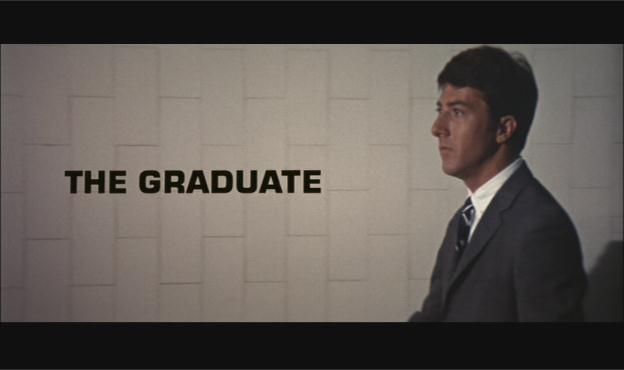
Benjamin positioned to the side of the frame

Benjamin positioned to the side of the frame

Firstly, consider his positioning in the frame. Early in the film Benjamin is rarely centred in the shot composition. Instead he is largely situated to the right of the screen with expanses of space to his left. It is only later in the film, once he has met Elaine and found a sense of purpose and that his character possesses the conviction to dominate the image.
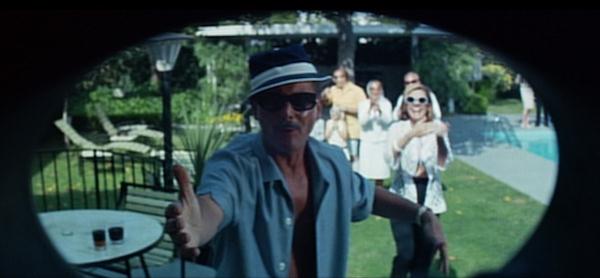
Subjective camera angles help us to empathise with Benjamin

Subjective camera angles help us to empathise with Benjamin

Secondly, on a few occasions the camera adopts Benjamin’s subjectivity, often as a means to demonstrate his claustrophobia in the suburban world of his parents. This is, of course, most notable is the scene in which a reluctant Benjamin is forced to model his new scuba suit for his parents’ friends. For this scene we see the world through Benjamin’s scuba mask – as well as hearing the muffled audio and his breathing. This same sense of claustrophobia is stylistically represented in a different fashion at the first party scene, the welcome home, through the use of very close shots of Benjamin’s face with other faces squeezing their way into the frame.

Thirdly, Nichols makes use of zooms. Using a zoom shot was traditionally considered bad filmmaking. However, Nichols uses zooms at a number of points throughout the film for particular emotional effect. When Nichols zooms out, it is to emphasise the isolation of a character (the opening shot of Benjamin in his seat on the plane). When he zooms in, it is to take us into their soul (this strategy is employed later in the film with Mrs. Robinson as we start to discover more layers to her character).

The stylistic influence of the French New Wave extended to the editing. Like the New Wave filmmakers, Nichols chooses at times to abandon the principles of classic continuity editing in order to use his cutting as a narrative or emotive device. Two particular moments come to mind.
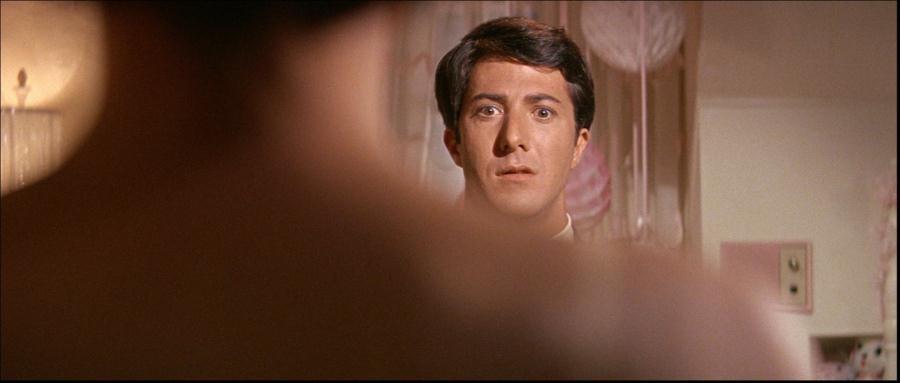
Rapid cutting reflects Benjamin's panic

Rapid cutting reflects Benjamin’s panic

The first is the moment when a naked Mrs. Robinson corners Benjamin in Elaine’s bedroom. In a reflection on a portrait of Elaine, we see Mrs Robinson sneak into the room unbeknownst to Benjamin. As the door bangs shut behind her, Benjamin spins. Nichols breaks his turn down into three different shots, exaggerating the movement through editing. We see his face in an over-the-shoulder shot as he looks at Mrs. Robinson. He is panicking and this panic is reflected in the cutting of the scene. As Mrs. Robinson propositions Benjamin, the over the shoulder shot is interrupted by five very short flashes of different parts of her naked body. Quick glances, like those of a panicking young man who doesn’t know where to look. In all, there are 15 cuts in this very short moment between her entering the room and him running away downstairs. This rapid cutting emphasises his panic in that moment, and is beautifully juxtaposed by the calm, measured way in which Mrs. Robinson speaks.

Benjamin's life: lying in the pool and visiting Mrs. Robinson

Benjamin’s life: lying in the pool and visiting Mrs. Robinson

The second I call the “Out of the pool and onto Mrs. Robinson” transition. We see Benjamin in the pool. He goes to pull himself up onto his lie-lo, and the motion that starts with in the pool finishes with him on top of Mrs Robinson. While lying on top of her we hear his father’s voice, which brings us back to the pool. This one cut works almost like an entire montage in itself. This is Benjamin’s life at the moment: lying in the pool and meeting with Mrs Robinson.

One of the primary ways in which The Graduate aligns itself with the youth counterculture of the time is through its soundtrack. Rather than a traditional orchestral score, Nichols employs the songs of folk duo Simon and Garfunkel, with the resulting soundtrack being one of the most striking features of the film. The use of popular music in the place of a traditional score was a recent innovation. Richard Lester’s two Beatles films, A Hard Day’s Night (1964) and Help! (1965), had employed the group’s music to great effect, and films like The Graduate, Easy Rider and American Graffiti would see the popular music score become a prominent feature of the New Hollywood period.
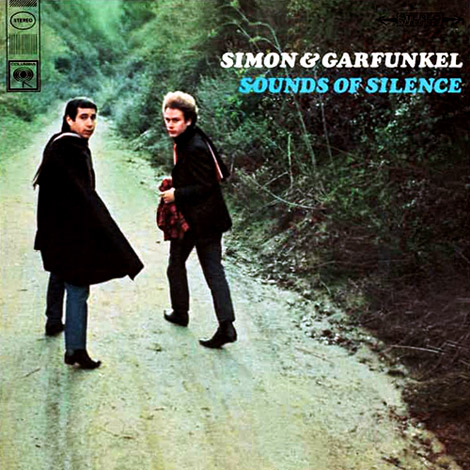
Sounds of Silence

Sounds of Silence

Nichols had always wanted Simon and Garfunkel for the soundtrack. They had risen to prominence in 1965 with their hit single ‘Sounds of Silence,’ and were strongly identified with the counter-culture movement that was bubbling up in the 1960s in America.

While the majority of Simon and Garfunkel songs used on the soundtrack were pre-existing, the producers made a deal with Paul Simon to provide them with three new songs. However due to a busy touring schedule, Simon did not get around to writing the agreed upon songs. When Nichols pleaded with Simon to show him something new, he played him a bit of a song he had been working on about time past, about Joe DiMaggio and Eleanor Roosevelt. Nichols persuaded him to change it from Mrs. Roosevelt to Mrs. Robinson and the song made its way into the film. Paul Simon only recorded as much as appears in the film. The producers of the film wanted him to write the rest so they would have a promotional tie-in, but Simon was reluctant. However, the movie becoming a big hit was enough to persuade Paul Simon very quickly wrote and recorded the rest of the song. So, for any Simon and Garfunkel fans out there, this accounts for why the version of ‘Mrs. Robinson’ that appears in the film sounds significantly different to the version which was released as a single.

As well as providing an iconic score and serving as useful cross-promotion for both the band and the film, Nichols used Simon and Garfunkel’s music to very specific narrative purposes. Musically there are three distinct stages through the film. In the first third of the film we hear ‘Sounds of Silence’ again and again. It becomes the theme for Benjamin’s uncertainty as he ponders his future while in the suburbs. In the second third of the film the music changes and the song ‘Scarborough Fair/Canticle’ becomes very prominent. It is the theme for Benjamin’s pining after Elaine after she discovers about him and Mrs Robinson. For the final third of the film we get the much more upbeat ‘Mrs Robinson,’ it’s faster tempo marking Benjamin’s newfound determination as he pursues Elaine and seeks to rescue her from her upcoming marriage. And the payoff for this aligning of different tunes with different states of Benjamin’s psyche comes in the film’s final scene.

The conclusion of Nichols film is masterful, and gives us a number of things to consider. As we watch Benjamin and Elaine ride away together, it is tempting to assume that we have just witnessed a standard Hollywood, happily-ever-after conclusion, but in fact nothing is that straight forward. For starters, Benjamin doesn’t actually succeed in stopping the wedding. He arrives to see Elaine kissing her husband. The vows have already been exchanged. As Mrs Robinson points out, “It’s too late.” So what does this mean for Benjamin and Elaine running away together, knowing that legally she is married? The way Nichols concludes the film leaves us with great uncertainty about the future of these characters, and that uncertainty is communicated through two subtle directorial decisions. Firstly, we watch them run onto the bus and sit down together giddy with excitement, but the camera stays with them long enough to watch the adrenaline die down and their faces go blank. Secondly, the music that accompanies the bus driving away is ‘Sounds of Silence,’ the song which we have been encouraged to associate with Benjamin’s insecurity and uncertainty about his future. Had Nichols cut that shot while they were still smiling and shown the bus driving away to the up-tempo rhythm of ‘Mrs. Robinson’ you would have had a perfect feel-good ending. Instead, through two subtle choices the director allows for ambiguity and uncertainty, leaving his audience with something to ponder.

In 1998, the American Film Institute marked the centenary of American cinema by releasing a list of the 100 greatest American films, with The Graduate coming in at #17. Despite coming from a period that delivered a number of truly remarkable pieces of American cinema, The Graduate still stands out as a fine achievement. Hilariously funny but still undeniably authentic, it is undoubtedly one of the finest youth movies ever made.

By Duncan McLean
Review – Iron Man 3 (2013)

Director: Shane Black

Starring: Robert Downey Jr, Gwyneth Paltrow, Don Cheadle, Guy Pearce, Ben Kinsley, Jon Favreau

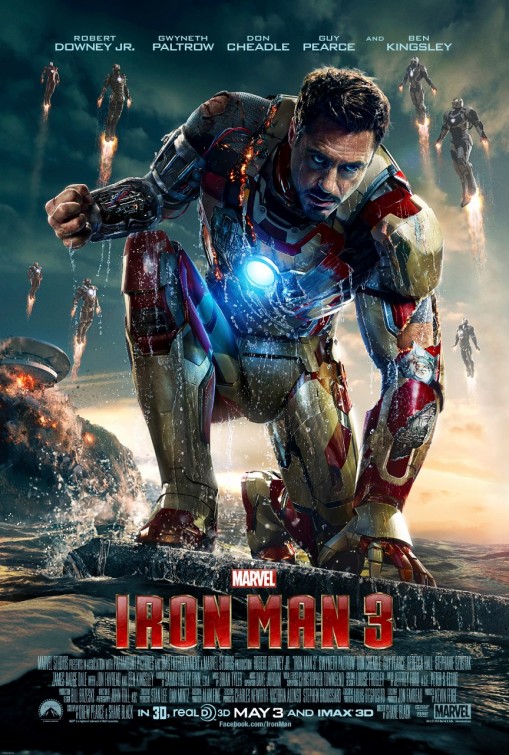
Iron Man 3

Iron Man 3 provides our first look at ‘Phase Two’ of Marvel’s Avengers plan – that is, the movies that come between The Avengers and its sequel – and our first insight into how that process is going to work.

For starters, there is continuity from the events of The Avengers into this next Tony Stark adventure. However, these events have resulted in a logical shift within realism of the ‘Iron Man universe.’ For the first two films in the trilogy, Stark existed in a world that was more or less realistic. Our heroes and villains may have been ultra-rich and incredibly smart, but they were always basically human beings transformed into superheroes and villains through the use of technology. But The Avengers broke this realism by introducing aliens and gods, alternate dimensions and portals. Iron Man 3 acknowledges this shift in reality, giving a prominent narrative place to Tony Stark and other characters coming to terms with what they experienced in New York (“In New York” becomes code for the things that happened in The Avengers). Stark himself is traumatised by the events to the point that he suffers from anxiety attacks.

This shift in reality also allows for a scaling up of the threat in Iron Man 3. Our villain this time is the mysterious terrorist, the Mandarin, played menacingly by Ben Kingsley with a voice that is some combination of Richard Nixon and Heath Ledger’s Joker. The Mandarin is resourced by jaded scientist Aldrich Killian, continuing the tradition from the first two films of it being a battle of the brains. However rather than resourcing him with weapons or super-suits, Killian resources him with an army of genetically modified super soldiers. Therein lays the break in realism which would not have been acceptable without The Avengers.

Of course, not all our questions are answered. The primary one being, when the world comes under threat again, why does Tony Stark have to face this particular challenge on his own? At what point does a catastrophe become significant enough to warrant getting the band back together?

For this third instalment in the Iron Man trilogy, Jon Favreau has handed over directorial duties to Shane Black. Black’s only previous directorial experience was 2005’s Kiss Kiss Bang Bang, a brilliant if under-appreciated film which represented a very important step the comeback of Robert Downey Jr. which ultimately culminated in Iron Man. Black had made his name as a screenwriter of action-comedies, most notably the Lethal Weapon series, making him a pretty good fit for Iron Man 3. And Black does what he does best in this film, ramping up the laughs and the sense of fun in the film without undermining its drama and tension. Black taking over as director has also enabled Jon Favreau’s character, Stark’s body guard Happy Hogan, to take on a much larger role than he did in the first two films.

For a film about a superhero who wears a mechanical suit, Drew Pearce and Shane Black’s screenplay surprisingly sees Tony Stark spending the vast majority of the film, including a number of the action sequences, not suited up. That they felt the freedom to do this is indicative of the fact that over the span of this franchise the writers have successfully achieved what all superhero scribes wish for; they have got the audience invested in Tony Stark as a person, not just as Iron Man. When Christopher Nolan and David Goyer set about writing Batman Begins, one of their primary goals was to get the audience to care about Bruce Wayne as a person so that they weren’t just killing time until he put on the suit. In the case of the Iron Man franchise, you could almost go so far as to argue that audiences have a greater investment in the character of Tony Stark, and the charisma of Robert Downey Jr.’s portrayal of him, than they do in the figure of Iron Man. Downey Jr. as Tony Stark is the trump card this franchise has to play, so it makes sense that Black set out to give him as much screen time as possible. This is further assisted from within the unfolding narrative of the series, with the constant evolution of the suit now seeing it as a piecemeal set of armour, which enables him to have any combination of his arms, legs and torso suited up without necessarily having to have his face covered.

Amazingly, Iron Man 3 represents Downey Jr.’s fifth appearance as Tony Stark – the Iron Man trilogy, The Avengers and a brief cameo The Incredible Hulk. This is staggering considering that the first Iron Man film was only released in 2008. It took Bruce Willis 25 years to appear five times as John McClane. Stark is now without a doubt the role with which Robert Downey Jr. will be forever associated. The way in which he has brought this character to life could also be arguably his greatest acting achievement, although he is excellent in Chaplin. It does not necessarily go hand in hand that the role for which an actor is remembered is also their best work, so he is quite fortunate there.

Iron Man 3 also contains a very brave plot twist, which I’ve been careful not to give away here. Brave in the sense that it is in equal parts fantastic and disappointing, and has thus far left audiences very divided.

Where Iron Man goes from here is anyone’s guess. We know there is going to be a sequel to The Avengers, there is no way that Marvel will let that not happen, and Iron Man 3 finishes with a Bond-esque “Tony Stark Will Return,” but it also has a sense of wrapping up which makes gives the impression that this may be the last solo Iron Man adventure. If that ends up being the case, Iron Man 3 is a fitting completion to a rollickingly fun trilogy.

Rating – ★★★★

Review by Duncan McLean

Review – A Good Day to Die Hard (2013)

Director: John Moore

Starring: Bruce Willis, Jai Courtney, Sebastian Koch, Yuliya Snigir, Rasha Bukvic, Mary Elizabeth Winstead

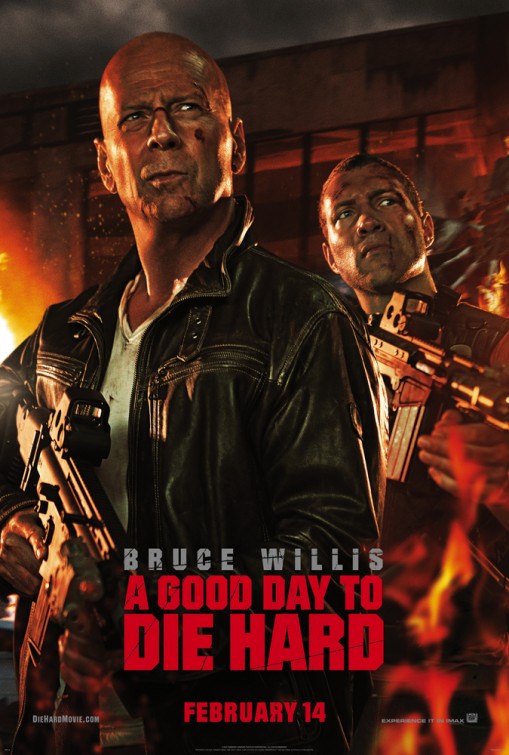
Good Day to Die Hard1In the 1980s Hollywood was overtaken by blockbuster fever, and a major beneficiary of the studios’ quest for the perfect high concept franchise was the action movie. The 1980s saw action cinema at the peak of its prominence. Films like The Terminator, Predator and the Rambo trilogy had made Schwarzenegger and Stallone among the biggest stars on the planet. But arguably the best movie to come out of the 1980s action cinema was John McTiernan’s Die Hard. Released in 1988 it propelled Bruce Willis into mega-stardom and really raised the bar in terms of quality for action movies. It introduced a blue-print which would be followed by big and loud Hollywood action movie from then on, the one-man army. We were introduced to John McClane, an engaging and charismatic hero, a modern American cowboy who was never short of a witty wise-crack (it is interesting to see the way that McClane’s  trademark “yippee-ki-yay motherfucker” starts out with a context, coming out of villain Hans Gruber’s suggestion that he is just playing cowboy, and as the series goes on it is reduced to a simple catchphrase). That hero was then placed in story with a simple but effective premise. He just happened to be in the building that was taken over by terrorists. That building then becomes a labyrinth in which a game of cat-and-mouse can take place. The original Die Hard is a legitimately great movie.

While the sequels released over the 25 years since have steadily declined in quality, the character of John McClane remains, and it is the audience’s goodwill towards this character which keeps them coming back, each time hoping against hope that this one will be better than the previous slightly underwhelming sequel. Unfortunately, this is where A Good Day to Die Hard really drops the ball. In Skip Woods’ screenplay, John McClane is practically reduced to a supporting character in his own movie. The film sees McClane travel to Moscow in order to bring home his estranged son, Jack, who he discovers has been arrested. However, it turns out that his son is actually a CIA agent on a covert mission to rescue a prisoner named Komorov who knows some rather damning information about a Russian politician. After Jack breaks Komorov out, McClane joins his less charismatic son on his mission, and spends most of the remaining screentime following his son around. As a result, the one-man-army which had been the central structure of the previous four Die Hard films is not in place here.

So rarely has a good sequel ever been built around the introduction of a child for our hero. It was worked fine in Live Free or Die Hard (known in some countries as Die Hard 4.0), where the introduced child was his daughter, who mainly served as a motivation for our hero. She was the thing he needed to rescue. But introducing a child to serve as the next generation of hero only ever seems to frustrate audiences, yet lazy writers continue to go back to that well.

Of course, the other staple of the Die Hard series is explosive action, and that is still very much present. John Moore makes sure he gives his audience the requisite amount of carnage, with a major car chase, some quite impressive sequences with a helicopter, and lots and lots of guns. Some of the action sequences do employ digitally generated shots, which can be slightly jarring, not because they are poorly executed, simply that they are stylistically inconsistent with the aesthetic of the other films in the series.

I so badly wanted this movie to be good, or at least good enough, but while it had its moments and there is plenty for the fan of large-scale, explosive action, only the most blindly devoted Die Hard fan will be really satisfied with this one.

Rating – ★★

Review by Duncan McLean

Review – God Bless America (2011)

Director: Bobcat Goldthwait

Starring: Joel Murray, Tara Lynn Barr

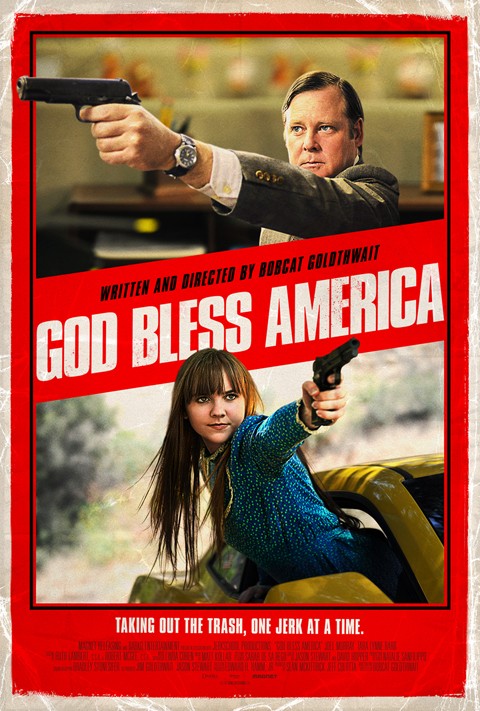
God Bless AmericaThe fifth film from comedian turned writer/director Bobcat Goldthwait, God Bless America is the blackest of black comedies. It is also a really strong piece of satire, commenting on the downward spiral of American culture. Goldthwait laments a society which has come to celebrate the loudest, the meanest, the dumbest and the shallowest.

Joel Murray – Bill Murray’s brother (he must hate that every reviewer feels that it is necessary to mention his more famous brother) – plays Frank. Frank’s life is going down the toilet. He is divorced, with a young daughter who doesn’t want to see him. He is diagnosed with a brain tumour. He has grown tired of an American civilisation that is no longer interested in being civilised. Not only does the world around him celebrate cruelty and bigotry, kindness and generosity are treated with suspicion. When he tries to make a nice gesture by sending a bunch of flowers to a woman from work who he thinks looks like she could use some cheering up, he is fired for sexual harassment. It all becomes too much to bear for Joel, and he decides to take his own life. But before going through with it, he comes to the realisation that perhaps the world would be better served if rather than killing himself he killed those who deserved to die. So, joined by an equally disenfranchised teenage girl named Roxy, he travels around the country knocking off reality TV stars, shock jocks and spoilt brats.

What makes Goldthwait’s satirical observations about the state of American culture so effective is that they aren’t exaggerated. They simply don’t need to be. We recognised the degrading reality television programs, the hate-mongering political commentators, the bigoted and intolerant religious conservatives and the general lack of common courtesy in the day to day interactions. When Joel and Roxy rattle off a list of all the groups of people and traits that irritate them you can’t help but nod in agreement (and occasionally sheepishly recognise they are talking about you). Goldthwait doesn’t need to hyperbolise. He doesn’t need to fabricate something that isn’t there. He just puts what we have become used to up in front of our eyes and forces us to acknowledge it.

However, despite the validity of his observations, it could be argued that the execution – pardon the pun – of the satire is slightly flawed. Is the intolerance of our protagonists any different to the intolerance of those they can’t tolerate? The idea that some people deserve to die, even if presented ironically like in this film, is always going to raise problems. Is Joel and Roxy’s course of action, a killing spree that is here presented as a solution, only representative of another troubling aspect of American culture? This question raises another point, and what I think is the number one issue facing Goldthwait’s film.

Sometimes the reception of a movie is impacted by events well beyond the control of its makers, and that is definitely the case here. While God Bless America is a very clever film, and very justified in its social commentary, you can’t help but feel conflicted while watching it. In light of recent events, now more than ever it is difficult to laugh at the idea of Americans shooting each other. Being the kind of film that it is, God Bless America was never destined to be a popular success – it slandered the very audience it would have to have pandered to if it wanted to succeed at the box office – but even within its niche of the market the way it is received will be influenced.

Rating – ★★★★

Review by Duncan McLean

Great Movies – Le voyage dans la lune (1902)

Le voyage dans la lune

Director: Georges Méliès

Starring: Georges Méliès, Victor André, Bleuette Bernon, Brunnet, Jeanne d’Alcy, Henry Delannoy, Depierre, Farjaut, Kelm

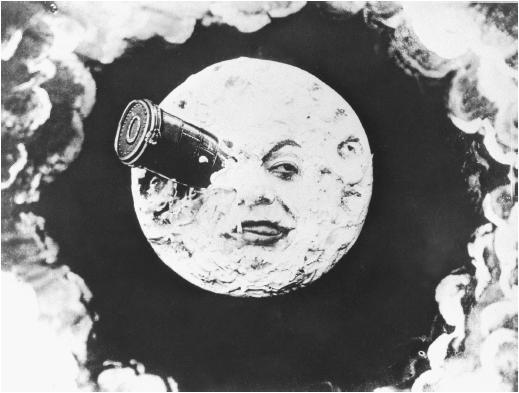
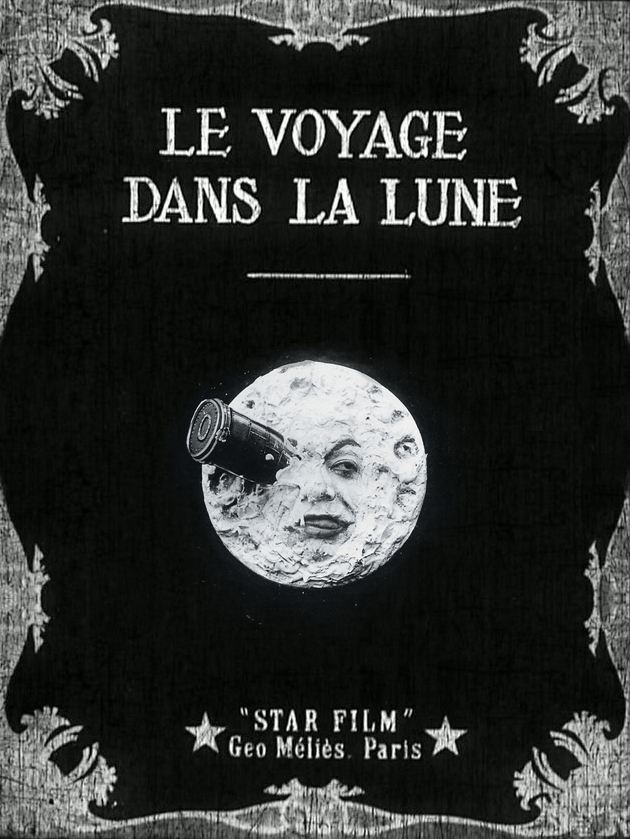
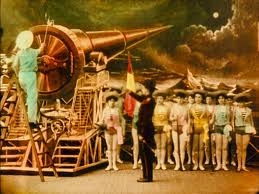
Le voyage dans la luneThe image of a rocket stuck into the eye of the anthropomorphic-faced moon in Georges Méliès’ 1902 film Le voyage dans la lune (A Trip to the Moon) is among the most famous and enduring in cinematic history. The film itself, which tells the story of a scientific expedition to the moon, the resulting encounters with aliens, and the return journey via the bottom of the ocean, is undoubtedly the first great movie.

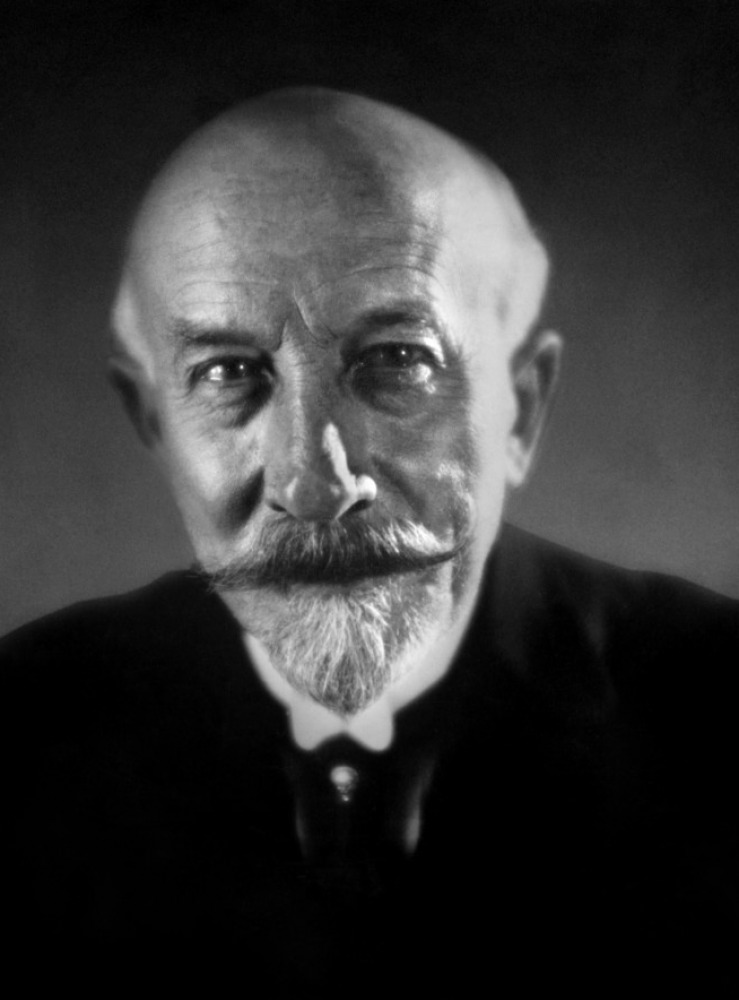
Often referred to as the father of narrative filmmaking, Georges Méliès is arguably the first cinematic master. Directing more than 500 films between 1896 and 1913, the majority of which he also wrote, produced and starred in, Méliès can be credited with establishing many of the elements which would become the foundations of what we know as the cinema. The moving picture medium was invented by the Lumière brothers, Auguste and Louis, in the late 19th century. They toured their short, fifty second films around the world and were wildly popular, but at this point, the attraction was the medium itself, moving pictures, rather than the specific content of their films. The Lumières’ films were all actuality films – a primitive form of documentary simply concerned with the capturing of real events – the most famous of which was 1896’s L’arrivée d’un train à La Ciotat (Arrival of a Train at La Ciotat), which featured a train pulling into a platform and caused audiences to scream and duck for cover as the train approached the screen. It was Méliès who, having become fascinated with the Lumières’ invention, saw the potential of this new medium for imagination and fictional storytelling. Nowhere is this imagination more apparent than in the fantastic narrative of La voyage dans la lune. As Martin Scoresese put it, “the Lumières gave us the world as we knew it, and Méliès gave it to us as we imagined and extended it.”

Georges melies

Georges Méliès

Before becoming a filmmaker, Méliès had been a magician, and that background in theatricality and illusion would be incredibly influential on his filmmaking. While his earliest films were simply recreations of his stage shows, he soon began to experiment with the technology and as a result became responsible for the development of many of the earliest forms of special effects including stop motion, time-lapse photography, multiple exposures and dissolves. For a film made only seven years after the Lumières first introduced the medium to the world, Le voyage dans la lune features a staggeringly sophisticated use of both staged visual effects and more complicated editing effects. With each scene being a single shot from a stationary camera, the sets are able to function much like traditional theatre sets, with openings and trapdoors which characters can come in and out of. The iconic image of the face on the moon was achieved through superimposing one image shot over another. We have characters appearing and disappearing into puffs of smoke through the use of jump cutting, the very same principle I Dream of Jeannie would employ 65 years later. The picture was released in both black-and-white and colour prints, with the colour prints having been hand coloured, frame-by-frame. This magician really put the wonder and magic into moviemaking.

Not only did Le voyage dans la lune feature a fantastical story – the first ever sci-fi movie – and innovative use of the medium, at a time when the average film only ran for one or two minutes, La voyage dans la lune’s fifteen minute runtime (at the then standard 16 frames per second) made it positively epic by comparison.

Le voyage dans la lune - Colour

A hand-coloured frame

In 1993, the Filmoteca de Catalunya in Barcelona discovered a hand-coloured print of the film, the only one known to have survived, that had almost completely decomposed. In 1999 the Technicolor Lab of Los Angeles launched a frame-by-frame restoration project which would take over a decade. The completed restoration, with a new soundtrack by the French band, Air, was screened at the 2011 Cannes Film Festival almost 110 years after its initial release, and has been released on DVD and Blu-Ray.

By Duncan McLean

Review – Red Dawn (2012)

Director: Dan Bradley

Starring: Chris Hemsworth, Josh Peck, Josh Hutcherson, Adrianne Palicki, Isabel Lucas, Connor Cruise, Will Yun Lee

Red DawnA remake of the 1984 Patrick Swayze movie, Red Dawn tells the story of a group of high schoolers who, under the guidance of a young marine recently returned from Iraq played by Chris Hemsworth, become guerrilla soldiers when their home town is overrun by a North Korean invading force. Taking on the mascot of their high school, the Wolverines become Spokane, Washington’s version of the Vietcong, terrorising the occupying forces with their superior knowledge of the local terrain, and giving hope to an imprisoned people.

If you want to enjoy Red Dawn it is important that you leave your brain at the door, because if you let yourself think about it even for a second the whole premise unravels. Whether it is little questions like how is it that the Wolverines seem to be able to move in and out of the town with such ease, or bigger ones like how can a well-drilled North Korean invading force be so easily and consistently out-skilled and out-strategised by a group of high schoolers after only a couple of weeks (the time periods are intentionally kept vague) of basic training from an early-career marine, the film just doesn’t stand up to logic. It’s pretty ludicrous stuff.

In the 1984 original, it was the Soviets who were invading, and despite the premise being the same, Cold War anxiety made the whole thing a bit more acceptable. This time around it is the North Koreans. I always find it a bit awkward when a non-historically based film speculates about a war between two actual countries. Most films of this kind will give the enemy a fictional name or leave them anonymous while subtly or unsubtly alluding to a real life country. But in this case the studio has obviously figured that they weren’t going to damage the film’s international box office potential by getting North Korea offside. Interestingly, the film had to be re-edited with certain scenes reshot, as the invading force was originally identified as Chinese. Obviously China was too big a potential market to alienate.

Directed by Dan Bradley, a stuntman, it heavily favours action over psychological insight. Only for the briefest of moments is attention given to the thought that a teenager might be psychologically conflicted by being required to take another person’s life. For Australian readers who will understand the reference, Red Dawn is Tomorrow When the War Began done American style. It’s the same concept but with a much higher ammunition and explosives budget.

Rating – ★★

Review by Duncan McLean

Review – The Perks of Being a Wallflower (2012)

Director: Stephen Chbosky

Starring: Logan Lerman, Emma Watson, Ezra Miller, Mae Whitman, Melanie Lynskey, Paul Rudd

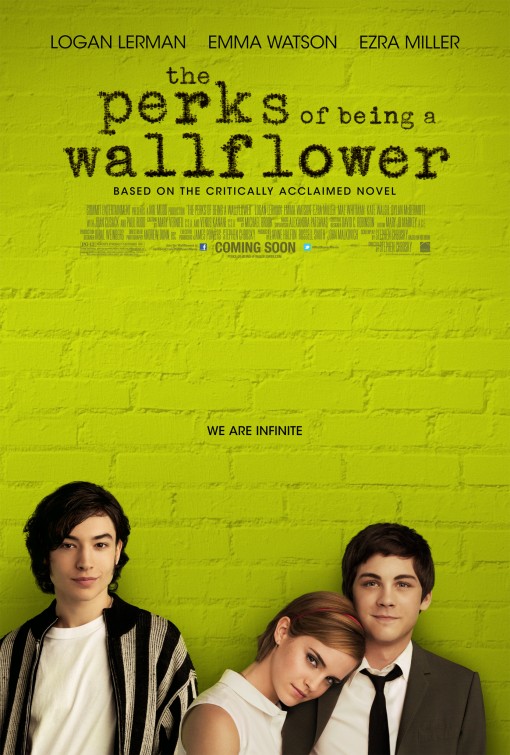
Perks of Being a WallflowerWith the rise of hipster culture in recent years it has never been cooler to be uncool, and in that regard Stephen Chbosky’s film The Perks of Being a Wallflower couldn’t have come at a better time.

The Perks of Being a Wallflower is a coming-of-age story set in the early 1990s. Emotionally scarred Charlie has always felt invisible. He’s always been on the outside looking in. On his first day of high school he is already counting down the days until it’s over. But when he is taken in by a group of equally misfit seniors, he finds himself in a situation he has never been in before, he has friends, and through them he is able to take the first steps towards putting his past behind him.

Chbosky wrote the cult, young-adult novel of the same title in 1999, and made the rather bold decision to direct the film adaptation himself, despite his experience as a director being limited to one film almost two decades ago. However, his bold decision really seems to have paid off.

While there is a certain level of pretentiousness in their desire to be alternative, it still has an incredible authenticity. For example, the fact that Sam takes such pride in her good taste in music, yet along with Charlie spends the whole film trying to identify David Bowie’s ‘We Can Be Heroes’ seems to ring true of an eighteen year old know-it-all who despite her best efforts still has enormous gaps in her knowledge and experience.  That authenticity is really important. So much of contemporary hipster culture is artifice, simply adhering to a set of conventions in order to be cool, even if they are a non-traditional set of conventions. If that was all The Perks of Being a Wallflower work was it would be an incredibly frustrating film, and this group of teens would probably come across as obnoxious and unlikeable. But it isn’t. There is an authenticity to their lifestyle. Their alternativeness doesn’t come from a desire to identify as being different. It comes from the acceptance and embracing of the fact that they are different. Whether as a by-product of their sexuality (Patrick), or as a result of childhood trauma (Charlie) or abuse (Sam), their lives have conspired against them to make them outsiders. Yet they manage to find a place with other different people (the inclusion of The Rocky Horror Picture Show as one of the group’s defining activities speaks volumes).

The performances of the film’s leading trio are fantastic. Logan Lerman’s is impressive as Charlie, providing the film’s emotional centre in a part that either makes or breaks the film. Lerman manages to make Charlie instantly likeable despite his closed off and troubled personality. As Patrick, Ezra Miller provides a fun and flamboyant character without forfeiting his humanity. Emma Watson delivers a career-changing performance which may well become her post-Harry Potter calling car – which is important for her career given that was a decade’s worth of employment she gained on the basis of being a talented ten year old.

There is one element in the story which distracted me. Charlie is a freshman (first year of high school) while the rest of his friends are seniors (final year). That is quite a sizeable age difference for a school context, but it is never really suggested in the film that this is in any way unusual. It is simply not an issue. Yet in real life it would be an issue. Why would a bunch of eighteen year olds want to hang around with a fourteen year old?

Some critics have complained that this film lacks originality, and it is true that there isn’t really anything here we haven’t seen in some form before, but a well-made coming-of-age story will find a way to connect with audiences and it is no surprise that The Perks of Being a Wallflower managed to sneak onto a few best films of 2012 lists. It’s a gem.

Rating – ★★★★☆

Review by Duncan McLean

Review – Shadow Dancer (2012)

Director: James Marsh

Starring: Andrea Riseborough, Clive Owen, Domhnall Gleeson, Aiden Gillen, Brid Brennan, David Wilmot, Gillian Anderson

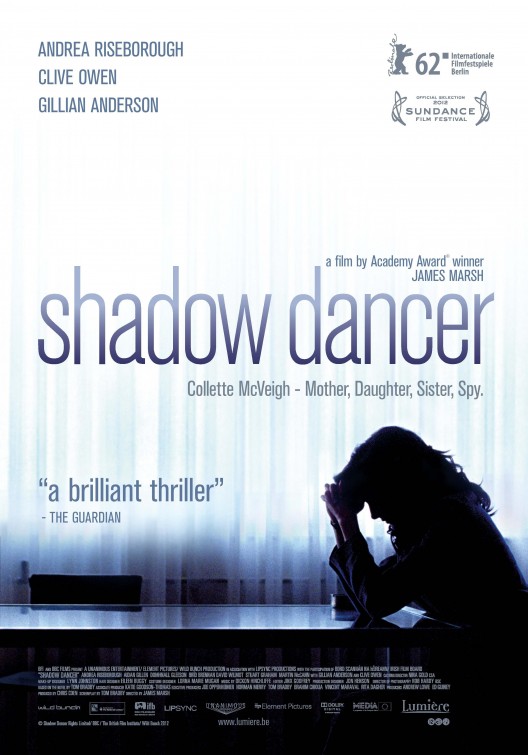
Shadow DancerColette McVeigh, a single mother with connections to the IRA, is picked up and interrogated by Mi5 agents after failing to go through with mission to plant a bomb on the London Underground. She is given a choice between a long prison sentence and separation from her young son, or agreeing to share information on the IRA cell in which her brother is a key member. She reluctantly chooses the latter and Shadow Dancer – a title which won’t make sense until a revelation late in the film – then follows the relationship between Colette and her Mi5 controller, Mac, as she goes about the dangerous business of being an informant.

If you want to think about it in generic terms, Shadow Dancer would be categorised as a spy thriller. But you would have to throw out a number of your preconceived notions of what a spy thriller is. Like Tomas Alfredson’s Tinker Tailor Soldier Spy in 2011, Shadow Dancer is a slow burning film with a steadily escalating tension rather than a roller coaster ride we expect from the majority of spy thrillers which follow the conventions established by James Bond films. Shadow Dancer moves at a very slow pace, to the point that it will be very off-putting for some viewers.

The performances are quite strong, even if the motivations for some characters are not always clear. In particular, Andrea Riseborough has earned some acclaim for her central performance as Colette. The key to her performance is the way that, while allowing us to see some of her anxieties and concerns, she manages to retain a moral mystery which means we never really know where she stands in terms of the larger conflict. Is she a believer in the IRA cause or obliged to play a role out of a sense of family duty or guilt? But I will admit to struggling with her character at times. I found her character so closed off, so internalised, that it became difficult to empathise with her.

Director James Marsh’s background is in documentary making – he won the Best Documentary Oscar in 2009 for Man on a Wire – and Shadow Dancer is a revealing picture in the way that it exposes the danger and volatility of life in Belfast in the 1990a. However, it fails to really give a sense of the socio-political context which explains that violence and volatility, and as a piece of entertainment it can be a really hard slog.

Rating – ★★

Review by Duncan McLean

Review – Gangster Squad (2013)

Director: Ruben Fleischer

Starring: Josh Brolin, Ryan Gosling, Sean Penn, Emma Stone, Giovanni Ribisi, Robert Patrick, Michael Peña, Anthony Mackie, Nick Nolte

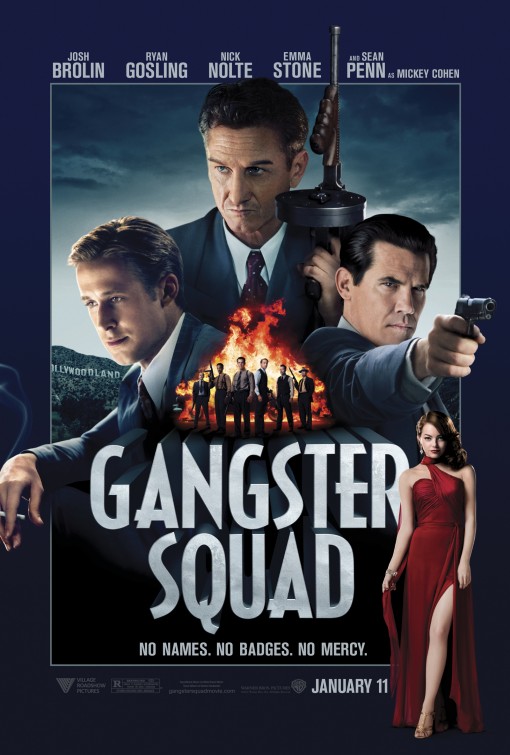
Gangster SquadWarner Brothers is the spiritual home of the gangster picture. Back in the golden era of the 1930s and 1940s it was Warner Brothers who gave us the early classics of which helped established the genre, films like The Public Enemy, Little Caesar, Angels with Dirty Faces, The Roaring Twenties and White Heat. Fast-forward to the 1960s and it was Warner Brothers who gave us the film which redefined the genre, Bonnie and Clyde, and their association continued through Martin Scorsese. While he has worked with a number of different studios through his career, it is no coincidence that it is with Warner Brothers that he made Mean Streets, Goodfellas and The Departed.

Warner Brothers’ latest offering in the genre, Gangster Squad, returns to the classic formula. Director Ruben Fleischer, best known for his comic work in films like Zombieland, takes us to post-war Los Angeles, a city that has lost its innocence inhabited by men who, having returned from the battlefield, can’t stop fighting. Los Angeles is under the thumb of Mickey Cohen, and Sgt. John O’Mara is given orders to put together a crack squad and go to war with him. However, despite its rather classic premise, unfortunately Gangster Squad will not be joining the list of classic Warner Brothers’ gangster films.

Gangster Squad has been getting a tough rap from critics – an unfairly tough rap in my opinion – primarily for two reasons; its lack of originality and shoddy writing.

First, the writing. The screenplay is indeed pretty terrible. Based on Paul Lieberman’s book of the same title, Gangster Squad is the first feature film for screenwriter Will Beall, a former LAPD officer whose only previous writing credits were a handful of episodes of Castle, and it does sound a bit like a first time screenwriter. The film is overly reliant on clichéd dialogue and scenes (there is actually a scene where a pensive police officer throws his badge into the ocean). The substandard writing is a shame because it means that the film doesn’t get to take full advantage of the quite stellar cast that they’ve managed to assemble. The actors all seem to be trying their hearts out but the chemistry isn’t quite there on the screen because it obviously wasn’t there on the page.

The primary cause for accusations of unoriginality is that Gangster Squad plays exactly like The Untouchables. If you are in any way familiar with De Palma’s film you can’t help but seeing the parallels as the movie goes along. Both movies have a city at the mercy of a corrupt gangster. In both cases that gangster is played by a big name, respected actor – Robert DeNiro as Capone and Sean Penn as Cohen. Both movies involve an honourable, Irish detective putting together a special squad to take down that gangster. In both cases that squad ends up being a bit of a motley crew. The parallels continue, but I don’t want to get into spoiler territory. When the parallels are so constant, you can’t help but compare the two and, unfortunately for Gangster Squad, The Untouchables is a great movie, well written and performed, and as such Fleischer’s film suffers by comparison.

Visually, Fleischer and Aussie cinematographer Dion Beebe (Chicago, Memoirs of a Geisha) have given us a stylised version of the classic gangster aesthetic. You still have all the iconography you expect, and that beautiful Art Deco vibe that drops you straight into the era, but through the combination of some interesting camera angles, a colour palate that is dominated by blues, and some digital alteration, you end up with something that looks a bit like a cross between a classic gangster film and The Watchmen. I’m not really sure if I liked it or just noticed it, but it is distinctive.

As I said before though, I think the harshness with which some critics have met this film has been a bit excessive. Gangster Squad is pure escapism and suffers in the eyes of some because so many great gangster films before it have aspired to more than just escapism. But there has always been a place for escapism at the movies. It is not a hugely original story, but the foundation of the genre system is the joy of familiarity. If you are a lover of gangster movies, as I am, there is an enjoyment that comes from revisiting a traditional gangster premise and seeing today’s stars playing roles straight out of old Hollywood. You don’t always need to be rewriting the rules and breaking new ground. Gangster Squad is not going to rock your world, but it’s not a bad way to spend a couple of hours.

Rating – ★★★☆

Review by Duncan McLean

Review – Liberal Arts (2012)

Director: Josh Radnor

Starring: Josh Radnor, Elizabeth Olsen, Richard Jenkins, John Magaro, Allison Janney, Zac Efron, Elizabeth Reaser

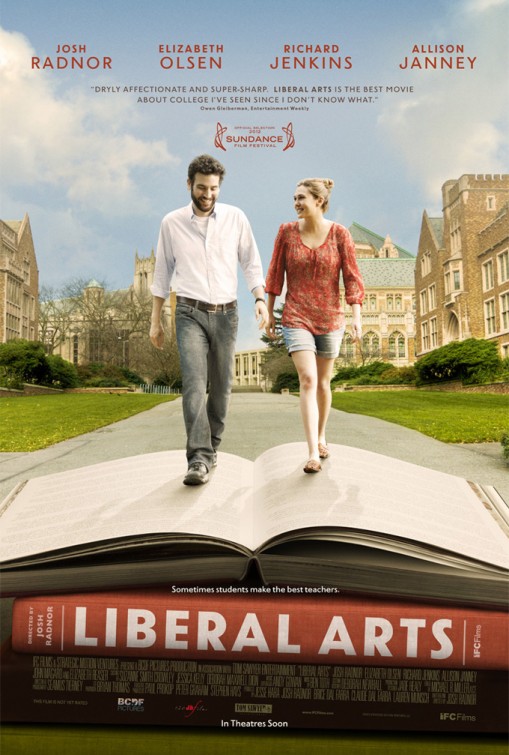
Liberal ArtsPlenty of films have been made about nostalgia for the glory days of college, but invariably they are most concerned with partying and responsibility-free living. Rarely do you find a film which considers the university years with the same level of earnest idealism as does Liberal Arts.

Jesse Fisher is a 35 year old liberal arts graduate who is working as an admissions officer in a New York college. He accepts and invitation to return to his alma mater in Ohio for the retirement dinner of one of his favourite professors from his time there. While back on campus he strikes up a friendship and romance with a 19 year old drama student named Zibby (short for Elizabeth), a relationship that at the same time manages to make Jesse feel young and remind him of how old he is.

At its heart, Liberal Arts is a film about growing up, and the college becomes a metaphor for youth, and all the opportunity and boundless potential that entails. Jesse is overwhelmed with excitement to get back to his alma mater and really wants to once again feel like he did back then. However, for all his excitement at getting back to college, we also get, as a contrast, the perspectives of two lifelong academics; one whose passion has been replaced by bitterness and resentment, the other who, facing retirement, is concerned that like a prisoner he has become an ‘institution man’ and won’t be able to function in the outside world.

It takes you a while to get on board with Jesse and Zibby’s relationship. Initially, it doesn’t quite seem plausible. You don’t understand her interest in him. It just seems to happen. But once it is established it starts to make more sense. With the sixteen year age gap being so prominent – there is a great little scene where Jesse tries to get his head around their age difference by working out how old she was or will be at different stages of his life – Jesse and Zibby’s relationship also ties into this theme of growing up. He sees her as a way back to the hopeful young man that he was, someone with whom he can have the lofty, intellectual conversations which were once so important to him but have since become absent in his life. For her, frustrated by the calibre of male in her peer-group, he is a chance to fast-forward into adulthood.

The film also contains a few subplots, the most interesting and authentic of which is Jesse’s relationship with a manic depressive boy he meets on campus – another relationship Jesse just seems to fall into. The two bond over reading, and Jesse becomes a surrogate father figure for this brilliant but troubled young man.

Liberal Arts is written and directed by its star, Josh Radnor. It is Radnor’s second film as a writer/director after 2010’s Happythankyoumoreplease, another film about growing up. Radnor would be most familiar to viewers as Ted Mosby from How I Met Your Mother, and viewers of that show will struggle not to see him playing a version of the same character here. Elizabeth Olsen – the younger sister of twins Mary-Kate and Ashley – is quite good as Zibby, and is definitely one of the young actresses to watch over the next couple of years.

At times Liberal Arts can briefly cross the line into pretentiousness, but no more than you would expect from a screenplay trying to capture the vibe of young, faux-intellectual liberal arts students. But despite this, the film is quite charming, will appeal to people who have had that particular experience of college, and does enough to suggest that Radnor could develop into quite an interesting filmmaker.

Rating – ★★★

Review by Duncan McLean