Review – Total Recall (2012)

Director: Len Wiseman

Starring: Colin Farrell, Kate Beckinsale, Jessica Biel, Bryan Cranston, Bill Nighy

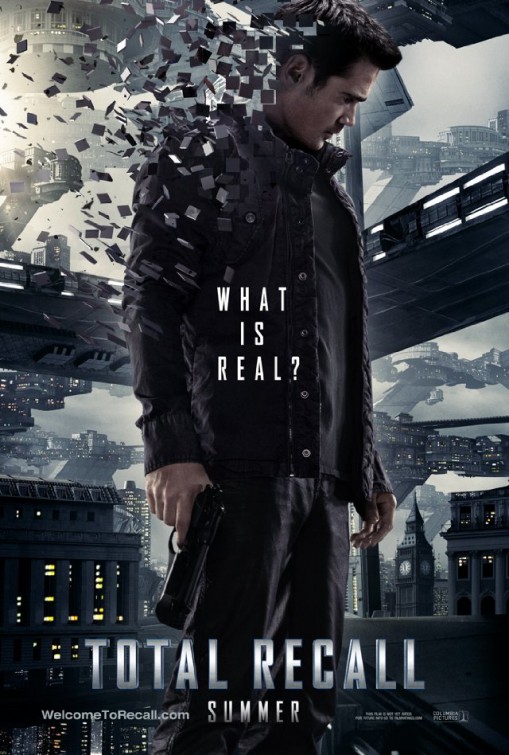
Total RecallTotal Recall is a remake of the Paul Verhoeven and Arnold Schwarzenegger cult classic from 1990, which begs the question, why? Why did this film need to be remade? Director Len Wiseman, best known for the Underworld series, doesn’t take the story anywhere new, but he does lose the satire, the existential questions and sense of fun which made Verhoeven’s film work.

Total Recall takes us to a futuristic dystopia, where disenchanted factory worker Douglas Quaid decides to visit a Rekall centre, a company that implants clients with fake memories of the life they would like to have led. He chooses the life of a secret agent but as the procedure commences the technicians discover that he has had his memory erased and was previously, in fact, a secret agent. Quaid then finds himself on the run from those who had previously engineered his disappearance.

Colin Farrell takes on the role that Schwarzenegger made his own 22 years ago. Farrell is obviously a better actor than Schwarzenegger and does a passable job of getting you to empathise with his character’s confusion, but whether that is enough to make you accept him in Arnie’s place is uncertain. Arnie’s ownership of a role rarely has anything to do with his acting skill. What Farrell’s presence does do is demonstrate how, twenty years on, audiences demand a different style of action hero, with him being a far cry from the 1980s beefcakes like Schwarzenegger, Stallone and Van Damme.

Wiseman’s film is very visual effects heavy and while these effects are sound they are nothing we haven’t seen before. The look of the film is clearly based on Ridley Scott’s neo-noir masterpiece Blade Runner. If only it could have managed just a fraction of Blade Runner’s nuance.

Drawing on the Philip K. Dick short story “We Can Remember It For You Wholesale” (Dick also wrote “Do Androids Dream of Electric Sheep” which was the basis for Blade Runner), the intrigue of Total Recall is supposed to come from an uncertainty as to whether what we are watching is real life or whether Doug is simply experiencing his Rekall fantasy. Unfortunately this existential element is almost completely lost in this remake, with the film never quite doing enough to genuinely make you wonder about the reality of what is being experienced. What you are left with is a largely unengaging film which feels like one extended, two-hour chase sequence.

Rating – ★☆

Review by Duncan McLean

Review – Prisoners (2013)

Director: Denis Villeneuve

Starring: Hugh Jackman, Jake Gyllenhaal, Terrence Howard, Mario Bello, Viola Davis, Melissa Leo, Paul Dano

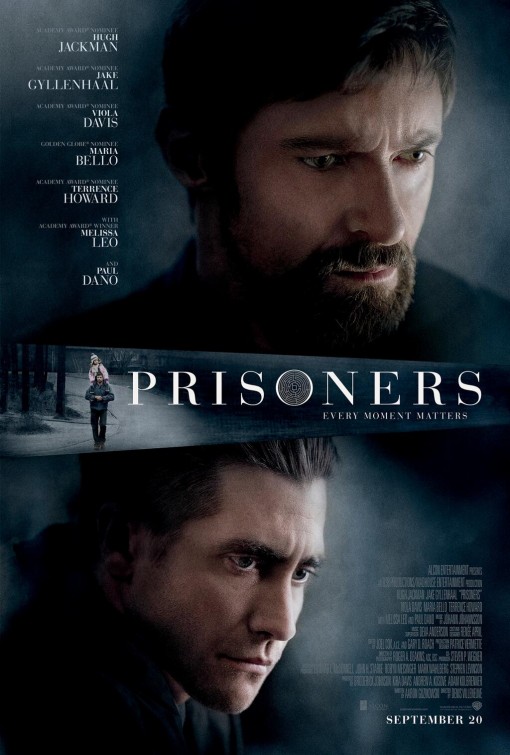
PrisonersThe compelling, morally complex mystery film Prisoners tells a story of child abduction in suburban Pennsylvania. Two families, the Kellers and the Birchs, come together for Thanksgiving lunch and are enjoying a lovely day until they realise that both of their youngest daughters are missing. When their search proves fruitless, the abrasive Detective Loki, a specialist in finding missing persons, is put on the case. However, the kidnapped girls are not the only prisoners the film’s title alludes to. While Detective Loki continues his investigation, Dover Keller takes things into his own hands. In his desperation he abducts an intellectually challenged man who he believes was involved in his daughter’s abduction and knows her whereabouts, and sets about trying to persuade him to speak by any means necessary. It is at this point that Prisoners ventures beyond the realms of a standard abduction mystery movie and becomes a statement on America in the post-9/11, war-on-terror era.

As America continued its search for Osama bin Laden in the latter part of last decade, details started to leak about the extreme persuasion tactics being employed at Abu Ghraib (tactics confronted on screen last year in Kathryn Bigelow’s Zero Dark Thirty) and American society was struck with a moral question. How far is it acceptable to go to get information if you believe it will save lives? In Prisoners, director Denis Villeneuve and screenwriter Aaron Guzikowski confront that same question but put it on a smaller scale, personalising it. How far is it acceptable to go to get information if you believe it can save your daughter’s life?

It is this central moral question that makes Prisoners so painful and so compelling. Simultaneously we want Keller to stop because he might be wrong, but we want him to keep going because he might be right. What is the worse scenario in his mind: that he be wrong and as a result has tortured an innocent man, or that he be right and miss possibly the only opportunity to save his daughter’s life? As such Keller is at the same time the protagonist of the film and one of its chief antagonists. As we struggle to settle on our moral response to the actions being depicted, we are presented with another possible response by Nancy Birch, the mother of the other missing girl, who upon discovering what Keller is doing tells her husband, “We’re not going to help Keller, but we won’t stop him either. Let him do what he needs to.” Her reaction appears to be Villeneuve and Guzikowski’s indictment of an American administration and society that would turn a blind eye to things it could not stomach so long as the ends justified the means.

The first Hollywood film from French-Canadian director Villeneuve, Prisoners is a well-structured and executed mystery with strong performances from its principal cast, a number of whom are playing against their usual character types. For a savvy audience that is programmed to expect plot twists, Prisoners still manages to surprise you. There are some moments at which you feel like plot and character elements are missing –for example Gyllenhaal’s Detective Loki is quite an interesting character in terms of his mannerisms and presentation and you expect a backstory that is never forthcoming to explain why he is the way he is – but the film is none the less a gripping, intense mystery.

Rating – ★★★★

Review by Duncan McLean

Review – Rush (2013)

Director: Ron Howard

Starring: Chris Hemsworth, Daniel Brühl, Olivia Wilde, Alexandra Maria Lara

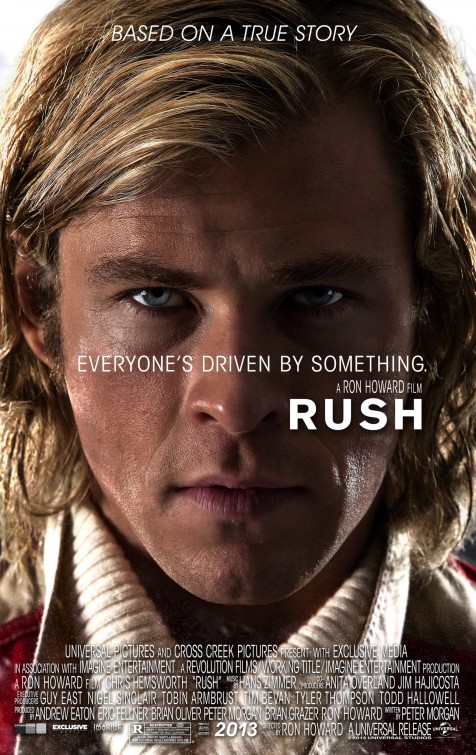
RushTwo men, both brilliant but both completely different. One is flamboyant, brash and impulsive. The other is calculating, methodical and abrasive. They are James Hunt and Niki Lauda, and they are the subject of Ron Howard’s latest film, Rush, which tells the story of their famous rivalry from its origins in lower division racing to its culmination in a head to head battle for the 1976 Formula One World Championship, a season which would for different reasons change both of their lives.

This is not just a movie for Formula One fans. In fact, to call Rush a sports movie feels reductive. The film starts with a voiceover from Lauda. “Twenty-five people start Formula One and each year two die. What kind of person does a job like that?” Rush is a character study. What kind of person willingly takes that kind of risk? The movie presents us with two opposite but co-dependent figures who are, in their different ways, that kind of person.

With two characters as diametrically opposed as Hunt and Lauda a more simplistic film would have sought to establish a clear hero and a villain, a protagonist and an antagonist. Rush gives no such clear cut definitions. Instead both characters are complex personalities and both characters at different times have the audience on their side. Hunt, despite his charm, provides many of the films darker moments. Likewise, Lauda, despite his analytical nature provides most of the films laughs.

With the entire film being built around these two personalities, much falls on the shoulders of Chris Hemsworth and Daniel Brühl and both arguably deliver career best performances. The key to both performances is the actor’s ability – with the help of Peter Morgan’s fine screenplay – to take their character beyond caricature. Having already played a superhero and being blessed with superhuman handsomeness, Hemsworth heightens Hunt’s charm and makes for a believable playboy. But it is the moments where he takes you beneath the surface, beneath the façade, that really show his talent. Likewise, Brühl’s calculating and abrasive Lauda could have been yet another a simplistic, Germanic villain but Brühl gives him depth and as a result his own charm and likeability.

That all being said, Rush still really works as a sports movie. It is the best film ever made about motor sports. The racing scenes are exhilarating. While the actual depiction of the sporting event is where many sports movies fall short, Howard successfully brings life to the contest between these two men (the rest of the drivers are irrelevant), demonstrating the speed, closeness and incredible danger of what they do. Just as importantly, no two of the races feel the same. For each race there is something specific that draws our focus, so the drama never disappears.

Ron Howard has always been a gifted storyteller but over the last decade he seems to have had more misses than hits. He is a filmmaker who at times has been prone to playing it safe, but there is nothing safe about Rush either in its subject or its execution. Rush is a real return to form for him, the best motor racing film ever made, and one of the films of the year.

Rating – ★★★★

Review by Duncan McLean

Review – This is the End (2013)

Director: Evan Goldberg & Seth Rogen

Starring: Jay Baruchel, Seth Rogen, James Franco, Craig Robinson, Jonah Hill, Danny McBride

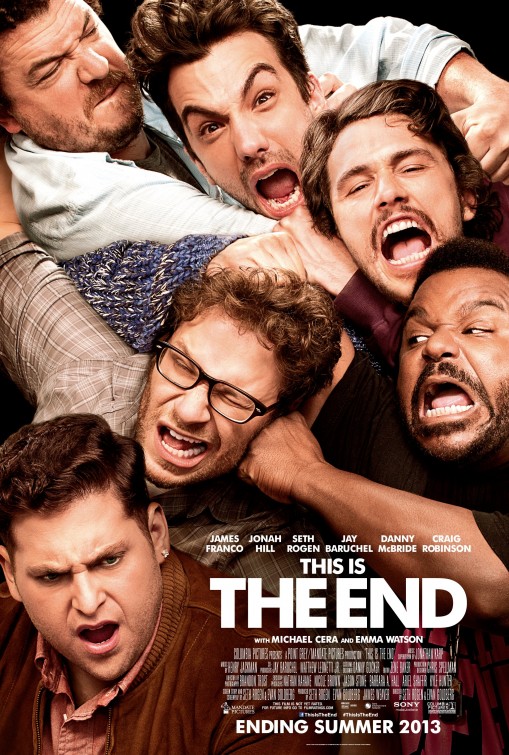
This is the EndEvery now and then a group of friends will be sitting around, having a few drinks, making each other laugh really hard and they’ll collectively think “We’re pretty funny. Somebody should make a movie about us.” What would happen if that group of guys were all well-known comic actors and had the clout to get someone else to pay for that movie to be made? The answer, as we see with Seth Rogen and Evan Goldberg’s This is the End, is you get the most self-indulgent movie ever made.

Under the guidance of Judd Apatow, that peer group of Rogen, Jonah Hill, James Franco, Jason Segel, Paul Rudd, Danny McBride and the rest – the core of which started with the short-lived TV series Freaks and Geeks and then expanded through films like The 40 Year Old Virgin, Knocked Up and Superbad – currently sits at the top of the comedy movie hierarchy. A big part of their appeal has always been that it is so apparent that they are friends in real life, that friendship resulting in an easy, natural chemistry on screen. Unfortunately, This is the End takes that one step too far and it feels like you are watching a series of in-jokes. Plenty of those jokes are still funny, but it feels like they’d be funnier if you knew the actor personally. This feels like a movie they made for themselves.

The setup is pretty simple. Jay Baruchel, Seth Rogen, Craig Robinson, Jonah Hill and Danny McBride – all playing fictional versions of themselves – are at a party at James Franco’s place when the apocalypse occurs. All of the good people are raptured up into heaven but our guys obviously didn’t make the cut. They are left in James Franco’s house/fortress to work out how they will survive in this hell on earth. The resolution is underwhelming and feels slapped together because ultimately the storyline isn’t important. This movie isn’t about the rapture. It isn’t about survival in a post-apocalyptic world. It is about Seth Rogen, Jay Baruchel, Jonah Hill, Craig Robinson, Danny McBride and James Franco finding themselves in an extreme situation and being funny. So towards the end of the film when it moves away from that scenario out of an obligation to wrap up the story, it isn’t nearly as engaging.

What saves this movie is the fact that these guys actually are funny guys, and at the end of the day all a comedy really needs to do to pass mark is make you laugh. It is a bit hit and miss, as you would expect from a film which clearly relies as much on improvisation as this one did, but at times it is quite sharp. If you weren’t a fan of Pineapple Express and Superbad you are better off steering clear of this one. It is that same style of frat-boy humour taken up a notch. Plenty of penis jokes. Plenty of drug jokes.

This is the End has cameos, cameos, cameos. Clearly some favours were called in as in addition to our central six characters we get as-self appearances from Michael Cera, Rhianna, Paul Rudd, Jason Segel, Aziz Ansari, Christopher Mintz-Plasse, Channing Tatum and the Backstreet Boys. The best of the cameos though has to be from Emma Watson, who clearly enjoyed the opportunity to leave the world of Harry Potter behind her and jump into some more unashamedly adult material.

If you like the Apatow style of whimsy then This is the End has plenty of laughs for you. But it will leave you feeling a bit like you’ve crashed someone else’s party.

Rating – ★★☆

Review by Duncan McLean

Review – London Boulevard (2010)

Director: William Monahan

Starring: Colin Farrell, Keira Knightley, Ray Winstone

London BoulevardHaving just been released after serving three years in Pentonville prison as a result of an “altercation,” Mitchell (Farrell) is determined to leave his gangster past behind him and go straight. A chance encounter results in an invitation to work as a part-time handyman, part-time bodyguard for the reclusive movie star Charlotte (Knightley) who hides away from the paparazzi in her Holland Park mansion.  However, cutting ones ties with the underworld is easier said than done (you can’t help but hear Michael Corleone in The Godfather Part III crying “Just when I thought I was out… they pull me back in”) and when prominent gangster Mr. Gant (Winstone) gets it in his mind that Mitchel would be a useful person to have around he sets about trying to ‘persuade’ him to accept the job.

While most people associate the gangster movie with Hollywood and the USA, Great Britain has an outstanding tradition in the gangster genre with the likes of Get Carter, The Long Good Friday, Sexy Beast and even Lock Stock and Two Smoking Barrels. With London Boulevard, first time director William Monahan is definitely hooking into that tradition, it has that real ‘geezer’ quality to it, but it’s too thinly drawn to reach the lofty standard of the aforementioned titles. That said, Monahan, who has experience with the gangster genre having won an Oscar for his screenplay for The Departed, delivers a competent directorial debut and a pretty solid gangster film.

Farrell is strong as a man who is trapped by his past, not only in the sense that he struggles to break free from the underworld ties of his pre-Pentonville life, but also by his own violent past, which betrays itself even in those moments when we can see his motives are noble. Farrell succeeds in making you feel for this character who just wants out.

Unfortunately, the other main characters lack a bit of depth. Keira Knightley’s Charlotte initially makes for an intriguing character as this young, beautiful, Howard Hughes-esque shut in. But despite the revelations of how she got to this point, and an all too predictable romantic sub-plot, her character never really progresses to become anything more than she was when we first met her. Ray Winstone, one of those great actors whose presence in a supporting role can instantly elevate a film, is in this case severely underutilised, with Gant being not much more than a Big Bad Wolf who huffs and puffs his way through the film.

If you are a fan of the gangster genre, you will find enough in London Boulevard to satisfy you, even if it does miss some opportunities.

Rating – ★★★

Review by Duncan McLean

Review – Gravity (2013)

Director: Alfonso Cuarón

Starring: Sandra Bullock, George Clooney

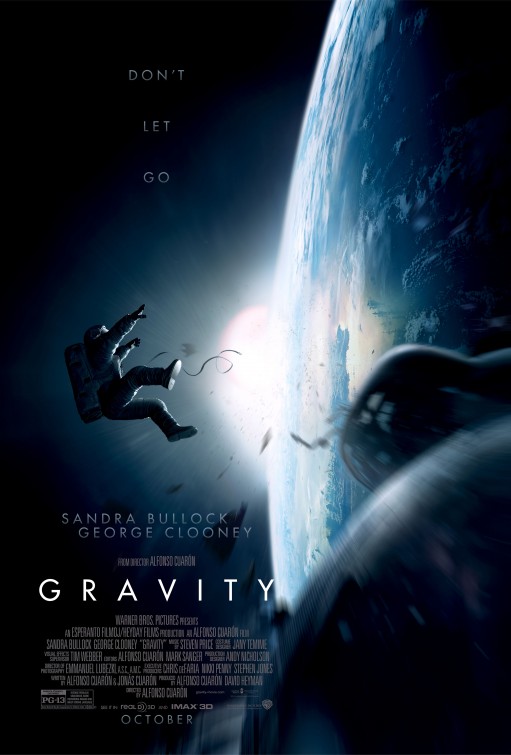
GravityMexican director Alfonso Cuarón’s 2006 film Children of Men stands alongside Neill Blomkamp’s District 9 and Duncan Jones’s Moon as one of the most interesting science fiction offerings since the turn of the century. Soon after the release of that film he went into pre-production on an even more ambitious science fiction project, Gravity. After a long wait, and going through a couple of studios and numerous casting changes, that film has finally hit the screen and with it Cuarón has stepped into the realm of the truly visionary. Stanley Kubrick’s 2001: A Space Odyssey has been thrown around by a number of critics as a point of comparison and rightly so. As was the case with Kubrick’s film in the late 1960s, Gravity a massive step forward in terms of creating an experience for the viewer and giving us some idea of what it must be like to be in space.

The simple narrative follows two astronauts, the rookie Ryan Stone (Bullock) and the experienced Matt Kowalski (Clooney), who are doing maintenance work on the Hubble Telescope when a field of debris from an exploded Russian satellite comes their way. Travelling so fast that it orbits the world every ninety minutes, the debris tears through everything in its path, destroying the Hubble, their shuttle and killing their crew. Stone and Kowalski are left floating in orbit, without radio contact with Earth, to try and get themselves back home. A classic survival tale, peculiarly the film is as much about being willing to let go as it is about fighting to hold on.

While the screenplay and the performances from Bullock and Clooney are solid, it is the visuals; the cinematography and digital effects, that make Gravity something special. Together with cinematographer Emmanuel Lubezki, Cuarón manages to make space simultaneously terrifying and mesmerizingly beautiful. Lubezki, who was also responsible for the stunning photography of Terrence Malick’s The Tree of Life, gives Gravity a number of moments where the power of the image alone will make you say “Wow.” The film starts with one continuous, 13 minute shot in which the scenario for the film is set up, and this sets the stylistic tone. Gravity employs a number of long shots to great effect, drifting with the characters, giving the camera the same sense of weightless movement as the protagonists. The film also seamlessly moves between points-of-view. A shot may start from within the helmet of one of our characters, looking out, but then move out, turning to catch their reaction to what we’ve just seen.

To get the full experience, Gravity is a film you need to see at the cinema and you need to see it in 3D. I’m not generally a huge fan of the 3D medium. Nine times out of ten it is an unnecessary gimmick used as an excuse to add a couple of dollars to ticket prices and inflate box office revenue. But there are some films, that remaining one out of ten, for which the 3D medium really works and Gravity is such a film. Cuarón’s film is experiential, it is about feeling the experience of being adrift in space, and the 3D helps to immerse you in that.

Gravity is a glorious, profound piece of cinema, and while it is not perfect – there are one or two points at which the spell is momentarily broken – it is unlike any experience you will have at the movies this year.

Rating – ★★★★★

Review by Duncan McLean

Review – Runner Runner (2013)

Director: Brad Furman

Starring: Justin Timberlake, Ben Affleck, Gemma Arterton, Anthony Mackie

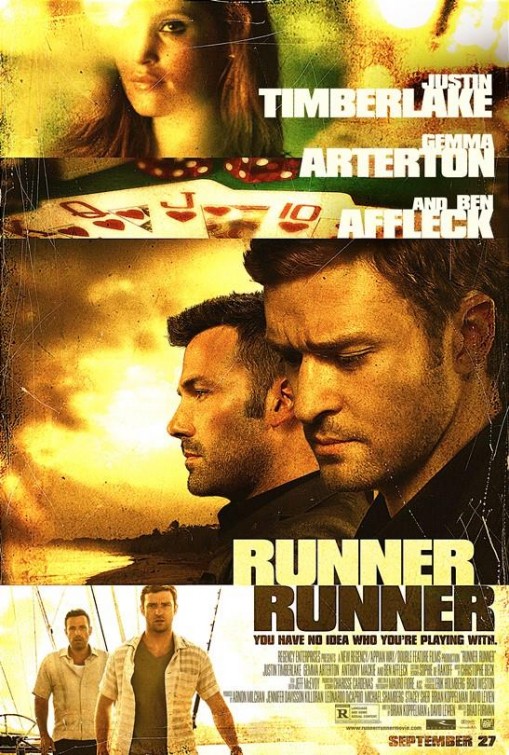
Runner RunnerBrad Furman’s Runner Runner is a movie about gambling and as Justin Timberlake’s character Richie Furst assures us in the film’s opening voice over, “Everybody gambles.” Of course not everyone plays online poker, the focus of the film, but whenever you take a chance, whenever you put yourself in a situation where in order to get something there is a chance you could lose something, that is gambling.

Richie is a gambler in every sense of the word. He used to be a Wall Street guy but lost his job and all his savings when the stock market crashed. Having returned to Princeton to complete his Masters, he pays his tuition by promoting and playing online poker. When he becomes convinced that the site has cheated him, Richie heads to Costa Rica to confront online poker tycoon Ivan Block. Block is so pleased that Richie chose to come to him rather than going to the press that he not only refunds his losses but offers him a job and before long Richie is living the high life as Block’s protégé. But of course Block is not the legitimate businessman that Richie had assumed and Richie soon finds himself needing to get his hands dirty, watch his back and ultimately make the biggest gamble of his life.

In the hands of a different, more ambitious filmmaker Runner Runner might have been an interesting, anthropological exploration of the world of online gambling – think what Scorsese did with Goodfellas and Casino – but Furman’s direction doesn’t give it that texture, that requisite sense of authenticity. Truth be told, he may have been hamstrung by the film’s screenplay, which has some problems. The familiar man-out-of-his-depth tale is difficult to completely get on board with because it is hard to believe that Richie, who the film’s early passages at Princeton are supposed to suggest is some kind of genius, could be so incredibly naïve. He seems to be genuinely surprised to discover that something the slightest bit dodgy might be going on at the off-shore online gambling empire he has joined up with.

Justin Timberlake has persevered through the novelty of being a singer who is having a go at acting to establish himself as an actor and has demonstrated some real talent. But at this stage in his career he seems better suited to supporting roles. He doesn’t yet have the charisma as an actor (as a performer is a different matter) to be a Hollywood leading man. Comparatively, despite all the unfair flack he gets, Runner Runner comes alive when Ben Affleck is on screen. He gives Block a real presence, using his usual friendly, charming persona as a disguise for Block’s darker side. While both are forced to wrestle with some pretty stilted dialogue, their predicament is preferable to that of British actress Gemma Arterton. Her character, spray-tanned to within an inch of her life, is as two-dimensional a love interest as you will find and the lack of characterisation means she struggles to generate much in the way of chemistry with either of the male leads.

While Runner Runner has its problems, it is a well enough made thriller that it will keep you interested and as you watch these expert gamblers plan their moves, make their plays and take their chances you will have a bit of fun.

Rating – ★★★

Review by Duncan McLean

Review – Lovelace (2013)

Directors: Rob Epstein & Jeffrey Friedman

Starring: Amanda Seyfried, Peter Sarsgaard, Chris Noth, Bobby Cannavale, Sharon Stone, Robert Patrick, Hank Azaria, Adam Brody, Juno Temple, James Franco

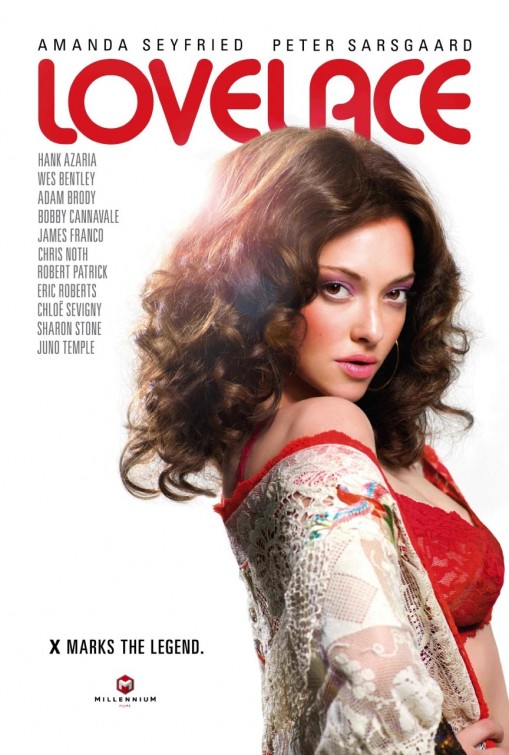
LovelaceOne of the great peculiarities of film history occurred in 1972. In the same year that The Godfather was released and took the place of Gone With the Wind as the highest grossing film of all time, the second highest grossing film of the year was a hard-core pornographic film called Deep Throat. Deep Throat was a sensation, crossing over to become a mainstream hit. It was reviewed in the mainstream media and discussed on television by the likes of Johnny Carson and Bob Hope.  It is estimated that this film which cost a mere $24,000 to shoot has had a lifetime gross of $600m, making it surely the most profitable film of all time – though it has been suggested that its gross figures were slightly inflated by the mafia, who used their porno theatres to launder money. At the centre of the film’s success was a seemingly ordinary woman, Linda Boreman, who thanks to a very particular talent would become the world’s first pornography superstar, Linda Lovelace. Forty years later, her story has been brought to the screen in the biopic Lovelace.

Lovelace is the first feature film from the documentary team of Rob Epstein and Jeffrey Friedman. In its early passages the film seems to tell the story of a self-conscious young woman, raised in a conservative Catholic household, who falls in love with a shady man and despite her shyness agrees to perform in low-budget pornographic film to help him get out of debt, all with the hope that it might lead to a career as a legitimate actress. However, at the halfway mark the story skips ahead six years to the film’s pivotal moment. When Linda Boreman went to write her autobiography, Ordeal, the material contained in it was so libellous the publishing company insisted that she take a lie detector test to verify her claims before they would publish it. This polygraph test provides the basis for the second half of the film to go back to the beginning and retell many of the events we have just witnessed from a different perspective. As a result, the Lovelace’s first and second half give us the contrast between the public perception of Linda’s rise to celebrity and the private, disturbing reality of it.

Lovelace is a biopic, its primary focus is on the person of Linda Boreman. As such, it is not really concerned with exploring some of the other interesting areas around the Deep Throat phenomenon, like answering questions of how Deep Throat became such an unlikely hit and what were the contributing factors to this strange moment of porno chic. If those are the areas that interest you, you would be better served seeking out Randy Barbato and Fenton Bailey’s 2005 documentary Inside Deep Throat.

Lovelace features a strong ensemble cast including the likes of Peter Sarsgaard, Chris Noth, Bobby Canavale, Sharon Stone, Robert Patrick and James Franco, led by Amanda Seyfried in the title role. Over the last decade Seyfried has appeared in a number of high profile films – Les Miserables, Mamma Mia, Mean Girls – but it is fair to say that until now she has never been called upon to carry a film. In Lovelace it is all on her, the success or failure of the film was largely going to come down to her ability to connect us to this character and she gives really comes to the fore delivering the strongest performance of her career. But while Seyfried makes us feel for Linda, eliciting a great deal of empathy for this woman trapped in an abusive relationship with no one to turn to, we don’t necessarily come to understand her a great deal more. I don’t know that Lovelace’s screenplay gives us any more insight into the character of Linda Lovelace and the events that took place than was already common knowledge.

Most films about the world of pornography tend to take a pro or anti-porn stance, and the real life Linda Lovelace did become a strong anti-porn activist, but viewers looking for such a stance will find it difficult to identify in Lovelace. The film doesn’t seek to make broad statements about the porn industry because when it comes down to it Lovelace isn’t a film about pornography. It is a film about an abusive relationship. Likewise, anyone buying a ticket to Lovelace expecting to be titillated will be sorely disappointed. This is not that kind of movie. There is nothing sexy about it. It is a heartbreaking story about a woman, victim to an abuse with extremely public consequences.

Rating – ★★★☆

Review by Duncan McLean

Six of the Best… Alfred Hitchcock

Known as ‘The Master of Suspense,’ Alfred Hitchcock was one of the first genuine superstar directors. As well as being a popular success, he is undoubtedly one of the true masters of the cinematic medium. Hitchcock was a central figure in the 1950s revaluation of the popular Hollywood cinema by the critics at Parisian film journal Cahiers du cinema who saw the potential for legitimate artistry in a commercial, studio context. With a career spanning six decades and transitioning from the UK to Hollywood, from silent film to sound, and from black and white to colour, Hitchcock has arguably done more than any other director to shape contemporary commercial filmmaking.
RebeccaRebecca (1940)

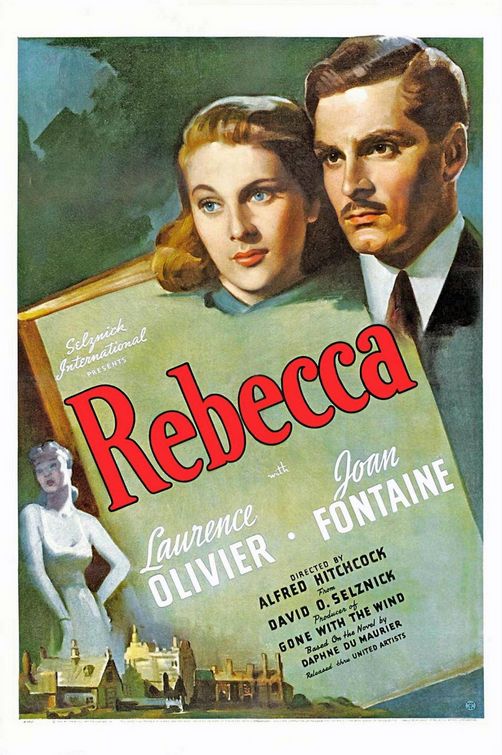
This 1940 adaptation of Daphne Du Maurier’s novel about a young bride living in the shadow of her husband’s deceased wife was Hithcock’s first American film and the only film he ever made to win an Academy Award for Best Picture. The film, brilliant as it is, is not as unmistakably Hitchcock as his work in the 1950s largely because his combination with producer David O. Selznik, hot off the heels of Gone With the Wind, meant there were two strong authorial presences on the film. Selznik’s influence results in a film with a much more typical classical Hollywood feel. A haunting piece of gothic cinema, George Barnes won an Oscar for his cinematography which featured strong use of deep focus photography a year before Orson Welles famously employed the technique in Citizen Kane. The way in which Hitchcock and Barnes shoot the De Winter mansion, Manderlay, was clearly an influence on Welles’ approach to shooting Xanadu in his masterwork.
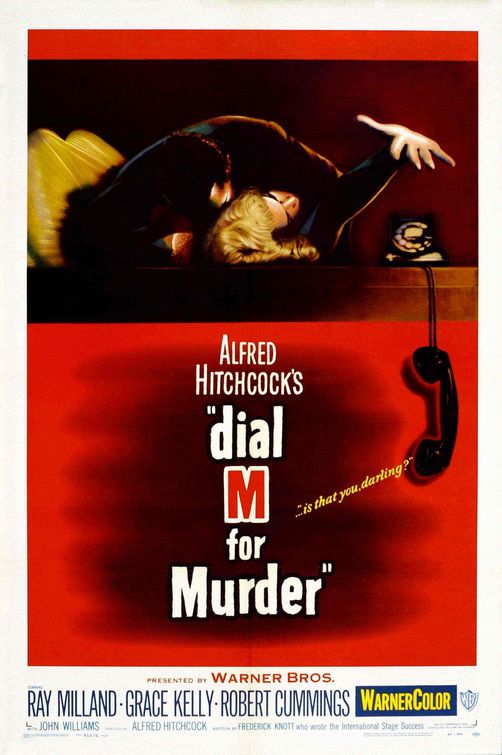
Dial M for MurderDial M for Murder (1954)

Adaptations from the stage, particularly those which take place in a single setting, often have a tendency of feeling decidedly uncinematic. The fact that Hitchcock manages to avoid that stagey, theatrical feel in his adaptation of Frederick Knott’s play is in itself an impressive achievement. Already an excellent film, Dial M for Murder becomes an absolute masterpiece when you see it as it was intended to be seen, in 3D. Hitchcock’s inspired use of the 3D format brings the shot compositions to life and creates a real sense of the space and geography of the apartment in which the film almost exclusively takes place. It is a testament to his mastery as a filmmaker that his one 3D film, made 60 years ago, is still one of the finest examples of the potential of the format. Dial M for Murder was also the first of three films Hitchcock would make with Grace Kelly.
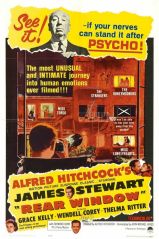
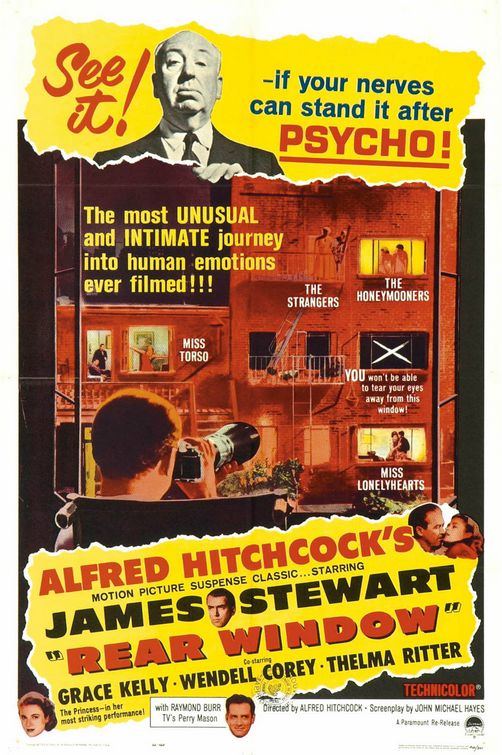
Rear WindowRear Window (1954)

1954 was clearly a brilliant year for Hitchcock as he followed up Dial M for Murder with one of his most enduring masterpieces, Rear Window. The story of a photographer cooped up in his apartment while his broken leg heals with only watching his neighbours to keep him entertained embraces the voyeuristic appeal of the cinema like no other film before or since. The entire film is from a single point-of-view: that of L.B. Jeffries’ apartment window looking out into an incredible purpose-built New York tenement set. From his apartment we watch different lives unfold before us. More to the point we watch Jeffries watch. Through the like of Miss Lonelyheart, Miss Torso, the songwriter, the fire escape couple, the newlyweds and, of course, the suspicious Lars Thorwald, Hitchcock finds the perfect blend of suspense and comedy and captures the complete spectrum of the joy we take from voyeurism.
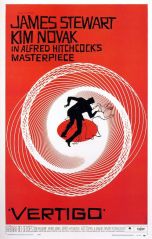
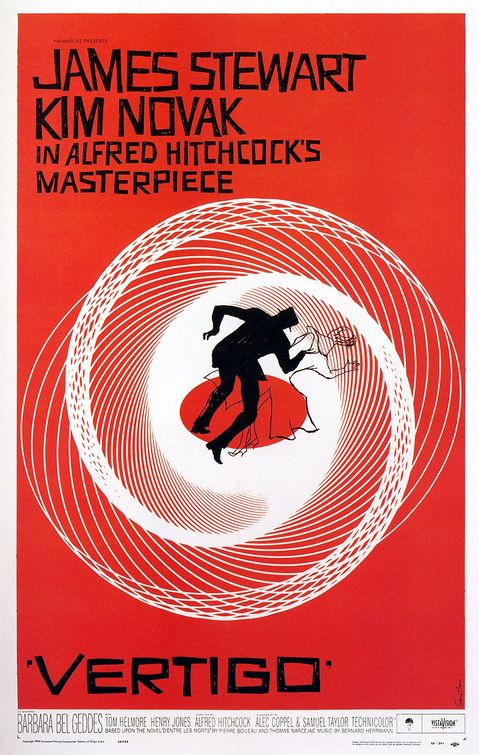
VertigoVertigo (1958)

While it was not initially well-received critically, Vertigo has gone on the become Hitchcock’s most celebrated film. In fact, in 2012 the picture managed to unseat Citizen Kane from the number one position in Sight and Sound’s top ten poll for the first time in 50 years. An incredibly disturbing and unsettling film, it takes one of American cinema’s most loved and likeable figures in James Stewart and makes him disconcertingly maniacal. With Hitchcock being a director renowned for controlling relationships with his leading ladies, the manner in which Scotty seeks to mould, shape and control Judy as he tries to transform her into his dream woman can be read as representative of Hitchcock’s own relationship with women. On the stylistic front, the simultaneous zoom in and pan out used to such great effect in Vertigo has become a much imitated technique (see Jaws).
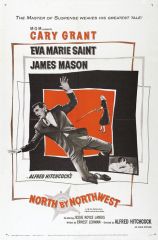
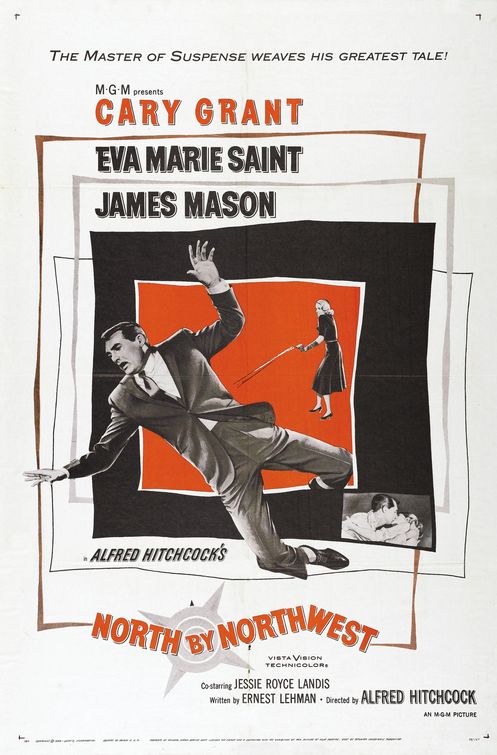
North by NorthwestNorth by Northwest (1959)

North by Northwest is the classic Hollywood blockbuster. It has big names, spectacle, action and thrills, and it exemplifies Hitchcock’s ability to turn out high-quality commercial fare. It is also the best film to come out of Hitchcock’s four-film, eighteen-year collaboration with Cary Grant. The story of an advertising executive who is mistaken for a spy, North by Northwest is one of the more extreme examples of Hitchcock’s fascination with the innocent protagonist swept up in a situation beyond his control. The film also provides some of the most iconic images not only of Hitchcock’s oeuvre but of Hollywood cinema, firstly with Cary Grant being swooped by a crop duster and secondly with the films climactic chase scene on the faces of Mount Rushmore.
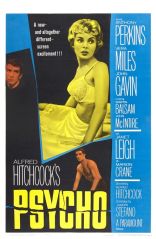
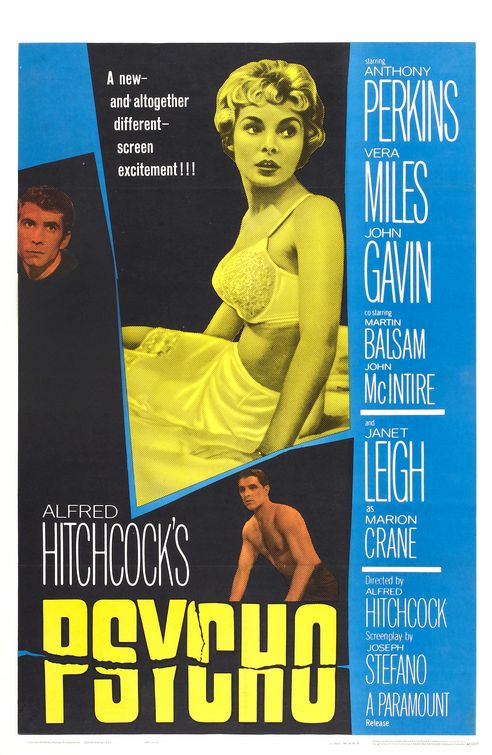
PsychoPsycho (1960)

With Psycho Hitchcock took a largely forgettable novel by Robert Bloch and transformed it into the most influential and imitated horror film ever made. Killing off a main character at any point is a bold move, but only a filmmaker of Hitchcock’s stature and self-assurance could get away with killing off his main character in the first third of the film. A masterstroke, it throws convention out the window, turns the movie on its head and tells the audience that anything is possible. To make sure audiences got the full effect, Hitchcock insisted that cinemas enforce a strict policy of not allowing people in once the film had started in case they missed Leigh’s appearance. While Jaws made people afraid to go in the water, Psycho made people afraid to have a shower.

By Duncan McLean

Review – The Call (2013)

Director: Brad Anderson

Starring: Halle Berry, Abigail Breslin, Morris Chestnut, Michael Eklund, Roma Maffia

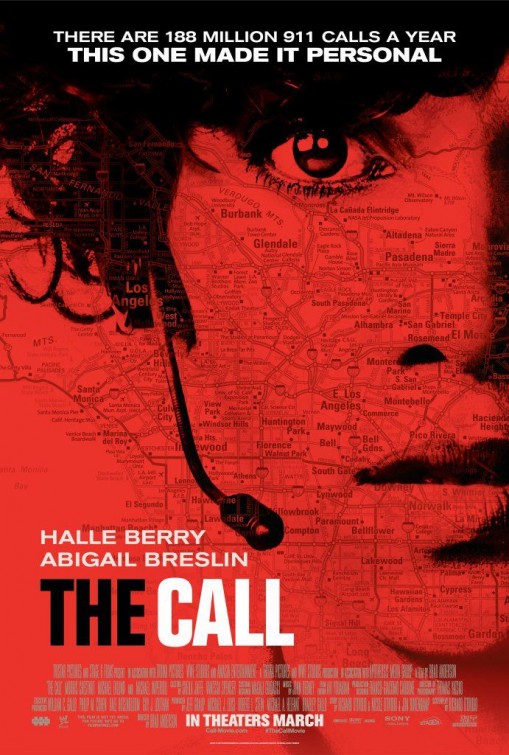
Call, The

The Call is a simple thriller with a premise so perfect that it is amazing we haven’t seen it a dozen times before. Halle Berry plays Jordan Turner, a veteran 911 dispatcher in Los Angeles. She fields a call from Casey, a teenage girl who has been kidnapped by an unhinged man at the mall and is locked in the trunk of a moving car. Casey’s phone is disposable and therefore unable to be traced electronically, so it is up to Jordan to try and figure out where she is before the car reaches wherever it is headed.

They call the Los Angeles 911 phone centre ‘the Hive’ because it is always buzzing. The Hive is the hub which connects the many emergencies taking place in Los Angeles at any given moment with the first respondents who are sent to deal with them, and it is a really interesting setting for a thriller. Jordan is a middle-man, and as such the ideal substitute for the audience. Despite being in the middle of this situation and feeling a great deal of responsibility for its outcome, her ability to influence it is limited. Her feeling of helplessness as she hangs on the line as they try and get a trace on the phone is a similar feeling to ours as viewers, forced simply to watch on in horror as the events unfold.

With the exception of a short prologue giving us some backstory on Jordan, the events of the film take place over a period of just a few hours. The clock is always ticking and the tension building. Halle Berry and Abigail Breslin shoulder most of the responsibility of keeping us invested. Breslin, once the little girl from Little Miss Sunshine, is not required to do much more than cry and scream, but effectively embodies the terror of her situation. Berry finds the difficult balance of someone struggling to maintain the control and composure she’s been trained for in the face of an emotionally crippling situation.

Where the film goes off the rails, and ultimately what prevents it from becoming something quite special, is in its final act when we leave the Hive as Jordan takes it upon herself to do some detective work and get involved. This sacrifices what had been quite a unique and effective premise in favour of a much more run-of-the-mill situation and, ultimately, resolution. But that doesn’t change the fact that The Call, while a bit gruesome at times, is short and punchy and filled with tension. While it won’t necessarily rock your world, for people who love a thriller that can have them on the edge of their seat it is an ideal Friday night movie.

Rating – ★★★

Review by Duncan McLean