Six of the Best… Robin Williams

It was with great sadness that the world received the news that Robin Williams had been found dead, suspected of taking his own life. It is always a tragedy when someone commits suicide, but when it is someone who has brought so much joy and laughter and fun into the world, it is particularly sad.

As a comedic performer, Robin Williams was a force of nature. With his mouth going at a hundred miles an hour and still seemingly struggling to keep up with his mind, he was an explosion of physical and verbal energy. As his career progressed from stand-up comedian to sit-com star to screen actor, he began to show that in addition to his comedic talents he could really bring something to dramatic roles. When Williams reined in that energy and slowed himself down he had a powerful but calming screen presence. He would be nominated for three Best Actor Academy Awards, as well as winning an Oscar for Best Supporting Actor.

So in recognition of one of the great talents of my lifetime, I offer six of the best performances from Robin Williams.
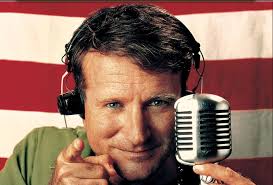
Adrian Cronauer

Adrian Cronauer

Good Morning, Vietnam (1987)

Barry Levinson’s Good Morning,Vietnam was the film which first showed the world Robin Williams’ potential as an actor. As Adrian Cranauer, a disc-jockey for Armed Forces Radio, Williams is in comfortable territory playing a comedian and gets the opportunity to improvise around a script, kick that motor-mouth into gear and do what only he can do. But as hilarious as Williams is, the movie is not a comedy, and his character is placed in positions and situations which demand emotional depth from his performance. Good Morning, Vietnam is the perfect blending of Williams’ comedic and dramatic abilities and appropriately earned him his first Oscar nomination.
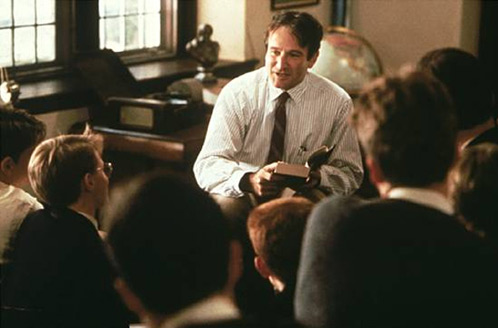
John Keating

John Keating

Dead Poets Society (1989)

In Peter Weir’s Dead Poets Society Williams played John Keating, the teacher we all wish we could have had. Keating inspires in his students a passion not only for learning but for life, with his instruction to his students: “seize the day, make your lives extraordinary.” Williams effectively plays a young idealistic intellectual, marrying restraint with moments in which he still gets to riff – Keating’s impression of John Wayne doing Macbeth seems to be straight out of the Robin Williams saddlebag. While elements of the film are a bit thinly drawn, and this is Williams in full-blown sentimental mode, it is near impossible not get goosebumps as the students one by one stand up on their desks to declare their allegiance to their teacher: “O Captain, my Captain.”
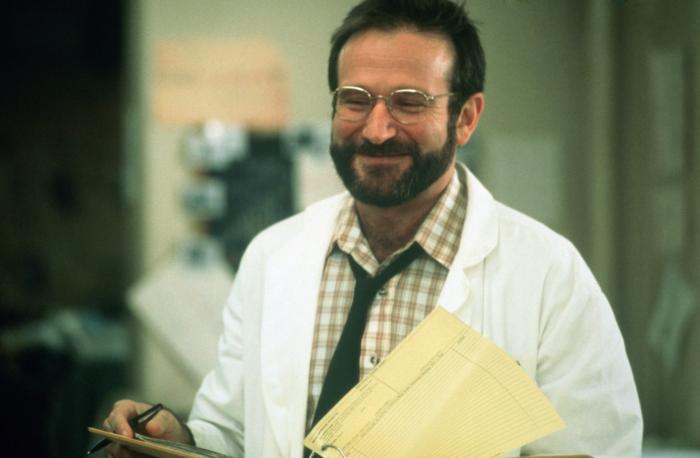
Dr. Malcolm Sayer

Dr. Malcolm Sayer

Awakenings (1990)

Not quite as high profile as some of Williams other films, Awakenings was a real change of direction for him as an actor. He plays Dr. Malcolm Sayer, an inexperienced, soft-spoken psychiatrist who finds himself working in a Bronx psychiatric hospital where a new drug is reviving patients who have been in a catatonic state for many years. What is interesting about this performance, is that for possibly the first time in his career, Williams did not play the dominant personality on the screen. As a patient revived after thirty years trapped in his own body, Robert De Niro has the more showy role. Williams’s role does not allow him to fall back on any of his usual shtick, but he rises to the occasion, holding his own opposite one of the all-time greats of screen acting.
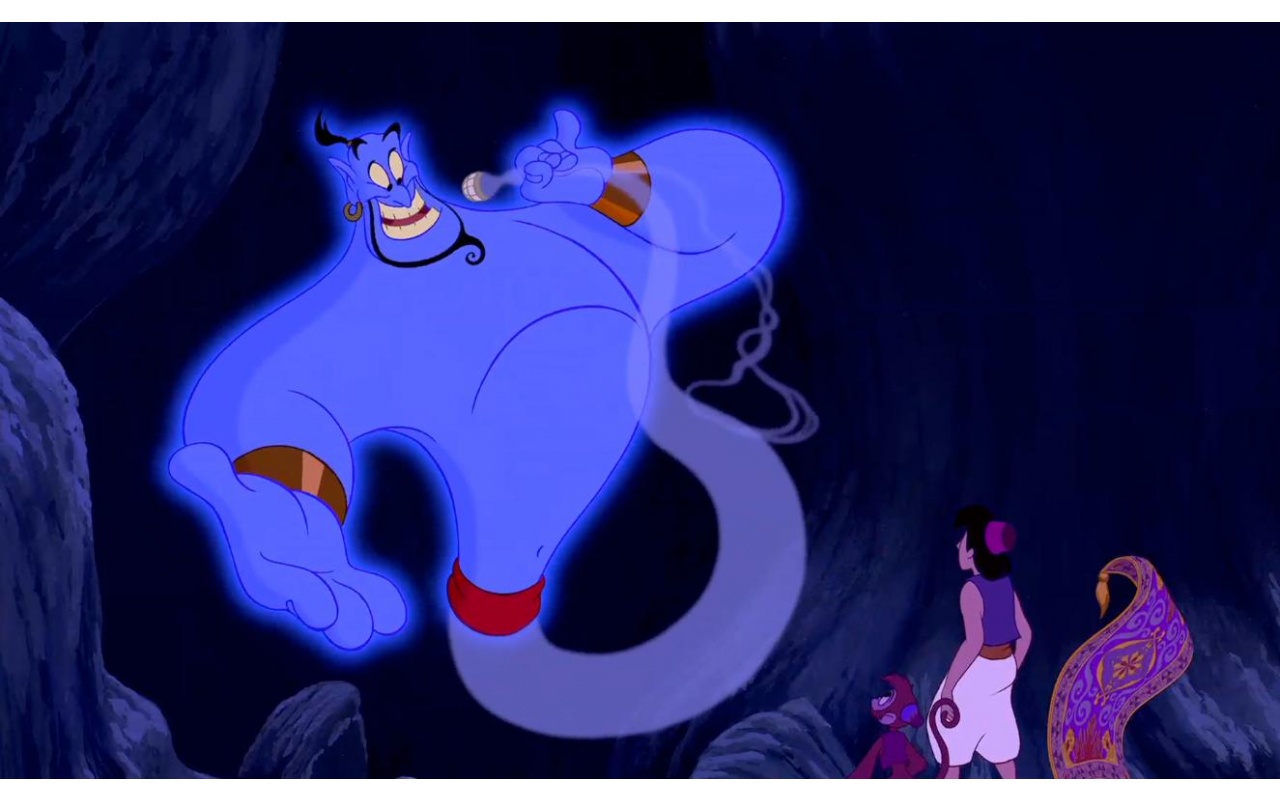
Genie of the Lamp

Genie of the Lamp

Aladdin (1992)

The Genie in Disney’s Aladdin is the pure physical embodiment of Robin Williams’ imagination. At the moment he is released from the lamp, we finally get to see a character with the freedom of form to keep up with Williams’ mind. The Genie owns the movie, completely overshadowing all other characters, and it is hard to imagine that Aladdin would hold its place in the pantheon of great Disney animated features without Williams. Aladdin was also a game changer for movie animation. Where animation had previously been the realm of the professional voice actor, the overwhelming response to Williams’ Genie showed studios, for better or worse, the potential of big name stars in animated movies. Without this performance there is no Tom Hanks and Tim Allen as Woody and Buzz, no Eddie Murphy as Donkey, no Jack Black as Po.
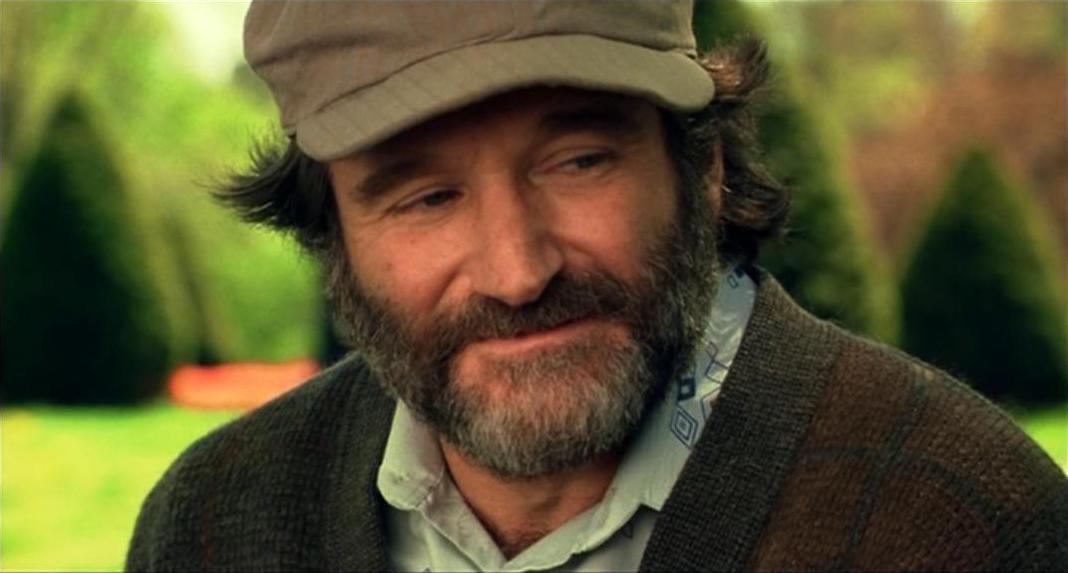
Sean Maguire

Sean Maguire

Good Will Hunting (1997)

Young screenwriters Matt Damon and Ben Affleck referred to the role of Sean Maguire in their screenplay of Good Will Hunting as the “Harvey Keitel part.” Like Keitel’s role in Reservoir Dogs, this was the role for an established star who could bring instant credibility to this small independent film. When Robin Williams committed to the role, all of a sudden it became much easier to get the film made. While Williams’ involvement was great for Damon and Affleck, it was pretty good for him too, finally earning him an Academy Award, for Best Supporting Actor. Playing a counselor to a brilliant but troubled young man, Williams took the fatherly persona he had employed in Dead Poets Society and gave it a harder edge. Sean Maguire was a man who had experienced loss, tragedy and hardship and Williams captured all of that beautifully.
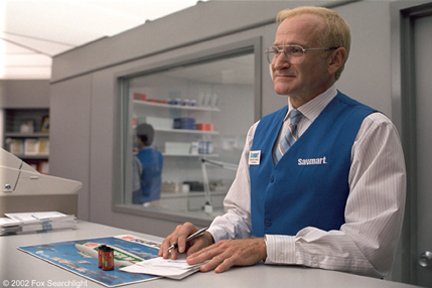
Seymour 'Sy' Parish

Seymour ‘Sy’ Parish

One-Hour Photo (2002)

This is a slightly left-field call given its inclusion at the expense of an Oscar nominated performance in The Fisher King, but it warrants a mention because it shows another element of Williams’ versatility. In 2002 Williams made two films in which he played the villain; Christopher Nolan’s Insomnia and Mark Romanek’s One-Hour Photo. Insomnia was the better film, but One-Hour Photo was the better Williams’ performance. Williams had done restrained before, he had done quiet before, but he had never done bland before. In becoming Seymour Parish, Williams entirely strips away the persona we associate with him to become so bland and beige that he is almost faceless, and in turn becomes incredibly unnerving, creepy and ultimately sinister.

 By Duncan McLean
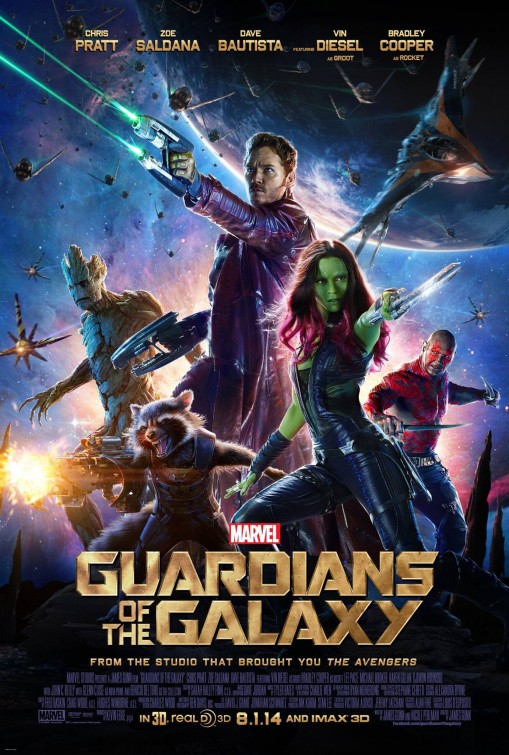
Review – Guardians of the Galaxy (2014)

Director: James Gunn

Starring: Chris Pratt, Zoe Saldana, Dave Bautista, Bradley Cooper, Vin Diesel

Guardians of the GalaxyDo you want to know just how hot a streak Marvel Studios are on at the moment? They have taken a minor comic book series about a motley crew of space adventurers that includes, among others, a green woman, a talking raccoon and a walking tree and they’ve turned it into possibly the best sci-fi adventure movie in decades.

Having been abducted from Earth as a child, Peter ‘Star Lord’ Quill travels the galaxy as a treasure hunter (read thief). Quill steals a mysterious orb, which turns out to be significantly more valuable, and dangerous, than he imagined. So he teams up with an assassin, Gamora, a pair of bounty hunters, Rocket and Groot, and the physically imposing Drax the Destroyer to sell it to the highest bidder. However, it just so happens that the orb contains one of the powerful Infinity Stones, and when it falls into the hands of the evil Ronan who plans to use it to destroy the galaxy, it falls to Quill and his rag tag bunch of misfits to save the day.

Despite being around since 1969, the Guardians of the Galaxy comic book series is not exactly a household name. This means there are a lot of new characters, places and concepts that need to be introduced to the viewer in the first act of the movie. Amazingly, though, it doesn’t become exposition heavy. Refreshingly, the film doesn’t bother giving us complete backstories and origins for all of the characters. It doesn’t seek to answer all of our questions, but rather just to give us as much information as we need. As a result, Guardians of the Galaxy doesn’t take a while to warm up; it gets rolling at the beginning and keeps going until the end.

Director James Gunn and his team have succeeded in making Guardians of the Galaxy completely different to The Avengers. After that first franchise was so successful, the temptation would have been there to copy that blueprint and import new characters and stories. But while there are minor narrative elements which connect Guardians of the Galaxy to the Avengers universe, and we will no doubt see a crossover film at some point in the future, Guardians of the Galaxy has a completely different style and tone.

For starters, it is not a superhero movie. It is a 1980s-style science-fiction adventure movie much more akin to Star Wars. This eighties resonance comes from within the narrative. Quill was abducted from Earth as a child in 1988, and as such all his points of reference are from the eighties. Similarly, the film cleverly uses music from that era to set the tone. The only memento Quill has from his life on Earth is a Walkman with a mix-tape of seventies hits his mother made for him. That mix-tape – including tracks from 10CC, Blue Swede and David Bowie – serves as the soundtrack to the movie, and from the outset of the film it is really successful in creating a very different, fun vibe.

Guardians of the Galaxy is also far and away Marvel’s funniest film. The Avengers, and in particular Iron Man, have always had that wise-cracking element of humour, but this film takes it to the next level and is legitimately comedic. Gunn and Nicole Pearlman’s screenplay is so sharp. They have given each of the characters a unique voice and can therefore draw different types of humour from each of them.

Chris Pratt is perfectly cast as Quill, bringing an irreverence to this mash up of Han Solo and Indiana Jones. It has potential to be a real star-making performance for Pratt, which could propel him from TV star to legit movie leading man. The CGI pairing of Rocket Raccoon and Groot, voiced by Cooper and Diesel respectively, were among the movie’s biggest question marks. But Rocket turns out to be a scene stealer and Groot, despite only being able to say “I am Groot” in different inflections, is used well to both comic and emotional effect.

With Guardians of the Galaxy, Marvel Studios have given us the most exciting, fun and fresh blockbuster movie in years, maybe even decades. For those of us not old enough to have been there, this could be as close as we will get to knowing what it felt like to experience Star Wars for the first time back in 1977.

Rating: ★★★★☆

Review by Duncan McLean

Have you seen Guardians of the Galaxy? Leave a comment and let us know what you thought.

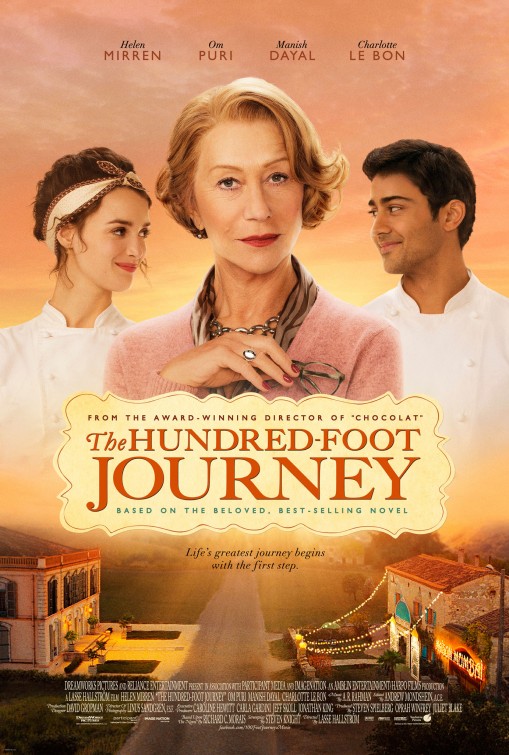
Review – The Hundred-Foot Journey (2014)

Director: Lasse Hallström

Starring: Manish Dayal, Helen Mirren, Om Puri, Charlotte Le Bon

Hundred-Foot JourneyLasse Hallström’s The Hundred-Foot Journey is based on Richard C. Morais’ bestselling novel about rival restaurants in rural France. But for a seemingly quaint little movie, The Hundred-Foot Journey has some heavy hitters behind it, with Steven Spielberg and Oprah Winfrey acting as producers (Morais’ novel had previously featured in Oprah’s magazine as a “favourite summer read”).

The Kadam family, having fled political violence in India, ruffle some feathers upon their arrival in a provincial French town by opening an Indian restaurant directly across the road from Madame Mallory’s Le Saul Pleurer. While Le Saul Pleurer may have a Michelin star, Papa Kadam has no fear, because Madame Mallory’s restaurant does not have his son, Hassan, whom he believes is the best Indian cook in Europe. What starts out as a bitter rivalry becomes a close friendship as Mallory takes Hassan under her wing, turning him from a great cook into a great chef.

Exploring the soul of food, and the connection of food and family, there is not a lot of new ground being covered here. Hallström himself has previously explored the prejudices of a small French town being broken down with food in Chocolat, and the last couple of years have seen British films like The Best Exotic Marigold Hotel and Slumdog Millionaire taking an interest in Indian culture. But while The Hundred-Foot Journey may not overly original, it is charmingly executed.

The story is very reliant on racial stereotypes, albeit endearingly portrayed racial stereotypes. The French are uptight and culturally elitist. The Indians are loud and colourful. The Hundred-Foot Journey is about a clash of cultures. The journey of the title refers to the hundred feet from the Kadam’s restaurant to Mallory’s, and just as Hassan’s cooking crosses the divide between these seemingly incompatible cultures, so too do the friendships that are forged.

While this is technically a film about Hassan, it is the rivalry and then friendship between Papa and Madame Mallory that is most endearing, with Helen Mirren and Om Puri sharing wonderful on-screen chemistry. Unfortunately, the film loses its trajectory at the 90 minute mark, as the third act puts the other characters to one side in favour of pursuing Hassan’s journey as a celebrity chef in Paris. This section of the film lacks the sweet tone of the first two acts and starts to drag a bit before it is pulled back into line.

With not quite as many gratuitous, mouth-watering images of Indian and French cuisine as the food-porn addicts might have been hoping for, The Hundred-Foot Journey is The Best Exotic Marigold Hotel meets Chocolat, but losing its steam a bit towards the end means it doesn’t end up being quite as good as either.

Rating: ★★★☆

Review by Duncan McLean

Have you seen The Hundred-Foot Journey? Leave a comment and let us know what you thought.

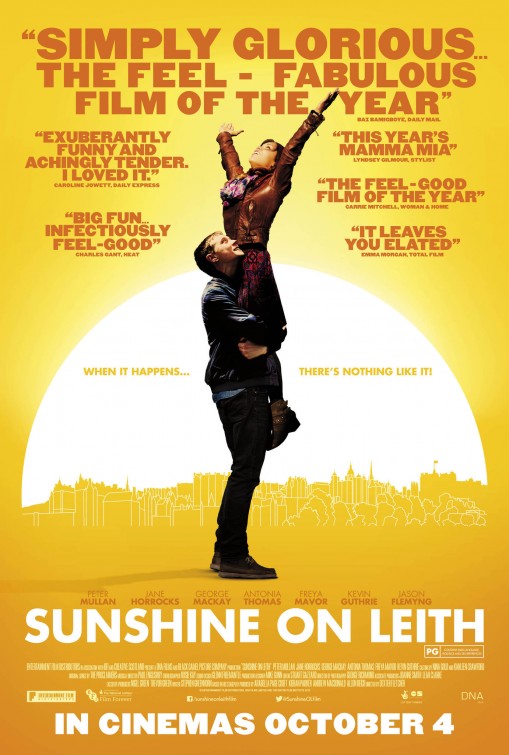
Review – Sunshine on Leith (2013)

Director: Dexter Fletcher

Starring: George Mackay, Peter Mullan, Jane Horrocks, Kevin Guthrie, Antonia Thomas, Freya Mavor

Sunshine on LeithFollowing in the footsteps of mega-bands like ABBA and Queen, the latest, somewhat unlikely group to be given the jukebox musical treatment is the Scottish duo The Proclaimers, with Sunshine on Leith.

The film uses the music of the bespectacled Reid brothers to tell the story of two best friends, Davy and Ally, who return home to Edinburgh after a tour of duty in Afghanistan keen to get on with their lives. Ally rekindles a romance, Davy finds a new one, and Davy’s parents, Rab and Jean, prepare to celebrate their 25th wedding anniversary. But this trio of relationships all hit rocks on the night of Rab and Jean’s big party.

Jukebox musicals by nature have highly contrived narratives – a lot of work has to go into making these pre-existing songs fit together in a logical way to tell a story – and this film is no exception. Early on you can sense there is a lot of setup being done, entire subplots are introduced in order for single lines in a song to make sense, and there are moments when things turn quite quickly. But unlike other films which have chosen to make fun of the contrived nature of their narratives by going over the top, Sunshine on Leith retains a down to earth honesty. These are still real characters telling a largely relatable story.

To most people the Proclaimers are one-hit, or at most two-hit, wonders. They don’t have the long back catalogue of well-known hits that other bands given the jukebox musical treatment have. But while the lack of familiarity means you don’t get that little spark of recognition with each song, it does allow the songs to fit into the story less obtrusively. It also ends up being the lesser known tunes rather than the hits which provide the film’s best numbers: ‘Over and Done With’ and ‘Oh Jean’ are great highlights, and the title track ‘Sunshine on Leith’ is sung beautifully by Jane Horrocks.

While all of the cast can hold a tune, none of them are amazingly polished singers. But this adds to the charm of the film. The ordinariness of their voices really fits with both the music of The Proclaimers (and I mean that as a compliment) and the overall tone of the film. This is not a glamorous, sparkling musical. It is a musical about ordinary people, performed by ordinary people.

Keep your eyes peeled early in the film for a quick cameo from Charlie and Craig Reid walking out of a pub during ‘I’m on My Way.’

Sunshine on Leith is an unpretentious and exuberant film, a joyful smile of a movie.

Rating: ★★★★

Review by Duncan McLean

Have you seen Sunshine on Leith? Leave a comment and let us know what you thought.

Review – Lucy (2014)

Director: Luc Besson

Starring: Scarlett Johansson, Morgan Freeman, Min-sik Choi, Amr Waked

LucyIt is a commonly believed myth that humans only engage 10% of their brain’s capacity. It is a favourite of science fiction speculation; just imagine what could be achieved if we could tap into that dormant 90%. The latest and most outrageous film to ponder this question is Luc Besson’s Lucy.

Lucy is an American student living in Taiwan who, thanks to her new loser boyfriend, falls in with the wrong crowd. Abducted by a Korean drug cartel, they surgically implant a pouch of their new super-drug CPH4 into her stomach for her to smuggle into America. But the pouch springs a leak, and as the synthetic drug floods into her body it starts to unlock the full potential of her mind.

While a number of films have previously toyed with the 10% idea, Lucy must be the most far-fetched exploration we have seen. As Lucy’s brain function increases, rather than becoming an ultra-high functioning human, she becomes almost godlike. She can read minds, manipulate time and space, and defy gravity. This is quite a leap to take, and the film does not offer adequate justification for what we are seeing. Usually a movie like this would engage some sort of pseudo-science (i.e. the DeLorean can travel through time because it has a ‘flux-capacitor’), but even Morgan Freeman’s character Prof. Norman, whose lecture on the potential of a fully functioning human brain is intercut with Lucy’s experiences, admits his theories are just hypotheses with no actual scientific proof supporting them.

The silliness of this premise wouldn’t be such a problem if the film didn’t take itself so seriously. Lucy seems to believe it is making profound philosophical points about the very nature of existence, but it is not. There are moments of humour in Lucy, and it is surprisingly simple humour. Were the rest of the film delivered in the same tone, embracing its silliness, it could be quite a fun movie. But because the majority of the time it takes its premise so seriously, it is hard to enjoy.

The other problem Lucy’s godlike powers create is that with every action sequence there is less at stake. The more powerful she becomes the less legitimate tension can be created by the illusion that she is in danger.

Despite all this, one cannot deny that Besson certainly had a clear vision. For all its faults, Lucy is a bold and interestingly executed film. Besson employs an almost impressionist montage style to bring his themes to the fore. When we first meet Lucy, as her boyfriend is trying to convince her to deliver a suitcase to the mysterious Mr. Jang for him, we momentarily cut away to an image of a mouse carefully approaching a sprung trap. As Lucy enters the hotel with the case, the scene is intercut with footage of a gazelle on the savannah being circled by cheetahs. This stylistic approach – far and away the most interesting thing about the film – continues throughout, being used to illustrate Prof. Norman’s theories, and results in film which feels like Tree of Life spliced with Salt.

Misrepresented in advertising so as to look like an all-out action movie with a butt-kicking heroine, this will undoubtedly help its box office takings but result in a number of miffed customers. Part science fiction, part action movie, part philosophical rumination, Lucy does not really satisfy as any of them, and for a film about unlocking the potential of the human brain, it manages to be quite dumb.

Rating: ★★

Review by Duncan McLean

Have you seen Lucy? Leave a comment and let us know what you thought.

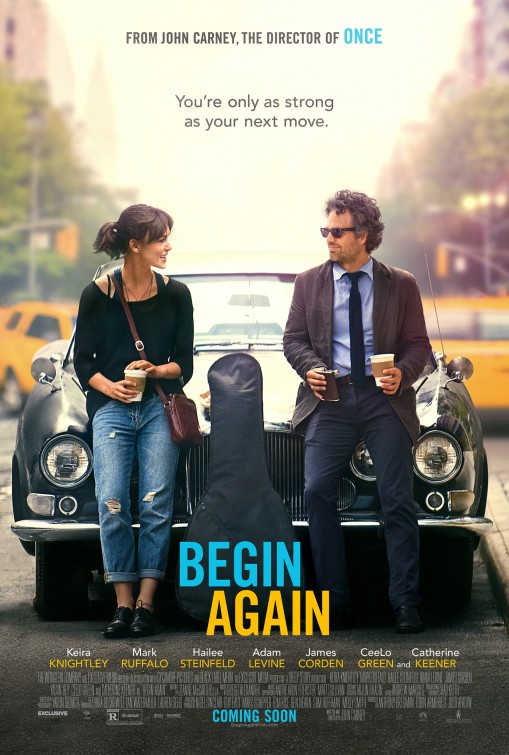
Review – Begin Again (2013)

Director: John Carney

Starring: Keira Knightley, Mark Ruffalo, Adam Levine, Hailee Steinfeld, James Corden, Mos Def, Catherine Keener

Begin Again

In 2006, Irish writer-director John Carney had an indie hit with his shoestring budget musical Once. The film, about a romance between a Dublin busker and a Czech flower seller who are brought together by their passion for music, won an Oscar for Best Original Song and spawned a Tony Award winning Broadway musical. Carney returns to familiar territory with Begin Again. Originally titled ‘Can a Song Save Your Life?’, the film explores the redemptive power of music and creative collaboration.

In a New York bar a young woman is invited up on stage to sing one of her songs and is almost completely ignored except for one man who stands transfixed. We rewind to approach the scene from two different perspectives; first his, then hers. He is Dan, a music producer who has hit rock bottom. His marriage has broken up, his daughter doesn’t respect him and he has just been fired from the record company he founded. She is Greta, recently broken up from her long-time boyfriend and song-writing partner after he hits the big time and is corrupted by fame. Dan hears something in Greta’s music that lights a fire in him and convinces her to record an album. Without access to a studio Dan and Greta decide they will make the album an ode to New York, and set about recording tracks live in different locations around the city, incorporating the ambient sounds of the town into their music.

While very derivative of Once, Begin Again is a glossier, more Hollywood movie with a bigger cast and bigger stars. Despite this, it manages to retain the sincerity of the earlier film thanks largely to strong performances from Keira Knightley and Mark Ruffalo. The two share great chemistry, but Carney thankfully resisting the urge to slip into cliché and keeps their relationship platonic. While that these two can act should be no surprise, that Knightley can sing might be. She does all her own singing, and while she doesn’t have a big voice, it is an emotive one. These two are surrounded by a quality supporting cast including Hailee Steinfeld, Catherine Keener and Maroon 5’s Adam Levine. It is James Corden though who steals the show as Greta’s old friend and the film’s chief comic relief.

While not a musical, music is obviously of central importance to the story. For these characters music is their life, and the film has some really clever ways of demonstrating the importance of music to them. There is one magical scene in which we see Greta’s initial bar performance from Dan’s perspective. As Dan’s imagination flies away arranging this song we see different instruments – a piano, drums, strings – start to play themselves accompanying the lone guitarist.

With music being so central to the story, it is supremely important that Carney and his team got the songs right. Fortunately, the film’s songs, primarily written by former New Radicals front man Gregg Alexander, are among its strongest attributes. However, there is a slight inauthenticity in the filmmakers’ unwillingness to back the premise of the album they are recording. We watch these live street recordings taking place but it is all too obvious that we are hearing studio mastered audio.

Begin Again is not as artistically aspirational as its characters are. It prefers to engage in some mainstream Hollywood feel-goodery. But the fact that this film remains upbeat, never wallowing even as the characters go through some low times, makes it a very hard film not to enjoy.

Rating: ★★★☆

Review by Duncan McLean

Have you seen Begin Again? Leave a comment and let us know what you thought.

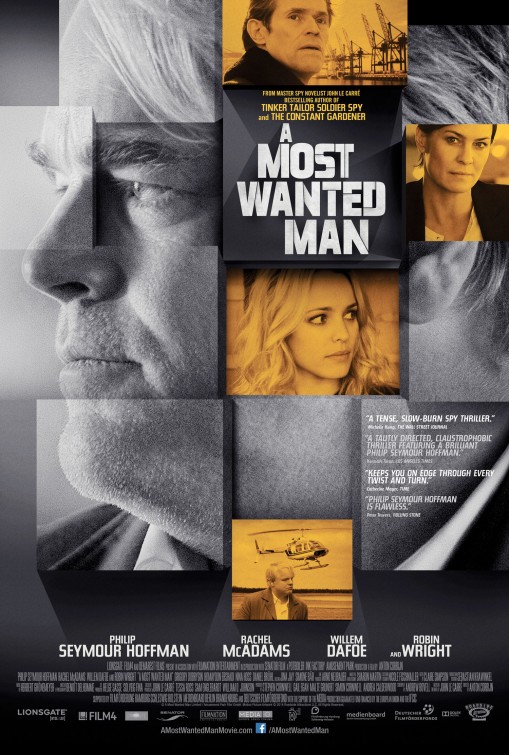
Review – A Most Wanted Man (2014)

Director: Anton Corbijn

Starring: Philip Seymour Hoffman, Rachel McAdams, Grigoriy Dobrygin, Willem Dafoe, Nina Hoss, Robin Wright, Daniel Brühl

Most Wanted ManIt is a bitter sweet time to be a film lover as new films from the late Philip Seymour Hoffman continue to hit the screen. The latest of them is Anton Corbijn’s slow burning spy thriller A Most Wanted Man.

With the 9/11 attacks having been planned from Hamburg, the German port city has become a key counterterrorist hub in the years since. There we meet the rumpled and weary Gunter Bachmann, head of a German counterterrorism unit. Constantly butting heads with Hamburg intelligence head Dieter Mohr who want to see more arrests, Gunter is interested in playing a longer game. As he explains, it is about using the minnow to catch the barracuda, and using the barracuda to catch the shark. Both have their sights set on Issa Karpov, a mysterious Chechen refugee with past militant links, who has arrived in Hamburg seeking to claim a multi-million Euro inheritance. For Dieter, Karpov is a prize, for Gunter he is a minnow with which he can catch the barracuda he his team has been tailing for years.

Being based on a John le Carré novel, A Most Wanted Man obviously does not deliver a spy thriller in the James Bond mould. There is a distinct lack of explosions, chases and action set pieces of any kind. Rather, this is classic espionage in a post-9/11 context. Corbijn’s film takes us into the morally dubious world of intelligence gathering where nothing is straight forward, nothing is black and white. We encounter rival agencies with rival motives, working together when it is convenient, and behind each other’s backs when that is. The result for the viewer is that we are left not just wondering who are the good guys and who are the bad guys, but whether there are good guys and bad guys at all.

This uncertainty about who to side with is reinforced by a structure which sees us move between apparent protagonists for much of the first half of the film. It takes a while for the film to settle into a fixed point of view. The ensemble cast features a number of Americans playing Germans, while impressive German actors like Nina Hoss and Daniel Brühl are reduced to minor roles. Of the Americans, some (Hoffman) do a more convincing job with their accent than others (McAdams).

Anton Corbijn, who came to feature filmmaking from music videos, is a very precise filmmaker, and in serving le Carré’s densely layered plot, he delivers a meticulously crafted film. With cinematography from Frenchman Benoît Delhomme, A Most Wanted Man is also a sharp looking film.

A subdued film that is at times quite slow, A Most Wanted Man is interesting without being truly compelling.

Rating: ★★★

Review by Duncan McLean

Have you seen A Most Wanted Man? Leave a comment and let us know what you thought.

Review – Dawn of the Planet of the Apes (2014)

Director: Matt Reeves

Starring: Andy Serkis, Jason Clarke, Toby Kebbell, Keri Russell, Gary Oldman, Kodi Smit-McPhee, Nick Thurston

Dawn of the Planet of the ApesThe decision to reboot the Planet of the Apes franchise in 2011 raised a few eyebrows. It felt like a slightly dated concept, and the previous attempt, Tim Burton’s 2001 Planet of the Apes remake, had been a terrible flop. But Rise of the Planet of the Apes proved to be one of the pleasant surprises of 2011, well received both critically and at the box office. But while a successful reboot is one thing, a successful sequel is an entirely different beast. However, expectations have been surpassed again, as Dawn of the Planet of the Apes is an intelligent, thrilling blockbuster which succeeds in taking this franchise to the next level.

Ten years after Caesar led his clan of genetically modified apes out of captivity and into the woods outside San Francisco the world looks very different. The ALZ113 virus which was being tested on the apes has become an epidemic, known as simian flu, and has wiped out most of the earth’s human population. Only those lucky enough to have a genetic immunity to the virus survive. A few hundred of these survivors have settled in San Francisco under the leadership of ex-military man Dreyfus and former architect Malcolm. With their fuel running low, their only hope is to get the hydro-electric system at O’Shaughnessy Dam up and running. Doing this means heading into the woods which the apes have made their home. While diplomacy between Malcolm and Caesar allows for initial cooperation, the hot-heads of Dreyfuss and Caesar’s second in command, Koba, mean that tension is never far from boiling over.

Dawn of the Planet of the Apes succeeds in going beyond what Rise of the Planet of the Apes gave us. The ambitious film gives us an expansion of scale. Where the first film was mainly shot in interiors, this sequel is shot entirely on location and primarily outside. This gives the picture a grander scope and a more epic quality. It also marks the first time that motion capture technology has been extensively used on location rather than in the controlled environment of a studio, and the results are stunning.

While upping the scale, Dawn of the Planet of the Apes returns to the heart of what science fiction is supposed to be. Rather than the simplistic spectacle it so often becomes these days, when done well science fiction uses its fantastical narratives to offer social commentary or insight into the human condition. The screenplay by Mark Bomback, Rick Jaffa and Amanda Silver, wears its political heart on its sleeve, exploring themes of empathy and fundamentalism, tolerance and prejudice.

In this war between humans and apes, we are not encouraged to take sides. This is a great strength of the movie. Instead it wants us to see the similarities between the two species. There are good humans and good apes, and there are bad humans and bad apes. Neither species can claim moral superiority. As tensions rise we see that peace requires us to see those things which we have in common, while conflict comes from an inability to see past those things that make us different.

Visually, this film is very impressive. The visual effects, supervised by Joe Letteri and Dan Lemmon, are tremendous in both the large scale action sequences, and the minute detail of the motion capture which brings the apes to life. But motion capture, or performance capture, is not just a technical achievement. The film’s strongest characters are simian, not human. The ape characters are both well-conceived and well written. The majority of the communication between them is in the form of a simple sign language, yet the actors use this primitive communication to effectively display complex emotions. Similarly, the film’s strongest performances come from the motion capture actors. Andy Serkis, with his iconic work as Gollum in the Lord of the Rings films, has established himself as the world’s premier motion capture actor. But his performance as Caesar is something to behold. Serkis gives the weary leader of the apes a real gravitas. Caesar shows arguably the most complex, subtle emotional depth the cinema has ever seen in a non-human character. While I’m not sure that the Hollywood establishment is yet ready to recognise a motion capture performance with an award nomination, Serkis would not be out of place in that discussion.

In an era where the science fiction genre is often merely an excuse for special effects and spectacle, Dawn of the Planet of the Apes aspires for something more. Refreshingly intelligent for a big budget sequel, Dawn of the Planet of the Apes is easily the best blockbuster of the year so far.

Rating: ★★★★

Review by Duncan McLean

Have you seen Dawn of the Planet of the Apes? Leave a comment and let us know what you thought.

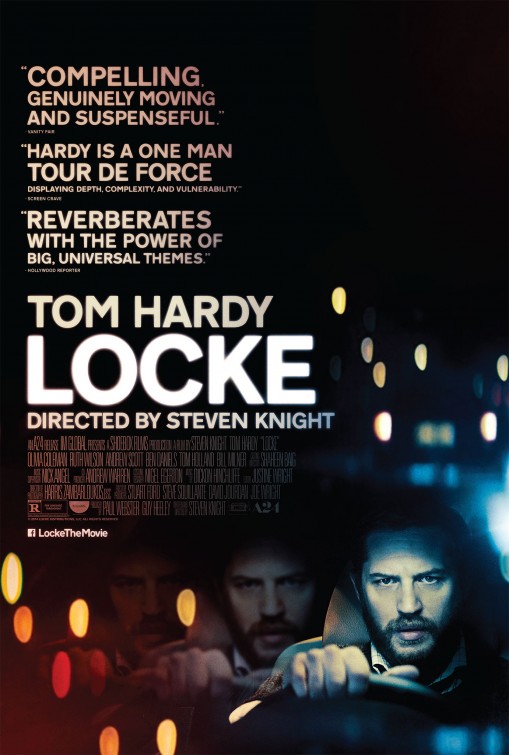
Review – Locke (2013)

Directors: Steven Knight

Starring: Tom Hardy, Olivia Colman, Ruth Wilson, Andrew Scott, Ben Daniels

LockeFilmmaking can be very formulaic, so it is exciting when you encounter a film that tries to do something quite different, a film that attempts something truly unique. In its brave rethinking of how to tell a story on screen, Steven Knight’s film Locke is such a film.

The evening before a major concrete pour, the biggest non-military pour Europe has ever seen, Welsh construction manager Ivan Locke gets in his car and leaves the Birmingham construction site, heading for London. He starts making phone calls. The first is to home, where his wife and two sons are waiting for him to join them for the big football game. He tells them he won’t be able to make it. The next is to his subordinate at work. He tells him that he won’t be on site tomorrow so must delegate responsibility for the pour. Where is he going? What is it which requires him to drop everything at such a pivotal moment? As Ivan’s journey continues, and calls are made and received, we come to understand the predicament he finds himself in and watch his endeavour to manage the situation.

A masterful piece of minimalist filmmaking, Locke reimagines the very nature of what is cinematic. Knight’s compelling script is a variation on a one-man play, with the entirety of the film taking place in Ivan’s car in real time as he drives to London. With no flashbacks or cutaways, the film places an incredible faith in the power of dialogue, with all of our narrative information coming through the phone calls Ivan makes and receives on his journey. Despite the seeming limitations of its format, Knight’s film is a gripping and suspenseful thriller.

There are very few actors in the world who can hold you in the palm of their hand for ninety minutes on their own, but Tom Hardy is definitely one of them. It is difficult to imagine this film working without Hardy’s performance. Having played some incredibly intense characters in his career, Hardy here delivers a wonderfully restrained and layered performance as a man trying to stay calm in a crisis. Ivan Locke is a really interesting character psychologically, as he wrestles with notions of culpability and responsibility. A meticulous man, he is determined to fix things. He is determined to control the chaotic situation in which he finds himself, and while we can see the flaws in what he is attempting to do, we also perfectly understand why it is the only thing that he, being the character that he is, can do in this situation.

This unusual film required an unusual shoot. The entire film was shot in six days. Each night, as the car was towed along the motorway, Hardy would perform the film in its entirety, from start to finish, stopping only to reload the memory cards on the three cameras mounted on and inside the vehicle. He had six autocues hidden around the vehicle, and the phone conversations were actual calls, with the rest of the cast located in a hotel by the motorway. With the whole project going from the initial idea to its debut at the Venice Film Festival in only a few months, there is an incredible energy in the production.

While the film is not perfect – there are moments in which Ivan addresses the ghost of his father, who appears in the rear view mirror in the back seat of the car, and these feel a bit forced in comparison to the rest of the film – you forgive those slight missteps because of the overall boldness of the piece. Coming in at just under ninety minutes, a perfect length, this unique, compelling piece of storytelling will have you absolutely riveted from beginning to end.

Rating: ★★★★☆

Review by Duncan McLean

Have you seen Locke? Leave a comment and let us know what you thought.

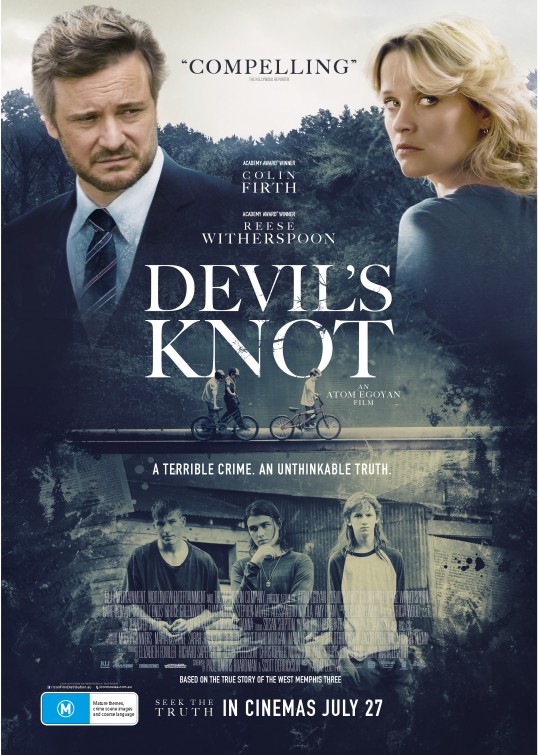
Review – Devil’s Knot (2014)

Director: Atom Egoyan

Starring: Colin Firth, Reese Witherspoon, James Hamrick, Rex Lin, Seth Meriwether, Kristopher Higgins, Kevin Durand, Dane DeHaan

Devils KnotIn 1993, the town of West Memphis, Arkansas was rocked by the brutal murder of three young boys. After a short investigation, three teenage boys, who would come to be known as the West Memphis Three, were arrested for the crimes. Despite stunning investigative blunders, a complete lack of physical evidence linking them to the murders and a confession filled with errors, they were found guilty of the murders. On 19th August 2011, after the presentation of new evidence, the West Memphis Three were released from prison having served 18 years. Devil’s Knot, based on investigative journalist Mara Leveritt’s bestselling book, explores the farcical events which saw the three teens convicted.

The film has two main protagonists. Pam Hobbs is the mother of one of the murdered children. Ron Lax is a private investigator. Between them we are given two perspectives on the events. Pam gives us the view of the shaken townspeople, Ron a seemingly more impartial view of the facts. Rather than seeking to answer the question of who actually committed the crimes, Devil’s Knot is more interested in examining how a community deals with fear. We watch as a town gripped with hysteria turns on those who are different. The three teenagers are vilified for their black clothes, heavy metal music and interest in the occult, none of which is acceptable behaviour in this conservative Bible-belt town. We see how an investigation literally became a witch hunt, and the legal systems of the town were deployed to simulate retribution. We watch people whose desire for answers and to apportion blame trumps their sense of logic and reason.

The case of the West Memphis Three has already been the subject of numerous books and documentaries, some of them quite good. Where Devil’s Knot struggles to add to this pool of material is that it does not have a clear purpose. Pre-production on the film started before the release of the trio. As such, its initial purpose was to expose the trial for the farce that it was and to campaign for the release of the three no-longer-young men. However, when the state of Arkansas released the West Memphis Three, the project’s original purpose was no longer required. While the case is still interesting, and the film presents it methodically, it simply fails to grip you.

A devil’s knot is a knot which theoretically cannot be opened. It is a puzzle without a solution, and that is exactly what we are given with this film. We leave the film with an incomplete picture. Devil’s Knot answers the question of who did it only by concluding that the trio in question did not. The film hopes to trouble us with its lack of resolution, but with this material having been explored before, albeit not in a feature film, its lack of new insight and unwillingness to speculate only serves to frustrate and underwhelm.

Rating: ★★☆

Review by Duncan McLean

Have you seen Devil’s Knot? Leave a comment and let us know what you thought.