
Category: Reviews
Review – The Hunger Games: Mockingjay – Part I
Director: Francis Lawrence
Starring: Jennifer Lawrence, Josh Hutcherson, Liam Hemsworth, Woody Harrelson, Donald Sutherland, Philip Seymour Hoffman, Julianne Moore, Elizabeth Banks, Willow Shields, Jeffrey Wright, Sam Claflin, Stanley Tucci
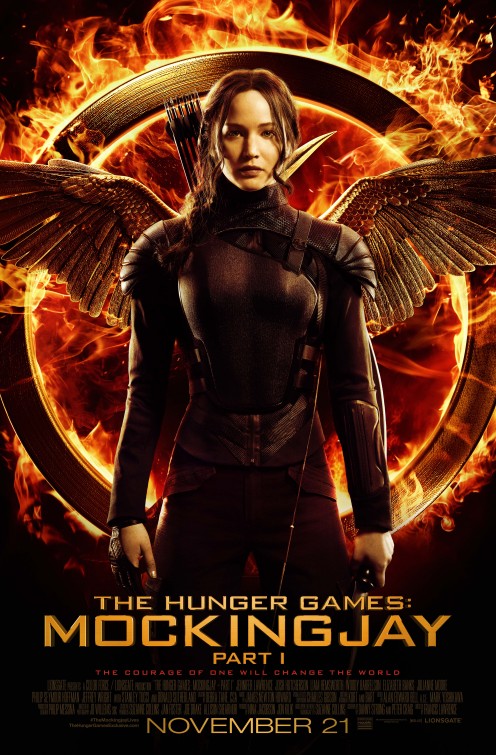 After two films which have netted a combined $1.56 billion at the international box office, Lionsgate’s Hunger Games franchise has followed the lead of the Harry Potter, Twilight and Hobbit franchises, in becoming the latest to break a single book into multiple movies for seemingly no other reason than to inflate profits. And so we have The Hunger Games: Mockingjay – Part I, aka ‘The Hunger Games Part 3A.’
Mockingjay – Part I picks up where Catching Fire left off, with Katniss having been rescued from the arena by a band of rebels who have been hiding away in District 13. Katniss’ act of defiance which ended the Quarter Quell has inspired the people of Panem’s districts, and the rebels are now attempting to harness this groundswell of action and unify the districts against the Capitol. To help them achieve this, they need Katniss to serve as their standard bearer, their Mockingjay, but Katniss is more concerned with the fate of those victors who were not rescued and now find themselves prisoners of the Capitol; Johanna, Annie, and most importantly, Peeta, who the Capitol are using as their PR weapon. After failed attempts to film staged propaganda ads, the rebel leaders realise that it is Katniss’ authenticity which people most respond to, and as such she needs to get out in the field and experience firsthand the destruction the Capitol has wreaked.
Mockingjay – Part I is a very different film to the first two in the series; The Hunger Games and its superior sequel Catching Fire. For starters, this time around there is no games to serve as the centrepiece for the film, and this really changes the dynamic of the movie. Mockingjay – Part I is a darker film, both thematically and visually. Director Francis Lawrence chooses to tell the story almost entirely from the point of view of the rebels. We are rarely privy to what is going on in the Capitol. That means that we as an audience are working off the same assumptions the rebel characters are. But as it was the scenes in the Capitol and arena which gave the first two films much of their visual flair, it means that Mockingjay – Part I lacks the colour and vibrancy of its prequels. Instead, we spend the majority of the film in the subterranean bunker of the rebellion, making for a less expansive, more claustrophobic film.
Mockingjay – Part I is a war movie but not a combat film. Instead, its focus is on the behind the scenes mechanisms that are at play in war. The film explores the significant role of propaganda and messages, of symbols and songs, in unifying people in times of conflict. This is quite a topical area of exploration. As we watch the rebels and the Capitol engage in a back-and-forth through public addresses and viral video releases one can’t help but think about the parallels to the media wars between the West and Al-Qaida and now ISIS.
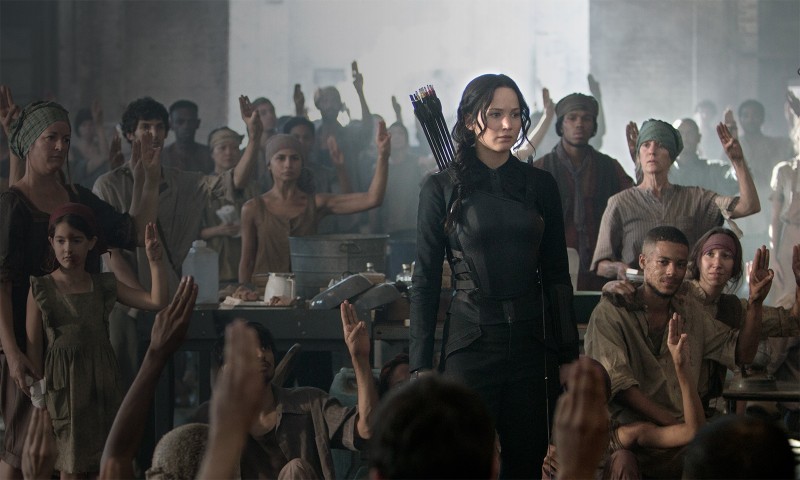
Katniss Everdeen (Jennifer Lawrence) is the Mockingjay
As their Mockingjay, their unifying symbol and standard bearer, Katniss is the revolution’s primary weapon. Peeta is the Capitol’s. His gaunt appearance leads us to assume that Peeta is being coerced and used by the Capitol to speak out against the rebellion. But is Katniss being just as used? From the start of the film we can see that she is tapped out, an emotional wreck after two rounds in the arena. But the rebellion needs her. How much, though, is this rebellion an extension of what Katniss represents and how much are the rebels simply co-opting her image and the people’s goodwill towards her to benefit their cause. The rebel leader President Coin is a cold and determined woman and we are only slightly more trusting of her than we are of President Snow. Our uncertainty of her is reinforced by her proclamations to the rebels, which are greeted with aggressive war chants in scenes that feel eerily reminiscent of Nazi rallies.
It is the performances from the deep, high quality cast that elevates the film, as it has done for the entire series. This starts with Jennifer Lawrence, who again does most of the heavy lifting. By then end of this series Lawrence’s Katniss will undoubtedly stand alongside Sigourney Weaver’s Ellen Ripley and Linda Hamilton’s Sarah Connor as one of the cinema’s greatest action heroines. While Mockingjay – Part I is less physically demanding of Lawrence– she only fires one arrow in the whole film – it is still her character’s emotional journey we are on. The Katniss/Peeta/Gale love triangle is again prominent; a love triangle that is saved from cliché by the fact that it is entirely unromantic. Katniss’ interest in both guys is much more about emotional support than it is romance or passion. Most of the previous characters return for this instalment – some with bigger roles, others with smaller roles – and it is the presence in these supporting roles of veteran, high quality actors like Donald Sutherland, Julianne Moore, Jeffrey Wright, Stanley Tucci and Philip Seymour Hoffman (to whom the film is dedicated) that fleshes out this world and gives it weight.
The themes of rebellion against the machine that are central to Mockingjay – Part I feel slightly insincere when presented in such a formulaic major Hollywood blockbuster. The film lacks the rebellious spirit of its narrative. There is nothing the slightest bit subversive about the film, as evidenced by the cynical, money-grabbing decision to split Collins’ final novel into two instalments. Mockingjay – Part I suffers from all of the problems that are to be expected of a ‘Part I’ movie, a film which only tells the first half of a story. The film is light on narrative events and action. The games are gone and have not been replaced with an equivalently satisfying action source. The film is much more about character development than narrative action, and while it does succeed in building up some tension it obviously lacks any sort of resolution. You leave this film feeling like you’ve only watched the first half of a movie, though you’ve paid for a whole one.
Katniss continues to be a strong heroine, Collins narrative is as engaging as it has always been, and Mockingjay – Part I performs its function within the overall Hunger Games franchise by setting up the final film quite well. However, what seems to often get lost in Hollywood studio thinking when dealing with their money-spinning franchises is that each piece should, first and foremost, function effectively as a film in its own right. Mockingjay – Part I feels like the first half of a pretty good film. Ultimately, it will fall to Mockingjay – Part II to show that there was creative and not just economic justification for the decision to break the final instalment into two films rather than a single two-and-a-half to three hour movie.
Rating: ★★★
Review by Duncan McLean
Have you seen The Hunger Games: Mockingjay – Part I? Leave a comment and let us know what you thought.
Review – The Dark Horse (2014)
Director: James Napier Robertson
Starring: Cliff Curtis, James Rolleston, Wayne Hapi, Kirk Torrance
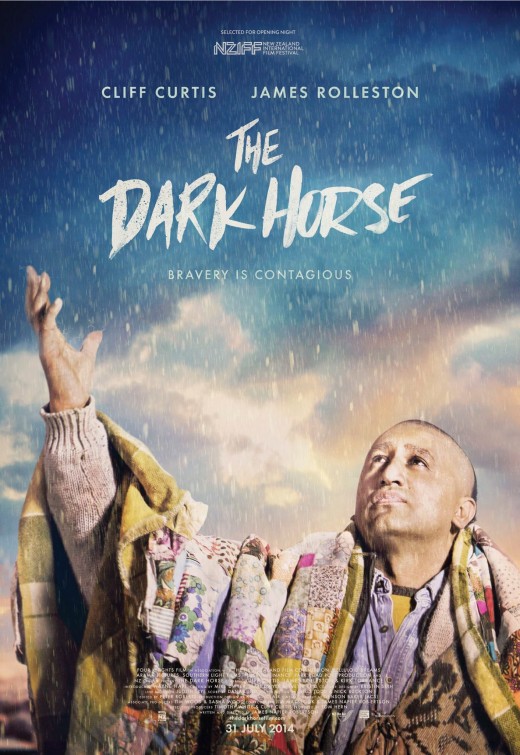 Even if you put the Hobbit films to one side, the New Zealand film industry has really punched above its weight in 2014. Taika Waititi and Jermaine Clement’s vampire mockumentary What We Do in the Shadows has proved to be one of the year’s best comedies, and now we get James Napier Robertson’s affecting and uplifting biopic of the late Genesis Potini, The Dark Horse.
Genesis Potini was once a chess prodigy, but has spent the majority of his adult life in of psychiatric institutions as a result of his bipolar disorder. It is decided that Gen can check out of the facility provided he remains under the care of his brother, Ariki. He is told to avoid stressful situations, something easier said than done given Ariki is the leader of a gang, the Vagrants, and his house serves as their headquarters. Gen moves in with his brother and starts to bond with his nephew, Mana. One day Gen’s eye is caught be a flyer for a local chess club, the Eastern Knights. When it turns out the club is for kids, specifically kids with absent parents in need of some stability in their lives, Gen is not deterred. He decides this club could be a positive thing for him to put his energy into so ambitiously announces at his first meeting that he will lead these kids to the National Junior Chess Championships in Auckland in just six weeks.
On the surface, The Dark Horse sounds like it could be an incredibly formulaic and familiar story. It has the potential to be both a ‘brilliant individual defying the limitations of his mental illness’ story and a ‘disadvantaged kids pulling themselves out of adversity through sport/dancing/chess’ story. Both have been done plenty of times before. But Robertson’s film manages to be neither of them. The Dark Horse is no fairy tale, for Genesis or the kids. There are some harsh realities on display in this at times quite dark story. Gen’s struggles with his bipolar disorder are real, they do not conveniently disappear when he finds a sense of purpose. Likewise for the kids, when they leave the Chess Championships in Auckland, they still go home to the same family situations. Robertson succeeds in showing his audience the incredible significance of this group without sugar-coating or hyperbolising its effect.

Genesis Potini (Cliff Curtis) and his nephew Mana (James Rolleston) play chess
The film is able to cleverly connect chess, its rules and strategies with elements of Maori mythology and spirituality. The result is that The Dark Horse becomes an unmistakably New Zealand story. Since his childhood Gen has always known chess as “the warrior game.” In teaching the Eastern Knights the principles of the game he draws on Maori creation stories. For the at-risk youths of the Eastern Knights, Gen’s chess lessons serve not only as instruction in the game but as important lessons in cultural identity as well as more general life lessons about living in community.
The Dark Horse is built around a powerfully emotive performance from veteran Kiwi actor Cliff Curtis. Best known for roles in Once Were Warriors, Whale Rider and bit pieces in Hollywood films taking advantage of his multipurpose ethnicity, Curtis gives a career best performance here. Through the rhythms of his speech, the shuffling awkwardness of his movement and the glazed over eyes that denote a lifetime of heavy medication, he gives authenticity to his character. He swings between moments of heartbreaking fragility and aggressively earnest energy in displaying Gen’s condition as something with which he constantly wrestles.
Mana is played by James Rolleston, who may be familiar to some having played the title character in the comedy Boy in 2010. Rolleston is growing up and shows some real dramatic subtlety here. But the most striking supporting performance comes from first time actor Wayne Hapi as Mana’s father Ariki. Hapi is a physically imposing presence with his large frame, dreadlocks, tattoos and weathered features, but behind his stony face he reveals genuine emotion. Ariki is a father doing what he thinks is best to get his son through a hard life, a life that has done him no favours and gives him no reason to assume it will be different for Mana. He wants to get his son inducted into the Vagrants, a process which involves some horrific hazing initiations, because it is the only way he knows to ensure the boy’s security after he is gone.
Robertson’s script is tight and well balanced, with the exception of a subplot about a troubled teenager, Michael, who has a gift for chess and is ordered by the juvenile court to join the Eastern Knights which appears set to be a major narrative thread only to take a back seat for most of the film before returning to prominence at the end. That said, The Dark Horse is a deeply affecting film with strong performances and a New Zealand setting and cultural context that gives it a unique point of difference.
Rating: ★★★★
Review by Duncan McLean
Have you seen The Dark Horse? Leave a comment and let us know what you thought.
Review – Interstellar (2014)
Director: Christopher Nolan
Starring: Matthew McConaughey, Anne Hathaway, Jessica Chastain, Michael Caine, David Gyasi, Bill Irwin, Matt Damon, Wes Bentley, John Lithgow, Ellen Burstyn, Topher Grace, Casey Affleck
 And so it has arrived. Arguably the year’s most anticipated film, the film which had blockbuster lovers and serious cinephiles alike impatiently counting down: Christopher Nolan’s Interstellar. As the first step in Nolan’s post-Dark Knight Trilogy career Interstellar delivers exactly the sort of bold, ambitious and audacious filmmaking we have come to expect from this British director who has established himself as today’s premier large-canvas filmmaker.
In the not too distant future a still very recognisable Earth is on the verge of being uninhabitable. Ravaged by dust storms and a major blight that has caused the death of most crops – the only thing that still grows is corn – making sure that there is enough food to keep people alive has become humanity’s first and only priority. Once a NASA pilot, Cooper is now a frustrated farmer, living in the Midwest with his son Tom and daughter Murph, but still maintaining the heart of an explorer. By this time NASA has become an underground organisation; at times like these the government cannot be seen to pour money into something as frivolous as space exploration. There Professor Brand is working on a plan to ensure the long term viability of humanity. While there are no other inhabitable planets in our galaxy, a wormhole has opened up near Saturn which has given them access to other stars and galaxies and twelve planets with potential have been identified. When an unusual occurrence lands Cooper on NASA’s doorstep, Brand invites him to pilot the exploratory mission. So, motivated by the chance of ensuring the survival of his children, Cooper joins the crew and sets off on a mission to save humanity.
Interstellar takes us into the world of theoretical physics. The narrative is built around concepts of time and relativity. As the crew explore different planets of different masses, it impacts the relationship between their time and Earth time. In one instance, a three hour stopover to investigate a water covered planet ends up equating to 23 years on Earth, an occurrence which is emotively captured through the lifetime’s worth of video messages from home that await the team when they return to their ship. The film attempts to explain relativity in simple, visual terms in order to keep the audience on board, so you don’t have to be a physicist to understand what is going on. That said, Nolan has always been a filmmaker who prefers to trust his audience to keep up rather than over-explain things. Consider the reverse chronology of Memento or the multi-layered narrative of Inception. Likewise, here he trusts his audience to glean enough from the film’s many discussions of theoretical physics that they will be able to follow what is happening even if they don’t completely understand the concepts.
California Institute of Technology physicist Kip Thorne, known for his work on traversable wormholes, was a script consultant for the Nolan brothers (Christopher’s brother Jonathan was co-writer) and receives an executive producer credit on the film. As such, Interstellar has been praised for the unprecedented accuracy of its depictions of black holes and wormholes. But even for those of us who are none the wiser on such matters, the visuals of these phenomena are still very striking. These impressive visual effects are complemented by the use of stunning location shooting for those scenes which take place on foreign planets. The result is that Interstellar is very much a big screen movie.

Cooper (McConaughey) explores a potential colony site.
Science fiction, particularly when you move away from the action-adventure end of the spectrum towards the more ideas-based narratives, is often accused of being cold and emotionless. Nolan has faced similar criticisms of his own filmmaking, that for all the spectacle and grandeur, the scope and scale, his films lack a beating human heart. In Interstellar the filmmaker seems to be searching for that balance, accompanying the theoretical physics which inform the story with an exploration of human themes of hope and sacrifice. Interstellar sets itself up as a very scientific film, in which people act pragmatically, but it then introduces emotion, love and the bonds between people as motivating forces which must be factored into this scientific equation. The film also contains more humour than we have previously seen in Nolan’s work, mostly courtesy of TARS, the artificial intelligence robot which accompanies the crew. However, in seeking to bring a human warmth to his film, Nolan arguably overcorrects and in the third act takes the film in an overly sentimental and fantastical direction.
With a runtime of 169 minutes, Interstellar is a long movie. Christopher Nolan hasn’t made a film under two hours since Insomnia in 2002 – most have been around the 150 minute mark – so the length here shouldn’t be a surprise. Of course, length is not, in itself, a problem if a film can maintain your interest for that period of time. But while Interstellar is never slow and crams a lot into its runtime it still feels long and the multiple codas that make up the film’s last twenty minutes drag.
At its best, Interstellar is very impressive indeed. It is hard to watch this film without thinking of Kubrick’s masterpiece 2001: A Space Odyssey. Given that film is one of Nolan’s favourites, the similarities are likely no accident. Unfortunately, Interstellar does not maintain that high standard for the entirety of its runtime. It is not always engrossing, despite an impressively deep cast some of the characters are thinly drawn, Hans Zimmer’s score (which has shades of Vangelis) at times overpowers the dialogue, and the film’s third act and coda will frustrate a lot of people. Interstellar contains some major cinematic achievements, but does not deserve to take its place in the science fiction pantheon.
Rating: ★★★☆
Review by Duncan McLean
Have you seen Interstellar? Leave a comment and let us know what you thought.
Review – Fury (2014)
Director: David Ayer
Starring: Brad Pitt, Logan Lerman, Shia LaBeouf, Michael Peña, Jon Bernthal
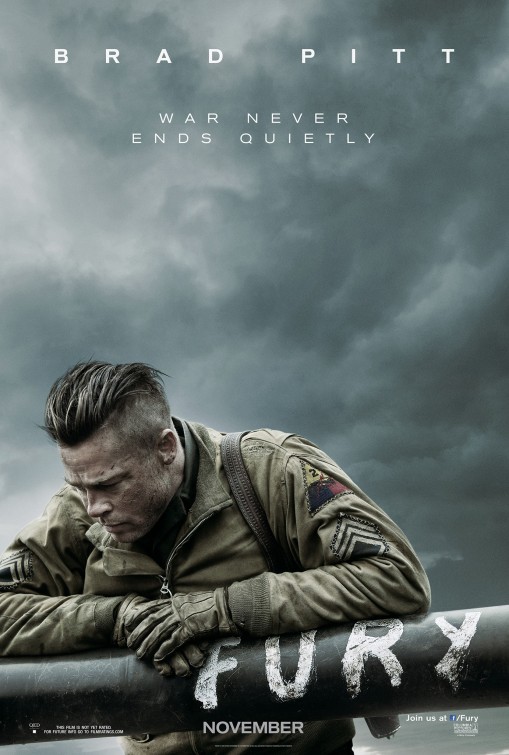 Hollywood is long past the stage of glorifying war in its films. Once World War II finished the themes of heroism and adventure which home front morale demanded made way for a more honest approach, one which was further cemented in the cinematic response to the Vietnam War. Even still, there are few films which have shown war to be quite as hellish, gruesome and violent as Fury.
Sgt. Don ‘Wardaddy’ Collier is a veteran tank commander. His tight knit crew of five came together in Africa and have stayed together, and alive, for a surprisingly long time. It is now April 1945 and they find themselves in Germany. With allied troops closing in on Berlin the end of the war is in sight, but the fighting is not done. When Collier’s assistant driver is killed in combat he is replaced by a young office clerk, Norman Ellison. Trained to type rather than to kill, Ellison has never even seen the inside of a tank. Collier has to break in Ellison fast, because the longer it takes him to fall into line and start doing his job, the more danger the crew is in.
The title Fury comes from the name given to their tank, painted on its gun barrel, but more significantly it reflects the emotional state of the characters. This is not a simplistic war of heroes and villains, good guys and bad guys. This is a war where the ends justify the means. This is a dirty, violent and messy war where it is kill or be killed and the desire for survival turns people into monsters. Different characters deal with the demands of their situation in different ways. Some, like Shia LaBeouf’s man of faith Boyd Swan, need to believe in the righteousness of their mission. For others, it is simply a matter of embracing and accepting the chaos.
Collier’s efforts to break in Norman and harden him for war confront us as an audience. On the one hand we know that unless he can learn to adequately do his job the others are in danger, yet we also don’t want to see this young man lose his innocence and sacrifice his morality. When we finally see Noman spraying the enemy with hateful profanity as well as bullets, are we supposed to celebrate? Fury reminds us that the line between good and evil is not one which runs between people or between sides of a conflict, but one which runs through each and every person.
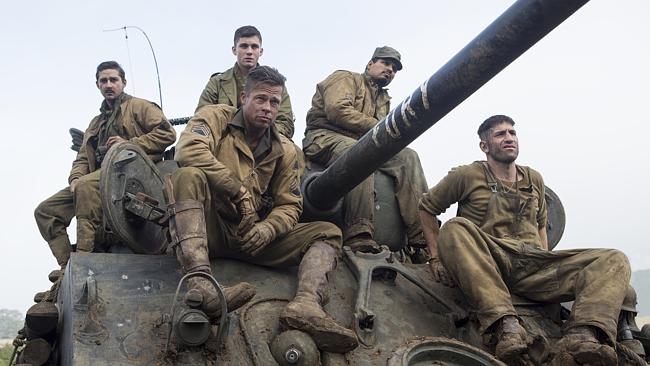
‘Wardaddy’ and his crew
Director David Ayer is best known as a screenwriter, having penned the screenplays for Training Day, S.W.A.T. and The Fast and The Furious, as well as writing and directing End of Watch. Across his body of work Ayer has shown a fascination with masculinity – particularly violent masculinity – and the relationships between men. In Fury, Ayer is able to pick up on those themes again, but transplant them from Los Angeles based police dramas to a European World War II setting. Collier’s crew enjoy a complicated relationship. They have been through a lot together and survived. Ayer treats them like a family. The first scene we meet them they are arguing and fighting, but you can tell that this is not evidence of division, it is just them blowing off steam, and Collier is very much in control of the situation. In this claustrophobic iron box they are forced to live in each other’s pockets. They bicker and squabble, but when the moment demands it they have each other’s backs.
In 1998, Steven Spielberg rewrote the book on how to shoot war movies with Saving Private Ryan. The use of handheld shaky-cam in its startling Omaha Beach sequence created a frantic and immersive combat experience unlike any we had seen before. This shaky-cam technique quickly became the standard approach to shooting combat scenes. Fury is a film of graphic and impactful violence, but it abandons that recent popular aesthetic in favour of a more classic look. Ayer opts for more carefully and obviously composed shots in his battle sequences. The film gives us tank battles like we’ve never seen before, taking us inside these cumbersome iron giants as they manoeuvre through the battlefield. That is probably Fury’s most notable contribution to the war movie genre.
The combination of these interesting visual elements and psychological focus makes it quite disappointing when the film reverts to cliché for its final act. When they dig their heels in with their disabled tank to fight a 300 strong SS platoon all of the attempted nuance of the film to this point is abandoned in favour of good old-fashioned heroism. This is yet another classic last stand. Therein lies what makes Fury such a peculiar film. It is at once new and old fashioned. It takes quite a modern approach to its psychological view of war and what it does to people, but it places all of that interesting character study on quite an old fashioned and increasingly unrealistic story.
The timing of this release might give the impression that Fury is an Oscar contender. Unfortunately it does not quite reach those heights. But Ayer’s film is visually exciting as well as being, at times, insightful and thought provoking.
Rating: ★★★★
Review by Duncan McLean
Have you seen Fury? Leave a comment and let us know what you thought.
Review – The Good Lie (2014)
Director: Philippe Falardeau
Starring: Arnold Oceng, Ger Duany, Emmanuel Jal, Reese Witherspoon, Kuoth Wiel, Corey Stoll, Femi Oguns
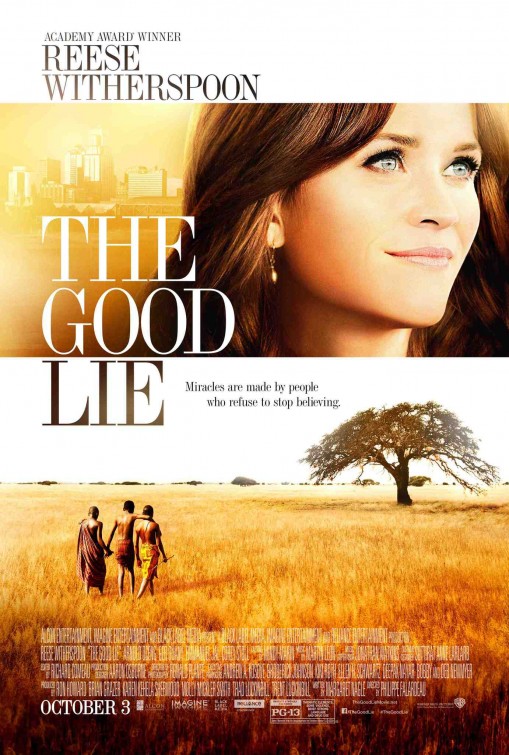 The title of The Good Lie refers to a lesson learned by Huckleberry Finn, that a lie told for noble purposes can be excused, that the rightness of the outcome can pardon the wrongness of the action. For example, say a film studio were to put Reese Witherspoon front and centre in all of the marketing material for a film despite the fact she only plays a supporting character who does not even appear until half an hour in, all as a means of tricking audiences into seeing an important story about the experiences of Sudanese refugees, that might be considered a “good lie.”
‘The Lost Boys of Sudan’ was a title given to the approximately 20,000 Sudanese children who were displaced during the second Sudanese Civil War. The Good Lie tells the story of four such children, Mamere and his sister Abital, and brothers Jeremiah and Paul. When their village is attacked and their parents slaughtered, the children are forced to flee by foot. They walk first to the Ethiopian border, and when no help is to be found there, to the Kenyan border. After 785 miles of walking they arrive at Kakuma Refugee Camp, where they will stay for 13 years before receiving the news that they are to be relocated to America. On arrival though, they discover that the three men are to be settled in Kansas City while Abital is to be sent to Boston. According to program rules, while men can be settled together, females must be placed with families. As the three men struggle to fit in and endeavour, with the help of an employment agency counsellor, to make a life for themselves in Missouri, they also work to reunite their family.
The demands of movie marketing means that Reese Witherspoon has to top billed and feature strongly in advertising campaigns. In all likelihood the film only got financing as a result of her agreeing to star in it. But this isn’t her film. While the trailers for The Good Lie would suggest that it is going to be The Blind Side without the football, the great strength of the film is that it is actually allowed to be their story rather than hers. Rather than another white-person-rescuing-black-people narrative, the young Sudanese characters are actually allowed to be the heroes of their own story.
The central quartet of African characters are all played by actors who are either Sudanese refugees themselves, or the children of refugees. Two of the performers were even former child soldiers. While their acting can be a bit stilted at times, especially in moments of high emotion, knowing their real-life backgrounds adds to the sincerity of the story.
But as much as The Good Lie is refreshingly different in its willingness to put the African characters front and centre in its narrative, there are moments in the film that are frustratingly familiar. Screenwriter Margaret Nagle drew upon real stories and experiences in creating her fictional character, which makes it disappointing when things feel a bit inauthentic and it feels like we have seen certain scenes before. There is some gentle culture clash humour that is drawn from watching these characters acclimatising to life in America. While some of this humour is subtle – a sweet moment when Jeremiah offers half of his orange to a woman sitting next to him on the bus – at other times it can feel like cheap laughs – they don’t know how to use a telephone! Ha, ha!
Despite this, the movie’s heart is clearly in the right place. The Good Lie is obviously a real passion project for its writer and director. Nagle fought for the best part of a decade to bring this important story to the screen, while French-Canadian director Philippe Falardeau was drawn to the project (his first English-language feature) after he was forced, years earlier, to abandon a documentary he was shooting in the Sudan about the plight of these refugees.
While the execution is imperfect, the story is still incredibly affecting and empathetic, leading you to forgive other elements of the film. Ultimately The Good Lie is more than just a movie, with the producers launching ‘The Good Lie Fund’ (www.goodliefund.org), hoping to use the profile of the film to raise funds for educational and humanitarian programs for Lost Boys and Girls communities.
Rating: ★★★☆
Review by Duncan McLean
Have you seen The Good Lie? Leave a comment and let us know what you thought.
Review – Kill the Messenger (2014)
Director: Michael Cuesta
Starring: Jeremy Renner, Mary Elizabeth Winstead, Rosemarie DeWitt, Oliver Platt, Andy Garcia, Tim Blake Nelson, Michael Sheen, Barry Pepper, Michael Kenneth Williams, Ray Liotta
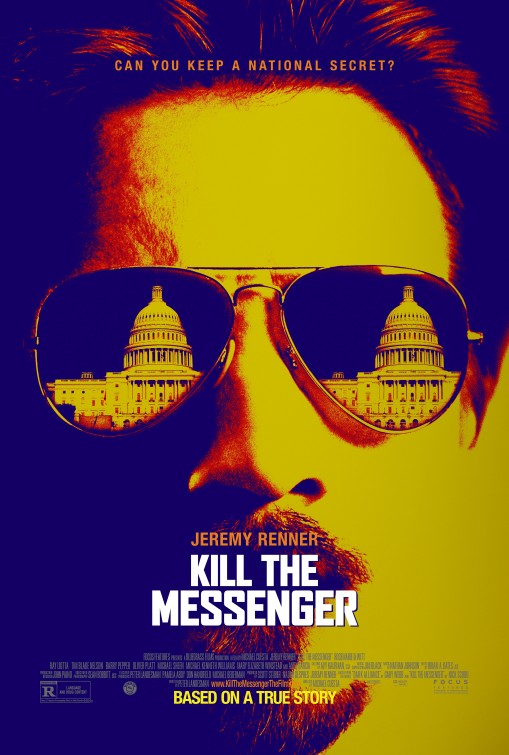 Hollywood has a history of celebrating the heroic investigative journalist who, spurred on by an ardent belief in the public’s right to know, exposes corruption in the system and keeps the government and its institutions accountable. But with his political thriller Kill the Messenger, Michael Cuesta uses the true story of San Jose Mercury News journalist Gary Webb to deliver a cautionary tale about the potential ramifications of crusading journalism.
In 1996 Webb penned an explosive series of articles which alleged links between US intelligence services and the Central American cocaine trade during the 1980s. The three-part series, called “Dark Alliance,” suggested that the CIA was aware that Nicaraguan rebels were smuggling cocaine into the US but opted not to intervene as they were using the profits to arm Contra militia in their civil war against Nicuragua’s Sandinista government. These revelations caused outrage not only because it amounted to a violation of congressional rulings that the CIA was not to aid the Contras, but because the resulting crack cocaine epidemic had ravaged the African American community. Not only did Webb’s work ruffle feathers at the CIA, it also raised the ire of the larger newspapers – the New York and Los Angeles Times in particular – embarrassed that this huge story had passed them by.
Where Kill the Messenger is interesting, and deviates from the model of All the President’s Men, is in its exploration of the aftermath of the exposé. Webb’s investigation only makes up part of the film. The publication of “Dark Alliance” comes at about the halfway point and the rest of the film is about what happens to him as a result of his actions. Rather than make Webb’s career, it destroys him. We see the expected denials from the CIA and their efforts to intimidate him – he is unnervingly reassured “we would never threaten your children, Mr. Webb” – but what is more confronting is the way that he is cannibalised by peers in the press. The embarrassment of the bigger newspapers for missing the scoop leads them to devote their energy not to investigating the story but to discrediting Webb and his methods, often through overinflating his claims. Ultimately, the distressing thing is not that the government silenced him or destroyed him, it is that they didn’t have to.
While Kill the Messenger invites comparison to some of the great political thrillers of the past, it is not quite of that level. The film is a bit hit and miss; more interesting than it is engaging. It moves so quickly through the investigation phase that it is difficult to keep up with the ins and outs of the case, and to fully appreciate the significance of each new piece of information. Director Michael Questa is best known for his work in television (he has directed a number of episodes of Homeland), and it is fair to say that there are moments in which Kill the Messenger feels more like a television show than a movie. In fact it may have been better served as a TV miniseries where it would have had a bit more time to explore the intricacies of its plot.
It is Jeremy Renner that really makes Kill the Messenger worth watching, as he gives arguably his best performance since The Hurt Locker. He is obviously really invested in this project, also acting as one of the film’s producers. The film is very much on Webb’s side. We are never invited to question his information or his ethics, as other characters do. But Renner brings the light and shade to the character which prevents Webb from being a two-dimensional hero, a simplistic crusader for truth. Renner is supported by quite an impressive cast, fleshed out with a series of single scene cameos from quite big names; Andy Garcia, Michael Sheen, Robert Patrick, Michael Kenneth Williams, Ray Liotta.
Kill the Messenger is one for lovers of conspiracy theories, and with its story not being as well-known as some other conspiracy thrillers, it will leave you with a bit of homework to do when you exit the cinema.
Rating: ★★★
Review by Duncan McLean
Have you seen Kill the Messenger? Leave a comment and let us know what you thought.
Review – Whiplash (2014)
Director: Damien Chazelle
Starring: Miles Teller, J.K. Simmons, Paul Reiser, Melissa Benoist
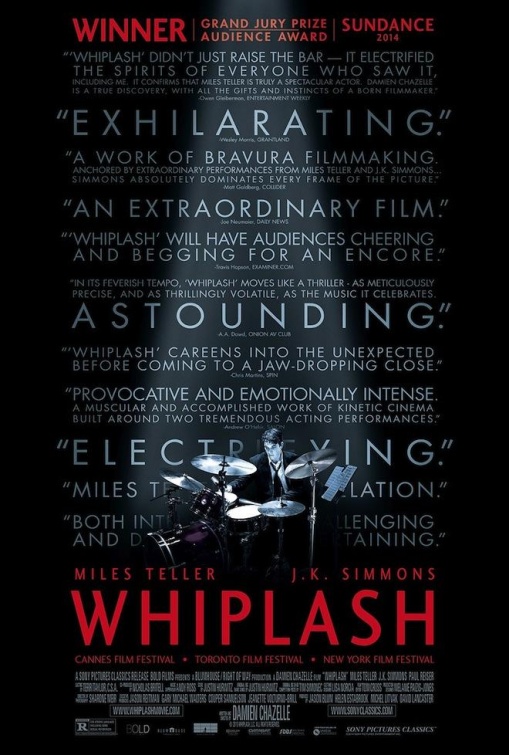 All too often movies about music and musicians restrict their focus to the importance of finding and retaining ones passion, soul, creativity, and love for the art. Rarely do films attempt to explore the other side of the equation. With Whiplash writer-director Damien Chazelle draws on his own experiences as a driven high school jazz drummer to examine the determination, perfectionism, obsession and back-breaking hard work that that is required to be the very best.
Nineteen-year-old Andrew Neyman is a jazz drummer in his first year at New York’s prestigious Shaffer Conservatory of Music. Neyman is good. He is very good. But he wants to be great. After a chance evening encounter with Terence Fletcher, the infamous conductor of the conservatory’s award winning studio band, Neyman finds himself shockingly transferred into the band as the alternate drummer. Fletcher is more drill sergeant than music teacher but he is the best there is and the students know it. But is the combination of Fletcher’s psychological brinksmanship and Neyman’s determination to be the best leading the young drummer towards greatness or madness?
At what point does drive become obsession? When does determination go from being an admirable quality to being a repugnant one? At what point does the quest for perfection become counter-productive? We watch Neyman try and fail, and try again. We see him drumming until his hands blister and bleed. But rather than cheer him on, we become conflicted by his drive. His single-mindedness makes him selfish. His need to accept nothing but the very best from himself makes him incapable of acknowledging more ordinary achievements and aspirations in other people. His progress as a musician seems to be to the detriment of his development as a person.
Whiplash has the potential to stir up some debate with its controversial depiction of the student-mentor relationship. Fletcher’s aim is to push his students beyond what is expected of them. In his mind it is only then that greatness can emerge. Comfort and contentment breed mediocrity. There are no two more harmful words, he says, than ‘good job.’ But at what point does motivation and pushing just become abuse? Fletcher’s favourite anecdote, one repeated numerous times in the film, concerns a teenage Charlie Parker. One night he was playing in a recording session and made a mistake in his solo, prompting the drummer to throw a cymbal at his head. He went home humiliated and cried himself to sleep, but woke up more determined than ever and only a year later was playing some of the best jazz the world had ever heard. For Fletcher, fear and humiliation are powerful motivating tools. They provide the heat and the pressure with which a diamond can be forged.
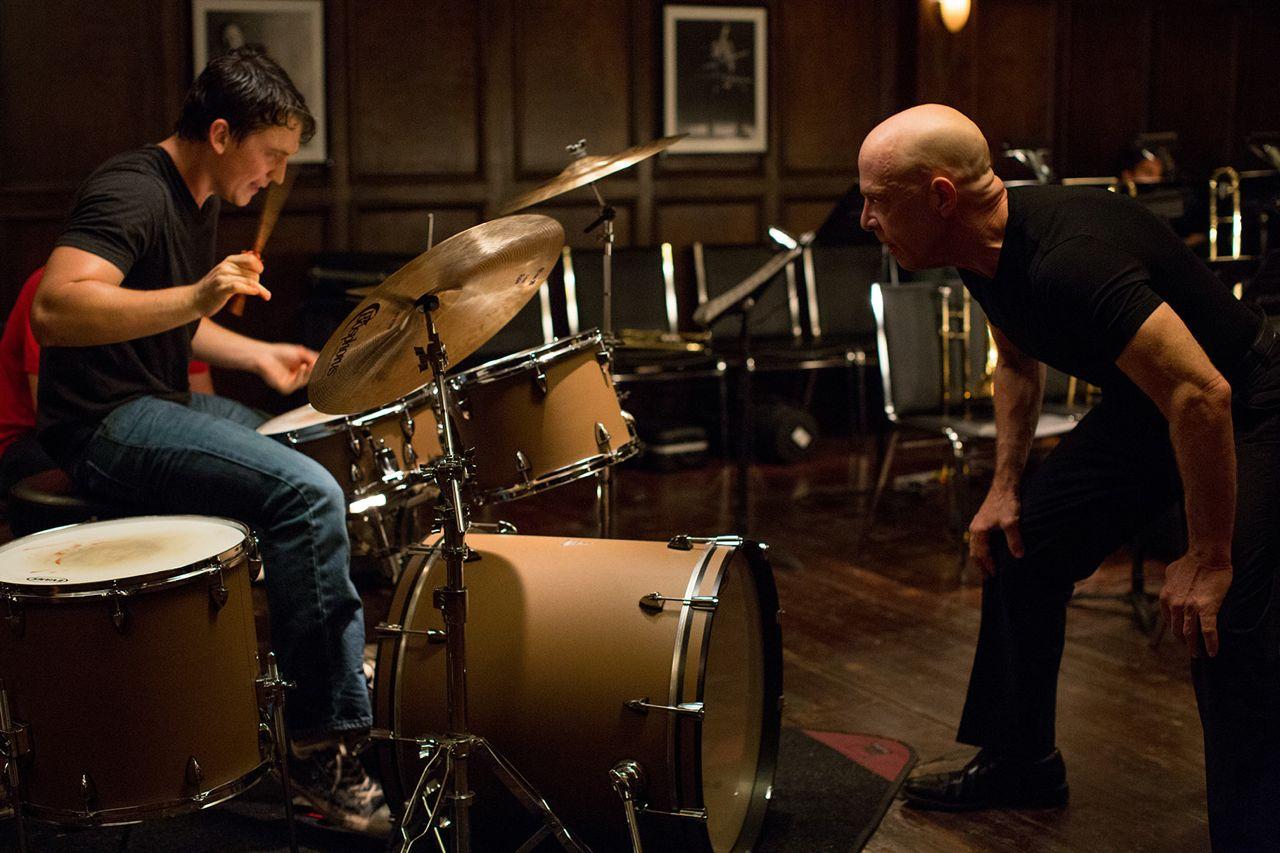
Andrew Neyman (Miles Teller) and Terrence Fletcher (J.K. Simmons)
At the centre of this film are two powerful, award-worthy lead performances, one from a young actor on the rise the other from a long-time character actor finally given the role of his career. Miles Teller and J.K. Simmons deliver complex characters that are equal parts repellent and engrossing. The character of Fletcher in particular, is very carefully realised by Simmons and Chazelle. Early in the film we find his bluntness and barbs humorous, and in lesser hands he could become an over-the-top caricature. But as the film progresses these situations lose their humour. His aggression becomes frightening and we start to feel the cruelty of his words. Yet even then we understand where he is coming from.
As much as the clashing egos of Neyman and Fletcher seem destined to destroy each other, they are one and the same, entirely co-dependent. Fletcher’s methods don’t work unless a student is headstrong enough to persevere through them. Neyman can’t continue to improve unless he has someone who can push him beyond what he thinks he’s capable of. So dedicated are they both, so high are their standards, that eventually they have only each other.
Chazelle and his director of photography Sharone Meir shoot bands and musicians brilliantly. The director wanted to make a movie about music that felt like a war movie and he really has achieved that. The rehearsals feel like battles. The performances play like action set pieces, edited for maximum intensity. You don’t have to know jazz in order to appreciate this explosive film because ultimately the movie is not about jazz. It is not even about music. Whiplash is an emotionally and psychologically brutal film about the dangers of perfectionism and single-minded obsession.
Rating: ★★★★☆
Review by Duncan McLean
Have you seen Whiplash? Leave a comment and let us know what you thought.
Review – Gone Girl (2014)
Director: David Fincher
Starring: Ben Affleck, Rosamund Pike, Carrie Coon, Kim Dickens, Tyler Perry, Neil Patrick Harris
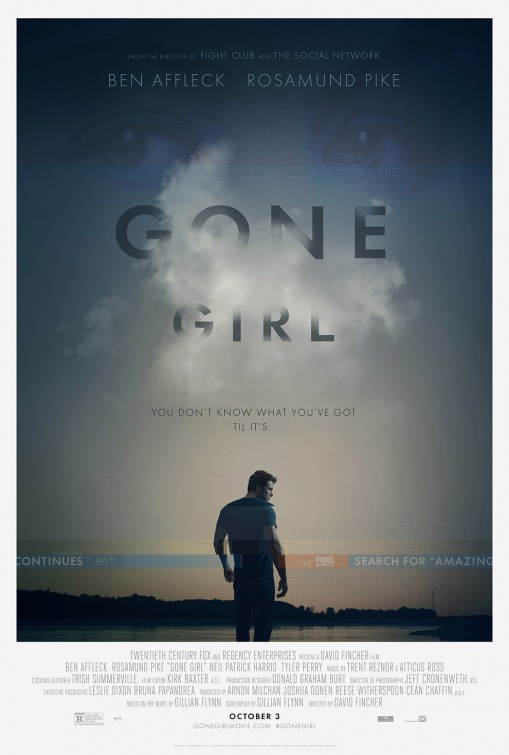 Gillian Flynn’s best-selling thriller Gone Girl was a literary sensation and was destined for the big screen. Flynn herself was given the task of streamlining the novel into a 150min screenplay, and with films like Se7en, Fight Club, The Social Network and Zodiac proving him to be a brilliantly methodical director and a master of misdirection, David Fincher was just the director to manage the various major twists and turns that Flynn’s story throws at us.
On the day of their fifth wedding anniversary, Nick Dunne arrives home to find his wife Amy missing. The police are called in but something doesn’t seem quite right. The kidnapping investigation soon becomes a murder investigation, and with an intensifying media circus that brings with it revelations big and small about their relationship, Nick finds himself the prime suspect.
Gone Girl looks at the role the media plays in turning investigations into sensations. We see the ease with which public perception is manipulated by the media, how little details and tangential titbits can be put under the spotlight and made to look incredibly significant. It is Nick’s inability to appropriately play the media game that causes him to look suspicious, and the court of public opinion judges accordingly. Ben Affleck is perfect casting in this regard. As we watch Nick being hounded by the press, and we see him breaking under the pressure of constantly being scrutinised and judged, knowing that Affleck has lived that experience adds to the character.
Gone Girl starts on the morning of Amy’s disappearance and follows the investigation from there, but we get flashbacks of their relationship narrated to us through excerpts from Amy’s diary. As such we experience Nick in an objective present, but Amy in a subjective past. What we see and know of Amy is determined by what she has written in her diary, and as the film progresses the reliability of her narration comes into question.
Unlike a traditional thriller, Gone Girl gives us its game changing reveal quite early. Barely halfway through the film we learn the truth about Amy’s disappearance. That revelation changes the focus of the film. For the audience, the investigation is no longer about working out what happened to Amy, but about revealing who Nick and Amy really are. More than just a mystery thriller, Gone Girl is a film about human relationships, and quite a cynical one at that. The film explores the place of narcissism in marriage, examining the way in which people play roles during courtship, pretending to be the person they want their partner to think that they are, or the person they think their partner wants them to be, and then how relationships break down and resentment builds when partners grow tired of playing those roles. Through its hyperbole it asks how well one can really know their partner when both are simply playing roles.
As good as Affleck is, it is British actress Rosamund Pike for whom this movie is a real breakout. Pike’s look perfectly suits Amy; the privileged, trust fund kid. We believe her intelligence, and we also believe her insecurity. After all, her trust fund is the result of a successful series of children’s books her mother wrote in which the lead character, Amazing Amy, lives out an idealised version of her own life. But there is also something mysterious and unreadable about Pike and as we start to discover more about her character she shows us something new and the film really becomes hers.
Gone Girl is an extremely interesting and engaging film, but it is not without its problems. Tonally it will cause some viewers difficulty. What starts out as a pretty straight drama gradually morphs into a tragicomedy, a perverse satire, without ever openly embracing a satirical tone. There are moments in the film that are quite brutal and others that are obviously being played for laughs. It is a very fine tonal balance that the Fincher is trying to strike, and he is not always completely successful in achieving it. Similarly, after an engrossing first and second act, the third act falls flat. Rather than building to a crescendo, Gone Girl reaches its peak at the end of the second act and then gently burns out. With a two-and-a-half hour runtime, it is in this third act that the film starts to feel long.
Gone Girl is the kind of smart, insightful, middle-budget (around $50 million) film which is few and far between in Hollywood these days. Well performed and expertly directed it is a peculiar and engrossing piece of filmmaking.
Rating: ★★★★
Review by Duncan McLean
Have you seen Gone Girl? Leave a comment and let us know what you thought.
Review – The Skeleton Twins (2014)
Director: Craig Johnson
Starring: Bill Hader, Kristen Wiig, Luke Wilson, Ty Burrell
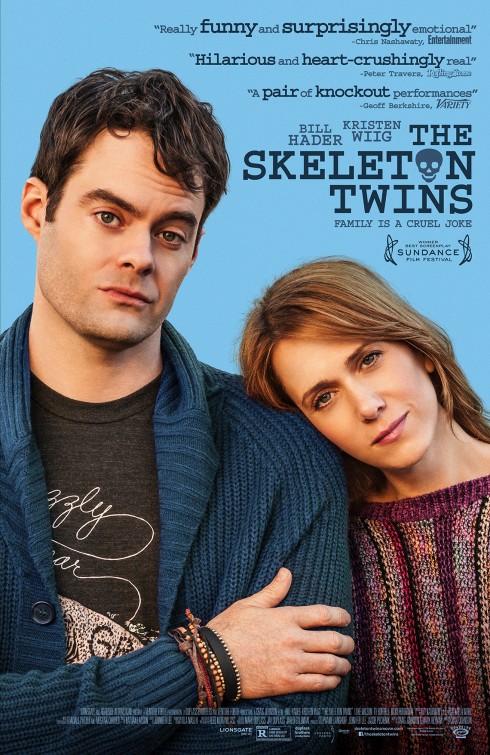 They say you should never judge a book by its cover. It is equally true that you should never judge a film by its cast. With Saturday Night Live alumni Bill Hader and Kristen Wiig headlining, and Luke Wilson and Modern Family’s Ty Burrell in key supporting roles, one would assume The Skeleton Twins to be a flat out laugh riot. But Craig Johnson’s film has deeper, darker issues to explore.
The film opens with the concurrent unsuccessful suicide attempts of a twin brother and sister, Milo and Maggie. Milo is a gay, unemployed actor. Maggie is a married, discontented dental hygienist. His attempt fails; hers is interrupted by the news of his. Despite being thick as thieves as kids, they haven’t spoken each other in ten years. Rushing across the country to be by Milo’s side, Maggie insists that he move in with her and her husband Lance until he has recovered. Living under the same roof, these two troubled people reconnect, rediscovering the bond that they share, confronting old wounds and helping each other address their issues.
Obviously, The Skeleton Twins is not the light giggle-fest you might have expected. The movie is best described as a ‘dramedy.’ It explores some serious issues – depression, self-worth, the effects of suicide – in a serious way, but with the cast it possesses it can’t help but allow some humour to sneak in.
Covering some familiar thematic ground, Craig Johnson and Mark Heyman’s screenplay feels a bit paint-by-numbers indie. Over the last two decades of American independent film we have seen dysfunctional, estranged families and adults trying to deal with the scars inflicted by their parents explored ad nauseam. While The Skeleton Twins is an earnest film, it doesn’t offer us anything drastically different. While Johnson and Heyman succeed in creating strong, complex and largely believable characters, the narrative itself occasionally opts for the easy and conventional route.
The strength of the movie comes from the revelatory central performances from Hader and Wiig. Both are clearly heavily invested in the project and show impressive dramatic range which may surprise some given their improvisational comedy backgrounds. We’ve seen glimpses of what Wiig is capable of in dramatic moments in Bridesmaids and The Secret Life of Walter Mitty, but Hader’s film career has to this point been made up of supporting roles in broad comedies. He joked about himself in the James Franco roast, “Bill’s ok in the movies if you need a best friend’s best friend to ask an exposition question.” With one of Hader’s most beloved SNL characters being the ultra-camp Stefon, it is impressive to see that Hader’s Milo doesn’t fall back on lazy gay stereotyping but is a well-crafted and complex character.
Having worked together for so many years on SNL, there is a chemistry between the two which helps make them very believable as siblings. Milo and Maggie have a shared sense of humour and shorthand communication which is obviously natural to Hader and Wiig. While their performances in the film’s more dramatic moments which is what surprises, their comedic abilities are still pivotal. Their humour shines through in moments that break through the film’s bleakness but also serve to reinforce it. It emphasises the fact that these are two fun individuals who have been squashed by life.
The Skeleton Twins is moving, at times quite confronting, and at others very funny and reminds us of the special bond that siblings share.
Rating: ★★★☆
Review by Duncan McLean
Have you seen The Skeleton Twins? Leave a comment and let us know what you thought.
Review – What We Do in the Shadows (2014)
Directors: Taika Waititi & Jermaine Clement
Starring: Jermaine Clement, Taika Waititi, Jonathan Brugh, Cori Gonzalez-Macuer, Stuart Rutherford, Ben Fransham
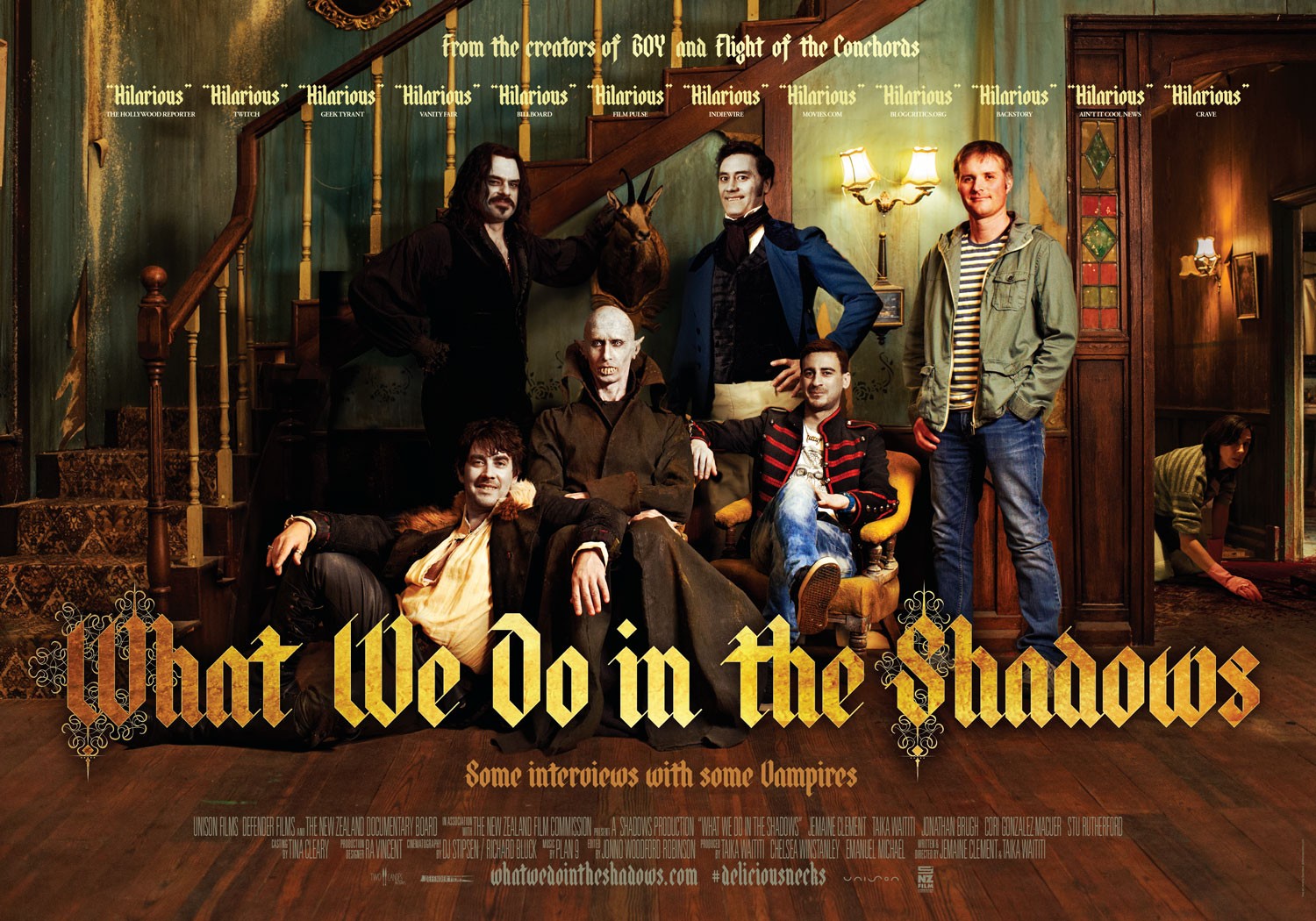 Kiwi duo Taika Waititi and Jermaine Clement do something quite surprising with their film What We Do in the Shadows. They take a subject, vampires, with which popular culture is teetering on the edge of overload, and combine it with a form, the mockumentary, which seems just as tired, and through the combination create a vibrant, original and downright funny movie.
A documentary crew observes a group of vampires flatting together in Wellington, New Zealand, in the months leading up to the undead community’s annual night of nights, the Unholy Masquerade. Viago is 379 years old. He’s an 18th century Dandy and the unofficial organiser of the house. The 862-year-old Vladislav the Poker is a legendary lothario and hypnotist, though his powers have dulled in recent years. Deacon is the young bad boy of the house, being that he is only 183. Down in the basement lives Petyr, an ancient vampire, 8000 years old, clearly modelled on Max Schreck from F.W. Murau’s legendary 1922 silent Nosferatu. In between catching and devouring virgin victims, the group deals with the usual politics of share house living. Their dynamic is challenged though when Petyr turns young kiwi Nick into a vampire. While they have much to teach Nick about being a vampire, he teaches them a thing or two about living in the modern world.
What We Do in the Shadows transcends the seeming limitations of its subject matter and form because of the slightly different sensibility the New Zealand sense of humour brings to the fold. An American version of this movie would in all likelihood have been horrible. The strength of Waititi and Clement’s screenplay (or perhaps their scenarios is a better term given the mockumentary form is so dependent on improvisation) is in the way that the film combines the extraordinary with the mundane. It is hilariously absurd watching vampires having flat meetings to discuss household chores – if someone is going to kill a victim in the living room, they should be considerate and lay down some towels first. The film also plays on the incongruity of a group of people who are so determined to keep their existence a secret allowing themselves to be the subject of a documentary.
All the best genre comedies take convention and turn it on its head. In the case of What We Do in the Shadows, there are centuries’ worth of vampire lore and mythologies to be played with. Waititi and Clement then plant these well-known conventions in a very ordinary context to explore the difficulties of being a vampire in the present day. How do you look after your appearance if you can’t check your reflection in the mirror? How do you enjoy a night out on the town when you can’t enter a venue without being explicitly invited in?
While Clement and Waititi are the headliners of this cast – Clement known as half of Flight of the Conchords and Waititi as the writer-director-actor behind the wonderful film Boy, the highest grossing New Zealand film at the domestic box office – Jonathan Brugh more than holds his own and even steals a few scenes as Deacon. There is also a great cameo from Rhys Darby as the alpha male of a group of werewolves who our vampires occasionally cross paths with.
Horror comedy isn’t the easiest genre balance to get right but What We Do in the Shadows is start-to-finish funny while still having enough schlock, gore and surprisingly impressive effects to keep genre fans happy. At just 85 minutes, the movie is short and sweet. It doesn’t stretch the premise beyond what it can support, and what you end up with is one of the most consistently funny comedies of the year.
Rating: ★★★★
Review by Duncan McLean
Have you seen What We Do in the Shadows? Leave a comment and let us know what you thought.


You must be logged in to post a comment.