
Tagged: thriller
Review – Shadow Dancer (2012)
Director: James Marsh
Starring: Andrea Riseborough, Clive Owen, Domhnall Gleeson, Aiden Gillen, Brid Brennan, David Wilmot, Gillian Anderson
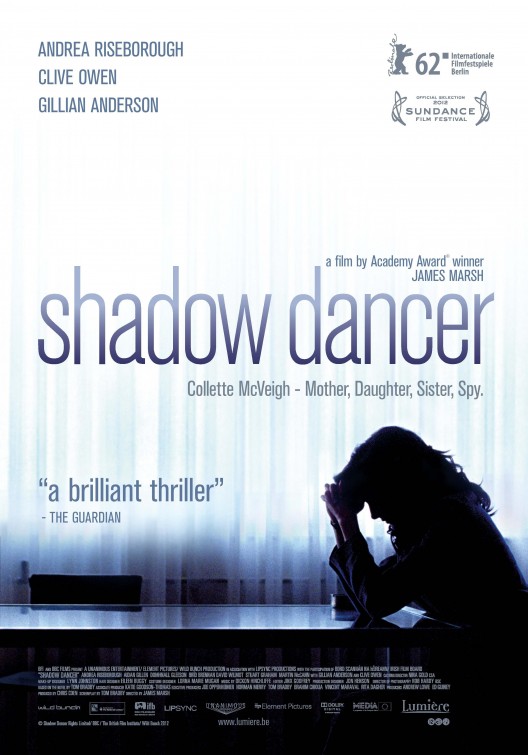 Colette McVeigh, a single mother with connections to the IRA, is picked up and interrogated by Mi5 agents after failing to go through with mission to plant a bomb on the London Underground. She is given a choice between a long prison sentence and separation from her young son, or agreeing to share information on the IRA cell in which her brother is a key member. She reluctantly chooses the latter and Shadow Dancer – a title which won’t make sense until a revelation late in the film – then follows the relationship between Colette and her Mi5 controller, Mac, as she goes about the dangerous business of being an informant.
If you want to think about it in generic terms, Shadow Dancer would be categorised as a spy thriller. But you would have to throw out a number of your preconceived notions of what a spy thriller is. Like Tomas Alfredson’s Tinker Tailor Soldier Spy in 2011, Shadow Dancer is a slow burning film with a steadily escalating tension rather than a roller coaster ride we expect from the majority of spy thrillers which follow the conventions established by James Bond films. Shadow Dancer moves at a very slow pace, to the point that it will be very off-putting for some viewers.
The performances are quite strong, even if the motivations for some characters are not always clear. In particular, Andrea Riseborough has earned some acclaim for her central performance as Colette. The key to her performance is the way that, while allowing us to see some of her anxieties and concerns, she manages to retain a moral mystery which means we never really know where she stands in terms of the larger conflict. Is she a believer in the IRA cause or obliged to play a role out of a sense of family duty or guilt? But I will admit to struggling with her character at times. I found her character so closed off, so internalised, that it became difficult to empathise with her.
Director James Marsh’s background is in documentary making – he won the Best Documentary Oscar in 2009 for Man on a Wire – and Shadow Dancer is a revealing picture in the way that it exposes the danger and volatility of life in Belfast in the 1990a. However, it fails to really give a sense of the socio-political context which explains that violence and volatility, and as a piece of entertainment it can be a really hard slog.
Rating – ★★
Review by Duncan McLean
Review – Zero Dark Thirty (2012)
Director: Kathryn Bigelow
Starring: Jessica Chastain, Jason Clarke, Kyle Chandler, Jennifer Ehle, Mark Strong, Chris Pratt, Joel Edgerton, James Gandolfini
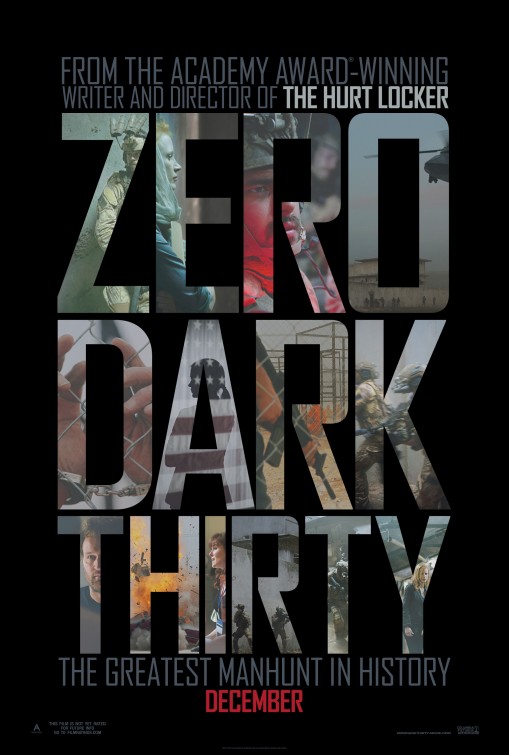 “We got him.” Those were apparently the words President Obama uttered as confirmation came through that Osama bin Laden had been killed at 12:30am (‘zero dark thirty’ in military speak) on the 2nd May 2011 as part of a successful raid on a fortified compound in Abbottabad, Pakistan. Less than two years later, Academy Awards winning director Kathryn Bigelow has brought the story of that mission to the big screen. She was able to turn the movie around so quickly because it was already in development at the time bin Laden was killed, though significant rewrites were required as it was originally intended to be about the unsuccessful decade-long manhunt.
Maya is a young CIA analyst assigned to the operation to find bin Laden. When interrogation of a prisoner (more on that later) reveals the name Abu Ahmed a-Kuwaiti, supposedly a personal courier for bin Laden who everyone has heard of but no one can identify, Maya becomes fixated on the idea that finding him will lead them to bin Laden. But not only is Maya a woman in a man’s world, she is a young woman in an older man’s world, and as the search continues over a number of years, she consistently finds herself butting heads with male superiors whose Cold War era understanding of intelligence makes them difficult to convince.
Zero Dark Thirty is effectively a historical drama in the style of a thriller, set in the very, very recent past. This makes it a bit strange on two fronts. As a thriller, the fact that you already know the resolution creates an unusual dynamic, and as a historical drama, it feels odd watching a recreation of events which still feel like part of the present. The strangeness struck me in a moment when President Obama appeared on a television screen in the background of a shot. I’m used to seeing much older Presidents on television screens in movies; JFK, Nixon or Reagan, not the guy that I see on the news every night. Historical dramas usually require a bit of distance from the events they are trying to depict in order to gain some sort of objective perspective. For example, despite his impressive track record of historical dramas, Oliver Stone’s biopic W. was terrible, and one of the primary reasons for its shoddiness appeared to be that it was too biased and politicised a film. Released in late 2008, in the final months of Bush’s second term as president, the film had an obvious agenda leading into the election, which coloured its portrayal of characters and events. It is for this reason, among many others, that Bigelow’s film is a great achievement. Zero Dark Thirty manages to depict very recent events which are still hot-button topics with a sort of neutrality, without being preachy or didactic in any way.
It is this currentness of events that has landed the picture in a bit of controversy. One of the hottest political issues to come out of the hunt for bin Laden at the time was the role of torture and humiliation tactics in CIA intelligence gathering. The first third of Zero Dark Thirty contains some quite graphic and very confronting scenes of CIA interrogators using the torturing of prisoners as a means of getting them to divulge information. These depictions have prompted some commentators to accuse the film of endorsing the controversial practice. Others have come to the defence of the film, including Michael Moore who wrote this article for the Huffington Post.
Watching the film myself, I never felt that I was watching a pro-torture film. The film doesn’t shirk away from showing the central role torture played in early intelligence gathering, but when you think about it there was no other option. Could you imagine the equivalent shit-storm that would be surrounding the film if Bigelow had somehow tried to undersell the role of torture or even write it out of the history completely? It was such an ugly and public controversy that it had to feature prominently in the retelling of the story. However, as Bigelow herself has argued, depiction is not the same as endorsement. I would add to her point that a film containing characters, even protagonists, who endorse the practice of torture is not the same thing as the film itself endorsing the practice.
The scenes of torture, particularly the waterboarding, are very difficult to watch. And therein lies the key. They are difficult to watch because of where our empathy lies. As Moore alluded to in his argument, at no point do we find ourselves empathising with the interrogator, hoping that he can break the prisoner and make them talk. In these scenes we always find ourselves emotionally aligning ourselves with the tortured prisoner, even when we are told of their supposed role in the 9/11 attacks. That we find ourselves compelled to side with the ‘enemy’ in the scene suggests that the film is anti-torture.
After her critical success with The Hurt Locker, Kathryn Bigelow’s direction of Zero Dark Thirty cements her as the world’s premier director of films about modern warfare, a very different beast to the style of combat which has for so long been the staple of the war movie genre. The final raid on bin Laden’s compound is masterfully staged with a gritty realism. The methodical way the soldiers go about performing their task is very interesting and makes for a really engaging scene, even if it is not the big, high-octane payoff that a thriller usually ends with. The tension is impressive given the potential for the film’s third act to be a massive anti-climax with everyone knowing exactly what happens. Bigelow’s failure to be recognised with an Oscar nomination in the Best Director category was one of the bigger surprises of this year’s nominations.
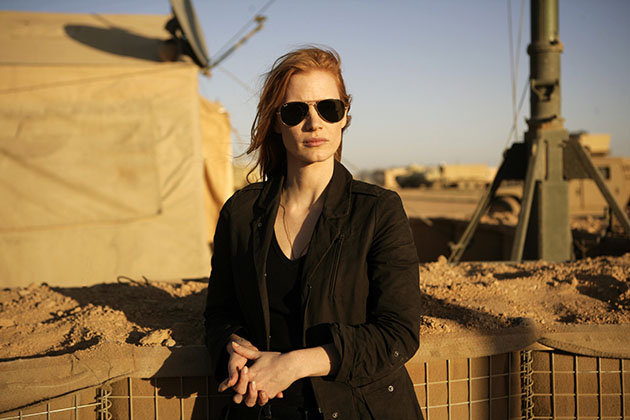
Jessica Chastain as Maya
With Bigelow’s profile as a director meaning she is forced, whether she wants to or not, to wave the flag for women in film, it is also pleasing to see her direct a film with a female protagonist. Jessica Chastain delivers a very strong performance as Maya and is one of the favourites in the Best Picture category at this year’s Oscars. Over the last couple of years Chastain has emerged as a talented and versatile performer. She was delightful in The Help as the hopeless housewife and social outcast, Celia Foote, and also caught people’s attention as Brad Pitt’s wife in Terrence Malick’s The Tree of Life. As Zero Dark Thirty’s determined heroine, Maya, Chastain shows us something different again. Her roles in The Help and Tree of Life were both very emotionally open characters, here she plays her cards much closer to her chest. She is very closed off and methodical, living for the job.
Zero Dark Thirty is different to any thriller or war movie you have seen –our protagonist isn’t an action hero, she’s a desk jockey – but it is no less thrilling. It is a masterfully orchestrated film that takes you inside the intellectual process of finding the most wanted man in the world.
Rating – ★★★★
Review by Duncan McLean
Review – Following (1998)
Director: Christopher Nolan
Starring: Jeremy Theobald, Alex Haw, Lucy Russell
Before Christophe r Nolan was the man who reinvented the superhero movie with the brilliant Dark Knight Trilogy, before he was even “the guy who made that backwards movie with Guy Pearce” (Memento for those of you playing along at home), he made an interesting little noir-thriller called Following. It is the story of Bill, an aspiring writer who decides to start following people at random, just to see what they do, thinking it will give him special insight for his writing. When one of his targets, a burglar named Cobb who breaks into people’s homes not so much to steal things as to voyeuristically look into people’s lives, approaches him, Bill finds himself involved in a very strange relationship.
Nolan’s debut feature, Following is a no-budget film shot handheld in grainy, black-and-white. Nolan wrote, directed, produced and shot the film himself. For cast and crew, he used friends and acquaintances, with the picture being shot over a period of about a year, shooting on Saturdays whenever people were free. I quite enjoy watching the really early films from directors who go on to become big names – the Directors Suite released a great DVD of Martin Scorsese’s early short films which is really worth a look – because it is interesting to see what traces of the filmmaker they would become can be found in those early, often much smaller scale, works.
The primary feature of Following is its narrative structure. Nolan takes a linear story, divides it into four sections and then inter-cuts them, delivering to the viewer a non-chronological narrative which tells us the young man’s story through a series of flash backs and jumps forward. Innovations in the realm of narrative form have become one of Nolan’s chief attributes as a filmmaker, with films like Memento, The Prestige and Inception all playing with form and narrative structure different ways. Following gives us an early, and much simpler example of the kind of innovation Nolan would employ as his career progressed.
The other thing which is great about Following is that it is only 70mins long. In a time when it is becoming increasingly common for films to go well beyond the two-hour mark regardless of whether they really need to or not, it is refreshing to see a filmmaker show that a good story can be told in under 90 minutes.
If anything lets this film down, it is they quality of the performances. However this is to be expected given the amateur cast – none of whom have added many credits of substance outside of small cameos in later Nolan films – and the disjointed nature of the production.
There is also a nice little moment of Nolan serendipity for the movie nerds out there. After Bill and Cobb break into a man’s apartment, we see them leave through a front door which proudly displays a Batman logo.
While it was really his next film, Memento, which established Nolan as one of the upcoming filmmakers of the early 2000s, Following did win a few awards, most notably at the San Francisco Film Festival and the Slamdance Film Festival, and announced Nolan as someone to watch. Following has recently been released on Blu-Ray as part of the Criterion Collection, and includes a commentary from Nolan, an essay by film critic Scott Foundas and Nolan’s short film Doodlebug.
Rating – ★★★☆
By Duncan McLean
 Doctor of Movies
You must be logged in to post a comment.