
Tagged: Drama
Review – Zero Dark Thirty (2012)
Director: Kathryn Bigelow
Starring: Jessica Chastain, Jason Clarke, Kyle Chandler, Jennifer Ehle, Mark Strong, Chris Pratt, Joel Edgerton, James Gandolfini
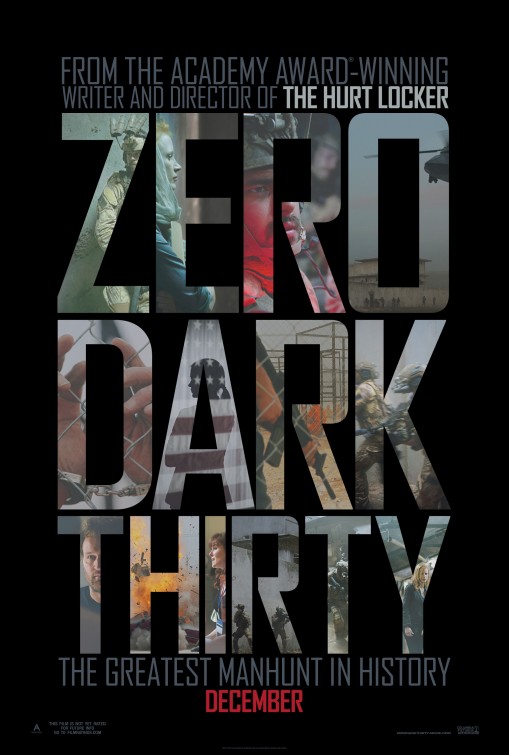 “We got him.” Those were apparently the words President Obama uttered as confirmation came through that Osama bin Laden had been killed at 12:30am (‘zero dark thirty’ in military speak) on the 2nd May 2011 as part of a successful raid on a fortified compound in Abbottabad, Pakistan. Less than two years later, Academy Awards winning director Kathryn Bigelow has brought the story of that mission to the big screen. She was able to turn the movie around so quickly because it was already in development at the time bin Laden was killed, though significant rewrites were required as it was originally intended to be about the unsuccessful decade-long manhunt.
Maya is a young CIA analyst assigned to the operation to find bin Laden. When interrogation of a prisoner (more on that later) reveals the name Abu Ahmed a-Kuwaiti, supposedly a personal courier for bin Laden who everyone has heard of but no one can identify, Maya becomes fixated on the idea that finding him will lead them to bin Laden. But not only is Maya a woman in a man’s world, she is a young woman in an older man’s world, and as the search continues over a number of years, she consistently finds herself butting heads with male superiors whose Cold War era understanding of intelligence makes them difficult to convince.
Zero Dark Thirty is effectively a historical drama in the style of a thriller, set in the very, very recent past. This makes it a bit strange on two fronts. As a thriller, the fact that you already know the resolution creates an unusual dynamic, and as a historical drama, it feels odd watching a recreation of events which still feel like part of the present. The strangeness struck me in a moment when President Obama appeared on a television screen in the background of a shot. I’m used to seeing much older Presidents on television screens in movies; JFK, Nixon or Reagan, not the guy that I see on the news every night. Historical dramas usually require a bit of distance from the events they are trying to depict in order to gain some sort of objective perspective. For example, despite his impressive track record of historical dramas, Oliver Stone’s biopic W. was terrible, and one of the primary reasons for its shoddiness appeared to be that it was too biased and politicised a film. Released in late 2008, in the final months of Bush’s second term as president, the film had an obvious agenda leading into the election, which coloured its portrayal of characters and events. It is for this reason, among many others, that Bigelow’s film is a great achievement. Zero Dark Thirty manages to depict very recent events which are still hot-button topics with a sort of neutrality, without being preachy or didactic in any way.
It is this currentness of events that has landed the picture in a bit of controversy. One of the hottest political issues to come out of the hunt for bin Laden at the time was the role of torture and humiliation tactics in CIA intelligence gathering. The first third of Zero Dark Thirty contains some quite graphic and very confronting scenes of CIA interrogators using the torturing of prisoners as a means of getting them to divulge information. These depictions have prompted some commentators to accuse the film of endorsing the controversial practice. Others have come to the defence of the film, including Michael Moore who wrote this article for the Huffington Post.
Watching the film myself, I never felt that I was watching a pro-torture film. The film doesn’t shirk away from showing the central role torture played in early intelligence gathering, but when you think about it there was no other option. Could you imagine the equivalent shit-storm that would be surrounding the film if Bigelow had somehow tried to undersell the role of torture or even write it out of the history completely? It was such an ugly and public controversy that it had to feature prominently in the retelling of the story. However, as Bigelow herself has argued, depiction is not the same as endorsement. I would add to her point that a film containing characters, even protagonists, who endorse the practice of torture is not the same thing as the film itself endorsing the practice.
The scenes of torture, particularly the waterboarding, are very difficult to watch. And therein lies the key. They are difficult to watch because of where our empathy lies. As Moore alluded to in his argument, at no point do we find ourselves empathising with the interrogator, hoping that he can break the prisoner and make them talk. In these scenes we always find ourselves emotionally aligning ourselves with the tortured prisoner, even when we are told of their supposed role in the 9/11 attacks. That we find ourselves compelled to side with the ‘enemy’ in the scene suggests that the film is anti-torture.
After her critical success with The Hurt Locker, Kathryn Bigelow’s direction of Zero Dark Thirty cements her as the world’s premier director of films about modern warfare, a very different beast to the style of combat which has for so long been the staple of the war movie genre. The final raid on bin Laden’s compound is masterfully staged with a gritty realism. The methodical way the soldiers go about performing their task is very interesting and makes for a really engaging scene, even if it is not the big, high-octane payoff that a thriller usually ends with. The tension is impressive given the potential for the film’s third act to be a massive anti-climax with everyone knowing exactly what happens. Bigelow’s failure to be recognised with an Oscar nomination in the Best Director category was one of the bigger surprises of this year’s nominations.
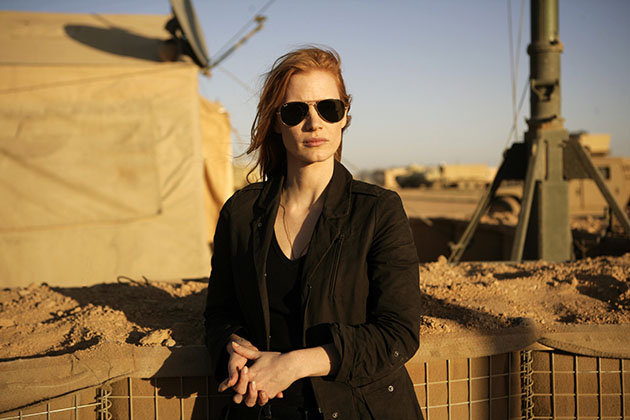
Jessica Chastain as Maya
With Bigelow’s profile as a director meaning she is forced, whether she wants to or not, to wave the flag for women in film, it is also pleasing to see her direct a film with a female protagonist. Jessica Chastain delivers a very strong performance as Maya and is one of the favourites in the Best Picture category at this year’s Oscars. Over the last couple of years Chastain has emerged as a talented and versatile performer. She was delightful in The Help as the hopeless housewife and social outcast, Celia Foote, and also caught people’s attention as Brad Pitt’s wife in Terrence Malick’s The Tree of Life. As Zero Dark Thirty’s determined heroine, Maya, Chastain shows us something different again. Her roles in The Help and Tree of Life were both very emotionally open characters, here she plays her cards much closer to her chest. She is very closed off and methodical, living for the job.
Zero Dark Thirty is different to any thriller or war movie you have seen –our protagonist isn’t an action hero, she’s a desk jockey – but it is no less thrilling. It is a masterfully orchestrated film that takes you inside the intellectual process of finding the most wanted man in the world.
Rating – ★★★★
Review by Duncan McLean
Review – Flight (2012)
Director: Robert Zemeckis
Starring: Denzel Washington, Kelly Reilly, Bruce Greenwood, Don Cheadle, John Goodman
 Captain ‘Whip’ Whitaker is piloting a commercial flight from Orlando to Atlanta when an equipment malfunction causes the plane to nosedive from 30,000 feet. Whitaker manages to perform a miraculous manoeuvre to clear a residential area and bring it down in a field. Only six of the 102 souls on board lose their life and Whitaker is hailed as a hero. However, routine toxicology reports after the crash reveal something that Whitaker has managed to keep secret his whole career. Whip Whitaker is an alcoholic and a drug user, a revelation that could have a devastating effect on his career.
Flight sees director Robert Zemeckis return to live action filmmaking after a decade in which he was an industry leader in the exploration of motion capture. It also marks a departure for the director in terms of tone. Zemeckis started his career as a Steven Spielberg protégé and with films like Back to the Future, Forrest Gump, Who Framed Roger Rabbit and The Polar Express his body of work has maintained that whimsical, Spielbergian sense of fun. Flight goes somewhere much darker, tackling the serious subjects of alcoholism and addiction. Despite a couple of moments that lacked a bit of subtlety, Zemeckis handles the material very competently.
Flight doesn’t over-simplify Whip’s alcoholism, but allows for complexity in the exploration of a complex issue. The film would have been much more straightforward, and much less interesting, had Whip’s alcoholism been the cause of the crash. But as it is, screenwriter John Gatins makes Whitaker the hero of the incident. He is an excellent pilot. It is on the ground, in his private life, that he can’t function.
Most of the noise around Flight has concerned the performance of Denzel Washington, who gives a powerful performance as Whitaker and has rightfully been nominated for a Best Actor award at the upcoming Oscars. Playing believable drunk without going over-the-top is not as easy as you’d imagine. Aside from his incredible talent, what really makes his performance work is the brilliant ‘against type’ casting. As an audience we associate Denzel Washington’s characters with qualities like honour, strength of character, courage and determination. His performance as quite an unsympathetic character in Flight works against all those associations we have and leaves us really conflicted by Whip. Working against type is something Washington has done before with great success, most notably in his Oscar winning performance in Training Day.
There are also some strong supporting performances. Most notable is Kelly Reilly who plays Nicole, a drug addict who Whip meets in hospital and befriends. Nicole becomes the emotional centre of the film. Her character is so important because she provides the contrast to Whip. Despite struggling with the same issues of addiction that Whip is, their approaches are completely different. She is determined to get better. He lives in denial. She is open. He is defensive. Nicole is as sympathetic a character as Whip is unsympathetic. Also, John Goodman – one of the best character actors working today – provides some humour in his role as Whip’s friend and supplier.
Flight is a good film carried by a great leading performance. It is a powerful exploration of the impact of alcoholism on a person and those people around them.
Rating – ★★★★
Review by Duncan McLean
Review – Arbitrage (2012)
Director: Nicholas Jarecki
Starring: Richard Gere, Susan Sarandon, Tim Roth, Brit Marling, Laetitia Casta, Nate Parker
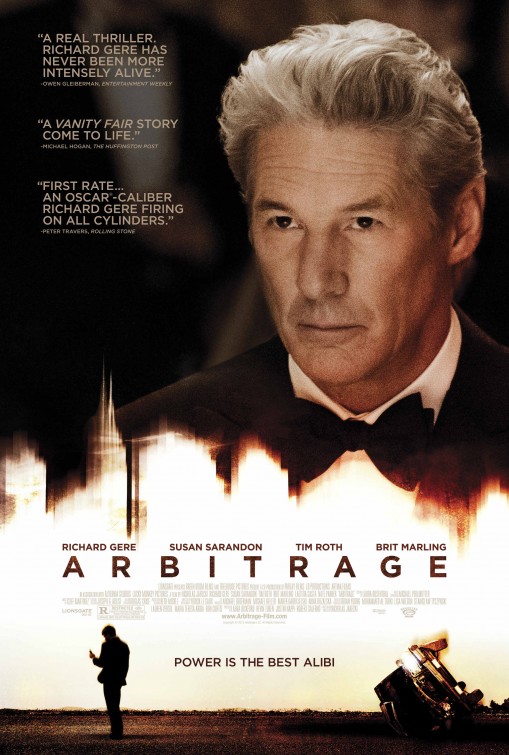 One of the wonderful things about cinema is that a well-made film can get you to identify with almost anyone. Obviously, it is easy to encourage an audience to identify with a protagonist that is charismatic, honourable, heroic and, above all, good. But sometimes a filmmaker will challenge an audience by making them identify with deplorable character. This is the case in Nicholas Jarecki’s impressive debut feature Arbitrage.
Richard Gere plays Robert Miller, a Wall Street legend who is in the process of selling off his company. Miller is sweating on an audit that could reveal he has cooked the books to cover up losses in the hundreds over millions of dollars. As it turns out, the audit is not the only thing that threatens to derail the deal.
Most films of this type would start out showing the central character enjoying the fruits of their extravagant lifestyle, living it up without a care in the world, and then further into the movie things would start to unravel. In Arbitrage we don’t see this first part. We are never given the outsiders view of Robert Miller. From almost the very beginning, we know that Robert Miller is in trouble, and the film that follows is the escalation of that trouble and Miller’s attempts to protect the deal, his family and, most importantly, himself.
Despite the fact that Miller is a deplorable character, a selfish man who believes the world can be bought and sold and seems to have little regard for other people, we find ourselves strangely hoping that he succeeds, hoping that he gets away with it. That is what is special about Arbitrage and that is what is impressive about Jarecki and Gere’s achievement. Gere puts in a very strong performance and has already started collecting award nominations. He leads an impressive cast that includes Susan Sarandon and Tim Roth.
Arbitrage got a pretty low profile cinematic release, it wasn’t a big movie, but is very much worth seeing. An impressive achievement for a first time feature film director, it is one of the better films of 2012.
Rating – ★★★★
Review by Duncan McLean
Review – Life of Pi (2012)
Director: Ang Lee
Starring: Suraj Sharma, Irrfan Khan, Rafe Spall
 Yann Martel’s 2001 novel Life of Pi was a best seller and much loved. However the story of a young man’s spiritual journey whilst stranded in the Pacific Ocean on a lifeboat with a Bengal tiger was considered by many to be unfilmable. But Ang Lee, director of Crouching Tiger, Hidden Dragon and Brokeback Mountain, has proven that with the right director there is no such thing as unfilmable, creating a piece of art that is both highly spiritual and visually breathtaking.
I haven’t read Yann Martel’s novel so I can’t comment on how faithful an adaptation Lee’s film is, but I don’t really think it is important. I find it frustrating when people get hung up on the similarities and differences between novels and film adaptation and about which is better. A faithful adaptation of a novel does not necessarily make a good film. It is more important that the filmmaker use the novel as inspiration for his/her own take on the story. For example, Coppola’s The Godfather is a great film. Mario Puzo’s The Godfather is a great novel. But stylistically they are quite different, with Puzo’s novel being kind of pulpy, while Coppola’s film is grand and operatic. So its faithfulness to Martel’s Life of Pi isn’t as important as the fact that Ang Lee’s Life of Pi is a very good film in its own right.
At the beginning of the film the writer tells the adult Pi that he has sought him out because he has been told he “had a story that would make me believe in God.” It is this spiritual element which differentiates Life of Pi from Robert Zemeckis’s Cast Away and other survival stories we have seen – that and the Bengal tiger. A very spiritual man, Pi sees his journey as having a spiritual significance that goes well beyond a simple fight for survival.
Above everything else, Lee’s film looks amazing. Life of Pi is a stunning aesthetic achievement. With the use of digital technology Lee creates a heightened reality out at sea. Sometimes the sea is rough and choppy and looks very realistic, but at others it is so still and flat it is as though Pi’s boat is floating on nothing at all. This is one of the few films you should try and make sure you see in 3D. I’m not a huge fan of 3D movies, I think the vast majority of the time it is a gimmick used to inflate box office figures, but there are a handful of films which have really demonstrated the potential of the medium if used properly and Life of Pi is one of them.
Equal to the visual achievement as the film’s overall aesthetic is the believability of the tiger, Richard Parker. At the end of the day, the success or failure of the film was largely going to be determined by how successfully Lee made you believe that you were watching a boy and a tiger together on a boat. Richard Parker is created almost entirely with CGI, a wise move as it means there is a consistent look whereas had they tried to use a real tiger as much as possible, there would undoubtedly been jarring moments which would draw attention to the CGI tiger. The computer generated tiger looks brilliant though. You never doubt the reality of the beast before you. Credit should also go to Suraj Sharma, whose performance opposite a CGI tiger is pivotal in establishing the believability of the animal.
Life of Pi is a beautiful, thoughtful film which will be a definite player in the upcoming award season, particularly in the fields of visual effects, cinematography and directing.
Rating – ★★★★
Review by Duncan McLean
Review – Les Misérables (2012)
Director: Tom Hooper
Starring: Hugh Jackman, Russell Crowe, Anne Hathaway, Eddie Redmayne, Amanda Seyfried, Samantha Barks, Aaron Tveit, Helena Bonham Carter, Sacha Baron Cohen
Les Miséra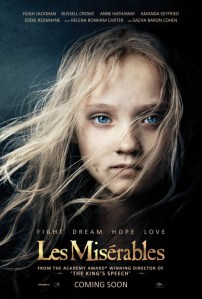 bles first appeared on stage on the West End in 1985 and in the 27 years since it has become one of the most successful musicals of all time. That said, it was still a bit of a risk for Tom Hooper to announce it as his next film project after winning an Oscar for The King’s Speech. It was always going to be a high profile event film, and let’s face it, history has shown us that when you get a big budget musical wrong it can be really, really bad. Hooper assembled a great cast lead by Hugh Jackman – amazingly making his first movie musical despite his strong musical pedigree. But early critical reviews were mixed. Some called it a mess, others heralded it as one of the year’s best. So I was really keen to see it for myself, particularly as I saw the stage production in London earlier in the year and loved it.
The big experiment with Les Misérables, and again part of what made it a risky project,was having the actors sing live. Usually when you make a musical one of the first things you do is get the cast into a recording studio and record an album. Then a couple of months later when it is time for the shoot, the actors simply lip-synch to the mastered recording. With Les Misérables, Tom Hooper decided that he wanted his actors to sing live on each take. The major advantage of doing it this way is it frees up the actors creatively. When you record the songs in advance, the actors are forced to make many of their acting choices well before getting on set, and once on set they are restricted by the necessity of matching up with the recording. This would be far from ideal for a musical like Les Misérables where so much of the emotional crux of the story is delivered through song. This greater level of freedom in performance for the actors has resulted in a musical which is not necessarily as brassy and robust as the stage show, but packs an incredible emotional punch.
This different approach was then complemented by the way the musical numbers have been shot. Unlike a traditional musical, Les Misérables only features one heavily choreographed number, the comical ‘Master of the House’ performed by Sacha Baron Cohen and Helena Bonham Carter’s grotesque tavern owners. The other numbers are shot very simply, often in close-up. The beauty of this approach is you get to see characters faces, something you don’t get on stage. Les Misérables is a very tragic, very emotional story, and the impact of being able to see the faces of characters as they sing is quite powerful. Never is this more apparent than when Anne Hathaway sings ‘I Dreamed a Dream,’ shot entirely in one shot, a medium close-up.
Hugh Jackman was always the logical choice to play Jean Valjean. With his baritone voice, his award-winning musical theatre experience, broad chest and handsome features, Jackman seems born to play the part. As Valjean, he carries much of the emotional weight of the film and he does it admirably, imbuing the character with a real strength and masculinity. The film’s other clear stand out is Anne Hathaway as Fantine. She delivers one of the most gut-wrenching performances you will ever see, demonstrating her versatility in a year which also saw her playing Catwoman in The Dark Knight Rises. While Jackman will be in the mix come award season, Hathaway can start deciding where she wants to put her Best Supporting Actress Oscar now.
One of the big questions in the lead up to the film was the singing ability of Russell Crowe. Everyone knew Jackman and Hathaway could sing, but the fact that Crowe used to have a band, Thirty Odd Foot of Grunt, not to mention his old Russ le Roq days, didn’t have people convinced he was the right man to tackle the demanding role of Javert. This concern was not helped by the fact that his voice was notably absent from a couple of the early trailers. As it turns out, he does alright. His voice is nowhere near as full as some of the others in the film, but you get used to it. He definitely looks the part, and still manages to give some emotional depth to the character.
Hooper’s film is a very faithful adaptation of the musical, plus the requisite new song, ‘Suddenly,’ so that they have something to submit for Award consideration. This faithfulness means that if there was anything in particular that irked you about the stage musical, it still will in the film. In my case, it is the fact that Cosette and Marius are still really boring. It also means that, as is the case with many film musicals, the critical reception will be varied. Musicals are really divisive. People tend to like them or they don’t and if you are someone who can’t get behind the concept of a musical, you’re never going to enjoy one. Even people who like movie musicals may struggle with this one as the ratio of dialogue to song is much closer to an opera than to a normal movie musical. So with a film like this it is difficult to make a general judgement. Instead, I can only speak as a person who enjoys musicals, and who particularly loves this one. I thought it was brilliant.
Rating – ★★★★
Review by Duncan McLean
 Doctor of Movies
You must be logged in to post a comment.