
Tagged: Comedy
Review – The Big Wedding (2013)
Director: Justin Zackham
Starring: Robert De Niro, Diane Keaton, Susan Sarandon, Katherine Heigl, Amanda Seyfried, Topher Grace, Ben Barnes, Robin Williams
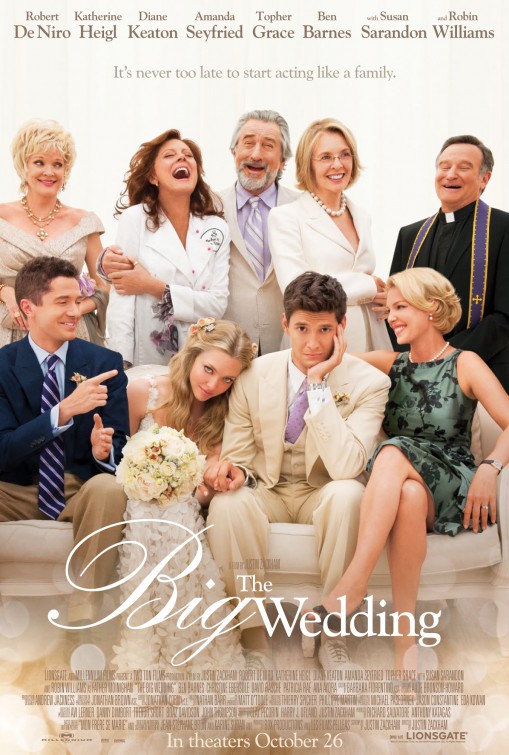 There was a time when a film starring Robert De Niro, Diane Keaton, Susan Sarandon and Robin Williams would have raised a bit of interest. But with recent all-star comedies like Valentine’s Day and New Year’s Eve consistently underwhelming and proving to be considerably less than the sum of their parts, it is understandable that The Big Wedding is approached with a great deal of scepticism. While Justin Zackham’s remake of the 2006 French Film Mon frère se marie (My Brother is Getting Married) is more of a traditional farce than yet another multiple-plotline, Love Actually imitation, the scepticism is unfortunately warranted.
Long divorced couple Don and Ellie Griffin are forced to pretend to be happily married once again when their adopted son Alejandro announces that his ultra-conservative Catholic biological mother is unexpectedly flying in from Columbia for his wedding, and confesses that he never informed her of their separation for fear of offending her beliefs. Add in a step mother who is now forced to move out of her home to maintain the illusion, a sister who is experiencing relationship troubles of her own, a brother who finds himself rather attracted to Alejandro’s biological sister and a slightly racist soon-to-be mother-in-law who is unsure about the “beige babies” the union will result in and you have all the ingredients for an eventful wedding celebration.
If the combination of the scenario, the age of some of the principal cast, and the similarity in title to My Big Fat Greek Wedding lead you to expect a gentle comedy for the whole family you could be in for a bit of a shock. From the very first scene the filmmakers seem determined to try and tap into the recent success of more ‘adult’ comedies and as such The Big Wedding is surprisingly crude, having been slapped with an MA15+ rating for strong coarse language and sexual references. The result is part screwball comedy, part American Pie-style sex-romp except that rather than being sixteen our protagonists are in their sixties.
Crudeness aside, the screenplay is reasonably witty. There are some good comic moments and while none of the cast members really shine like we know they can, they each have their moments and no one is bad. Ultimately however, where you want a good farce to build to an absurd crescendo, this one seems to get overwhelmed as the layers of ridiculousness are piled on. A film like this needs a straight character in amongst all the chaos to act as the audience’s surrogate and point of view. In this case it is likely supposed to be the betrothed couple, played by Ben Barnes and Amanda Seyfried, but they aren’t featured prominently enough to perform the function, likely due to their incredible blandness.
Incredibly predictable but entertaining enough, this comedy about seniors behaving badly is the latest in a growing tradition of Hollywood remakes of French comedies that just seem to lose something once they’re Americanised.
Rating – ★★★
Review by Duncan McLean
Review – Peace, Love and Misunderstanding (2011)
Director: Bruce Beresford
Starring: Jane Fonda, Catherine Keener, Elizabeth Olsen, Nat Wolff, Jeffrey Dean Morgan

When New York lawyer Diane’s husband surprises her with a request for a divorce, her response is to take her two children to visit her mother with whom she has not spoken for twenty years. It sounds like the set up for a tense family drama until you add a couple of details. The mother, Grace, is an ageing hippie living in Woodstock and their estrangement was as a result of her being arrested for selling marijuana at Diane’s wedding.
Thematically, Peace, Love and Misunderstanding is a film about parents and children, specifically the need for children to accept the humanity of their parents. However, Australian director Bruce Beresford chooses not to delve too deeply into these themes, seemingly happy to let the film simply be a charming light comedy.
The film relies on heavily on stereotypical characters and formulaic situations. The fact that Diane, her daughter Zoe and son Jake all manage to meet their respective love interests within 24 hours of arriving in Woodstock is nothing if not convenient. It’s these sorts of things which leave you always feeling like you know exactly where the film is going.
Jane Fonda, who returned to acting in the mid-2000s after a 15 year retirement, here plays the hippie activist Grace, obviously a caricature of her own activist public persona. It’s a character we’ve seen many times before in films, as is Keener’s uptight lawyer, but the fact that it is Jane Fonda playing the role adds a great deal to the character by association.
Peace, Love and Misunderstanding is very formulaic and not particularly deep, but it isn’t trying to be anything more than it is. It is a charming picture with some likeable characters. Good harmless fun.
Rating – ★★☆
Review by Duncan McLean
Review – The Details (2011)
Director: Jacob Aaron Estes
Starring: Tobey Maguire, Elizabeth Banks, Laura Linney, Dennis Haysbert, Ray Liotta, Kerry Washington
 Sometimes things can snowball. You can start a series of events in motion and before you realise, the situation has got away from you. For mild-mannered Dr. Jeffrey Lang, this starting point is his decision to go ahead with an extension to his house without the required council permits. Before he knows it his life has spiralled into a mess of cat-killing, infidelity, and ultimately murder.
The Details is a hyperbolic tale of the dark side of suburbia, a place in which not everything is as it seems and you never know what is hiding behind the pleasant veneer of middle class family life. In this regard, Tobey Maguire is well cast as Jeffrey. Maguire’s baby-faced appearance and nice guy persona – which served him so well as Nick Carraway in The Great Gatsby – here combine well with Dr. Lang’s congenial, friendly presentation to disguise and contrast the darker aspects of his character.
Where The Details is most interesting is in the way that it challenges mainstream cinema’s usual dichotomy of good and evil in which bad people do bad things because they are bad and good people do good things because they are good. Instead The Details shows us bad people capable of doing very good things and good people capable of doing very bad things, so that when it all comes down to it no one is bad and no one is good, they are all just people.
What is notably missing from the film, however, is any form of ramification for bad deeds committed. That one thing can snowball into another and Jeffrey can find himself in a worse and worse predicament is one thing, but that there never appears to be any negative consequence or backlash for him personally makes the film unsatisfying.
The Details is a tonally odd film, with a campy style that seems to stifle the effectiveness of its thematic message. Writer/director Jacob Aaron Estes has given the film a light and breezy comic tone which juxtaposes its quite dark story. The result of this juxtaposition is a film that is quite difficult to know how to react to. You can’t bring yourself to laugh because the events are a bit too tragic, but at the same time you can’t completely empathise because the tone is too campy.
Rating – ★★☆
Review by Duncan McLean
Review – Scary Movie 5 (2013)
Director: Malcolm D. Lee
Starring: Ashley Tisdale, Simon Rex, Gracie Whitton, Ava Kolker, Lidia Porto, Charlie Sheen, Lindsey Lohan
 Let’s cut to the chase. Scary Movie 5 is terrible. After an absence of seven years, the Scary Movie franchise was reignited to continue in its quest for the lowest common denominator, and surely this time it has found rock bottom.
With many of the more iconic horror films already having been exhausted, this instalment of series is built primarily around parodies of Paranormal Activity, Mama and Darren Aronofsky’s Black Swan – an excellent film deserving of a higher class of parody – with nods to Inception, Rise of the Planet of the Apes and Fifty Shades of Grey. Through the work of Mel Brooks (Young Frankenstein, Blazing Saddles) and the Zucker Brothers (Flying High, Top Secret and The Naked Gun) we know that when done well, genre parody can be very clever and very funny. However where some of the previously mentioned films were incredibly clever and dense, even when revelling in lowbrow humour, Scary Movie 5 is lazy and unimaginative, not realising that even toilet humour needs to be done well in order to get a laugh.
The key creative players in previous instalments, namely the Wayans brothers and actress Anna Farris have all moved on. Even Carmen Electra didn’t come back to be a part of this film. Seriously, if that is not a sign to move on then I don’t know what is. Taking over as the lead we have High School Musical star Ashley Tisdale. While it is common practice for young Disney starlets to seek out roles which will help them shed their innocent child-star persona and transition into a more mature career, Tisdale has certainly chosen a poor way to go about it. Scary Movie 5’s trump card, which says a lot about what is in store, is an opening cameo from Charlie Sheen and Lindsey Lohan, two actors who didn’t exactly cover themselves in glory in 2012, playing themselves preparing to make a sex tape together.
A comedy without laughs and a horror movie without scares, if Scary Movie 5 has one redeeming feature it is that it is mercifully short. That the brief 82min run-time includes over 15mins of credits and bloopers tells you just of how short on material the filmmakers were. A simply horrendous movie.
Rating – ☆
Review by Duncan McLean
Review – The Internship (2013)
Director: Shawn Levy
Starring: Vince Vaughn, Owen Wilson, Rose Byrne, Aasif Mandvi, Josh Brener, Max Minghella, Dylan O’Brien, Tiya Sircar, Tobit Raphael
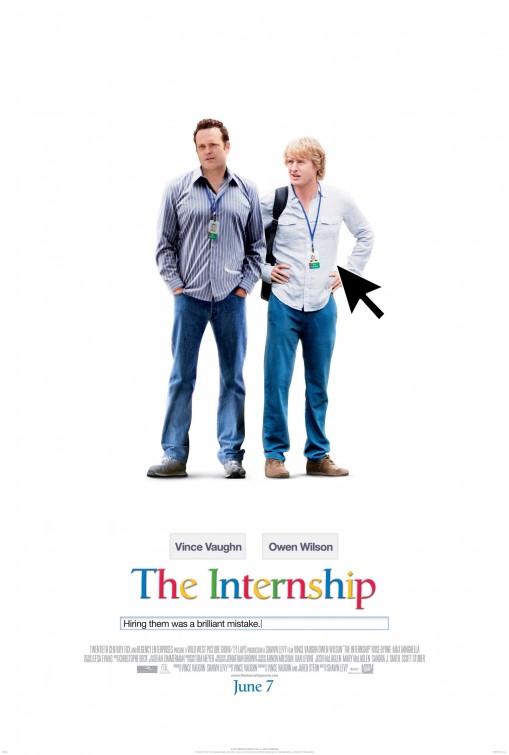 When are the limits of product placement? With The Internship, Google pushes them.
When watch salesmen Billy and Nick lose their jobs because their industry becomes obsolete (no one wears watches anymore, they just look at their phones), Billy decides to go for a long shot and arranges for an interview for the two of them to enter an internship program with Google. Despite their complete lack of computer knowledge they somehow manage to secure a position in an program, where they are thrown together with a team of misfits to compete against the other interns in a week-long series of challenges in which the “Nooglers” (that’s new Googlers) must demonstrate their “Googliness.” At the end of the week only the best team earn jobs at Google.
There is the temptation to see The Internship as one, massive piece of product placement. Throughout the picture we are told about all the wonderful products and services Google has to offer its consumers, with one character even going so far to say that she believes Google makes the world a better place. But Product placement tends to imply something more sneaky and subliminal – James Bond flashing his Omega watch while ordering a Heineken, the Men in Black wearing Ray Ban shades. That’s not what we are getting in The Internship, because Google is as central and essential to the film as any of its stars. Would the film have worked if it was any other tech company that Billy and Nick would have been equally out of place at? Not really. The film uses the established idea we already have of Google as “the best place in the world to work,” the computer nerd’s paradise on earth.
What saves this movie from feeling too much like an ad is that it has a heart. Billy and Nick are not only 20 years older than all of the other interns, but 20 years older than a lot of the Google staff running the program. This generation gap is the source of much of the film’s comedy (Billy’s continuous efforts to inspire his team through references to Flashdance), and also what gives the film that heart, with both generations have something to teach and something to learn from each other.
Vince Vaughn and Owen Wilson are not quite the box office draw they were eight years ago when the teamed up for Wedding Crashers, but they are still a really likeable duo with have an easy rapport, who working well off each other. So between them and a feel-good if generic storyline, The Internship musters just enough goodwill to win you over by the end, allowing you to look put aside the cynic inside you which feels like you’ve just watched a two hour Google ad disguised as entertainment.
Rating – ★★★
Review by Duncan McLean
Great Movies – The Graduate (1967)
Director: Mike Nichols
Starring: Dustin Hoffman, Anne Bancroft, Katharine Ross, William Daniels, Elizabeth Wilson, Murray Hamilton
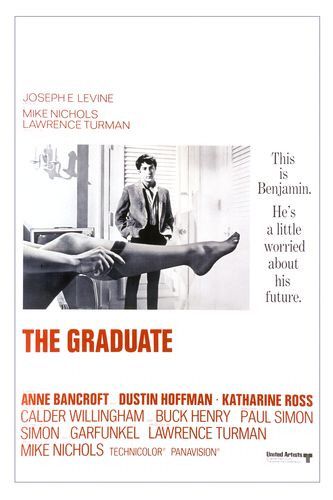 The late 1960s and early 1970s saw something unusual happen in the American cinema. A number of factors converged to create a window of opportunity for a different type of cinema to emerge from the Hollywood studios. For a period of just under a decade there was a mainstream American art cinema, with Hollywood studios producing youth-oriented films which borrowed stylistically from the art cinema of Europe and took advantage of recent changes in censorship laws to push the boundaries of sex, drugs, nudity and violence. This period, which came to be known as the New Hollywood or the Hollywood Renaissance, would provide some of the most celebrated films in the history of American movies, one of the best of which is Mike Nichols’ The Graduate. Together with another 1967 film, Arthur Penn’s Bonnie and Clyde, it marked the starting point of the New Hollywood period for most critics and film historians.
The Graduate tells the story of a disillusioned young man who returns home from college and commences an affair with the wife of his father’s business partner only to then fall in love with her daughter. Produced for $3m, it would become the highest grossing film of 1967, taking $49m at the US domestic box office. The key to its success was its ability to tap into the burgeoning youth market at a time when Hollywood’s traditional audience demographic, the family, had become less dependable. One audience survey found that 96% of viewers of The Graduate were less than 30 years of age. 72% under 24. The Graduate was a film which spoke to the Baby Boomer generation through its thematic content, its sexual frankness, its visual style and its use of music.
Thematically, The Graduate is about the head on collision between two generations. Benjamin’s parents are post-war parents. They know what they want from life and they’ve fought for it. Benjamin is a Baby Boomer. He has come into a readymade world and doesn’t know where he fits into it. He represents a youth that are dreaming about a future that they haven’t yet defined. Trying to explain this to his father Benjamin states, “I want my life to be… different.” He doesn’t know what he wants but he knows it isn’t this.
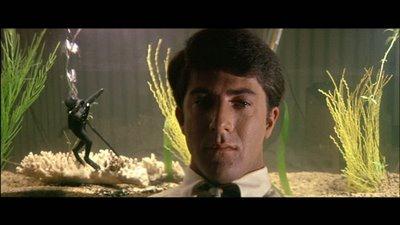
“I want my life to be… different.”
Benjamin represents the burgeoning counter-culture. New Hollywood cinema is full of counter-culture characters, but usually when we think of them we are drawn to the extremes – the long haired, drug taking, hippies of Easy Rider for example. These are characters that consciously identify themselves as being something different. Benjamin doesn’t have than self-awareness. However, in his unwillingness to simply accept the world as it is, even though he doesn’t yet know what he wants it to be, he becomes the counter-culture figure. Not just a counter-culture figure, but a more identifiable counter-culture figure for the vast majority of viewers. Benjamin is an alienated character. Again, it is a different type of alienation to what we saw in other films of that year (Bonnie and Clyde, Cool Hand Luke), but likely an alienation which is more in line with what a lot of young, middle class Americans were experiencing.
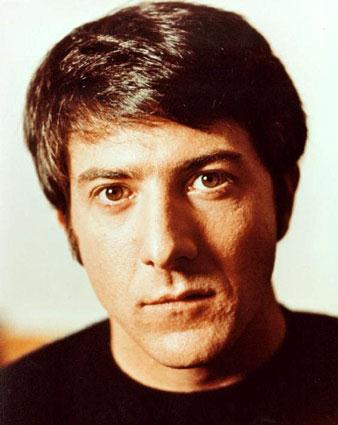
Dustin Hoffman is Benjamin Braddock
Hoffman’s performance in The Graduate is fantastic. He so perfectly encapsulates the awkwardness and uncertainty of a young man who doesn’t know who he is. He underplays the character beautifully, whispering rather than speaking, nudging rather than moving. Until Elaine comes into his life he doesn’t do anything with conviction.
Given how iconic Hoffman’s performance has become, it is interesting to note that he was not the obvious choice for the role that he seems to us now.
In the 1963 Charles Webb novel from which the film was adapted, the central characters are all WASPs (White Anglo Saxon Protestants). Benjamin is described as a blonde haired, blue eyed, six foot tall athlete, “a surfboard” is how co-screenwriter Buck Henry described him, and a far cry from the Benjamin we come to see on the screen. It was originally Nichols’ intention to stick with this vision. His vision for the film saw Benjamin being played by Robert Redford, Elaine by Candice Bergen and Mrs. Robinson by Doris Day. While Doris Day turned down the part as it “offended [her] sense of values,” both Redford and Bergen read for the parts.
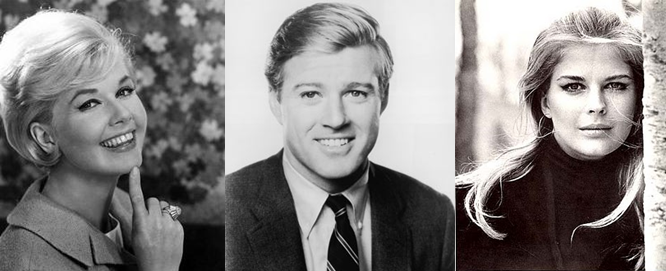
The original vision: Doris Day, Robert Redford and Candice Bergen
But Nichols’ instincts told him something was off. He explained, “When I saw the test I told Redford that he could not, at that point in his life, play a loser like Benjamin, ‘cause nobody would ever buy it. He said, ‘I don’t understand,’ and I said, ‘Well let me put it to you another way: Have you ever struck out with a girl?’ And he said, ‘What do you mean?’ It made my point.”
Hoffman had done a screen test for the part and despite not being the look they had been envisioning, all present were in agreement his test had been the most interesting. So Nichols’ made the decision to change the family from WASPs to Beverly Hills Jews and cast Dustin Hoffman. Rather than the strapping, stereotypical All-American boy that Benjamin was written to be, Hoffman became a sort of genetic throwback in the family line.
Prior to The Graduate Hoffman had done nothing of significance on screen. His only screen credit was 19th billing in Hap (1967). But Buck Henry had seen him on stage in a play called Harry Noon and Night in which he played a crippled, German transvestite. Henry said his performance had been so brilliant it was impossible to believe he wasn’t at least one or two of those things.
The casting of Hoffman over a young star like Redford was a big deal, with potentially huge financial ramifications, but it paid off handsomely, as Hoffman’s performance earned him the first of his seven career Best Actor Oscar nominations.
It should also be noted that the casting of Anne Bancroft was significant, given she was only six years older than Hoffman, but the two worked superbly together. The power relationship between Benjamin and Mrs. Robinson in the first half of the film is just brilliant comic acting. Mrs. Robinson is the polar opposite to Benjamin. She knows what she wants. She is authoritative and self-assured, although later we come to see her vulnerability. The power relationship between the two is perfectly demonstrated by the fact that at even their most intimate moments, Benjamin still calls her “Mrs. Robinson.”
The casting of Hoffman was representative of a greater trend in casting that would take place in the New Hollywood era. In the studio era, the industry operated largely on the understanding that people wanted escapism. They wanted a sense of distance between their own lives and what they saw on the screen. Baby Boomers, on the other hand, wanted to be able to engage with the movies. More to the point, they wanted the movies to engage with them. They wanted to see truth and reality up on the screen. So the New Hollywood period saw the arrival of a number of new faces, not just in the sense that they were new to the industry, but also in the sense that they were a different type of face to the faces we were used to seeing on the screen.
The New Hollywood period introduced a new type of movie star. A star that looked like an average Joe. Alongside Dustin Hoffman, the generation of actors who rose to prominence in this period of Hollywood’s history included Robert De Niro, Al Pacino, Richard Dreyfuss, Gene Hackman, Robert Duvall, James Caan, Harvey Keitel, John Cazale, Christopher Walken and Elliot Gould. These actors banished the vanilla features of the studio era in favour of a gritty realism and ethnicity.
The same was true to a certain extent for actresses, with new beauties like Jane Fonda, Meryl Streep and Faye Dunaway being joined by more normal looking actresses like Diane Keaton, Ellen Burstyn, Sissy Spacek and Shelley Duvall. Obviously, there remained a gender double-standard which says it is harder for an unattractive woman to become a movie star than an unattractive man, but none the less these actresses displayed a different look to the wholesome pertness of a Doris Day in the 1950s, or the studio era bombshells like Marilyn Monroe or Rita Hayworth.
Appealing to the youth audience in the late 1960s didn’t just involve telling young people’s stories, it involved telling them in a style which appealed to young people. This youth demographic that had been shunning traditional Hollywood fare were enthusiastically consuming foreign films, particularly the European art films. 1966, the year before The Graduate was released, was the highest grossing year for foreign films at the US box office. Much of that was due to the success of Blow Up. As Stanley Kramer put it, “Everyone in Zilchville [saw] Blow Up, not just the elite.”
European art films like Blow Up and, in particular, the French New Wave films of Godard, Truffaut, Rohmer and Chabrol, introduced a new style of cinematic storytelling. Where the studio era had always operated on a principle of invisible style, the French New Wave saw cinematography and editing as narrative tools. Filmmakers employed an unconventional visual style which drew attention to itself, in complete opposition to the principle of seamlessness.
Mike Nichols was a fan of New Wave filmmaking, as well as the later Italian neo-realists like Antonioni and Fellini. So in The Graduate we see a lot of non-traditional Hollywood cinematography and editing, giving the film a very contemporary look. But, like with the European films, this contemporary look was not just style for style’s sake. It was not simply a cynical imitation of what was popular at the time in order to make the film marketable. In The Graduate visual style, as well as music, is used for narrative purposes, primarily through emphasising tone and visually representing emotions.
For an example of this, let’s look at a few of the different ways that Benjamin is shot.
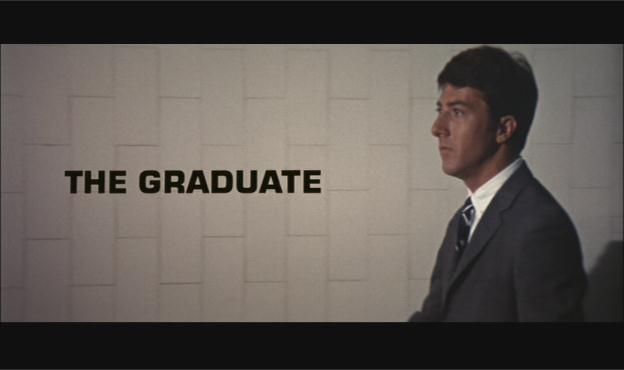
Benjamin positioned to the side of the frame
Firstly, consider his positioning in the frame. Early in the film Benjamin is rarely centred in the shot composition. Instead he is largely situated to the right of the screen with expanses of space to his left. It is only later in the film, once he has met Elaine and found a sense of purpose and that his character possesses the conviction to dominate the image.
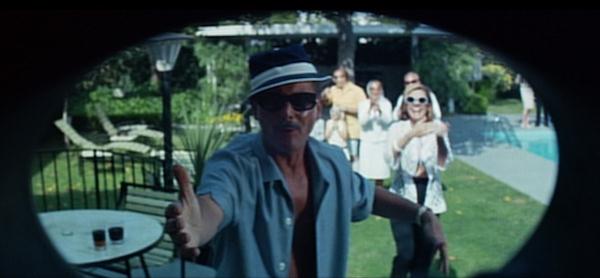
Subjective camera angles help us to empathise with Benjamin
Secondly, on a few occasions the camera adopts Benjamin’s subjectivity, often as a means to demonstrate his claustrophobia in the suburban world of his parents. This is, of course, most notable is the scene in which a reluctant Benjamin is forced to model his new scuba suit for his parents’ friends. For this scene we see the world through Benjamin’s scuba mask – as well as hearing the muffled audio and his breathing. This same sense of claustrophobia is stylistically represented in a different fashion at the first party scene, the welcome home, through the use of very close shots of Benjamin’s face with other faces squeezing their way into the frame.
Thirdly, Nichols makes use of zooms. Using a zoom shot was traditionally considered bad filmmaking. However, Nichols uses zooms at a number of points throughout the film for particular emotional effect. When Nichols zooms out, it is to emphasise the isolation of a character (the opening shot of Benjamin in his seat on the plane). When he zooms in, it is to take us into their soul (this strategy is employed later in the film with Mrs. Robinson as we start to discover more layers to her character).
The stylistic influence of the French New Wave extended to the editing. Like the New Wave filmmakers, Nichols chooses at times to abandon the principles of classic continuity editing in order to use his cutting as a narrative or emotive device. Two particular moments come to mind.
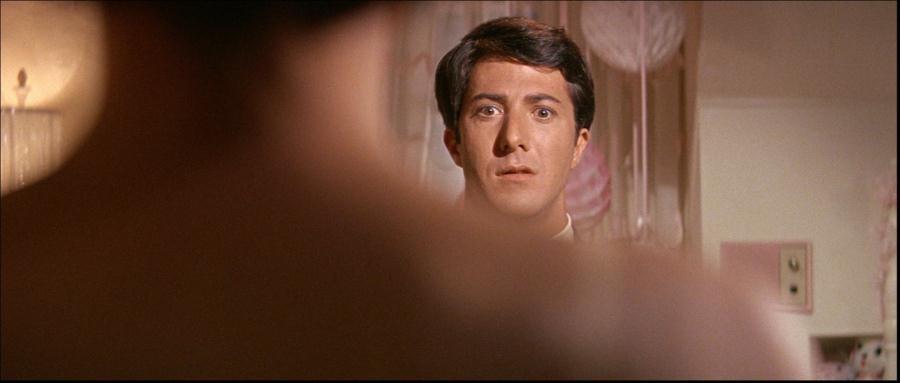
Rapid cutting reflects Benjamin’s panic
The first is the moment when a naked Mrs. Robinson corners Benjamin in Elaine’s bedroom. In a reflection on a portrait of Elaine, we see Mrs Robinson sneak into the room unbeknownst to Benjamin. As the door bangs shut behind her, Benjamin spins. Nichols breaks his turn down into three different shots, exaggerating the movement through editing. We see his face in an over-the-shoulder shot as he looks at Mrs. Robinson. He is panicking and this panic is reflected in the cutting of the scene. As Mrs. Robinson propositions Benjamin, the over the shoulder shot is interrupted by five very short flashes of different parts of her naked body. Quick glances, like those of a panicking young man who doesn’t know where to look. In all, there are 15 cuts in this very short moment between her entering the room and him running away downstairs. This rapid cutting emphasises his panic in that moment, and is beautifully juxtaposed by the calm, measured way in which Mrs. Robinson speaks.

Benjamin’s life: lying in the pool and visiting Mrs. Robinson
The second I call the “Out of the pool and onto Mrs. Robinson” transition. We see Benjamin in the pool. He goes to pull himself up onto his lie-lo, and the motion that starts with in the pool finishes with him on top of Mrs Robinson. While lying on top of her we hear his father’s voice, which brings us back to the pool. This one cut works almost like an entire montage in itself. This is Benjamin’s life at the moment: lying in the pool and meeting with Mrs Robinson.
One of the primary ways in which The Graduate aligns itself with the youth counterculture of the time is through its soundtrack. Rather than a traditional orchestral score, Nichols employs the songs of folk duo Simon and Garfunkel, with the resulting soundtrack being one of the most striking features of the film. The use of popular music in the place of a traditional score was a recent innovation. Richard Lester’s two Beatles films, A Hard Day’s Night (1964) and Help! (1965), had employed the group’s music to great effect, and films like The Graduate, Easy Rider and American Graffiti would see the popular music score become a prominent feature of the New Hollywood period.
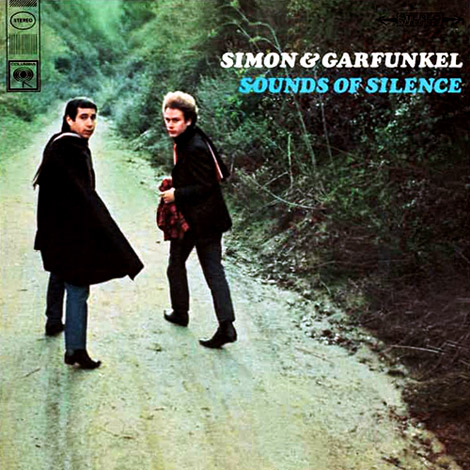
Sounds of Silence
Nichols had always wanted Simon and Garfunkel for the soundtrack. They had risen to prominence in 1965 with their hit single ‘Sounds of Silence,’ and were strongly identified with the counter-culture movement that was bubbling up in the 1960s in America.
While the majority of Simon and Garfunkel songs used on the soundtrack were pre-existing, the producers made a deal with Paul Simon to provide them with three new songs. However due to a busy touring schedule, Simon did not get around to writing the agreed upon songs. When Nichols pleaded with Simon to show him something new, he played him a bit of a song he had been working on about time past, about Joe DiMaggio and Eleanor Roosevelt. Nichols persuaded him to change it from Mrs. Roosevelt to Mrs. Robinson and the song made its way into the film. Paul Simon only recorded as much as appears in the film. The producers of the film wanted him to write the rest so they would have a promotional tie-in, but Simon was reluctant. However, the movie becoming a big hit was enough to persuade Paul Simon very quickly wrote and recorded the rest of the song. So, for any Simon and Garfunkel fans out there, this accounts for why the version of ‘Mrs. Robinson’ that appears in the film sounds significantly different to the version which was released as a single.
As well as providing an iconic score and serving as useful cross-promotion for both the band and the film, Nichols used Simon and Garfunkel’s music to very specific narrative purposes. Musically there are three distinct stages through the film. In the first third of the film we hear ‘Sounds of Silence’ again and again. It becomes the theme for Benjamin’s uncertainty as he ponders his future while in the suburbs. In the second third of the film the music changes and the song ‘Scarborough Fair/Canticle’ becomes very prominent. It is the theme for Benjamin’s pining after Elaine after she discovers about him and Mrs Robinson. For the final third of the film we get the much more upbeat ‘Mrs Robinson,’ it’s faster tempo marking Benjamin’s newfound determination as he pursues Elaine and seeks to rescue her from her upcoming marriage. And the payoff for this aligning of different tunes with different states of Benjamin’s psyche comes in the film’s final scene.
The conclusion of Nichols film is masterful, and gives us a number of things to consider. As we watch Benjamin and Elaine ride away together, it is tempting to assume that we have just witnessed a standard Hollywood, happily-ever-after conclusion, but in fact nothing is that straight forward. For starters, Benjamin doesn’t actually succeed in stopping the wedding. He arrives to see Elaine kissing her husband. The vows have already been exchanged. As Mrs Robinson points out, “It’s too late.” So what does this mean for Benjamin and Elaine running away together, knowing that legally she is married? The way Nichols concludes the film leaves us with great uncertainty about the future of these characters, and that uncertainty is communicated through two subtle directorial decisions. Firstly, we watch them run onto the bus and sit down together giddy with excitement, but the camera stays with them long enough to watch the adrenaline die down and their faces go blank. Secondly, the music that accompanies the bus driving away is ‘Sounds of Silence,’ the song which we have been encouraged to associate with Benjamin’s insecurity and uncertainty about his future. Had Nichols cut that shot while they were still smiling and shown the bus driving away to the up-tempo rhythm of ‘Mrs. Robinson’ you would have had a perfect feel-good ending. Instead, through two subtle choices the director allows for ambiguity and uncertainty, leaving his audience with something to ponder.
In 1998, the American Film Institute marked the centenary of American cinema by releasing a list of the 100 greatest American films, with The Graduate coming in at #17. Despite coming from a period that delivered a number of truly remarkable pieces of American cinema, The Graduate still stands out as a fine achievement. Hilariously funny but still undeniably authentic, it is undoubtedly one of the finest youth movies ever made.
By Duncan McLean
Review – The Intouchables (2011)
Directors: Olivier Nakache, Eric Toledano
Starring: François Cluzet, Omar Sy, Anne Le Ny, Audrey Fleurot
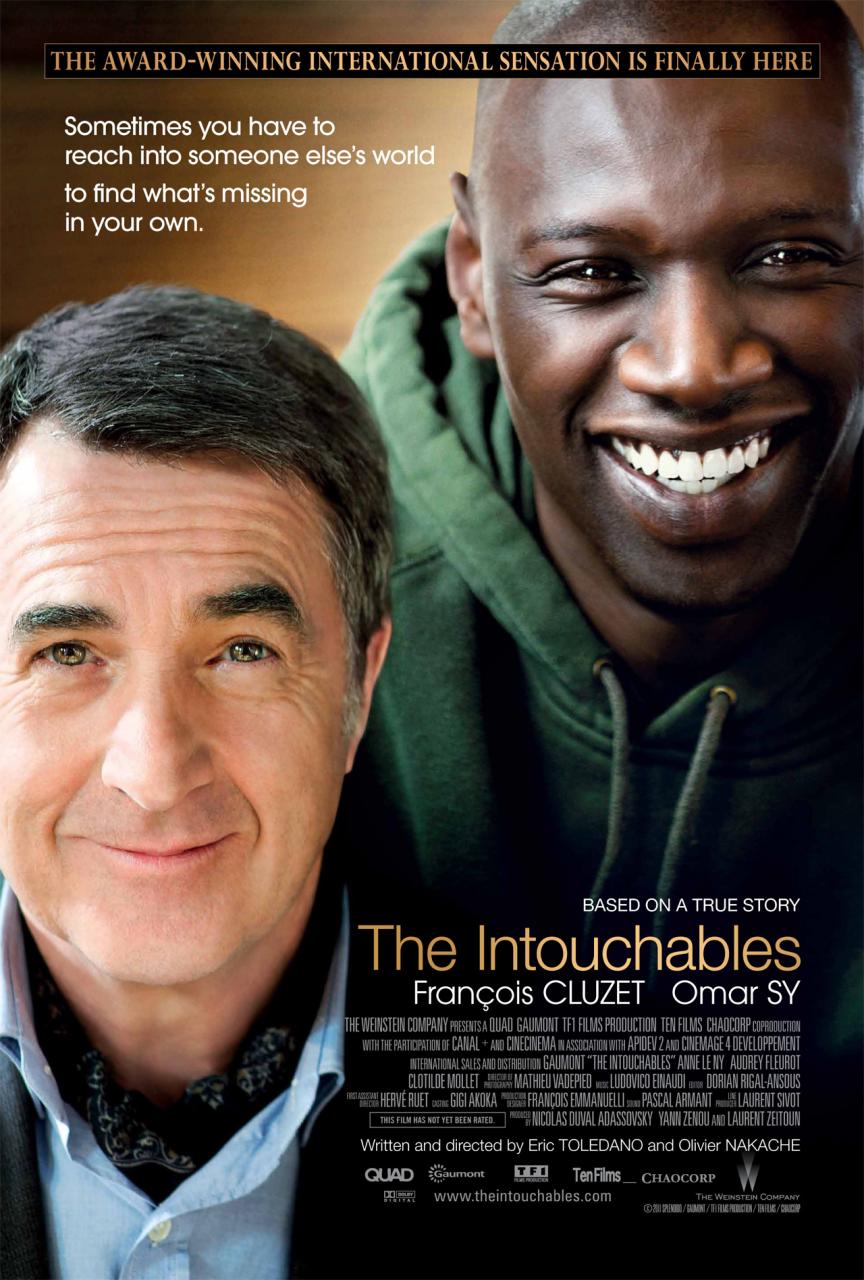 One of the biggest surprises in the world of cinema last year was the amazing success of the French film Intouchables. The story of an unlikely friendship between an aristocratic quadriplegic, Philippe, and the young, black man from the projects, Driss, who he hires as his caretaker became the second highest grossing film in the history of the French cinema after only eight weeks in cinemas. And armed with the hybrid English/French title The Intouchables (I assume they wanted to avoid being mixed up with Brian De Palma’s The Untouchables), it would go on to conquer the world, taking almost $300 million at the international box office and becoming one of the year’s most loved films.
The Intouchables is an uplifting experience. Based, loosely, on a true story (though we’ve seen similar concepts before in films like Driving Miss Daisy and Scent of a Woman), this story of a friendship that transcends socio-economic, class and race barriers makes you see the potential for good in humanity. That’s why people have responded so strongly to it. That’s why people love it.
The success or failure of a buddy movie invariably comes down to the chemistry between the two protagonists, and The Intouchables has it in spades. Both François Cluzet and Omar Sy put in magnificent performances. Cluzet, who is a dead ringer for Dustin Hoffman, has the added hurdle of being restricted to only acting from the neck up, but he manages to brilliantly embody the frustrations of a man trapped in a useless body. Sy, a French comedian, is very charismatic as Driss, who brings some colour and life into Philippe’s world. Sy won best actor at the César Awards, France’s equivalent to the Oscars, edging out not only Cluzet, but also Jean Dujardin for his work in The Artist which would go on to win him an Oscar.
There has been an interesting discrepancy between the public response to this film, which has been huge, and the critical response, which has been lukewarm. As an example of this, if you go to The Intouchables’ IMDb page you will see the film has an impressive user rating of 8.6/10, but right next to it is its Metacritic rating (a rating devised from the positivity or negativity of reviews in major American publications) which is only 57/100. The primary reason I can see for this is that as you watch The Intouchables you can feel your buttons being pushed. It is a very calculated film in how it goes about engaging you emotionally. Of course, every film manipulates your emotions. The filmmaker uses the tools at their disposal to try and elicit a certain emotional response from the viewer. The key, though, is to do it subtly, so the viewer feels the emotion without feeling the manipulation (George Lucas once said, “Emotionally involving an audience is easy. Anybody can do it blindfolded. Get a little kitten and have some guy wring its neck”). At times The Intouchables lacks that subtlety. There are scenes, moments and events which you can tell are there solely to make you feel something. For most casual viewers, that doesn’t really matter, but for a cynical critic who spends their life watching and analysing films, seeing it so blatantly could be off-putting.
As lovely, positive and compassionate as this film is, there is one thing which I feel cannot pass without comment. Beneath the film’s feel-good qualities, you find something quite troubling: how much it indulges in racial stereotyping. As loveable a character as Driss is, and as much as the film encourages to like him, it doesn’t change the fact that we are presented with a black character who is unemployed (seemingly by choice), uncultured, a thief, a drug user, prone to using physical aggression to intimidate people, irreverent, lecherous and, of course, a great dancer (not all stereotypes are negative). All of this in a world full of white people who are largely none of those things. Now you may be tempted to point to the fact that the film is “based on a true story” and argue therefore that if that is what he was like then that is what he was like. The problem with that argument is that it doesn’t appear that that is what he was like. At the end of the film we are shown a short glimpse of the real life men who the characters of Philippe and Driss are based on and, guess what? The man who inspired Driss is not black. He is an Arab named Abdel Sellou from the former French colony of Algeria. This prompts some awkward questions, particularly in a film as calculated in the way it engages with your emotions as The Intouchables is. Even if it is an accurate portrayal, with Sellou being exactly like Driss is portrayed in the film, the decision was still made at some point to recast him as a black man, with his blackness then becoming a key aspect of his identity in the film. Why? Was a black character deemed more marketable than an Arab character? Did they feel there was more comedy in a black character than an Arab character? Was it just that they wanted to cast Omar Sy? I don’t know the answer to the question, just that is it a troubling question that presents itself.
While some people may avoid French films, expecting them to be too arty and weighty, The Intouchables is really accessible. Awkward potential racism aside, it is a delightful story of the most unlikely of friendships. It is feel-good, warm-the-cockles-of-your-heart filmmaking at its finest.
Rating – ★★★★
Review by Duncan McLean
Review – To Rome with Love (2012)
Director: Woody Allen
Starring: Woody Allen, Alec Baldwin, Roberto Benigni, Penélope Cruz, Judy Davis, Jesse Eisenberg, Ellen Paige
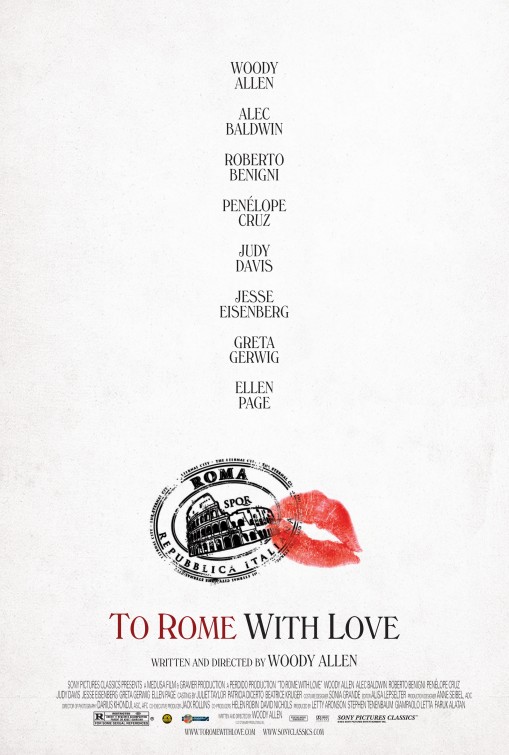 The most New York-centric of filmmakers for the first forty years of his career, in the last decade Woody Allen has discovered the rest of the world. At least, he’s discovered Europe. In recent years he has made films set in London (Match Point), Barcelona (Vicky Christina Barcelona) and Paris (Midnight in Paris). And now, with To Rome with Love, we get Woody Allen’s ode to the Eternal City.
Midnight in Paris was a great success, it was far and away Allen’s biggest box office earner, it earned an Oscar nomination for Best Picture, and it introduced a whole new audience to Woody Allen’s filmmaking. It also put a great deal of expectation on his next film, which at a glance looked like it followed the same formula. As it turns out, To Rome with Love is a much more typical Woody Allen film, and unfortunately it fails to reach the heights of his previous effort.
The film consists of four separate but interwoven storylines, with varying degrees of absurdity. There is the record producer who discovers an amazing opera singer who can only sing in the shower; the ordinary man who, for no apparent reason, becomes incredibly famous overnight; the man who is forced to spend the day pretending that the prostitute who came into his hotel room by accident is actually his wife; and the young man who is falling for his girlfriend’s best friend while his spirit guide, an older version of himself that he meets in the street, tries to convince him it is a bad idea. This format of separate story threads is reasonably common now, but in the better executions of it we expect the threads to connect somehow, either through their narratives becoming intertwined or through some thematic consistency. But that doesn’t happen here. The only connection is that they are all taking place in Rome.
All four storylines are based on funny little ideas, but none of them really has the substance to become a full story in its own right, though some do better than others. Because Allen doesn’t seem to know where to take them, the movie really loses its way and fizzles out towards the end. A filmmaker who makes as many films as Woody Allen does – roughly one a year for almost fifty years – is going to be a bit hit and miss, and this is one of the misses.
But despite all that, what really carries this film is the city of Rome itself. Allen has a tourist’s eye for the city and as such it never becomes just another city, just another location. It is always Rome, the Eternal City. So when storylines start to wear thin, or when jokes fall a bit flat (as happens more than a couple of times), Rome, in all its beauty, is still engrossing.
Rating – ★★☆
Review by Duncan McLean
Review – Casa de mi Padre (2012)
Director: Matt Piedmont
Starring: Will Ferrell, Genesis Rodriguez, Diego Luna, Gael Garcia Bernal, Efren Ramirez, Adrian Martinez, Nick Offerman
 Will Ferrell is probably the biggest name going around in comedy movies at the moment, so it seems amazing that a Will Ferrell comedy could fly under the radar as much as Casa de mi Padre (‘My Father’s House’) has. That is, until you see it. Then it all makes sense.
Ferrell plays Armando, the simple son – simple both in terms of intellect and in terms of what he wants out of life – of a Mexican rancher. One day his more successful brother, Raul, his father’s favourite, returns home with a new fiancée in tow. But Raul brings trouble with him as unbeknownst to the family, his success has come as a result of his work in the drugs trade, and his fiancée is the runaway neice of the local drug lord, Onza.
What makes this movie different from every other Will Ferrell movie, and provides both the movie’s primary point of interest and the number one reason that it has nowhere near the profile of his other work, is that it is almost entirely in Spanish. Casa de mi Padre pretends to be some cross between a cheap, Mexican B-movie Western and a Telemundo Spanish soap opera. Credit should be given to Ferrell who spent a month working with a dialect coach to get his Spanish dialogue down pat and appears to hold his own alongside a cast of native Spanish speakers, albeit in the opinion of a non-Spanish speaker.
For what is clearly meant to be a comedy though, there aren’t really that many gags. Instead the film relies on that premise – that it is pretending to be a poorly made Mexican melodrama – to get its laughs. So we get constant breaks in continuity, obvious painted backdrops, bad puppets in place of animals and actors being replaced by mannequins at for dangerous moments. There is even a moment where in place of a scene we get a letter from the 2nd Assistant Cameraman apologising that we won’t get to see a particularly exciting scene due to a terrible accident that resulted from poorly trained animals. While this premise might work quite well for a sketch, or even a series of sketches, on Saturday Night Live, it has been stretched really thin to reach even the relatively short runtime of 84 minutes. As a result the laughs are few and far between.
Rating – ★
Review by Duncan McLean
Review – This is 40 (2012)
Director: Judd Apatow
Starring: Paul Rudd, Leslie Mann, Maude Apatow, Iris Apatow, Megan Fox, Albert Brooks, John Lithgow, Jason Segal, Chris O’Dowd
 In the last ten years, Judd Apatow has really established himself as the comedy auteur of the moment, through both as a director and as a producer (his most recent success being backing Lena Dunham in the production of the HBO series Girls which just cleaned up at the Golden Globes). One of the defining features of Apatow’s work as a director, and what differentiates him from, say, Todd Phillips (Old School, The Hangover, Due Date), is that Apatow’s films combine big laughs derived from sexual and sometimes stoner humour, with a real human sincerity. Apatow’s best films, namely The 40 Year Old Virgin and Knocked Up, are surprisingly heartfelt and honest and you really care about the characters. Interestingly, when Apatow is slightly below his best, as he is in This is 40, it is the laughs which tend to be missing rather than the sincerity.
The film was marketed as the “sort of sequel” to Knocked Up. Paul Rudd and Leslie Mann reprise their supporting characters from Knocked Up. It’s a few years down the track, Pete and Debbie’s little children are a bit older, their marriage is a bit more dysfunctional and they are both on the cusp of turning forty. That’s the scenario and it is all you really need to know because this is not a film about narrative and plot, it is a film about characters. Rather than a structured storyline we just get a series of vignettes, some funnier than others, taking place over a period of a couple of weeks.
In Knocked Up Rudd and Mann were fantastic. While they were only supporting characters, the little glimpses we got into their lives were fantastic and funny because they seemed so real. For Allison (Katherine Heigl) and Ben (Seth Rogen) they represented everything that was terrible, but at the same time everything that was appealing about the prospect of having children. The problem that This is 40 has is that while Debbie and Pete become the focus of the film, we don’t really gain any further insight into their characters. Instead, the shtick which was funny for the 30-40 minutes of screen time they got in Knocked Up is just dragged on and repeated, stretched over 135 minutes which is half an hour too long.
This is 40 is a bit one-note. Because there isn’t a storyline as such, we don’t get real character progression and development. The fights and arguments you see at the 90 minute mark of the film are very similar to the fights and arguments you saw 15 minutes in. This lack of progression, lack of sense that either character is learning from their experiences means they actually start to become very frustrating in certain situations. This is quite an achievement given Paul Rudd has to be the most likeable man on the planet.
The “sort of sequel” thing is problematic too, because it raises certain questions. Primary among them is where are Ben and Allison, our protagonists from Knocked Up? In reality we know that there was a massive falling out between Apatow and Katherine Heigl which meant that there was not chance she was ever going to appear in the film, but still, at a narrative level it is an awkward absence. Particularly as Alison is supposed to be Debbie’s younger sister, which makes her unreferenced absence from the birthday party at the end of the film notable. Jason Segal is back, again playing a character called Jason who I think we are supposed to assume is the same character as he played Knocked Up, though he has progressed from being Ben’s stoner housemate to being a personal trainer.
This has all sounded a bit negative so far, but This is 40 isn’t that bad. As has been the case in much of his previous work, it is the supporting characters which really bring this film to life. You have great supporting performances from Albert Brooks and John Lithgow as Pete and Debbie’s respective fathers. Brooks in particular is a treat as a mooching father. I love when Judd Apatow uses his daughters, Maude and Iris, in his films. He writes really funny dialogue for them. While Maude’s character Sadie suffers a bit from being a one-dimensional angry teenager, Iris’s Charlotte is lovely and the one character that you consistently side with and feel for. There are also great cameos from Chris O’Dowd, Melissa McCarthy, Megan Fox, Charlyne Yi, Jason Segal and Lena Dunham.
This is 40 feels much closer to Funny People than it does to 40 Year Old Virgin or Knocked Up, which is a shame. It probably suffers a bit from audience expectations that it is going to be a riotous comedy, which it isn’t trying to be. The humour in this film doesn’t come from gags or crazy situations. It comes from recognising some element of our own lives on the screen. There are a number of laugh out loud moments in This is 40, but most of the time they are jokes that make you smile or jokes that make you nod rather than jokes that make you laugh.
Rating – ★★★
Review by Duncan McLean
 Doctor of Movies
You must be logged in to post a comment.